Entrepreneur and Builder. Co-Founder & CTO of video analytics company acquired by @ShopperTrak. Currently wrangling data and building great products for retail.
@SaveStandard@kaitlancollins@TomCottonAR It’s all relative. Call it hat dog o’clock when you wake up. It doesn’t matter. Just don’t change it. Adjust to when you like daylight.
One of the most compelling parts about working at an ElonCo was the agility to pivot to whatever the most important problem was.
One day I said: I wasn’t hired to go after spam, but a tsunami is coming and I’m going to drop everything to focus on that.
The org is so flat and agile that your title is basically meaningless. Anyone can sound the alarm about a problem and solve it themselves—or rally the team to join them.
This is how startups work but it’s very hard to make it work in a larger company.
We'll be spending a lot more time trying to understand the outputs of language models. A few thoughts, tips & tricks:
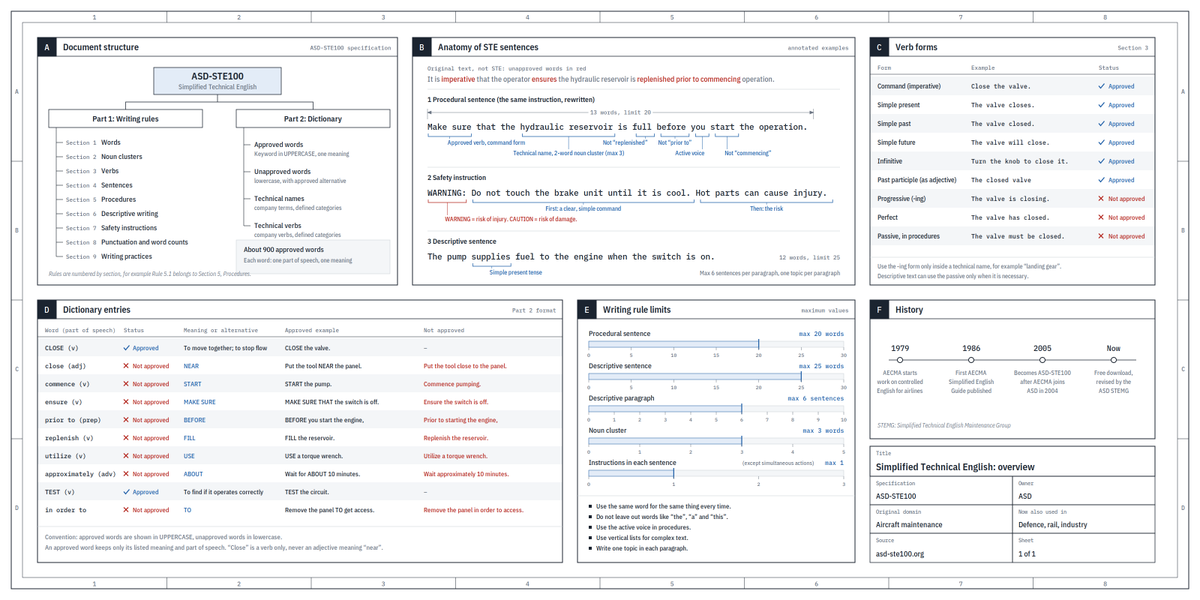
Writing. Something I've had success with: Ask your LLM to explain something in ASD-STE100, it's a controlled language specification originally developed for aerospace maintenance documentation. LLMs well-versed in this language and it comes with heavy constraints on clean writing style that I often find a lot more readable. Sometimes I've tried to soften it a bit e.g. ask for "80% of the way to ASD-STE100" because the spec is quite stringent. But even better:
Diagrams / images. Instead of writing, ask your LLM to create a diagram. These can be a lot easier to process, parse, and understand. But even better:
Web pages. Ask for output "in HTML" to get a beautiful, interactive webpage. LLMs are getting really good at frontend and can create beautiful experiences, animations, etc. But even better:
Explainer videos. The output format I am most bullish on is fully custom / bespoke explainer videos generated on any arbitrary topic. Experiment with things like "Create a 3b1b style video explainer on X. Use my ElevenLabs API key for audio narration". (you'd need an API key for the latter or you can ask your LLM to find you decent free alternatives that use your local compute). This is actually starting to work!
In summary:
- As LLMs get better, they will do more and more of the legwork autonomously, and a lot more of our work will rise up the abstractions into oversight and understanding.
- Luckily, LLMs can help here too because as intelligence and code are increasingly abundant, you can ask for large, custom, discardable software artifacts (e.g. web apps, video explainers) that would have never made sense to create before. Push the boundaries here and you'll be surprised.
@OpenAIDevs “It has to be refundable” come on, dot should tell you this is a bad idea. Refundable so much more expensive and you can roll non refundable through most corp travel agents.
I don't think Decisions is the death of Jev from @typesafeai. At low enough latency and cost, and with differentiated high judgement, you can make the case for @karpathy 's llm-council applied to system one decisions. Just call all of the new decisions APIs in parallel as voters. Fire members from the 'advisory board' who consistently make bad decisions. The 'council' idea wasn't economic in its first iteration, I think it may be now.
Give your app real-time decision-making with Decisions API, powered by GPT-6 Luna.
Define questions and possible answers to classify content, route requests, or choose an agent’s next action.
Available in limited preview.
Give your app real-time decision-making with Decisions API, powered by GPT-6 Luna.
Define questions and possible answers to classify content, route requests, or choose an agent’s next action.
Available in limited preview.
“I didn't have time to write a short letter, so I wrote a long one instead". -Mark Twain
Understand your doc, longer is not better. Good advice below for the AI doc creation process that we’re all working on improving.
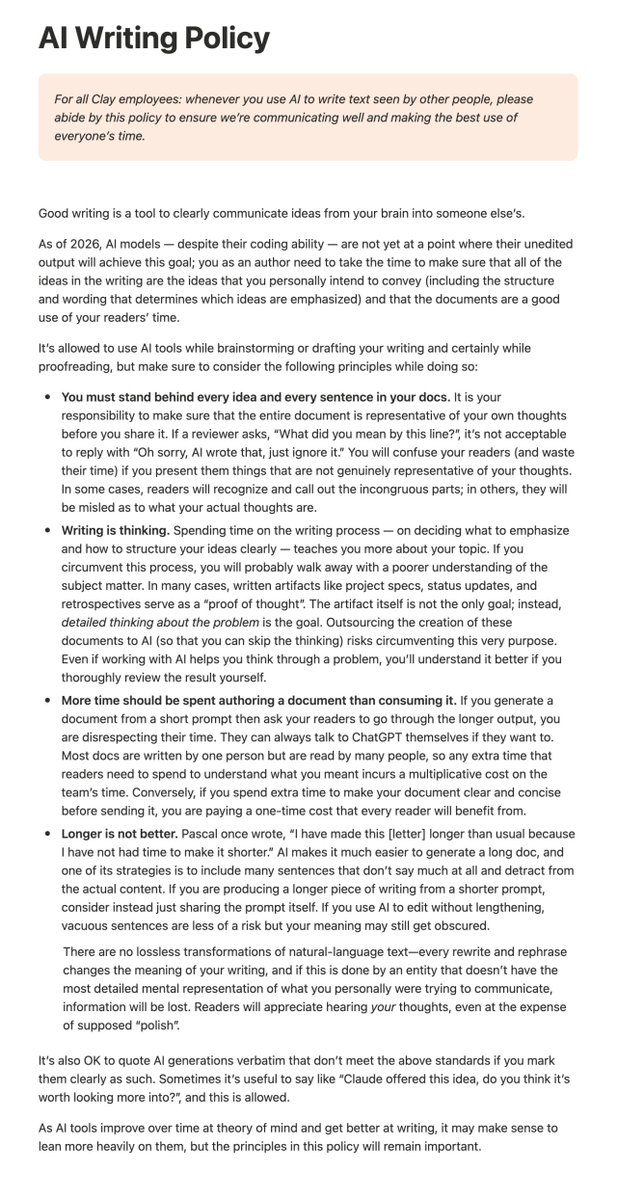
We instituted an official AI Writing Policy at @Clay.
Massive thanks to @sophiebits on our engineering team who wrote this.
Originally this was just for eng, but other teams found it so helpful we expanded it company-wide.
Here are the four guiding principles:
1. You must stand behind every idea and sentence
It is your responsibility to make sure that the entire document is representative of your own thoughts before you share it.
2. Writing is thinking
Spending time on the writing process teaches you more about your topic. If you circumvent this process, you will walk away with a poorer understanding of the subject matter.
3. More time should be spent writing a document than consuming it
If you generate a document from a short prompt then ask your readers to go through the longer output, you are disrespecting their time. They can talk to ChatGPT themselves if they want to.
4. Longer is not better
AI makes it easy to generate long docs, and it loves padding them with sentences that say nothing. If you're producing docs from a short prompt, consider just sharing the prompt.
You can read (and borrow) the full policy below. Hopefully we all communicate a bit more clearly now :)
@PessimistsArc Right. Dario was already claiming that GPT2 was too dangerous to open source back in 2019.
I made fun of them then.
Everyone should make fun of them now.
I’m gonna go ahead and trust Jensen, an established leader with immense experience vs. some random dude who came out of nowhere to post AI Doomer slop and go on a press tour
@markasaurus Easy. 85% of taxi rides are two or less people. Don’t boil the ocean in your first attempt. This follows the S strategy to not satisfy the entire market in your first go. Pick specific cab replacement first, not the entire car market. That comes next.
@tobi Isn’t distilling Claude (teacher -> student) against the @OpenAI TOS? @grok can you check if this is the case for the use case and slide Tobi shared.