[ AI 데이터센터에 돈을 빌려주던 마켓이 닫혔다.. "신용 낮은 AI 기업 채권 발행, 한 달째 0건" ]
AI 데이터센터를 짓는 회사 중에는 신용등급이 낮은 곳이 많다.
이런 회사들은 은행 대출 대신 금리를 높게 쳐주는 채권, 이른바 하이일드 채권을 찍어 건설비를 마련해왔다.
그런데 이 자금줄이 막히고 있다.
GS 레버리지 금융 글로벌 헤드 Miriam Wheeler에 따르면.. 지난 1년간 AI 관련 하이일드 채권은 약 30건 발행됐고 여름에는 2주에 한 번, 많을 때는 매주 새 채권이 나왔다.
9월 말부터 발행이 급감했고.. 최근 한 달은 한 건도 없었다.
사려는 투자자가 사라졌다는 뜻..
투자자들이 돌아선 이유는 두가지.
올가을에만 600억 달러어치가 쏟아질 것이라는 물량 부담이 먼저 왔고.. 중간선거 뒤 데이터센터 규제 움직임이 커지면서 프로젝트가 제때 완공될지에 대한 의심이 더해졌다.
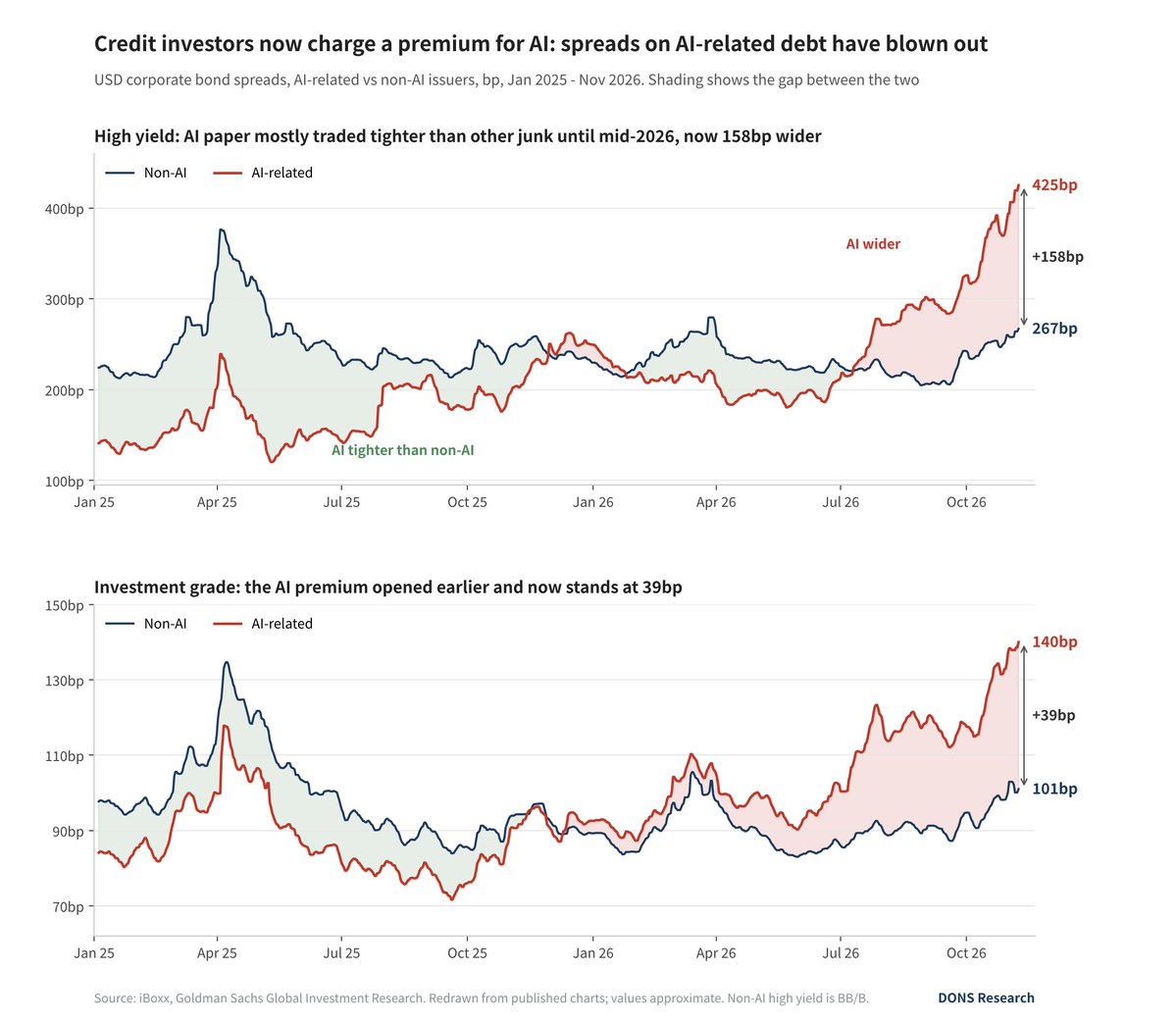
현재 AI 관련 하이일드 채권은 다른 정크본드보다 금리를 1.58%p 더 줘야 팔린다.
연초에는 오히려 AI 채권이 더 낮은 금리에 팔렸다.
숨어 있던 약점도 드러났다.
신용이 낮은 임차인이 들어가는 데이터센터에는 대기업이 보증을 서주는 경우가 많은데.. 이 보증은 건물이 완공돼야 효력이 생긴다.
완공이 늦어져 180일의 유예 기간을 넘기면 임차인은 계약을 깨고 나갈 수 있다.
공사가 지연되면 채권 투자자는 보증도 임차인도 없는 짓다 만 건물을 떠안게 된다.
Wheeler가 가장 먼저 지켜볼 곳으로 꼽은 곳은 주지사 당선인이 데이터센터 건설 중단을 거론한 텍사스다.
GS는 금융위기처럼 번질 일은 아니라고 본다.
컴퓨팅 수요가 워낙 커서 믿을 만한 개발사의 좋은 프로젝트는 계속 돈을 구할 수 있다는 판단..
대신 실적이 없거나 자기 돈이 부족한 개발사는 자금을 구하지 못해 프로젝트를 접게 된다.
실제로 CoreWeave 채권이 급락한 바로 다음 주에 마이크로소프트 채권에는 5배의 주문이 몰렸다.
SENATE REPUBLICAN THREATENS TO SUBPOENA NVIDIA CEO JENSEN HUANG
Sen. Kevin Cramer says Nvidia ($NVDA ) CEO Jensen Huang should step down, citing national security and potential Chinese blackmail risks.
Speaking on CNBC, Cramer warned that Congress could investigate Nvidia's China chip exports and Commerce Secretary Howard Lutnick's handling of restrictions.
“I'd be happy to support a subpoena,” Cramer said if Huang refuses to testify.
He also backed tighter AI chip export controls, warning that China's access to advanced US technology poses serious security risks.
$CRWV backlog went from $104B in June to $132.5B in one quarter...
So much for the AI buildout cracking. Revenue up 168% and still no adjusted profit until 2028, so the debt question stays. But demand sure isn't the problem!
@puckrin 50bp in December feels like a big jump from one hot print. CPI came in 0.4% though, so the hawks have the tape for now. Bonds are closed today, so we'll see how loud it gets tomorrow.
@MelvinInvests 2028 is the part everyone keeps skipping. DRAM pricing can stay sticky while hyperscalers keep buying, sure. But all that new capacity has to land somewhere.
Buybacks are doing a lot of the heavy lifting here. $340B by 2028 is a big bid under $MU, $NVDA and $AVGO while multiples keep compressing. The group puked and the tape still calls it cheap. Funny how that works.
UBS expect $MU, $NVDA and $AVGO buybacks to surge ~$340B by 2028, with half that equating to 20% of SPX total LTM buybacks.
That flow should support AI/Tech stocks broadly.
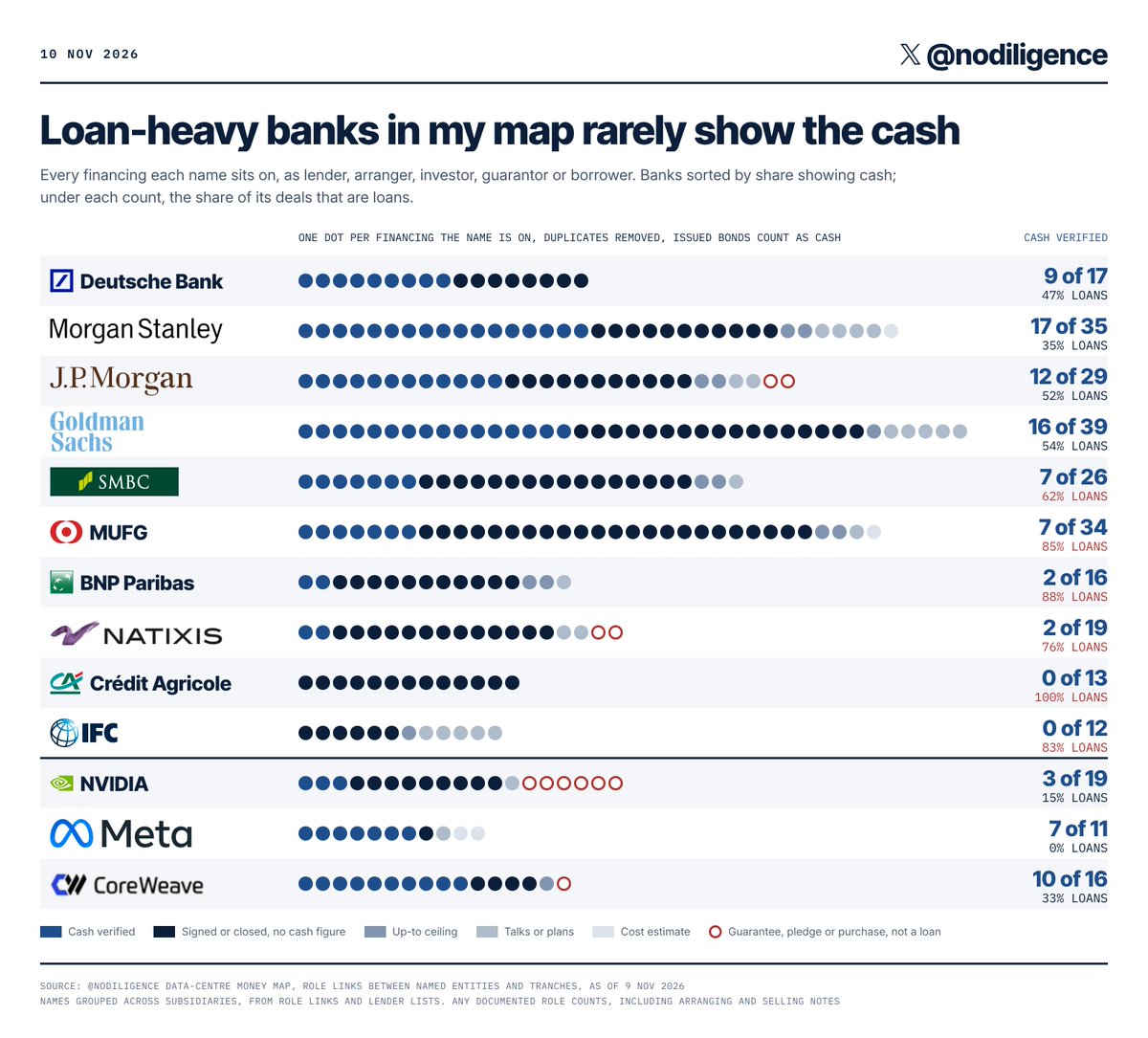
This map is the whole trade in one picture. The US banks arrange and sell it on. The Japanese and French banks sit on $95bn of loans nobody can see the cash on. Credit stays calm until the refinancing date shows up. Then it doesn't.
$MS $GS $JPM $DB $SMFG $MUFG $BNP $ACA $ORCL
i tracked every AI data-centre financing each big bank sits on in my map and counted how many show cash anyone can check. the banks split pretty cleanly by business model.
deutsche bank, morgan stanley, jpmorgan and goldman show cash on 41% to 53% of their deals. a lot of what they touch is bonds they arranged and sold straight on to investors, so they take the fee up front and pass the risk on.
SMBC and MUFG show cash on 27% and 21%, with loans at 62% and 85% of their deals. natixis, BNP paribas and crédit agricole are at 0% to 13%, with loans at 76% to 100%. these banks lend and hold, and in a stall they keep whatever doesn’t sell, which is the construction piece.
between them, japanese or french banks sit on $95bn of the US-dollar loans with no drawn figure. MUFG led oracle’s $38bn vantage package, is an agent on the $18bn jupiter loan, and put about $2bn into the anthropic-linked nexus bridge in texas. that puts a power delay in new mexico and a permit freeze in texas on the same balance sheet. and SMBC’s own james martin told reuters in october that investors favour data-centre deals closer to completion, which leaves the holders with whatever is furthest from it.
when these banks want out, they can do a risk transfer and pay someone to take the first losses. octus reported in july that the buyers are often funds that already own equity in the same buildings, at 7% to 9%, tighter than the 8% to 12% on other infrastructure. the risk ends up with someone who already owns the asset, at a price that assumes the building gets finished, and further from any regulator.
the regulators are starting to look. japan’s FSA is already planning inspections of US data-centre project finance, and the ECB has been asking european lenders about their exposure since at least february. neither publishes drawn amounts by bank, though, so from outside it’s hard to know how big any one bank’s stuck piece really is.
if you want AI financing exposure through banks, i prefer the ones that sell the paper over the ones that keep it.