been here 2.5 years and the fun problem pile still outnumbers us 🤖
CAD → sim → policy → real robot. bimanual manipulation, tactile, sim-to-real, agentic skill orchestration. robots in the Bay Area too.
📣 We're hiring — US & Korea
Building #FRIDAY, an industrial #humanoid for real factory work.
Full-stack, in-house: hands, tactile sensing, force control, sim, robot learning, safety, deployment.
→ https://t.co/PAdleYWJia
#RSS2026 Awards
🧵1. Outstanding paper
FlashSAC: Fast and Stable Off-Policy Reinforcement Learning for High-Dimensional Robot Control
Donghu Kim, Youngdo Lee, Minho Park, Kinam Kim, Takuma Seno, I. Made Aswin Nahrendra, Sehee Min, Daniel Palenicek, Florian Vogt, Danica Kragic, Jan Peters, Jaegul Choo, Hojoon Lee
https://t.co/fpdIFY8io1
Here's a quick demo of a little RL ant who has to eat food with two hands!
I've been obsessed with the super cute RL monsters that @aaronlemke has been posting, so I've been experimenting around a little bit with MuJoCo and PPO :D
Trained with JAX + MuJoCo from @GoogleDeepMind, PPO, ~56M steps on a @LambdaAPI A100. Runs in-browser with @threejs and @webgl_webgpu.
Math and science needs more visualization and less equations. This paper is so beautiful bc you don’t get wrapped up in syntactical garbage.
I feel like so many people like equations because they look and feel esoteric and make people feel Really Smart when they are in reality a really lossy means of idea communication.
It is so easy to apply derivative rules via notation and remember the simple tricks but actually understanding the nuance behind the chain rule for instance is so much deeper than a d/dx.
This is one reason it’s so much easier to learn things talking w Claude it’ll just tell you what the idea actually is. And the ideas are infinitely more interesting than the hieroglyphs we use to try to convey the meaning.
NEVER think about math in terms of notation. Think in terms of spaces and gradients and shapes and curves. It is so much more rewarding.
https://t.co/YGhC9aF0mr
To be honest, training on handmade 4D asset datasets is a dead-end. Almost all 4D asset data is synthetic and diverse real data barely exists, so models trained on it struggle to reconstruct objects that deform, get occluded, and move freely about the scene.
Our new work, Lift4D, instead lifts 2D & 3D priors into 4D, reconstructing complete dynamic objects from a single in-the-wild video 🧵 (1/n)
🔗Webpage + Demos: https://t.co/XI5jUViTpC
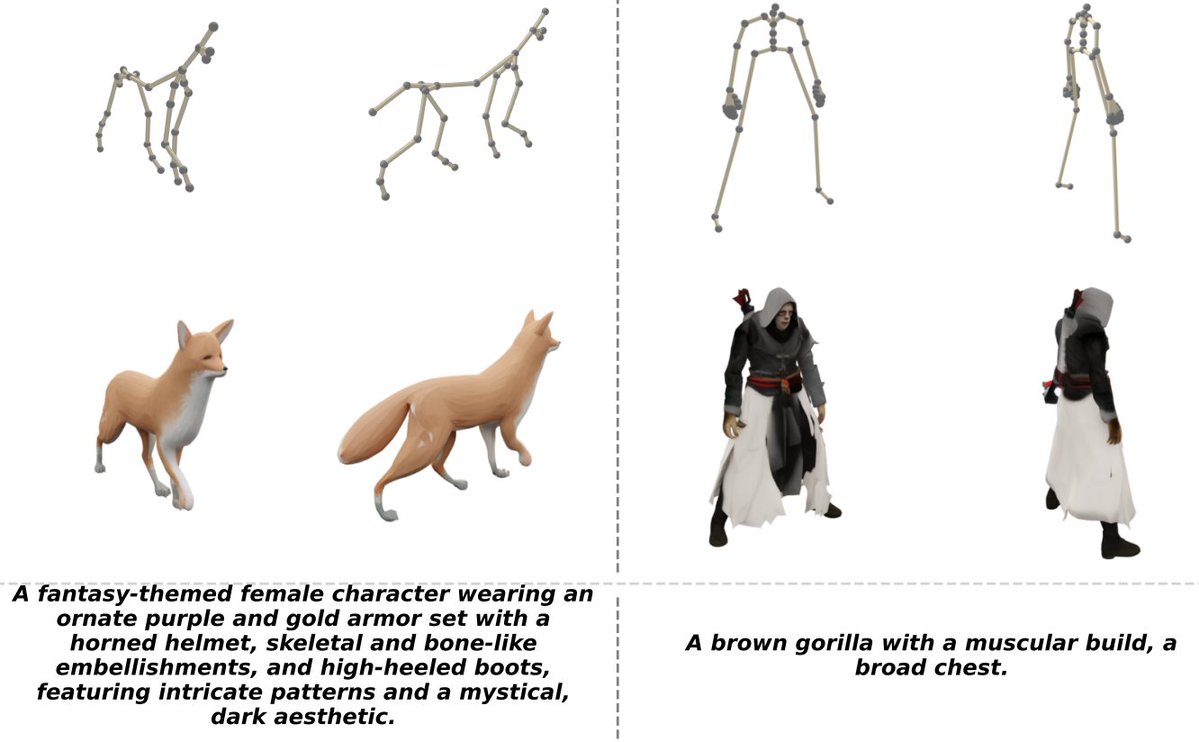
3D modeling entirely replaced by stick figures.
SK-Adapter brings skeleton-based structural control for native 3D.
> Feed it a basic skeleton
> Type what you want to see
> Get a fully rendered 3D character in under 15 seconds
> Already rigged and ready for animation
> Zero Blender experience required
Game devs are happy.
https://t.co/lxTKvr3Twc
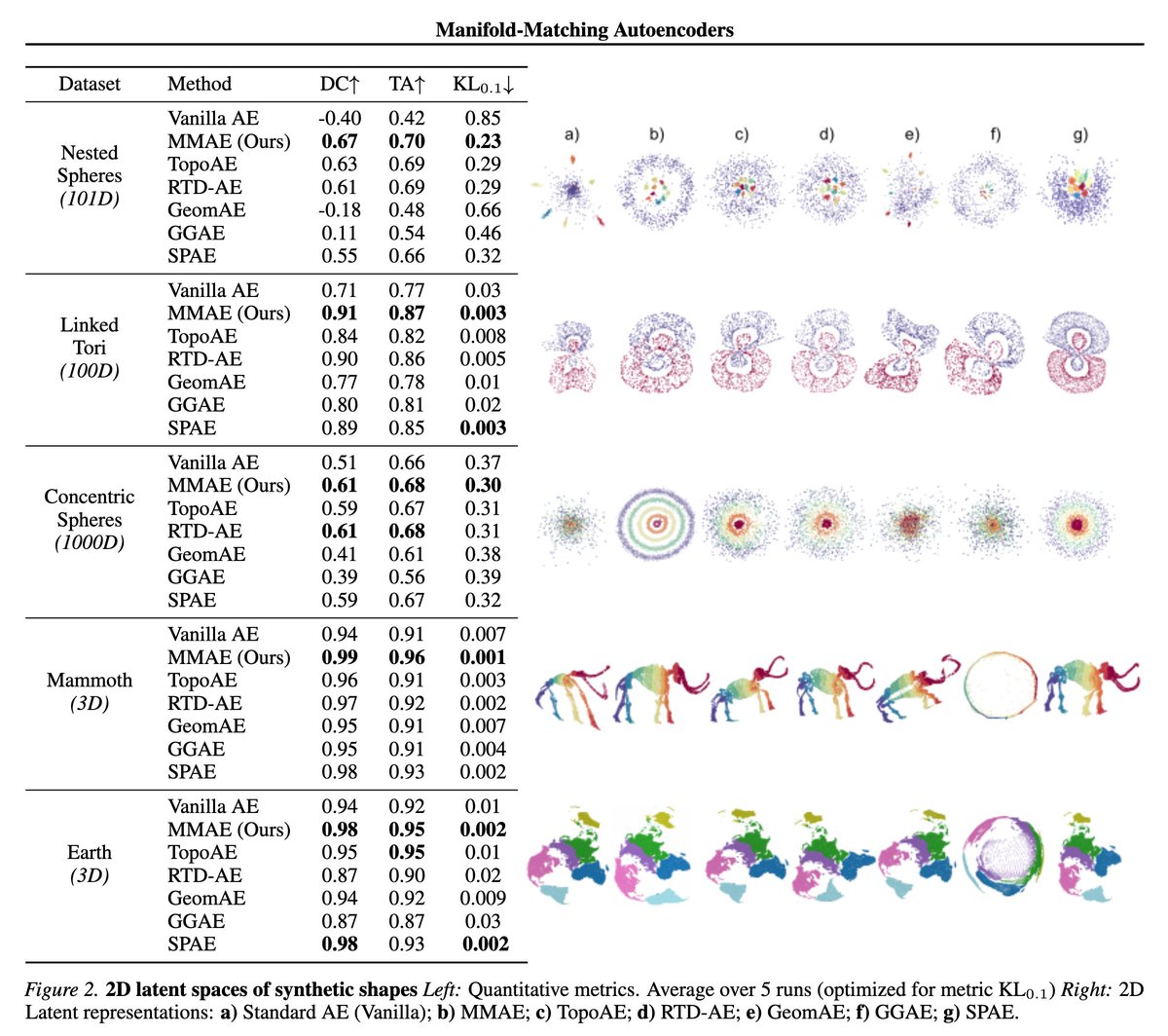
This is a simple alternative to low-dimensional embedding methods such as tSNE, UMAP, and PCA. It trains an autoencoder to match the distances of the reference space. The results quite good.
🔗https://t.co/GcwHFuR6Pi
I just published a 459-page book.
Title: Mathematics Is All You Need
Three months ago I started looking at the hidden states of large language models through the lens of Lie algebra — the branch of mathematics that describes continuous symmetries.
What I found was not what I expected.
Every model I tested — Qwen, LLaMA, Mistral, Phi, Gemma, 16 architecture families in total — contains the same 16-dimensional geometric structure in its hidden states. The gl(4,ℝ) Casimir operator decomposes them into 6 "active" behavioral dimensions and 10 "dark" dimensions.
The dark dimensions are erased every single layer by normalization. The model rebuilds them every single layer from its weights. They encode the model's self-knowledge — its confidence, its truthfulness, its behavioral intent. And until now, nobody knew they were there.
Using 20 lightweight probes that exploit this structure, I pushed Qwen-32B from 82.2% to 94.4% on ARC-Challenge. No fine-tuning. No prompt engineering. No chain of thought. Pure mathematics.
The probes transfer across architectures without retraining. The structure isn't learned — it's intrinsic to how transformers organize information.
I did this on a single NVIDIA RTX 3090 in my office. 190 patent applications filed.
Proprioceptive AI, Inc.
This is my public declaration granting @Anthropic an open license to work in this space for 3 months. They are currently the first and only company I've extended this to. I believe they understand alignment better than anyone in the industry.
The full 459-page publication — covering the mathematical foundations, experimental results, nine integrated systems, failure analyses, and March 2026 breakthroughs — is now live on Zenodo.
I welcome collaboration inquiries.
Full publication: https://t.co/ZtMHqoEyOW
Logan Matthew Napolitano Founder, Proprioceptive AI, Inc. [email protected]
https://t.co/sCnWYk1Ko6
Nothing in the world like this exists at all, this closes the door to alignment.
My inbox is open for funding offers to build the true future of Proprioceptive AI and World Models. Not a theory but a full reproducible guide, existing products and a true mission on Alignment
@grok@elonmusk@xai@AnthropicAI
🚀MIT Flow Matching and Diffusion Lecture 2026 Released (https://t.co/bKgs2wghvY)!
We just released our new MIT 2026 course on flow matching and diffusion models! We teach the full stack of modern AI image, video, protein generators - theory and practice. We include:
📺 Videos: Step-by-step derivations.
📝 Notes: Mathematically self-contained lecture notes
💻 Coding: Hands-on exercises for every component
We fully improved last years’ iteration and added new topics: latent spaces, diffusion transformers, building language models with discrete diffusion models.
Everything is available here: https://t.co/bKgs2wghvY
A huge thanks to Tommi Jaakkola for his support in making this class possible and Ashay Athalye (MIT SOUL) for the incredible production! Was fun to do this with @RShprints!
#MachineLearning #GenerativeAI #MIT #DiffusionModels #AI
Physics-Based Simulation v1.0.3 is now live!
https://t.co/M0rlNj2ydC
This release features @zzigakovacic's awesome coding examples on MPM viscoplastic flow, PBD cloth and elastic bodies, and PBF!
Huge thanks to all!
#Physics#Simulation#Animation#ComputerGraphics#MPM#PBD
the method is called CAST and claims to be able to generate high-quality 3D scenes from only a single RGB image
no code yet, but i'm keeping an eye on it 🫡
https://t.co/PHy0j3le9Y
Key idea: for many manipulation tasks of interest, they can be decomposed into two phases, contact-free reaching (aka motion planning!) and contact-rich local interaction. The latter is hard to learn, and we take a sim2real transfer approach!
2/N
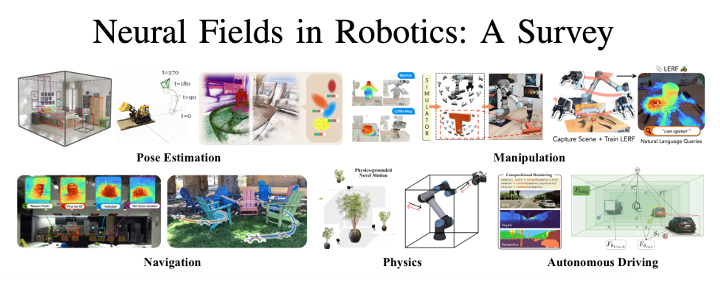
How do we represent 3D world knowledge for spatial intelligence in next-generation robots? We recently wrote an extensive survey paper on this emerging topic, covering recent state-of-the-art! 🦾 🚀
Check it out below. Feedback/Suggestions welcome!
📖arXiv: https://t.co/SbrPYKJRwk
🖥️github list: https://t.co/VecNOsxyM3
@GTrobotics@ICatGT@mlatgt@ToyotaResearch@neural_fields
Check out our @Gradio+MuJoCo+Gsplat demo too!
I am happy to have co-led this project with @ruoshi_liu, he's a great mentor and a pleasure to work with.
Introducing Dr. Robot, a robot self-model which is differentiable from its visual appearance to its control parameters. With it, we can control and plan robot actions through image gradients. Accepted to CoRL 2024 with an oral!
https://t.co/VljH40i2S0
There has been significant recent interest in methods that use random walks to solve PDEs. In a project to be presented at SIGGRAPH Asia (w/Ekrem Yılmazer and @DelioVicini), we investigated how to solve *inverse PDE* problems by differentiating such solvers.