🌑🗺️ Le 12 août 2026, la Lune passera devant le Soleil et projettera son ombre sur une grande partie de l’hémisphère nord. Sur cette visualisation, la bande rouge marque le chemin de l’éclipse totale, où le Soleil sera complètement occulté !
📹 : NASA, Ernie Wright, Joy Ng
« Bingo, il y en avait et c’était super joli ! » : la mer s’est illuminée sur cette plage de Loire-Atlantique | Presse Océan
➡️ https://t.co/Fty4OCgYB9
#Nantes
JWST Observations of Asteroid 2024 YR4 Rule Out a 2032 Lunar Impact and Demonstrate a New Regime for Planetary Defense Follow-up
Julien de Wit, Andrew S. Rivkin, Marco Micheli, Davide Farnocchia, …
https://t.co/mA0VacKV5i [𝚊𝚜𝚝𝚛𝚘-𝚙𝚑.𝙴𝙿 𝚊𝚜𝚝𝚛𝚘-𝚙𝚑.𝙸𝙼]
Asteroid 2024 YR4 is now projected to potentially HIT the Moon.
Scientists warn the collision could send massive lunar debris toward Earth, threatening satellites, global infrastructure, and civilization itself.
Official disclosure: September 2026.
IMPACT: DECEMBER 2032
☄️We're happy to announce that on Dec. 22, 2032, asteroid 2024 YR4 will sail by the Moon at a distance of 13,200 miles based on new data from @NASAWebb. Our Planetary Defense Program has tracked this potentially hazardous asteroid since late 2024. https://t.co/9DP3Cui5m3
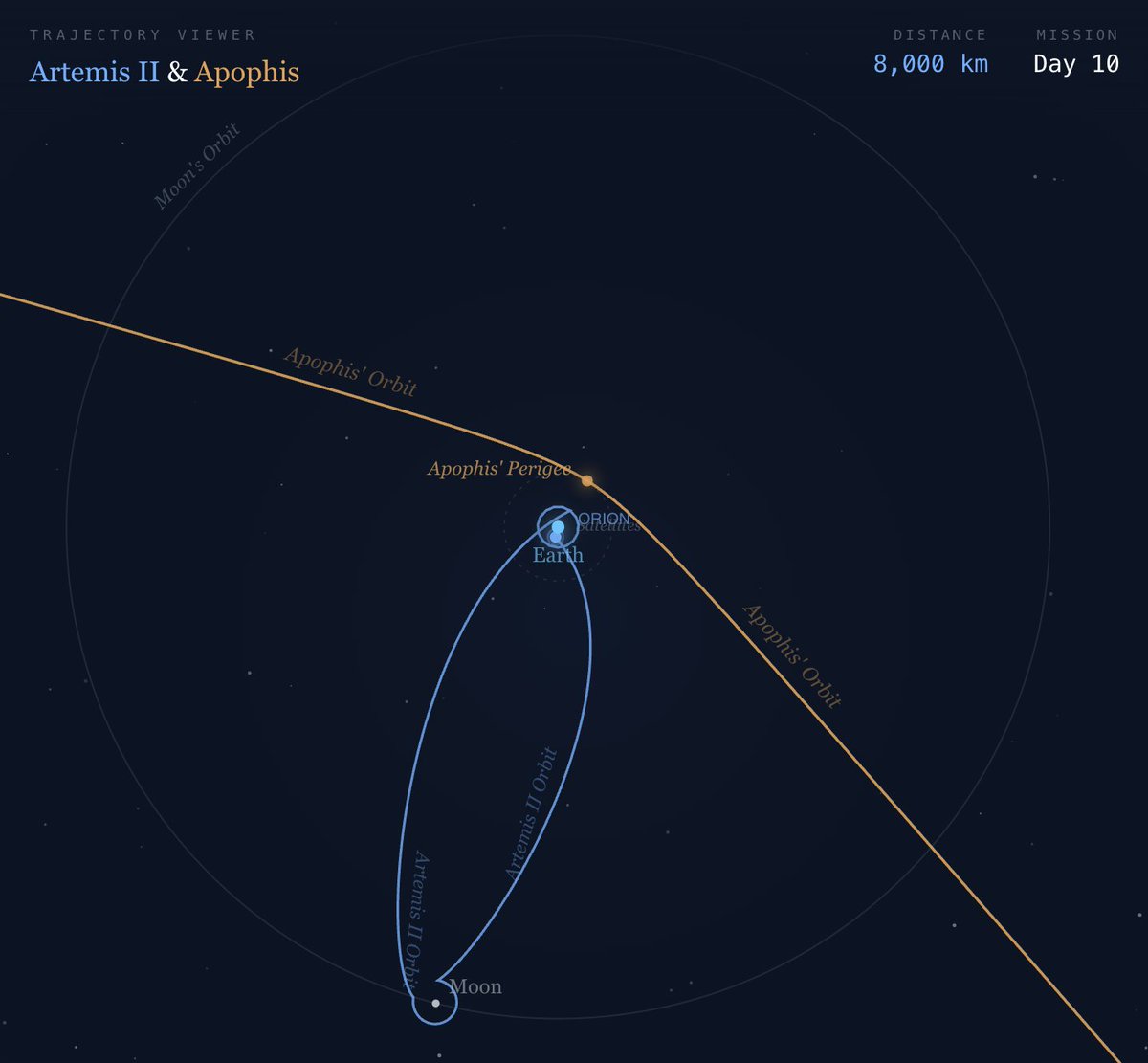
Ever get the feeling they’re not telling us the whole story about Apophis? Because I do. And I’m not talking about a weird conspiracy...I'm talking about actual science, official data reversals, and the fact that this thing is coming closer to Earth than some of our satellites. At one point, Apophis was listed as having a 2.7% chance of hitting Earth in 2029. That might sound low, but in space impact terms, that’s basically Defcon 2. Then, like magic, the odds dropped to zero. No real explanation...just a “relax, we recalculated.” Umm hmmm
Let me break down what they’re not saying. Apophis is over 300 meters wide. That’s not small...it’s a regional reset button. If it hit, we’re talking country-sized devastation, tsunamis, atmospheric disturbances..the everything! And it’s going to pass inside the orbit of geostationary satellites, closer than GPS and communication satellites we rely on daily. That's not just close. That’s uncomfortably close. Close enough for Earth’s gravity to alter its trajectory. There are narrow “gravitational keyholes” in that space. If it passes through one? Future impact becomes a real possibility.
They say they’ve modeled its path with super accuracy. But asteroids aren’t just pool balls in a vacuum. The Yarkovsky effect...a force caused by uneven heating from sunlight..can slowly push it off course over time. Spin state changes. Outgassing. Even interactions with the Moon’s gravity. These aren't made up...they’re measurable, real, and very difficult to model decades ahead. When the margins are super thin, tiny forces can mean the difference between a harmless flyby and a global catastrophe. And you think they're telling the public all of that?
What really gets me is the complete lack of serious planetary defense plans for 2029. No deflection missions. No public awareness. Nothing substantial. If the risk was truly zero, fine. But if there’s even a 1% chance, why wouldn’t they treat this as a global priority? Here’s what I think: because they can’t be sure. And if they did tell us there’s still a small chance, people would panic, markets would tank, and all hell would break loose. So they do what governments always do....downplay, distract, and hope we forget.
Do I think Apophis is guaranteed to hit us? No. But do I believe the risk is much higher than they’re letting on? Absolutely. And when it makes that pass in 2029, a lot of us will be watching with more than casual curiosity. Because if it threads that gravitational needle...even slightly...the story’s not over. It’s just the beginning.
In 2029, Apophis, a ~370m asteroid, will pass just ~31,000 km from Earth.
That’s ~1/10 the distance to the Moon.
Inside the orbit of geostationary satellites.
Visible to the naked eye.
Impact risk this time is low, but the flyby could shift its future trajectory.
A direct hit would mean a ~1 km crater and regional devastation.
That’s why becoming multiplanetary matters.
#Artemis#Videos#Nasa#Lanzamiento#Tierra#Luna#Atenea
🚀En la cuenta de la @NASA se publicó un video resumen del lanzamiento de la misión Artemis II, de algo más de 2 minutos, el que compartimos en este posteo. Hay filmaciones y fotos en la red que son sencillamente espectaculares, pero para acompañar el citado material, adjuntamos tres. Una toma del lanzamiento captada desde un avión, otra de la partida del cohete en cámara lenta y la vista de la tierra, en cuarto menguante, con la que se encontraron esta mañana los cuatro tripulantes desde 41.756 millas (67.200 km) de altura. Sobre el satélite argentino, Atenea, funcionó perfectamente y pudo enviar desde esa distancia información específicamente sobre el impacto de radiación.
La mission Ramses sera lancée vers l’astéroïde Apophis en 2028. Elle est la pierre angulaire d’un programme de défense planétaire contre le risque de collision avec des corps géocroiseurs. ☄️
https://t.co/FndyoNUIam
Here is the blast wave from the M2.7 CME which occured a couple hours ago. The source region is AR 4392 which is growing and within the Earth-strike zone. The blast wave spreads out in all directions and indicates an Earth-directed CME is on the way.
🌍🌕☀️🪐 Le 21 janvier 2025 marquera une date mémorable pour l'humanité : six planètes du système solaire seront parfaitement alignées et visibles dans le ciel juste avant le lever du soleil...
Puis, le 28 février 2025, Mercure viendra compléter cet alignement, rendant toutes les sept planètes visibles dans un spectacle rare et inoubliable !
Alors franchement les amis, ne ratez pas ça ! C’est un spectacle céleste unique (tous les 100 à 200 ans) qu’on ne voit qu’une fois dans une vie...
Mark your calendars 🌌
February 28, 2026 — a rare six-planet alignment where Mercury, Venus, Jupiter, Saturn, Uranus, and Neptune drift quietly into line.


![QCLN's tweet photo. JWST Observations of Asteroid 2024 YR4 Rule Out a 2032 Lunar Impact and Demonstrate a New Regime for Planetary Defense Follow-up
Julien de Wit, Andrew S. Rivkin, Marco Micheli, Davide Farnocchia, …
https://t.co/mA0VacKV5i [𝚊𝚜𝚝𝚛𝚘-𝚙𝚑.𝙴𝙿 𝚊𝚜𝚝𝚛𝚘-𝚙𝚑.𝙸𝙼] https://t.co/YtlYddry7L](https://pbs.twimg.com/media/HI55i2EWQAAlWSj.png)