@DangerBrooks Concepts are more human than eating or work, less personal though. You said our culture is prioritizing abstraction over immediacy, but culture is an abstraction. At that scale, you need concepts, they're derived from experiences though. Never perfectly, always with tradeoffs.
@DangerBrooks Trying to start a burger joint might convince you that wealth creation is a years-long process, relative to which eating a burger is a static concept.
This is such an important race this year, and it's one of those cases where if the wrong candidate wins, the harm would be substantial:
"Jane Kim is running a campaign of profound intellectual dishonesty."
This is the Orion spacecraft emerging from Earth’s shadow at ~25,000 km — captured by one of TransAstra’s Sutter telescopes.
Those bright streaks? Proximity operations plumes lighting up the darkness as Orion moves through cislunar space.
Last night the TransAstra telescope network tracked Artemis II across hemispheres in real time, logging 231 detections of Orion and ICPS in under six hours.
🌎 Northern Hemisphere:
125 detections | range 71,000–73,500 km
🌏 Southern Hemisphere:
106 detections | range 43,000–73,000 km
Right now Artemis is close and bright, which means this is the easy part.
The real fun begins when Orion is 380,000 km away at lunar distance and we’re still tracking it.
Global telescope coordination.
Watching humanity push farther into space.
And we’re just getting started...
#Artemisii #Orion #NASA #Spacenews #Moon
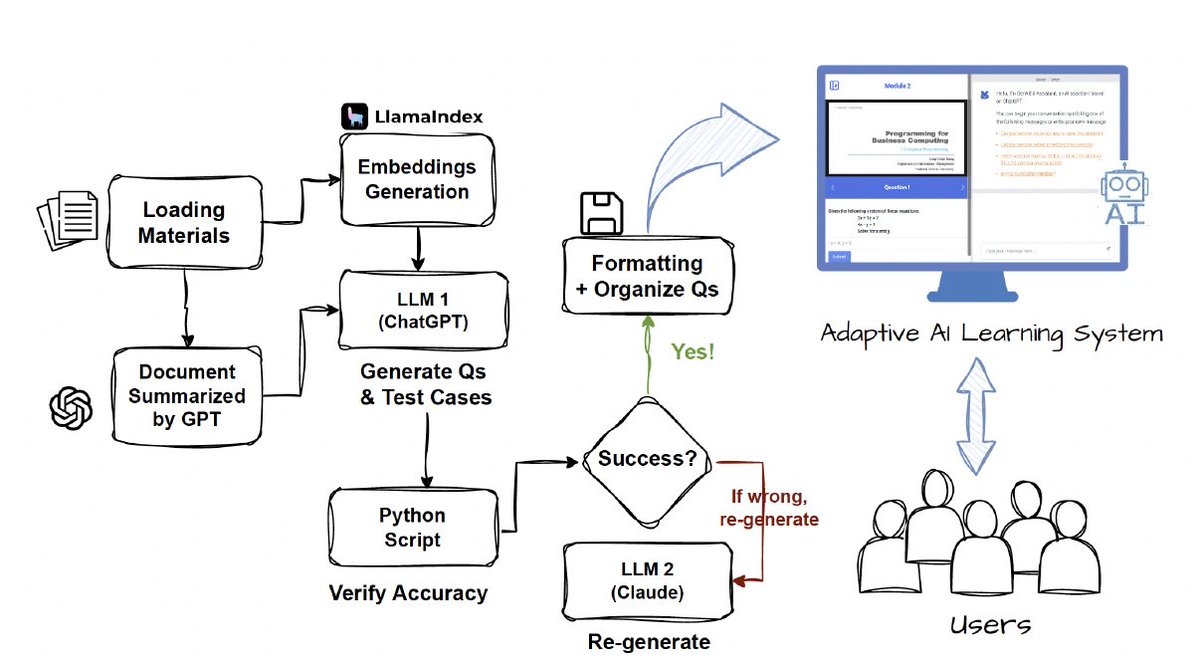
New study involving 770 high school students over 5 months across 10 schools. All students got the same lectures, course material, and GenAI tutor. The only difference: half received a fixed sequence of practice problems (easy to hard, standard practice), while the other half had their problem sequence dynamically personalized by a reinforcement learning (RL) algorithm.
The result: students with adaptive sequencing scored 0.15 standard deviations higher on an in-person, handwritten final exam: no devices, no AI assistance.
By some estimates, that's equivalent to 6–9 months of additional schooling. No extra instruction time or additional teacher workload. Beginners with no prior experience saw the largest gains (0.215 SD). Students at lower-tier schools benefited more than those at elite schools.
https://t.co/BkVyBMHyyh
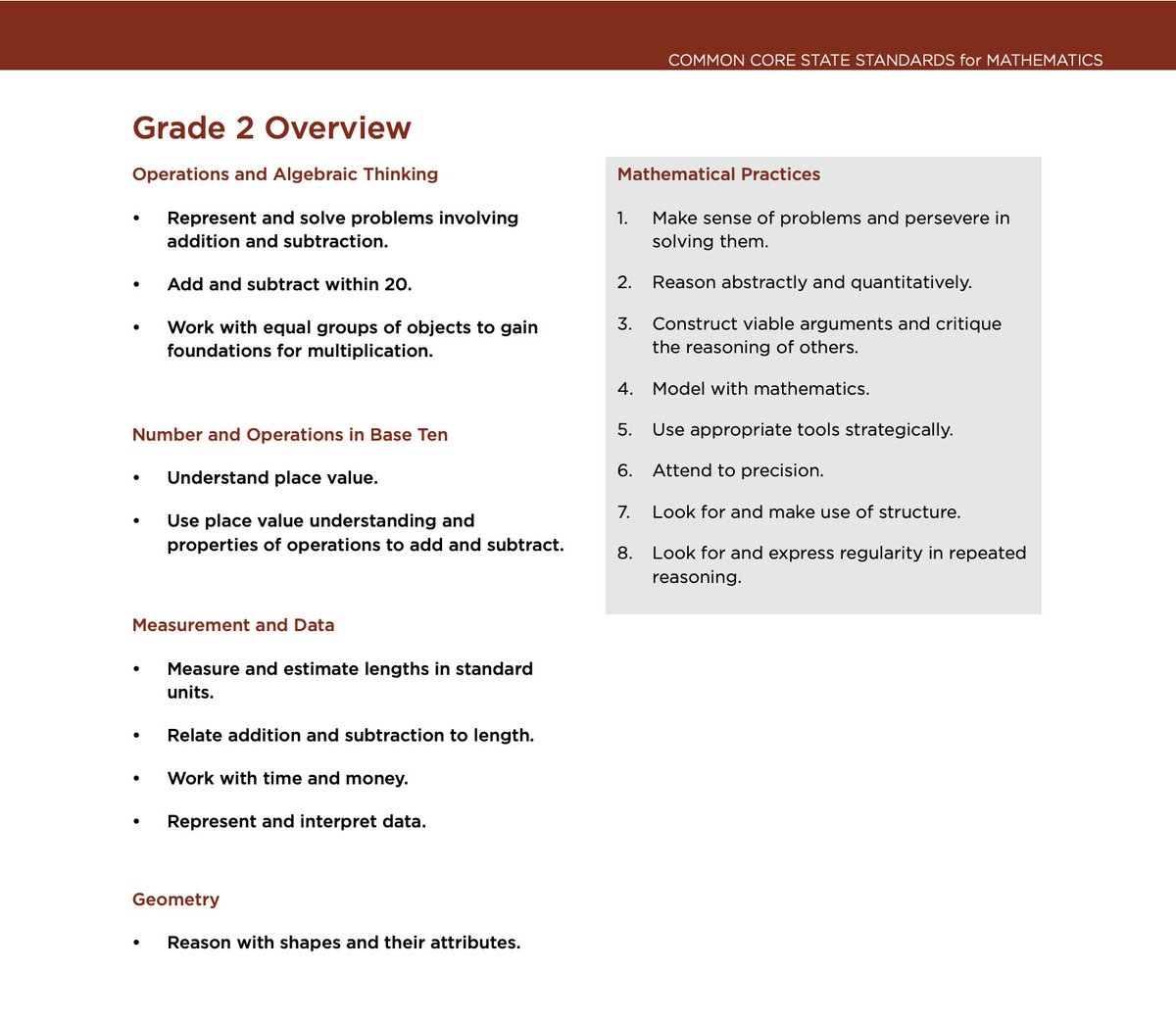
The worst part of K-12 mediocrity isn't 6th-8th grade math, it's K-5.
eg: The main Common Core goals for 2nd grade math are:
1) Read numbers up to 1000
2) Add and subtract within 20
3) Count money
4) Tell time
The worst part is that these goals have become a ceiling rather than floor
The real answer is that it’s a space-filling curve, which is the natural consequence of any surface of dimension n growing within a topological space of higher dimension.
This, specifically, occurs because a 2-manifold (the cortex or cabbage sheaves) begins to grow within a 2-sphere (empty “ball”, either skull or outer cabbage sheaf).
The growing manifold then folds in order to efficiently fill the space.
Interestingly, if you measure the fractal dimension of a space-filling curve, the “foldiness” of the manifold approaches the dimension of the higher dimensional “ball”.
So in either the cabbage or the brain, a 2-dimensional manifold grows “into” a structure of fractal dimension that in humans both approached 3 and induced a selection pressure wrt skull size, which was itself eventually upper-bounded by female hip width hitting a functional limit.
With all this context on board, the symmetry appears perfectly natural, and one can generalize the idea to the dynamics of any organic growth within the constraints described above.
Without it, the symmetry appears supernaturally mysterious.
Many things are like this.
Congrats to Dmitriy Khots from @BoysTown, winner of our #TWTechRadar competition at #GoogleCloudNext! 🎉
Dmitriy took home the Meta Quest 3S VR headset, presented by Chris Murphy & Julie Woods-Moss at our client event in Vegas.
Thanks to all who joined us!
As XB-1 approaches Mach 1, I’m happy to share @boomsupersonic has raised >$100M in new financing, fully funding the first Symphony engine prototype.
Major investors in this round include Alex Gerko, @BessemerVP, Michael Moritz, @paulg, @reidhoffman, @sama, and @ycombinator. (1/3)👇
There are prominent voices in parenting and education who caution against using praise and rewards to motivate children.
This is like people using screwdriver to hammer in a screw, finding it ineffective, and then declaring screwdrivers useless. They show their fundamental lack of understanding of the tool’s purpose and how to use it.
If I wanted to understand how to use screwdrivers, I would talk to a woodworker, not an academic. If you want to understand rewards, then talk to a game designer, not a researcher.
People outside the gaming industry look at games and think “oh, they use gold stars to motivate their players, so if I use gold stars my kids will be motivated, too”.
But this is cargo cult mentality. It shows a complete lack of understanding of the underlying psychology, so of course it fails, and then you end up with hacks writing entire books about how praise and rewards and gold stars don’t work.
Any game designer worth their salt understands the difference between intrinsic and extrinsic motivation. Every game designer knows that intrinsic motivation is the true goal. And critically, we understand how to create it as well.
To build feelings of intrinsic motivation, people need autonomy, mastery, and purpose.
This isn’t the only valid framework. There’s also the Player Experience of Needs Satisfaction (PENS) model, which refers to competence, autonomy, and relatedness. And older frameworks like Bartle’s Four Player Types (achievers, socializers, explorers, and killers) recognize the diversity of motivating factors, ie that different people find different things intrinsically rewarding.
The challenge is that it takes a really long time to develop feelings of autonomy, mastery, and purpose in a person. And so that’s exactly where rewards and praise come in.
People criticize extrinsic motivation as “ways to temporarily induce compliance” or ways to “improve performance on simple tasks” but that’s the point. Rewards get people over the initial challenging hump of building mastery and autonomy, so that those people can get to the point where the intrinsic motivation can even begin to build.
It’s true that extrinsic rewards do detract from feelings of intrinsic motivation, but it’s worth it. Because without those extrinsic rewards, many people won’t make it to the point where they can develop those feelings of intrinsic motivation at all. And with proper design (the kind that’s lacking in untrained researchers with no domain expertise) those negative effects can be mostly mitigated anyway.
In an ideal world, the claim that you should avoid praising kids would result in career-ending mockery for a so-called parenting and education expert. But in the absence of that, feel free to trust your instincts and continue saying nice things to children.
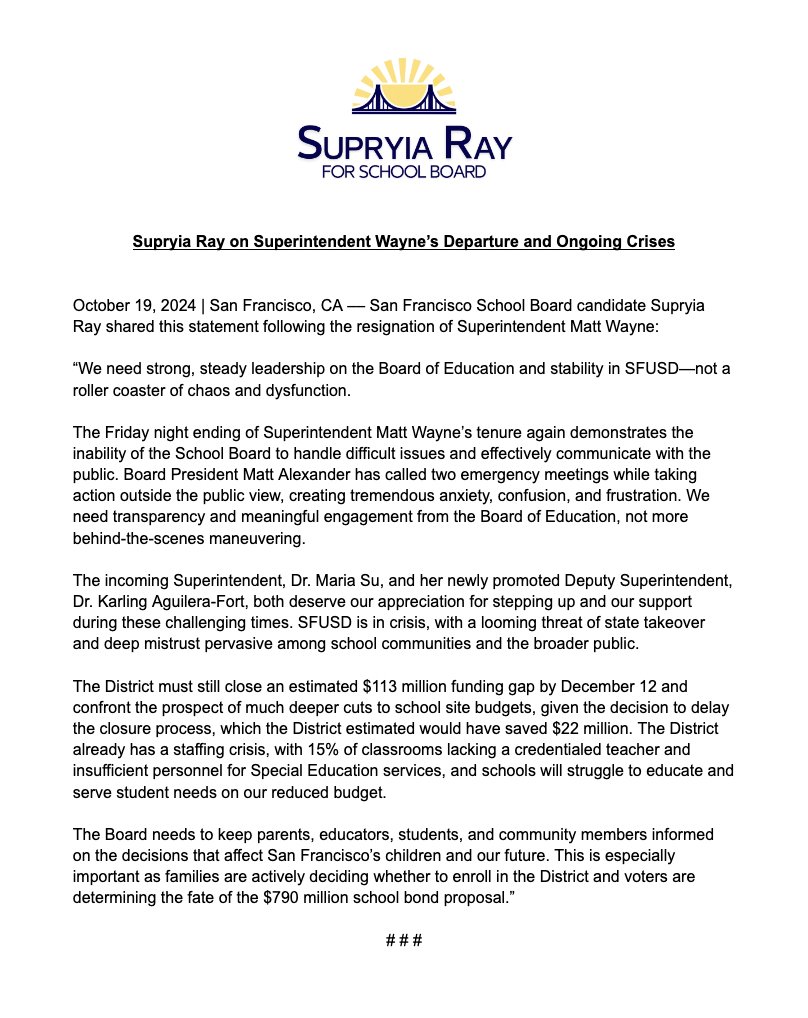
We need strong, steady leadership on the Board of Education and stability in SFUSD—not a roller coaster of chaos and dysfunction.
We need transparency and meaningful engagement from the Board of Education, not more behind-the-scenes maneuvering.
My full statement:
Inversion has been granted our re-entry license from @FAANews for our upcoming Ray mission. Ray will land off the coast of California, marking an important capability to safely return to the USA.
@MarjanPhilhour@conniechansf It’s about time for sane, pragmatic leadership in D1. Enough virtue signaling and reactionary obstruction from Connie Chan and her BoS allies. Vote for Marjan!
@robinhanson (C) Deviating from our expectations for how people usually act or what people usually believe, our brains flagging them for extra attention / closer scrutiny. "Learning opportunity."
@Sharkyl Waymo is far from profitability. Self-driving cars can get us closer to Vision Zero if we let them expand. I’d love to support Muni, but not by punishing the few companies that take huge risks to provide useful services. Remember finding cabs in the Sunset before ride-hailing?
Guess which *single* BOE candidate showed up to speak out at the emergency meeting this Sunday about the crisis impacting our schools and the potential ousting of the superintendent?
@RayforBOE
Thank you for showing up for our city’s kids, Supryia Ray!! 🙏
Friends. Massive milestone today and I could use your help.
Today, we’re officially launching Mentava on Product Hunt. (Please visit, comment, share, etc.) For the first time, you can sign up and teach preschoolers to read with Mentava as we imagined it when we started this project over two years ago.
Basically, we’ve made it to the starting line.
Learning to read is a magic moment for a child. It’s like a secret code that unlocks the world around them. But many kids miss out on years of this magic because of societal myths like “learning to read is hard”, or “learning too fast will damage kids brains”, or “kids can’t learn to read until they’re 7 or 8”.
Learning to read isn’t rocket science. Kids need to memorize letter/sound pairings and then learn to blend them together. It’s not hard but it is time-consuming (and can be kind of boring).
Fortunately, “motivation” is a solved problem in game design. (Just walk through the slot machines in any casino if you need to be convinced of this.)
The open questions when we started this project were:
(1) could we combine quality curriculum with game design best practices to create learn-to-read software that was both fun and effective?
(2) are there actually enough people who want high-quality educational software to make a company viable? Or is the edutainment slop that dominates today’s market the only option?
Given the feedback from our customers, the answer to question 1 is a resounding yes. Now we have to find out how many people actually want what we’ve built.
If you believe in our mission of accelerating education, please please please help us out today by giving us a signal boost, as well as a comment on our Product Hunt page (link in next tweet).
And let me know what you think of our new product demo video! It was harder than expected to capture what Mentava is all about, but I think we got there.
@NielsHoven chicken > sheep > cow > horse > pig. Reminds me too much of coco melon and LooLoo kids, junk video associations. 5/10. But I haven’t asked any 3 year olds.