What would be the lifespan of a human who has overcome all aging mechanisms except somatic mutations?
We build a model that estimates it as 140 years, here are details: https://t.co/lrtWgVSZCj
@fedichev 7) Yes, I'm an opponent of phenomenology. We are fed up with her. We need to start speaking about molecules, pathways and rank different mechanisms by their significance. Boldly predict interventions and test them.
@fedichev 5) "A few principal components can describe most of the story" - wrong. If you consider WGBS DNA methylation. I bet even 20 components will be not enough for describing even 80% of this data structure. Transcriptomics is more correlated, but it can be an amplification artifact
@fedichev 4) "Across mammals, bigger animals tend to live longer—and slower." - sure, and naked mole rat, spalax, bats, and birds successfully bypass this "law".
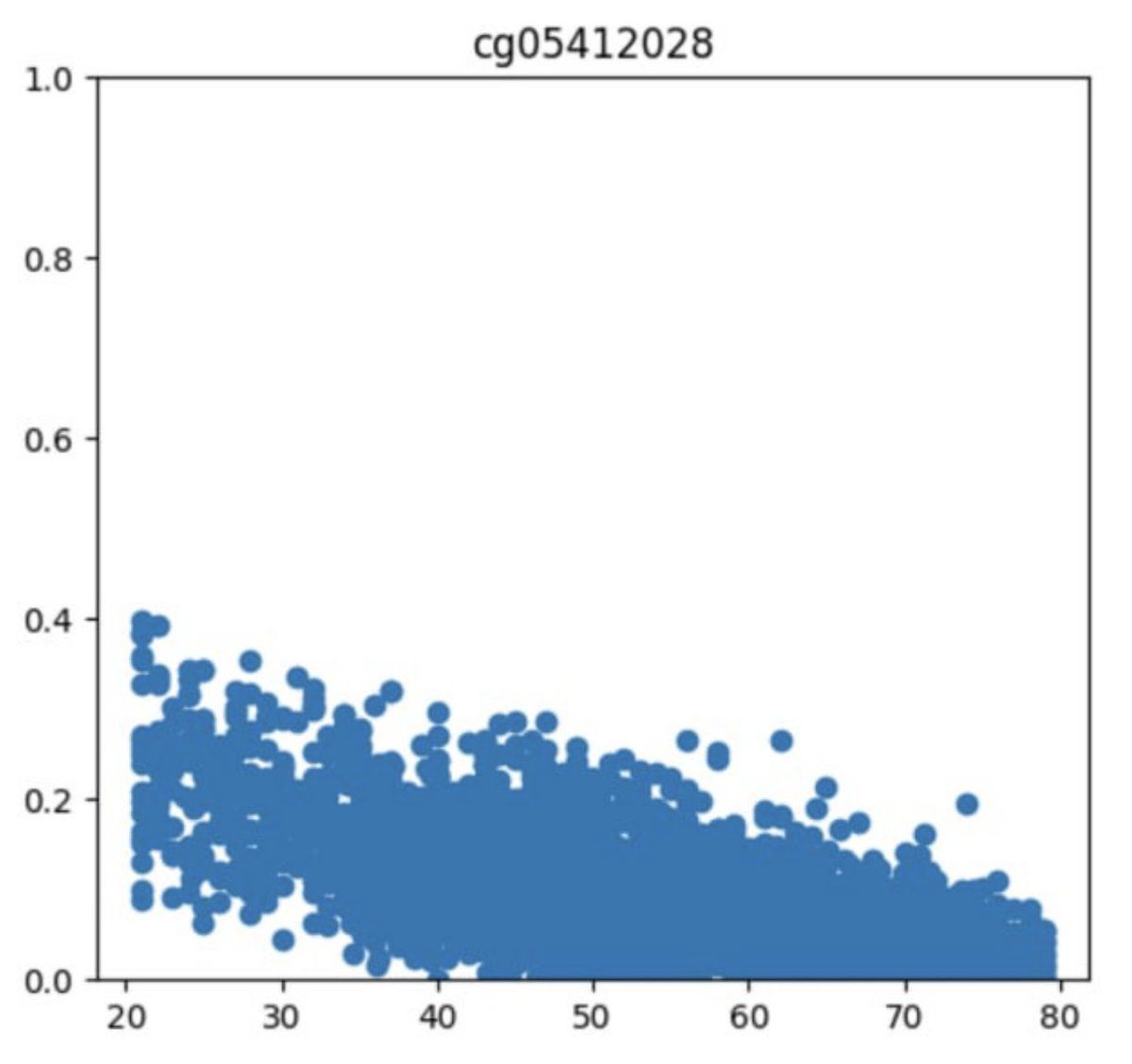
@fedichev "variance...actually increases with age" - surprise. This is not always so. Below is an example of CpG site with decreasing variance - there are a lot of such sites.
@fedichev 3) "aging is fundamentally stochastic" - to some extent, but not at all. The goal of any proper aging theory is to point to main cause of aging. It can be so, that quasi-program processes are main drivers as the hyperfunction theory says.
@fedichev 2) "mortality doesn’t just increase with age—it increases exponentially" - this is no more than your assumption. Human mortality data can be greatly described with Weibull distribution too. Moreover, the older ages (after 90) are better described by Weibull than Gompertz.
@fedichev 1) I disagree. We actually have quite many proper theories of aging: hyperfunction theory, information theory, epigenetic aging clock theory. The problem with them - they do not explicitly articulate what is the main cause of aging, nor suggest an anti-aging intervention.
@davidasinclair These "bad news" is just a result of extrapolation of linear function to never observed region of human biomarkers. This result absolutely does not proof anything.
I am happy to announce that we finished a huge work about Parkinson Disease and DBS. Check out the preprint https://t.co/m5CKh1kVnv and github https://t.co/Ra9TdXefjJ🥳
🪐ComputAgeBench - v2 — Epigenetic Aging Clocks Benchmark is released. Check our new version of the preprint [https://t.co/SCbktIZBFd]. We added 7k+ blood samples from 46 additional datasets of healthy individuals suitable for training clinically relevant 1-st gen aging clocks.
In fact, I'm super excited with the idea to thoroughly answer this question. However, this would require to gather a large cohort of people measuring clinical and epigenetic biomarkers simultaneously, then opening this dataset to allow all researchers to test this hypothesis.
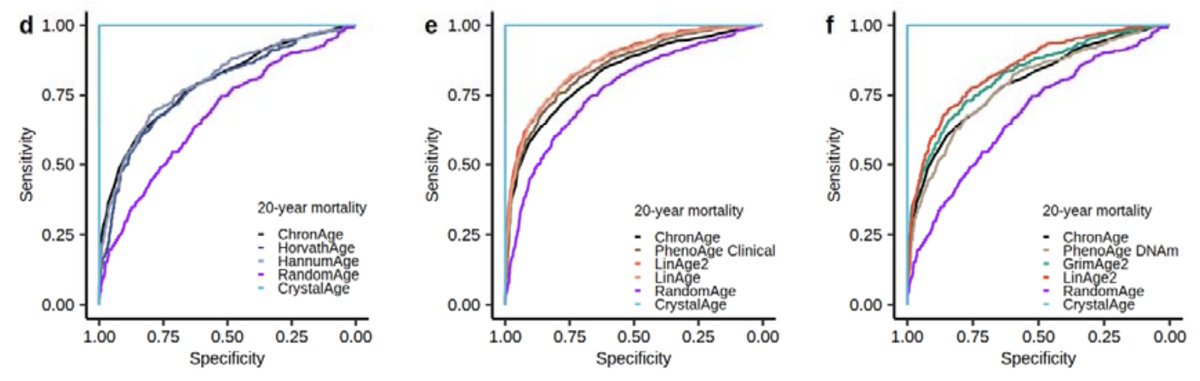
I saw this extremely important result in the preprint. PCA clocks fitted on clinical biomarkers OUTPERFORMED epigenetic clocks in terms of all-cause mortality ROC AUC. Great result, opening the important question, do we actually need epigenetic biomarkers?
People have been asking us how to interpret linAge, to drop difficult to obtain parameters and to compared to other clocks - we thought it would be a quick job to address these questions - it turned out to be a six month journey - preprint out now: https://t.co/jUV3nGgBSW
People have been asking us how to interpret linAge, to drop difficult to obtain parameters and to compared to other clocks - we thought it would be a quick job to address these questions - it turned out to be a six month journey - preprint out now: https://t.co/jUV3nGgBSW
@fedichev@jangruber467 I couldn't find a discussion in the article regarding negligibly aging mammal species (as well as so called "immortal" species), what the theory predicts for them?




![shappiron's tweet photo. 🪐ComputAgeBench - v2 — Epigenetic Aging Clocks Benchmark is released. Check our new version of the preprint [https://t.co/SCbktIZBFd]. We added 7k+ blood samples from 46 additional datasets of healthy individuals suitable for training clinically relevant 1-st gen aging clocks. https://t.co/Kb6UA9iIox](https://pbs.twimg.com/media/GjcORV9WkAAF29G.png)