Saccadic suppression was demonstrated in many species. In a new paper, using modeling and matched experimental paradigms in fish and primates, we explored the reasons for why saccadic suppression strength might be different in different organisms.
https://t.co/i9F1etXElk
A paper from my postdoc is out!
https://t.co/UuMrzVWnvE
How does the premotor cortex reuse the neural representation of single finger movements for simultaneous, multi-finger movements?
TLDR: Ensemble activity for simultaneous movements can be explained by linear summation of corresponding single-finger movements and magnitude normalization (so that the activity does not blow up as more fingers are moved).
🧵Training binary or spiking neural networks is hard.
Gradients vanish, surrogates are noisy, batchnorm is brittle.
We propose a Bayesian approach based on KL divergence minimization—and it works.
Paper: https://t.co/dHSKY4L3bo
Work by James Walker % @MKhajehnejad
1/6
New paper demonstrating saccadic suppression in zebrafish, as well as an intriguing selectivity for specific stimuli. In upcoming work, we'll also quantitatively compare the zebrafish suppression strength to that in primates.
https://t.co/rpzUl4Jyc4
OpenAI and DeepSeek’s reasoning LLMs have scored impressively on benchmarks that challenge humans, but how robust are their fundamentals? We test o1-mini & R1 on small-scale graph coloring problems and find limited reliability and signs of issues with non-linear reasoning.
(1/10)
We have a new PhD position available. Please spread the word and retweet. The project will combine retina recordings, computational modeling, and optogenetics to help further develop vision restoration therapy. See here for more information: https://t.co/FnP2JTsHay
Life update! I’ve joined the Amaranth Foundation as a NeuroAI researcher. I'll work on an ambitious roadmap for neuroscience for AI safety 🎉 1/ https://t.co/zv16dQ6jDZ
Exciting work with @MikeManookin, Fred Rieke, @GregDField, & Joel Zylberberg is now out in @NatureComms! We developed a new ANN with biophysical neural adaptation for better retinal response predictions to dynamic input.
https://t.co/iCReCKf5I7 #NeuroAI#DeepLearning
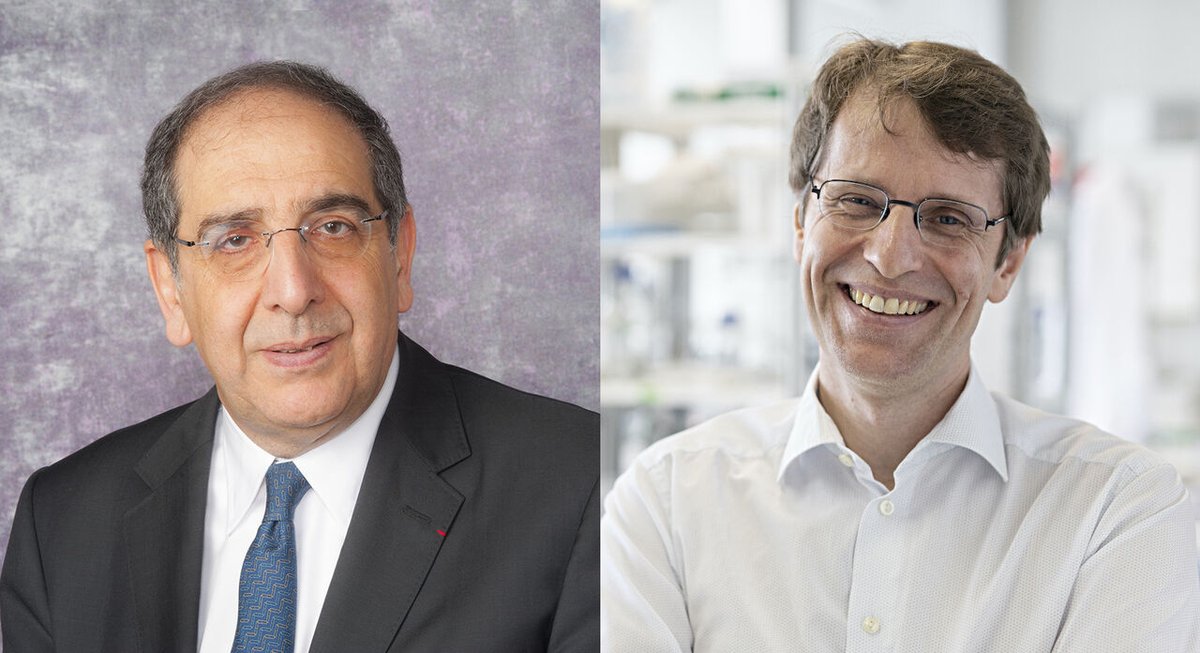
👏Congratulations to Botond Roska and José-Alain Sahel, 2024 Wolf Prize Laureates in Medicine!
For more information
https://t.co/kzBu5St3eX https://t.co/YrUghYkHm6…… #TranslationalNeuroscience#Optogenetics#IOB
New preprint @biorxiv_neursci w/ @AToliasLab & more
Our data-driven deep learning approach in🐭🐒identifies a new rule of contextual modulation in visual cortex
Pattern completion/disruption wrt natural image stats = surround facilitation/suppression🧵👇
https://t.co/95tctr9kBa
Tübinger Paläogenetiker erhält Preis der Heidelberger Akademie der Wissenschaften: Cosimo Posth entschlüsselt die menschliche genetische Vielfalt der Vergangenheit. Herzlichen Glückwunsch zur Auszeichnung! 👏 https://t.co/yKFkTZ7pSp #uni_tue#archäologie@Senckenberg@hadw_bw
New paper from the lab 🥳 @NatureNeuro
The 'internal compass' can do more than tracking head-direction (HD) 👉 thalamic HD cells respond to sensory stimuli and are modulated by behavioral state (e.g. during social interactions)
https://t.co/q4arkaUxDz
Pleased that York PhD grad @BBaltaretu just published her final thesis chapter: "Occipital and parietal cortex participate in a cortical network for transsaccadic discrimination of object shape and orientation"https://t.co/0MKZ2mPfGB
Araceli Cardenas, a trainee with the @neuron2brain lab @KBI_UHN working with @DrValiante, wows the crowd with a presentation on how intracranial recordings show the positive impact of exercise on cognition. #KrembilResearchDay2023
I am extremely delighted to share that our work on "Multidimensional cerebellar computations for flexible control of movements” is now published in @NatureComms.
Many thanks to my coauthors, @sungho_hong_ , @erik_deschutter , Junya Inoue & Peter Thier!
https://t.co/CrvgrGgN67