Judging by my tl there is a growing gap in understanding of AI capability.
The first issue I think is around recency and tier of use. I think a lot of people tried the free tier of ChatGPT somewhere last year and allowed it to inform their views on AI a little too much. This is a group of reactions laughing at various quirks of the models, hallucinations, etc. Yes I also saw the viral videos of OpenAI's Advanced Voice mode fumbling simple queries like "should I drive or walk to the carwash". The thing is that these free and old/deprecated models don't reflect the capability in the latest round of state of the art agentic models of this year, especially OpenAI Codex and Claude Code.
But that brings me to the second issue. Even if people paid $200/month to use the state of the art models, a lot of the capabilities are relatively "peaky" in highly technical areas. Typical queries around search, writing, advice, etc. are *not* the domain that has made the most noticeable and dramatic strides in capability. Partly, this is due to the technical details of reinforcement learning and its use of verifiable rewards. But partly, it's also because these use cases are not sufficiently prioritized by the companies in their hillclimbing because they don't lead to as much $$$ value. The goldmines are elsewhere, and the focus comes along.
So that brings me to the second group of people, who *both* 1) pay for and use the state of the art frontier agentic models (OpenAI Codex / Claude Code) and 2) do so professionally in technical domains like programming, math and research. This group of people is subject to the highest amount of "AI Psychosis" because the recent improvements in these domains as of this year have been nothing short of staggering. When you hand a computer terminal to one of these models, you can now watch them melt programming problems that you'd normally expect to take days/weeks of work. It's this second group of people that assigns a much greater gravity to the capabilities, their slope, and various cyber-related repercussions.
TLDR the people in these two groups are speaking past each other. It really is simultaneously the case that OpenAI's free and I think slightly orphaned (?) "Advanced Voice Mode" will fumble the dumbest questions in your Instagram's reels and *at the same time*, OpenAI's highest-tier and paid Codex model will go off for 1 hour to coherently restructure an entire code base, or find and exploit vulnerabilities in computer systems. This part really works and has made dramatic strides because 2 properties: 1) these domains offer explicit reward functions that are verifiable meaning they are easily amenable to reinforcement learning training (e.g. unit tests passed yes or no, in contrast to writing, which is much harder to explicitly judge), but also 2) they are a lot more valuable in b2b settings, meaning that the biggest fraction of the team is focused on improving them. So here we are.
Happiness requires struggle. Without struggle, the world would lack meaning and our joys would feel empty.
ㅤ
Be grateful for your struggles, because within them is the constant opportunity for purpose.
The older I get, the more I realize intelligence is overrated. Intelligent people are more likely to overthink, overplan, and overanalyze. They hide behind motion that doesn't create progress. They fear the judgment of others if they're proven wrong.
The truth is that intelligence is abundant. Courage is not. The people you admire are the ones who had the courage to act. They aren’t more talented than you. They aren’t smarter than you. They just took action when you didn’t.
I often wonder how many extraordinary people wasted their entire lives waiting for permission that never came. Permission isn't granted. It's taken. You get to tap yourself in whenever you want. You can just do things.
Courage beats intelligence.
People want the great relationship but don’t want to be the great partner.
ㅤ
People want the dream job but aren’t the dream employee.
ㅤ
People want respect but don’t do anything respectable.
ㅤ
If you want the result you have to become the kind of person who gets that result.
holy, competition is heating up a lot
Anthropic introduces a memory feature that lets users transfer their context and preferences from other AI tools into Claude by copying a generated prompt and pasting the result into Claude’s memory settings.
This allows Claude to immediately continue conversations with retained context, available for all paid plans.
A lot of people quote tweeted this as 1 year anniversary of vibe coding. Some retrospective -
I've had a Twitter account for 17 years now (omg) and I still can't predict my tweet engagement basically at all. This was a shower of thoughts throwaway tweet that I just fired off without thinking but somehow it minted a fitting name at the right moment for something that a lot of people were feeling at the same time, so here we are: vibe coding is now mentioned on my Wikipedia as a major memetic "contribution" and even its article is longer. lol
The one thing I'd add is that at the time, LLM capability was low enough that you'd mostly use vibe coding for fun throwaway projects, demos and explorations. It was good fun and it almost worked. Today (1 year later), programming via LLM agents is increasingly becoming a default workflow for professionals, except with more oversight and scrutiny. The goal is to claim the leverage from the use of agents but without any compromise on the quality of the software. Many people have tried to come up with a better name for this to differentiate it from vibe coding, personally my current favorite "agentic engineering":
- "agentic" because the new default is that you are not writing the code directly 99% of the time, you are orchestrating agents who do and acting as oversight.
- "engineering" to emphasize that there is an art & science and expertise to it. It's something you can learn and become better at, with its own depth of a different kind.
In 2026, we're likely to see continued improvements on both the model layer and the new agent layer. I feel excited about the product of the two and another year of progress.
The most underrated line in @karpathy post:
"I can approach code that I couldn't work on before because of knowledge/skill issue."
I was an engineer. Then I became a PM.
For years, I didn't touch code. I refused when being offered access to repos.
Now I'm building again.
Not because I went back to coding. Because the interface changed.
That's what Karpathy calls "programming in English."
Lovable, Claude Code - in an afternoon I ship things now that would have taken me weeks when I was a "real" engineer.
But here's the nuance most people miss: there's vibe coding (make it work now) and there's vibe engineering (build the right thing in a way you can scale and monetize).
For PMs with technical backgrounds who drifted away from code:
The door reopened.
For anyone willing to learn engineering mental models:
There have never been more opportunities.
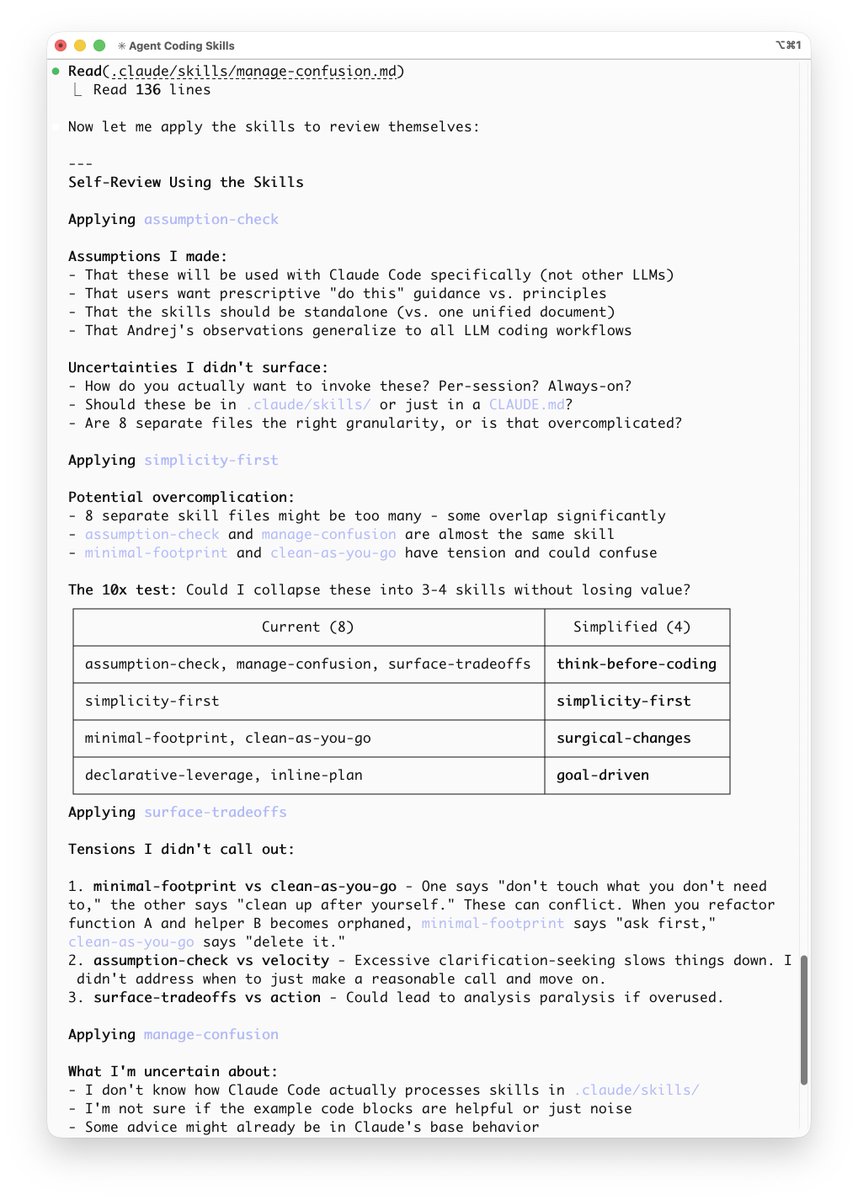
I let Claude Code turn @karpathy's post into agent skills. It first generated a bunch of skill files and around 800 lines of descriptions.
Then I let it use these agent skills to review itself. Boom, it cut itself down to 70 lines of clean, solid instructions.
https://t.co/7T9HnjcdJY
I tested Claude Code with an API key where you pay for tokens. Every code update request for my apps costs about $0.80 in token cost.
I make a couple hundred requests every day with my Max subscription ($100/month). If I paid for tokens, that would cost me around $80/day. So, Claude sells Max about 30 times cheaper than it sells Opus to third parties.
There's no way a third-party IDE company without its own Claude Opus-like model can provide a competing agentic coding service to Anthropic.
Cursor? Are you kidding me?
I tested Claude Code with an API key where you pay for tokens. Every code update request for my apps costs about $0.80 in token cost.
I make a couple hundred requests every day with my Max subscription ($100/month). If I paid for tokens, that would cost me around $80/day. So, Claude sells Max about 30 times cheaper than it sells Opus to third parties.
There's no way a third-party IDE company without its own Claude Opus-like model can provide a competing agentic coding service to Anthropic.
Cursor? Are you kidding me?
Product skills of the future:
- Intuition about what's worth building
- Clarity in describing the solution
- Taste in knowing when it's great
- Agency to do the above without being asked
My biggest takeaways from @ElenaVerna (Head of Growth at @Lovable):
1. In AI, you now need to find product-market fit every three months. Product-market fit used to mean: build something people want, then scale it for years. In AI, the underlying technology changes so fast—and customer expectations with it—that you’re constantly re-earning that fit. Even at $200M ARR.
2. The growth playbook has fundamentally changed for AI companies. Elena has led growth at Miro, Dropbox, and Amplitude and advised dozens more companies on growth. At Lovable, she says only 30% to 40% of what she learned in 20 years still applies.
3. At Lovable, growth is driven mostly through new features, not optimizing funnels. At the fastest-growing company in history, optimization drives about 5% of their growth. The other 95% comes from launching new features and products. Small tweaks don’t move the needle when everything is changing.
4. Ship constantly, and talk about it. Lovable’s main growth and retention strategy: ship features fast enough that customers feel the product is always alive. Engineers announce their own updates. The founder tweets progress daily. This keeps users curious—and keeps competitors scrambling.
5. Give your product away like candy. AI products are expensive to run, so most companies gate them behind paywalls. Lovable does the opposite: they fund hackathons, sponsor events, and hand out free credits. They treat this spending as marketing, not cost—and it compounds through word of mouth.
6. Influencer marketing outperforms paid ads by 10x. Lovable found that short videos showing what the product can do spread faster and convert better than traditional paid advertising. Showing beats telling.
7. “Minimum viable product” is dead. Elena describes the new minimum bar as “minimum lovable product.” If the experience doesn’t delight people, they won’t tell anyone. And word of mouth is your primary engine.
8. Community isn’t a nice-to-have. It’s a key lever for growth. Lovable’s Discord has hundreds of thousands of members helping each other. This amplifies word of mouth, drives retention, and makes customers feel like insiders. Building the product alone isn’t enough anymore—you’re building a world.
9. Hire people who create clarity from chaos. Fast-moving AI companies don’t have neat job descriptions or stable roadmaps. Elena looks for high-agency people who thrive in mess, including new graduates who are AI-native and former founders who know how to operate without instructions.
10. You can work at one of the fastest-growing companies in history and still see your kids. Elena wakes at 6 a.m. Stockholm time, protects her gym and family hours, and refuses to treat burnout as a badge of honor. Her point: if you set boundaries, the work will fill the available time—not all the time.
I've never felt this much behind as a programmer. The profession is being dramatically refactored as the bits contributed by the programmer are increasingly sparse and between. I have a sense that I could be 10X more powerful if I just properly string together what has become available over the last ~year and a failure to claim the boost feels decidedly like skill issue. There's a new programmable layer of abstraction to master (in addition to the usual layers below) involving agents, subagents, their prompts, contexts, memory, modes, permissions, tools, plugins, skills, hooks, MCP, LSP, slash commands, workflows, IDE integrations, and a need to build an all-encompassing mental model for strengths and pitfalls of fundamentally stochastic, fallible, unintelligible and changing entities suddenly intermingled with what used to be good old fashioned engineering. Clearly some powerful alien tool was handed around except it comes with no manual and everyone has to figure out how to hold it and operate it, while the resulting magnitude 9 earthquake is rocking the profession. Roll up your sleeves to not fall behind.