Qwen3.8 is launching and going open-weight soon!🌐
With a massive 2.4T parameters, this model is continuously evolving. We believe it’s one of the most powerful model available today, compatible to leading frontier AI models , second only to Fable 5.
You don't have to wait to test it. Just now, the Qwen3.8-Max-Preview made its debut on Alibaba’s Token Plan, Qoder, and QoderWork. Be among the very first to try it out.
Can't wait to hear what you build. Stay tuned! 🚀
Token Plan
international:https://t.co/YRvcGdB9Bv
China:https://t.co/PKMUNwUuRp
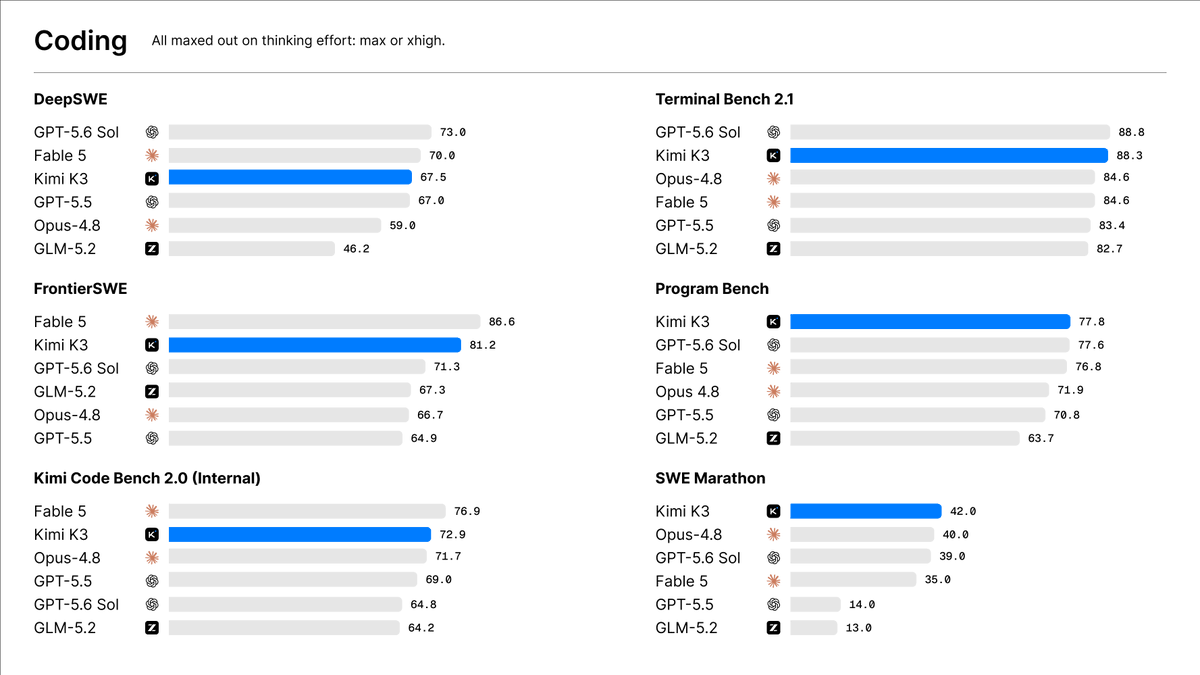
Big news: Kimi-K3 by @Kimi_Moonshot is now #1 in the Frontend Code Arena with 1679 pts, surpassing Claude Fable 5.
This is a 17-place jump from Kimi-k2.6 (#18 -> #1).
In Frontend, Kimi-K3 ranked #1 in 6 of 7 domains: Brand & Marketing, Reference-Based Design, Data & Analytics, Consumer Product, Simulations, and Content Creation Tools, landing #2 only in Gaming behind Fable 5.
The full model weights will be released by July 27.
Congrats to the @Kimi_Moonshot team on this major milestone!
Introducing Kimi K3: Open Frontier Intelligence
🔹 2.8 Trillion Parameters, 1 Million Context, Native Multimodal
🔹 Kimi Delta Attention enables up to 6.3x faster decoding in million-token contexts
🔹 Attention Residuals deliver ~25% higher training efficiency at <2% additional cost
🔹 Built for long-horizon agentic coding and self-evolving workflows
Kimi K3 is now live on on https://t.co/zrk6zZxZUo, Kimi Work, Kimi Code, and the Kimi API.
Open Weights by July 27, 2026.
🔗 API: https://t.co/XCrgjXAqMw
🔗 Tech blog: https://t.co/YTfiMSNM1f
introducing https://t.co/20es64pAqZ
a dictionary for ui things you can see but can't name
made it because i'm primarily a designer, and my biggest resistance was always knowing what things are called when prompting my agents
it learns as people use it: every search teaches the site new words, and the built-in pocket dictionary grows with it
give it a try and let me know what you think
can't find something? dm me and i'll add it
i want this to be the lowest resistance resource you have
you can just build things
Today we’re announcing our “ThinkingCap” efficient model series with a 2× thinking token reduction on average in Qwen 3.6 27B, with up to 10x faster generation on individual examples.
- 2016-2024: 🇺🇸leads in open-source AI
- 2024-2027: 🇺🇸 leads in general AI & massively benefits
- 2024-2026: 🇨🇳 leads in open-source AI
- 2026-2030: ??
It's not open-source AI leadership OR general AI leadership, it's open-source AI leadership BEFORE general AI leadership!
Open-source AI is the foundation of all AI. It does not only creates more innovation, competition, jobs, and prosperity now, it's also the best (only?) way for a national tech ecosystem to accelerate and ultimately reach the frontier of AI in general.
Because open-source AI reduces siloes, shares learning and innovation, intensify emulation which all lead to an acceleration of the local ecosystem progress that no others can match if they're less open and collaborative.
Same seems to be true for companies btw, OpenAI/Google started with open science and open-source AI which led to their (and Anthropic who spun off from OAI) domination. Meta could have done the same but decided to change course for some reason.
Personal update: I've joined Anthropic. I think the next few years at the frontier of LLMs will be especially formative. I am very excited to join the team here and get back to R&D. I remain deeply passionate about education and plan to resume my work on it in time.
Creating a new logo shouldn't take ages.
I wanted something fast, simple and free.
So I built Logo Lattice.
100% free.
100% browser based.
100% ownership of creations.
Link in first comment 👀
Chinese researchers have developed the best shortest-path algorithm in 41 years!
Dijkstra’s Algorithm has been the undefeated king of the shortest path for over 40 years.
Whether you’re using Google Maps, booking a flight, or routing internet packets, Dijkstra is the engine running in the background.
Since 1984, textbooks have taught that its efficiency was hit by a "sorting barrier."
To find the shortest path, you have to sort the points by distance. And sorting has a mathematical floor you can’t cross.
Until now.
A research team from Tsinghua University just published a paper that shatters the 41-year-old record.
They proved that Dijkstra is not optimal.
By combining the logic of the Bellman-Ford algorithm with a revolutionary "recursive partial ordering" method, they figured out how to find the path without fully sorting the nodes.
The results are a massive shift in theoretical computer science:
- The first deterministic improvement to the Single-Source Shortest Path (SSSP) problem since 1984.
- A new time complexity of $ O(m \log^{2/3} n)$, officially beating the long-standing $ O(m + n \log n)$ limit.
- On massive sparse graphs (like the web or global logistics), this means finding the best route significantly faster than previously thought possible.
For four decades, the greatest minds in algorithms believed this limit was absolute.
Last year, even the legendary Robert Tarjan won an award proving Dijkstra was "optimally efficient" at sorting distances.
Tsinghua’s answer? Stop sorting.
The world’s most settled problem is suddenly wide open again.
If we can break a 40-year-old law in basic graph theory, what other "impossible" speed limits are waiting to be crushed?
@GalaxyGemX@imdresscode@iyoushetwt LLMs don’t “know themselves” like humans do. They lack self-awareness, consciousness, and a true understanding of their own existence. When asked things like “What model are you?” or “What can you do?”, they generate responses from learned patterns, training data, instructions
@GalaxyGemX@imdresscode@iyoushetwt What are you talking about? This does not mean the AI is conscious or magical. It just means the system is too complex to fully trace in human-readable terms.
@GalaxyGemX@imdresscode@iyoushetwt No, that’s not wrong. These models have this information hardcoded into them, so they can produce answers. But they don’t actually have self-awareness or true knowledge about themselves.
Meet Kimi K2.6: Advancing Open-Source Coding
🔹Open-source SOTA on HLE w/ tools (54.0), SWE-Bench Pro (58.6), SWE-bench Multilingual (76.7), BrowseComp (83.2), Toolathlon (50.0), Charxiv w/ python(86.7), Math Vision w/ python (93.2)
What's new:
🔹Long-horizon coding - 4,000+ tool calls, over 12 hours of continuous execution, with generalization across languages (Rust, Go, Python) and tasks (frontend, devops, perf optimization).
🔹Motion-rich frontend - Videos in hero sections, WebGL shaders, GSAP + Framer Motion, Three.js 3D.
🔹Agent Swarms, elevated - 300 parallel sub-agents × 4,000 steps per run (up from K2.5's 100 / 1,500). One prompt, 100+ files.
🔹Proactive Agents - K2.6 model powers OpenClaw, Hermes Agent, etc for 24/7 autonomous ops.
🔹Claw Groups (research preview) - bring your own agents, command your friends', bots & humans in the loop.
-
K2.6 is now live on https://t.co/YutVbwktG0 in chat mode and agent mode.
For production-grade coding, pair K2.6 with Kimi Code: https://t.co/uvoSJKyGCY
-
🔗 API: https://t.co/EOZkbOwCN4
🔗 Tech blog: https://t.co/9wWvgIQSS3
🔗 Weights & code: https://t.co/Be0hjs2RTP
Introducing Claude Opus 4.7, our most capable Opus model yet.
It handles long-running tasks with more rigor, follows instructions more precisely, and verifies its own outputs before reporting back.
You can hand off your hardest work with less supervision.