Pivoted my view starting early last month ... gradually sold out of the semi conductor group, including AMD. Fully exited now (started the process around April)
AI’s direction feels pretty solid to me at this point. The world is about to move a lot faster once AI starts breaking through the old human bottlenecks in math, computation, and time. Next interesting layer for me is solutions where AI actually compresses real work time in specific areas
So I’ve started rotating into biotech, mainly the stuff tied to disease, aging, personalized medicine, and drugs. Not sure if I’m early or wrong again, but I’m using the same rough logic I had when I bought semis in 2022. We’ll see
Crypto side unchanged. BTC, ETH, SUI, LINK, and LINEA still the core. I think the retail window in pure blockchain plays is getting smaller. Better to move faster and stay away from no-moat or single-use niche stuff that can get overlapped overnight already seeing some of that.
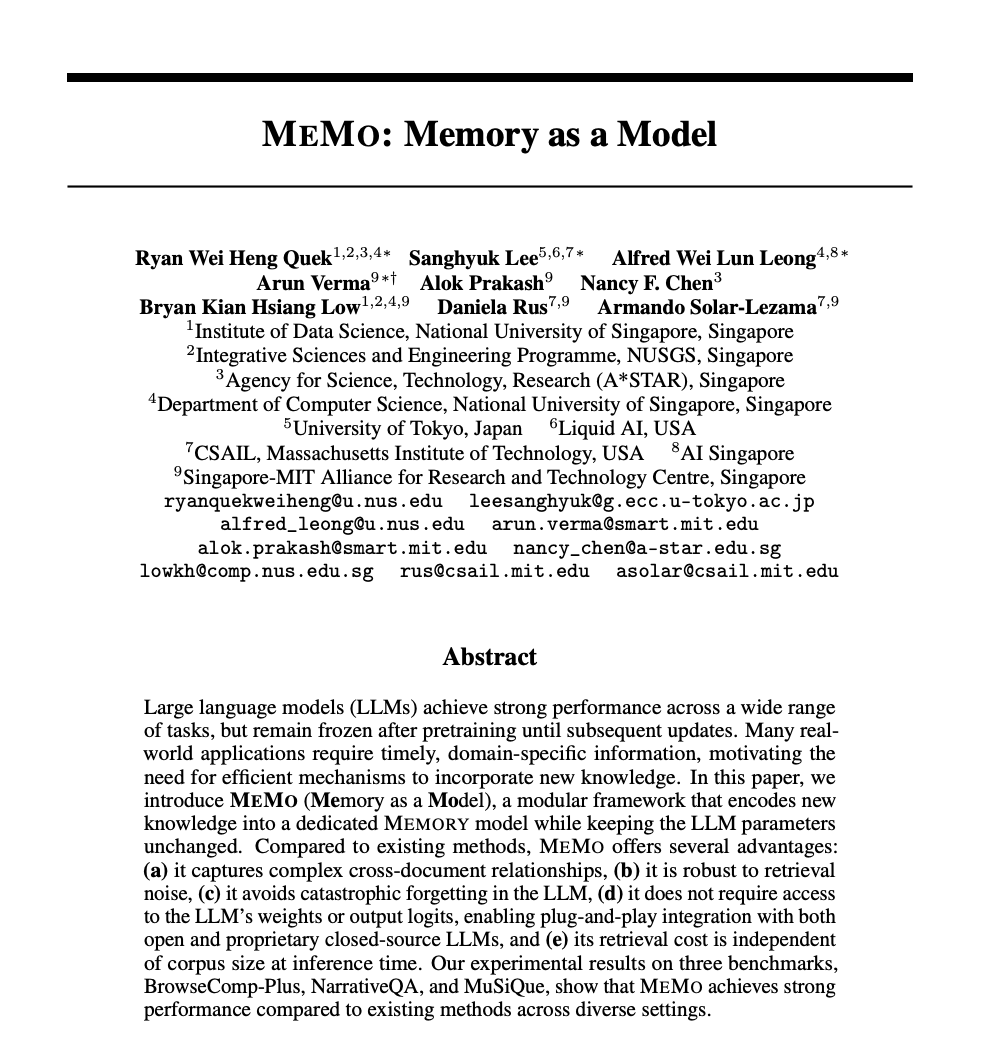
RAG is officially dead 🤯
MIT built an AI that doesn't need RAG.
It’s called MeMo, instead of storing knowledge in a database, you train a small, dedicated Memory model on your documents.
At inference time, your main frontier LLM stays 100% frozen. No vector DB. No chunking. No weight access.
It simply interrogates the Memory model in 3 quick turns, like a detective questioning a witness, to pull exact facts and synthesize the answer.
The results are brutal:
• NarrativeQA (long documents): 53.6% vs. RAG’s 23.2% (more than 2x better).
• Noise test: Doubled the corpus with fake distractors. RAG tanked -6.2%. MeMo didn't flinch (+0.55%).
And the sleeper advantage? It’s completely plug-and-play.
Train the Memory model once. When they upgraded the main LLM from Qwen2.5-32B to Gemini 3.0 Flash with zero retraining, accuracy jumped +26.7% overnight.
We spent 3 years trying to fix AI memory by building better search engines.
It turns out, the answer was giving the model a second brain.
Gemini-powered agents are accelerating discoveries across our @GoogleDeepMind Science missions.
Today, our team is sharing how this paradigm is able to increase the efficiency of quantum circuits, bringing forward the implementation of these algorithms on quantum hardware. 💻
Our agents found new algorithms that cut estimated compute costs by 10.9x for a fusion simulation, 8.1x for photochemistry, and 2.5x for simulating a molecule involved in drug metabolism. Similar to our recent software verification breakthrough with AlphaProof, each quantum circuit result is mathematically proved in Lean .
This agentic-powered method compresses work that once took years, and empowers researchers to focus on defining problems and interpreting results.
There is certainly more work to do — practical quantum simulations will require more powerful hardware than first-generation error-corrected machines — but these efficiency gains are promising.
Congrats to @benjaderberg, Johannes Bausch, @SergeyShir994 and the broader @GoogleDeepMind and @GoogleQuantumAI teams who collaborated on this project.
Read our blog for more details and a link to our technical paper: https://t.co/yrt3n4f8Rx
A toothpaste company has quietly killed the entire market research industry and nobody is talking about it.
Colgate published a paper showing you can predict real purchase intent by simply asking LLMs to roleplay customers.
And this is beyond insane.
If you ask an AI, "Rate this product from 1 to 5," it gives safe, middle-of-the-road garbage.
So researchers invented a method called Semantic Similarity Rating (SSR).
Instead of asking the AI for a number, they asked it to roleplay.
They gave the LLM a demographic profile. They showed it a product concept. And they asked it to write down its raw, unfiltered thoughts.
Then, they used a semantic model to translate those written thoughts into a numerical score.
The results are staggering.
Tested against 57 real personal care product surveys and 9,300 human responses, the synthetic consumers hit 90% of human test-retest reliability.
They perfectly mirrored how different age brackets and income levels react to price changes.
And they provided detailed, qualitative feedback that was deeper and more critical than what actual humans wrote.
This destroys the economics of traditional market research.
You don't need to wait a month to see if a product will sell.
You can simulate 1,000 hyper-targeted customer interviews overnight.
You can A/B test pricing across every demographic instantly.
Hashi mainnet is live.
Bitcoin holders can now use their $BTC as collateral to borrow stablecoins and access managed vaults on Sui.
20+ partners are expanding access across custody, trading, and DeFi.
Here’s what’s live and what’s next: 🧵
NEW: Hong Kong’s central bank and @Swiftcommunity partner with @HSBC, @StanChart and Bank of China to test cross-border tokenized deposit payments, as banks seek 24/7 international payment rails without relying on stablecoins.
Four new projects join LF Decentralized Trust today. IBC, ThunderID and Chaguar were contributed by @cosmos, @wso2iamplatform and @IBMResearch respectively. EUDIPLO is the first project to move over from the @OpenWalletFdn.
Read the full announcement:
https://t.co/r0522TJsdI