Switching to red netting can reduce pesticide use by up to 50%, offering farmers a simple, highly effective, and eco-friendly way to protect crops.
While most farmers use black or white insect nets, new research from Japan shows that changing the color to red dramatically improves pest control. A study by researchers at the University of Tokyo found that red nets are far more effective at deterring onion thrips, a major destructive pest, than traditional black or white nets.
The secret lies in how insects see color. Thrips perceive red as a strong deterrent, which disrupts their visual cues and prevents them from landing on or damaging the plants. Because the protection comes from color rather than fine mesh size, red nets can use larger openings. This allows better airflow, reduces heat buildup, lowers humidity (which helps prevent plant diseases), and makes working conditions more comfortable for farmers.
Field trials showed that crops protected with red netting required 25% to 50% fewer insecticide applications compared to uncovered fields.
This low-tech “optical pest control” method could help reduce chemical use, slow the development of pesticide resistance, and support more sustainable agriculture.
[Tokumaru, S., Tokushima, Y., Ito, S., Yamaguchi, T., & Shimoda, M. (2024). Advanced methods for insect nets: red-colored nets contribute to sustainable agriculture. Scientific Reports, 14, 52108.
DOI: 10.1038/s41598-024-52108-1]
Meet one of the most adorable birds in the world
Shimaenaga found only in Hokkaido Japan 🇯🇵
The long -tailed tit is also known as the winter bird.because they are mostly seen during winter.
Shimaenaga affectionately called the snow fairy is fluffy round and looks like a flying cotton ball.
#japan #naturelovers #shimaenaga #birds
At 93, Dr. Ruth Gottesman donated her late husband David Gottesman's $1 billion fortune to the Albert Einstein College of Medicine, making tuition free forever for all students.
Congrats Rod Strickland named Coach of the Year in the NEC
3 seasons ago LIU went 1-15 in conference play
This season 15-3
And the regular season title
Following a stellar 19-year NBA career, Iguodala wasted no time putting his basketball earnings and connections to work.
See the full ForbesBLK 50: Money Masters list:
https://t.co/rzv1yr9qUy #ForbesBLK50 (Photo: Shareif Ziyadat/Getty Images)
Historically, some of the world's most expensive delicacies started out as basic survival food. Necessity, rather than wealth, drove the culinary innovation of the working class.
Caviar was originally a widely available, everyday meal for locals living in sturgeon-rich regions of Russia. Across the ocean, coastal US communities had such an overwhelming supply of lobsters that they were considered a bottom-tier, practical protein used mainly to feed laborers. In France, Bouillabaisse was simply a desperate fishermen's stew, made strictly from the unsold, damaged, or extremely bony fish from the daily catch that no one else would buy.
Cooking methods evolved to make the absolute cheapest ingredients edible. Brisket and oxtail were tough, low-cost butcher's cuts given to physical laborers, requiring hours of slow simmering to break down the meat. Even the original Neapolitan pizza was nothing more than basic flatbread with minimal ingredients, engineered specifically as a fast, highly affordable street meal for the urban poor.
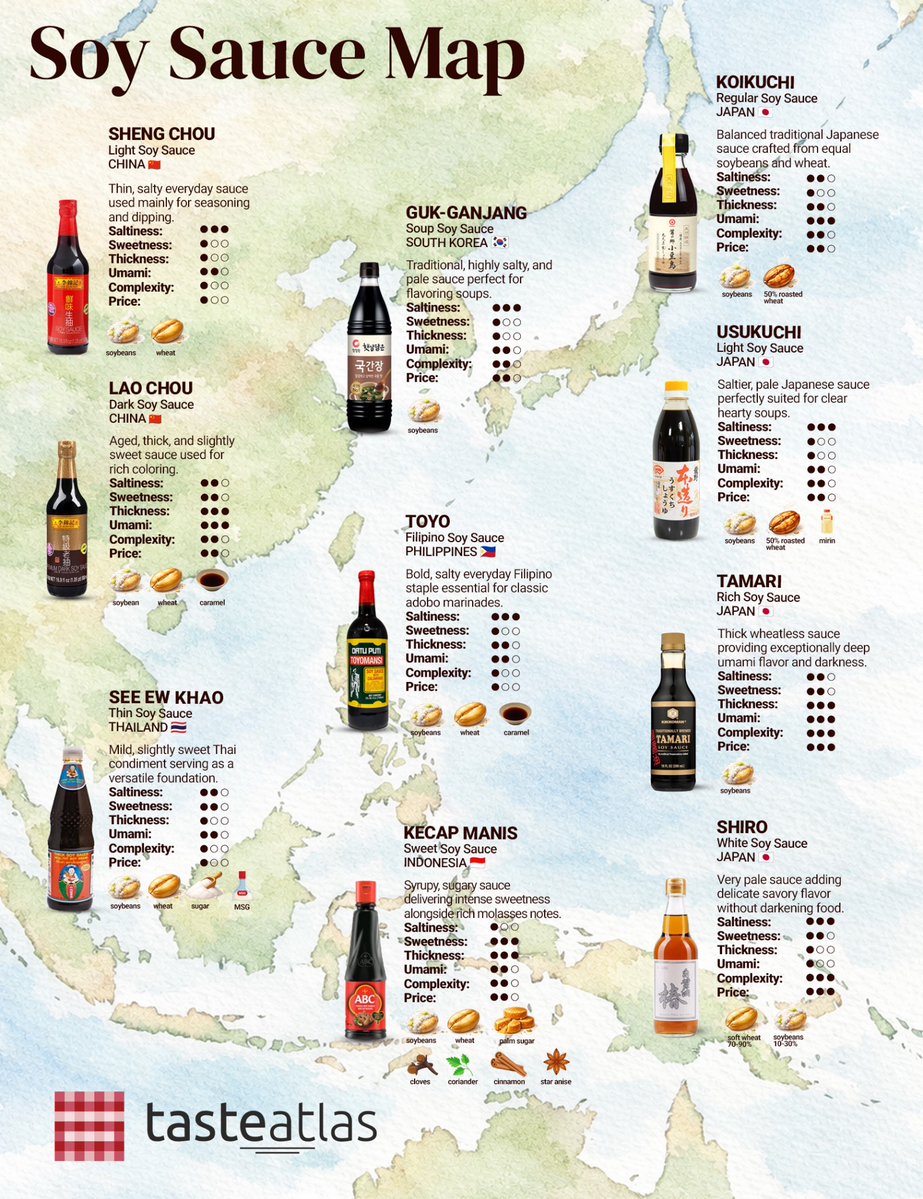
Learn more about soy sauce: https://t.co/UgRp6xgIec
Soy sauce began in China over 2,000 years ago purely as a byproduct of fermenting soybean paste to preserve food. Once cooks realized this salty leftover liquid was packed with flavor, it became the absolute foundation of Asian cuisine. Today, the brewing methods and ingredients change drastically depending on what the liquid actually needs to do.
Most people only know the standard Japanese Koikuchi, which is a balanced mix of soybeans and wheat. But local kitchens demand highly specific tools. Chinese cooks use the thick and aged Lao Chou strictly to add a dark caramelized color to their food. Down in Indonesia, the flavor profile changes completely with Kecap Manis, a dense syrupy sauce heavily sweetened with palm sugar.
Even the color of the sauce is engineered for specific dishes. South Korea relies on Guk Ganjang, a pale and extremely salty brew made specifically to flavor clear soups without turning the broth brown.
When decision-makers bear no consequences, bad decisions follow. Thomas Sowell's insight captures why Cato champions accountability, limited government, and the power of free markets—where every choice carries real stakes.
$JPM – Dimon sells $21M.
Context matters:
He’s sold ~$400M+ since 2023… and still owns 6.2M shares (~$1.9B).
Now zoom out:
📊 Confidence: 61
📈 63% Prob(Up) 1Y
💰 +8.7% median return
💪 ROE 16% | 34% margins
📉 10th pct downside: -21%
Insider selling ≠ bearish signal by default.
Diversification happens.
The real question:
Are fundamentals deteriorating?
Right now, the data says no.
$JPM - DIMON SELLS $21M IN JPMORGAN STOCK
JPMorgan CEO Jamie Dimon sold $21 million of the bank’s shares on Thursday.
❖ Dimon began selling in 2023 after holding stock for most of his 20-year tenure.
❖ He previously sold $180M at the end of 2023 and $233M in February.
❖ He still owns 6.2M shares, worth ~$1.9B, held personally and in family trusts.
❖ Other JPMorgan executives also disclosed recent share sales.
Chocolate cake is a relatively modern obsession. For centuries, chocolate was something you drank—a bitter, spicy liquid used for ceremony or medicine. It wasn't until the mid-1800s, when Dutch and English chemists figured out how to mechanically press cocoa butter from the bean, that "eating chocolate" became a reality. Once that smooth, refined cocoa powder hit European and American kitchens, the race to create the ultimate dark, moist sponge began.
The beauty of chocolate cake lies in its structural chemistry. Unlike a vanilla cake, which relies on the delicate fats of butter and eggs for flavor, chocolate adds its own complex solids and fats into the mix. This allows for a wild spectrum of textures that other cakes can't mimic.
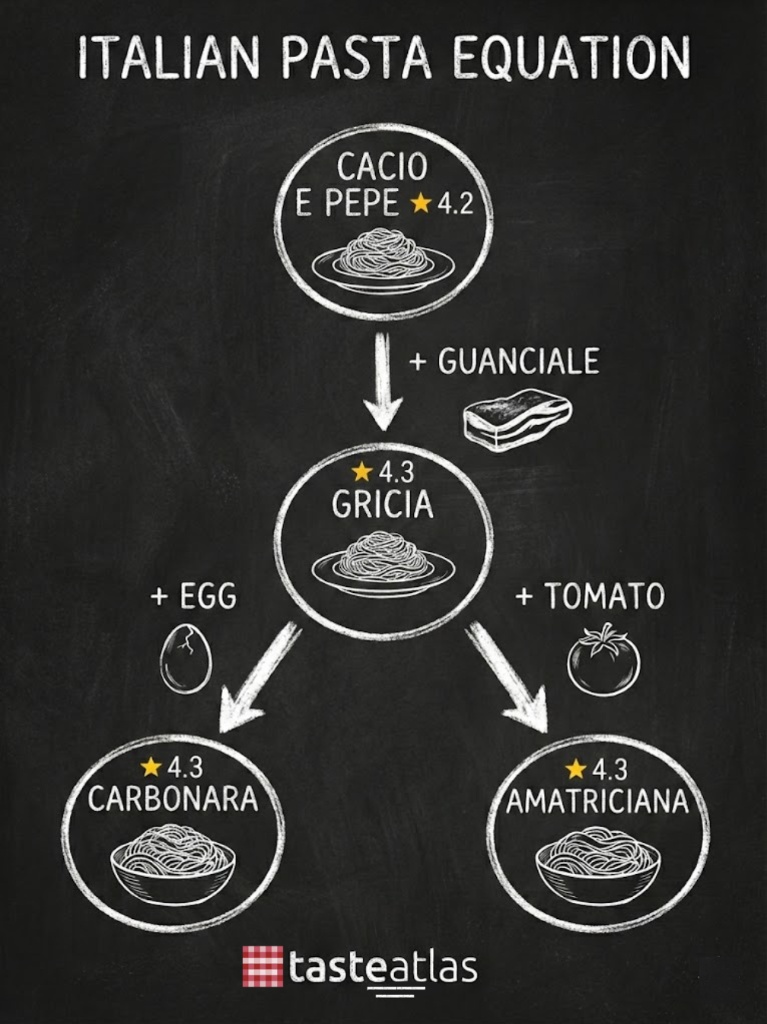
Roman pasta culture is built on a logical, mathematical evolution where one ingredient transforms an entire dish. It begins with Cacio e Pepe, the foundational duo of Pecorino Romano cheese and black pepper. By adding rendered Guanciale (cured pork jowl) to this base, the dish evolves into Gricia, a richer, saltier masterpiece.
From there, the "equation" branches into two global icons. Incorporating a fresh egg into the Gricia base creates the creamy, velvet texture of a true Carbonara. Alternatively, adding tomato to the Gricia transforms it into Amatriciana, introducing a bright acidity that cuts through the fat of the pork. This lineage proves that Roman cuisine isn't just about recipes; it's about a disciplined sequence of ingredients that has defined Italian comfort for generations.
BREAKING: President Trump to interview BlackRock Chief investment Officer of Global Income Rick Rieder this week as Federal Reserve chairman candidate, two sources tell @EdwardLawrence , as he also considers Kevin Warsh, Kevin Hassett and Christopher Waller
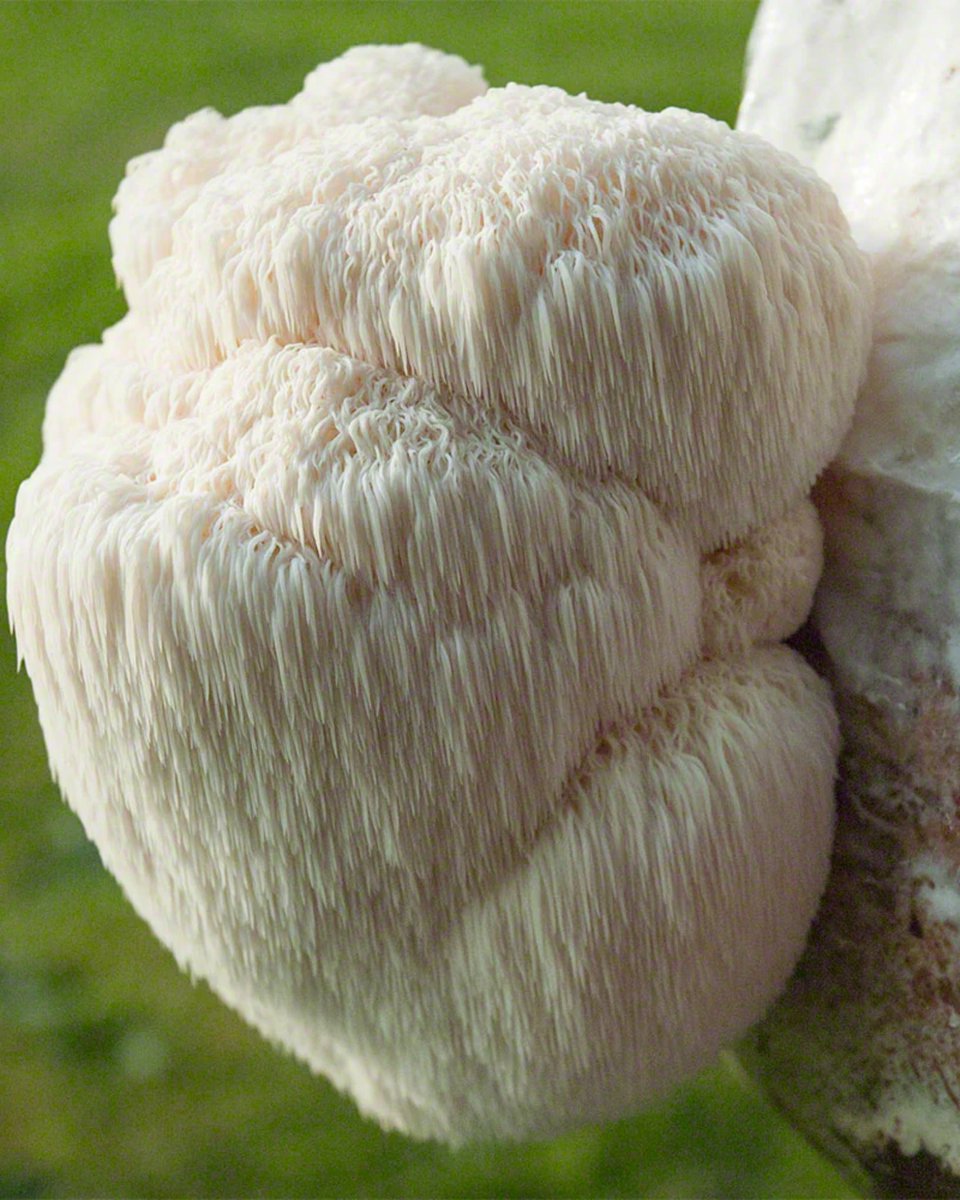
Lions Mane Mycelium out performs Lions Mane Fruitbody.
New research from @fungiperfecti and @HostDefense compared lion’s mane mycelium and fruiting body extracts, and the immune responses were notably different.
The mycelium extract supported a balanced, adaptable immune response. Under certain conditions, the fruiting body extract increased pro-inflammatory signaling.
As functional mushrooms move into the mainstream, rigorous science, proper extraction, and ingredient standardization are essential. Mushrooms are complex organisms, and oversimplifying them leads to poor outcomes.
These results track with two recent double blinded clinical studies using mushroom mycelium fermented rice - compared to a rice placebo, post ingestion.
Disclosure: I own Host Defense. The science is solid.
Learn more: https://t.co/VaooLFpGVw
In 2014, Peter Thiel gave a 1-hour masterclass on how to build a monopoly from scratch.
He broke down how:
• Google became untouchable
• PayPal beat the odds
• Facebook crushed competition
Here are 11 timeless lessons from his masterclass:
1. Create value, then capture it





![Rainmaker1973's tweet photo. Switching to red netting can reduce pesticide use by up to 50%, offering farmers a simple, highly effective, and eco-friendly way to protect crops.
While most farmers use black or white insect nets, new research from Japan shows that changing the color to red dramatically improves pest control. A study by researchers at the University of Tokyo found that red nets are far more effective at deterring onion thrips, a major destructive pest, than traditional black or white nets.
The secret lies in how insects see color. Thrips perceive red as a strong deterrent, which disrupts their visual cues and prevents them from landing on or damaging the plants. Because the protection comes from color rather than fine mesh size, red nets can use larger openings. This allows better airflow, reduces heat buildup, lowers humidity (which helps prevent plant diseases), and makes working conditions more comfortable for farmers.
Field trials showed that crops protected with red netting required 25% to 50% fewer insecticide applications compared to uncovered fields.
This low-tech “optical pest control” method could help reduce chemical use, slow the development of pesticide resistance, and support more sustainable agriculture.
[Tokumaru, S., Tokushima, Y., Ito, S., Yamaguchi, T., & Shimoda, M. (2024). Advanced methods for insect nets: red-colored nets contribute to sustainable agriculture. Scientific Reports, 14, 52108.
DOI: 10.1038/s41598-024-52108-1]](https://pbs.twimg.com/media/HK8fVSCWAAAOWxV.jpg)