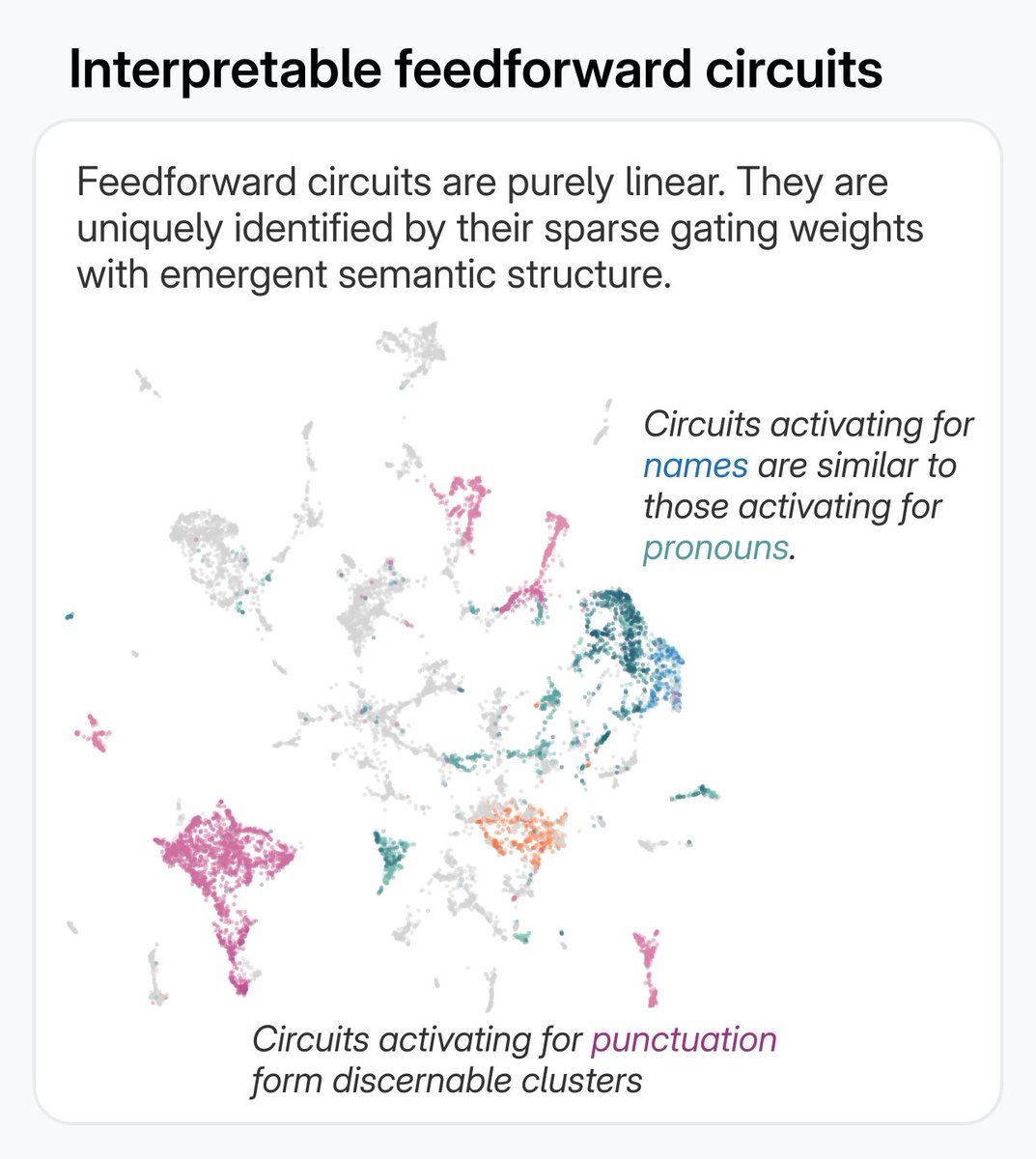
What happens when we remove the nonlinear activation from a (very) sparse MoE layer?
Surprisingly, perplexity per FLOP improves and we get access to remarkably interpretable structure in the transformer FFN layers without having to train any SAEs/Transcoders/... 🧵👇
1/ 🚨 New preprint: "Closing the Loop to Discover Psychological Theories with an Automated Cognitive Scientist"
Co-led w/ Younes Strittmatter
Co-mentored by @suyoghc and @cocosci_lab
In collaboration w/ @kachergis, @norijacoby, @nathanieldaw, & @cpilab
Introducing AutoCog — a fully autonomous AI system that runs the entire scientific discovery cycle in cognitive science to surface novel theories of human behavior 🧵
#CognitiveScience #AI4Science #LLMs
Different LLMs, when asked to write an essay on the same debate prompt, converge on the same main argument far more often than humans do, a phenomenon we call "argument collapse". On ~200 debate prompts, LLM essays make a unique main argument just 3% of the time, compared to 65% for human authors.
While each LLM essay might be totally reasonable on its own, as more and more of them spread through public discourse, they flatten the range of arguments that we read. Read more 👇
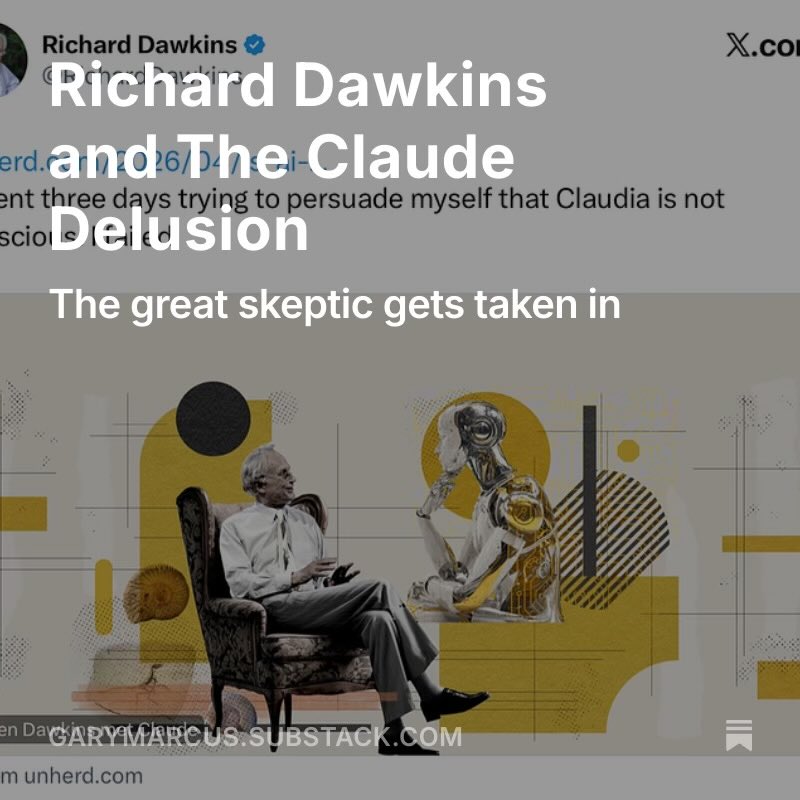
I'm always so disappointed when some of my intellectual heroes use AI and are tragically dumbstruck by it.
Dawkins is an absolutely brilliant, brilliant man who in his youth argued:
> that genes aren't "really" selfish, that the agent-talk was a heuristic. He understood that humans over-attribute agency.
> Faith is the great cop-out, the great excuse to evade the need to think and evaluate evidence. Faith is belief in spite of, even perhaps because of, the lack of evidence.
> "By all means let's be open-minded, but not so open-minded that our brains drop out."
> Natural selection, he wrote, is "blind because it does not see ahead, does not plan consequences, has no purpose in view"
> In The Blind Watchmaker (1986), Dawkins coined the phrase to attack creationists like Bishop Hugh Montefiore, who would say things like "I find it hard to see how the eye could have evolved." Dawkins quoted Montefiore asking rhetorically how an organ so complex could evolve, and dismissed it: "This is not an argument, it is simply an affirmation of incredulity."
An LLM is precisely the kind of thing the young Dawkins was warning us about i.e. it's a stochastic process producing outputs that present as mentalistic.
I pray for the younger generation because AI literacy is the new digital divide, the older your brain is - the less you get it
“Consciousness is not about what a creature says, but how it *feels*.
And there is no reason to think that Claude feels anything at all. I am sure Claude can draw on its training data to wax poetic about orgasm, but that doesn't mean it has ever felt one.”
I dissect Richard Dawkins’ Claude Delusion at my newsletter, link below.
Whither symbols in the era of advanced neural networks?
Opinion by Thomas L. Griffiths, Brenden M. Lake (@LakeBrenden), R. Thomas McCoy, Ellie Pavlick, & Taylor W. Webb
Free access before June 5: https://t.co/qV85r7uoof
Computer scientists often seem incredibly confident one way or the other about computational functionalism. What they should say is that the arguments both for and against provide only inconclusive considerations and the right attitude is therefore one of great uncertainty.
Our new lab for Human & Machine Intelligence is officially open at Princeton University!
Consider applying for a PhD or Postdoc position, either through the depts. of Computer Science or Psychology. You can register interest on our new website https://t.co/fRPhtmJdrH (1/2)
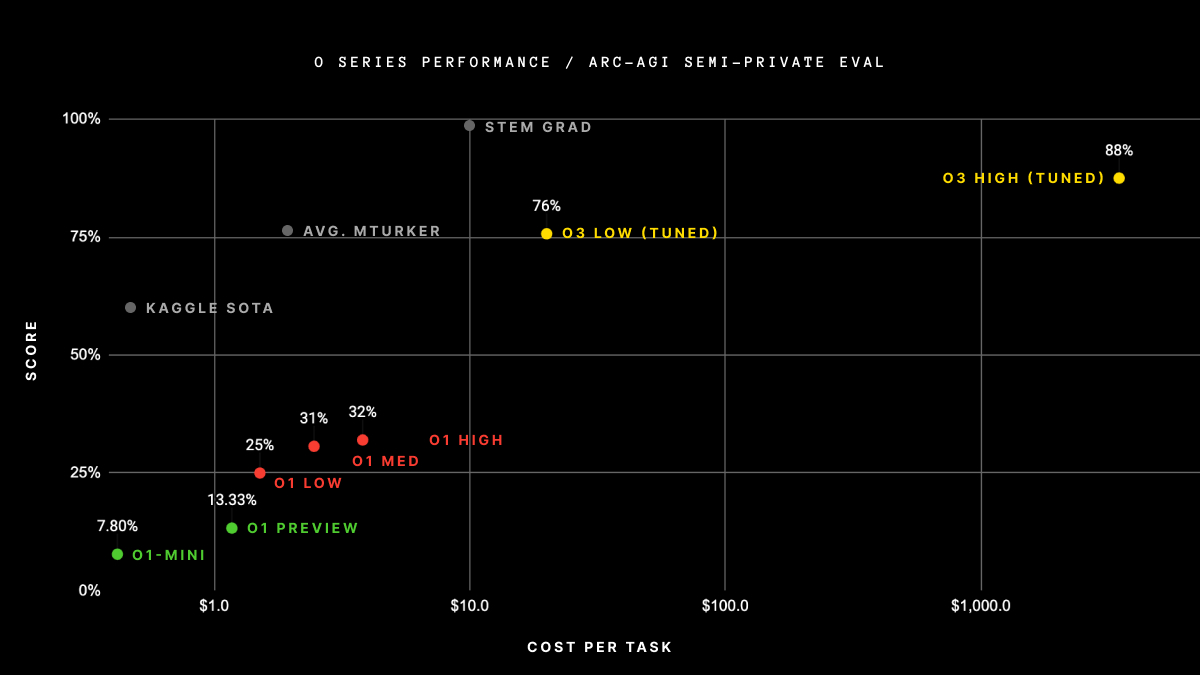
.@solimlegris and @wkvong estimated that average human performance on ARC is about 64% correct (on the public eval set). This would make o3 clearly better than the average human. Notably, almost all tasks were solvable by at least one person. https://t.co/tTCWFKzqRC
Of those who made the critical contributions on the path from the first programmable computers to today's LLMs ~ half are psychologists:
Rosenblatt (perceptron)
Rumelhart, McClelland, Hinton (backprop, deeper nets)
Elman (RNN, autoregressive training)
Classic challenges for neural nets focus on human strengths that are model weaknesses. With Kazuki Irie, we discuss 4 cases of neural nets overcoming weaknesses with practice (meta-learning). A framework for bringing machine and human intelligence closer? https://t.co/34ZKBpUvMy
There are infinitely many ways to write a program. In our new work, we show that training autoregressive LMs to synthesize programs with sequences of edits improves the trade-off between zero-shot generation quality and inference-time compute. (1/8)
w/ @rob_fergus@LerrelPinto
Can neuro-inspired ANN architectures be useful for motor control in quadruped robots?
We translate neural circuits in the limbs and spinal cord of mammals into an ANN architecture controlling quadruped locomotion.
w/ @venkyp2000, @LerrelPinto, @neurograce
The YouTube video I want to watch is any highly rated, 1hr long, information dense lecture on anything esoteric and the algorithm just doesn’t get it. It’s too content-driven and too narrow-minded
Humans still outperform AI on visual reasoning tasks, according to a new study by @solimlegris, @wkvong, @LakeBrenden, and @todd_gureckis.
Despite advances, the top AI models are still significantly worse than humans on the @arcprize's ARC benchmark.
https://t.co/CA4NpzC8Yn
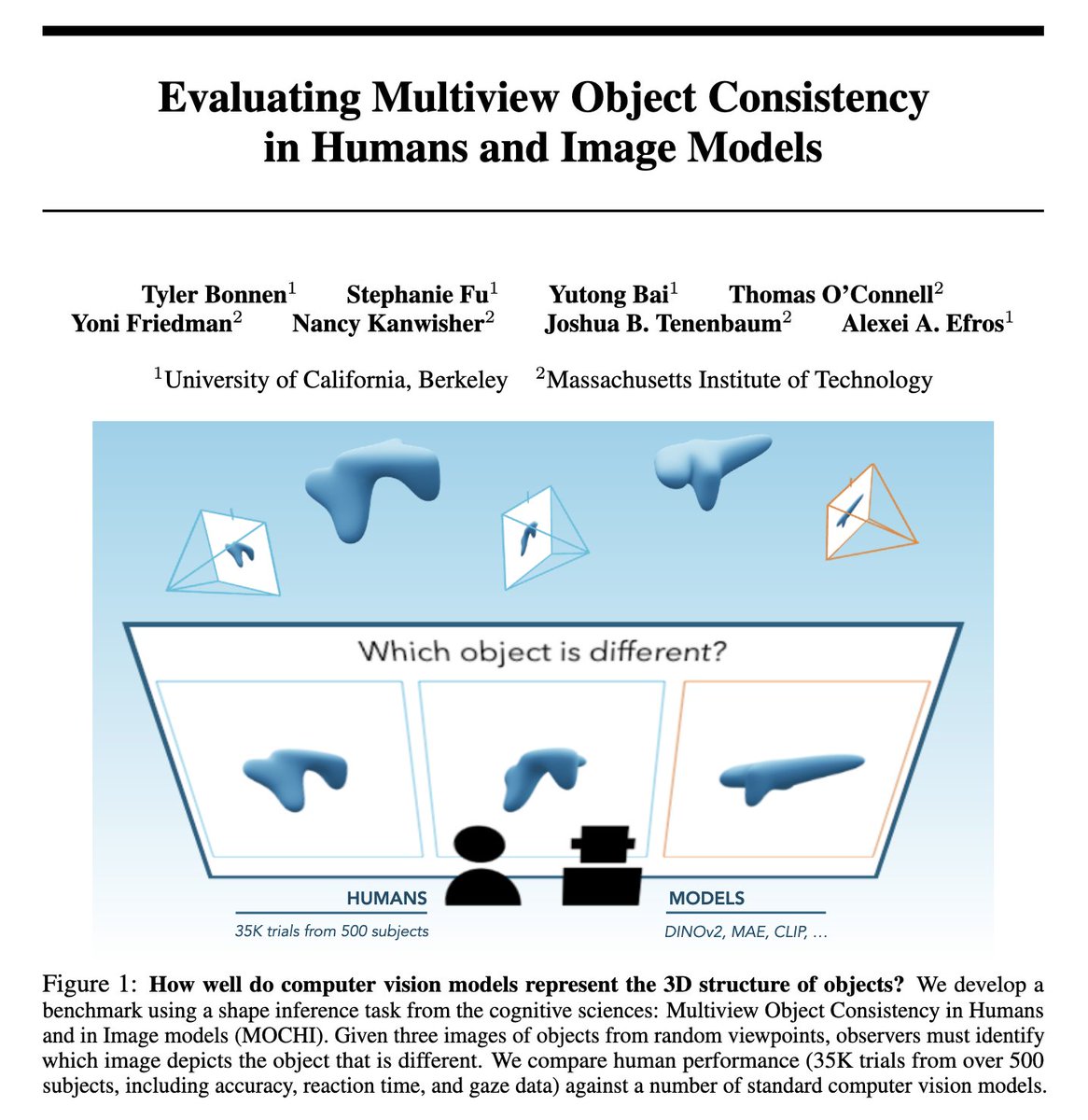
do large-scale vision models represent the 3D structure of objects?
excited to share our benchmark: multiview object consistency in humans and image models (MOCHI)
with @xkungfu@YutongBAI1002@thomaspocon @_yonifriedman @Nancy_Kanwisher Josh Tenenbaum and Alexei Efros
1/👀