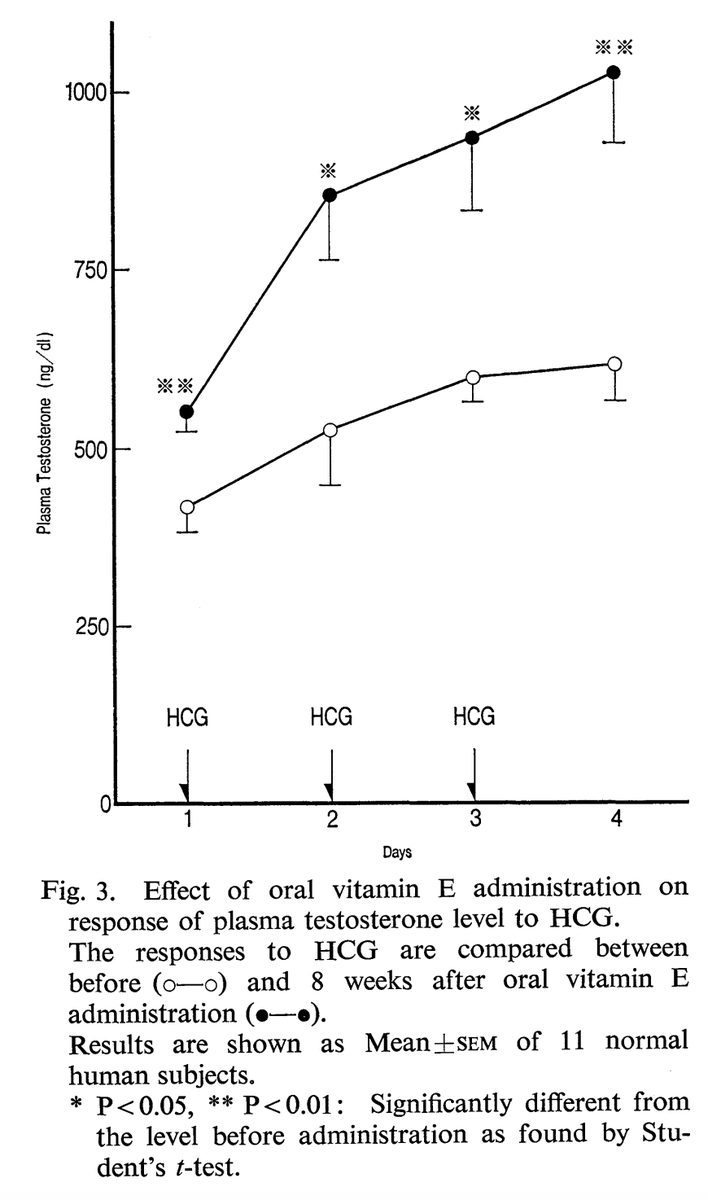
Vitamin E megadosing nearly doubled testosterone in response to stimulation in clinical trial.
483 mg for 8 weeks rose baseline T by >100 points.
T rose from 415.5 → 609.2 ng/dl (↑1.47x) after hCG stimulation.
But with vitamin E? 552.7 → 1015.7 (↑1.85x)
hCG is a hormone that stimulates the testes to produce T.
If you've been eating seed oils most of your life - your tissues are likely starved for vitamin E, and this impairs cell signaling and structure at nearly every level.
Want to clear your sinuses and calm your nervous system for free? Just hum.
James Nestor says humming boosts nitric oxide in your nasal passages by up to 15x, helping with rhinitis and sinus issues. One guy reportedly cleared his rhinitis by humming 10 minutes, 4 times a day. It also stimulates the vagus nerve for instant calm.
Pick a song you like and hum along.
What’s your take, have you tried humming for better breathing or calm?
The biggest cheat code is sweating every day. It boosts blood flow, accelerates collagen turnover, flushes toxins through your pores, and triggers heat shock proteins, which are great for skin elasticity and anti-aging. Daily sweating is the cheapest health routine on earth.
Peter Thiel’s advice to his younger self: “Value substance over status”
“One of the resolutions I came up with a number of years ago was to always value substance over status… I think if I’m honest about it, too much of [what I did] was driven by prestige and status—and not quite enough by the substance of really trying to learn things.”
Thiel continues on to explain that seven months into working at a prestigious law firm after graduating from Stanford Law School, he had a “quarter-life crisis” and quit.
“All you had to do was go through the front door, but peoples’ identities get so wrapped up in the things they compete for that it was inconceivable for people to actually do that.”
When he reflects on how he ended up in this situation, Thiel says:
“I think I had taken too many of these shortcuts of valuing what was prestigious and conventional over what I really wanted to do.”
Source: @StanfordLaw (Oct 2014)
My bad, let me speak plainly.
If you have depression or anxiety and are spending thousands on talk therapy and not $50 on probiotics, you might not make it.
But it’s bad depression?
“L. rhamnosus may have a more pronounced effect on individuals with more severe depressive symptoms”
How long?
“Moludi et al. found a 12-week L. rhamnosus supplement significantly reduced moderate to severe depression cases from six to zero”
I am blown the fk away again.
How to reduce nighttime urination:
"Daily fluid target is 8 oz (240 ml) per hour for the first 10 hours after waking."
"Gulping fluid moves it through your system faster than sipping due to mechanosensors in the gut; in the evening, sip rather than gulp to slow excretion."
"Limit intake to 5-8 oz between the 10-hour post-waking mark and bedtime, assuming adequate daytime hydration."
"Waking once or twice per night to urinate is normal; following this protocol can reduce that number to zero for most people."
@hubermanlab
“Failure is so much more interesting than success.
And it always saddens me that school doesn't teach that.
At school the thing is to be brilliant and to get the answer right first time. And there are brilliant people who could do that, but for the rest of us who are not brilliant, we have to strive, and we have to go through failure.
And we realize that you don't get it right the first time or the second time. In my case and I counted it. It took 5,127 times.
With failure you question it “Well why did it go wrong?” And actually the reason it goes wrong is often very, very interesting.
Where something works you say “Great that worked.” You don't even stop to wonder why it works.
So if you've got to enjoy failure.”
—James Dyson
Medieval teachers used to throw kids in rivers after lessons, to create a big emotional spike so they’d actually remember what they learned.
Andrew Huberman says the same principle works today: If you want to lock in new information, get your adrenaline up right after studying or reading.
A double espresso, ice bath, or anything that gets your heart racing immediately after learning helps tag the info as important and store it better.
Post-learning adrenaline release enhances memory consolidation. Studies by James McGaugh and others show that elevating catecholamines (e.g., via exercise, cold exposure, or caffeine) shortly after learning significantly improves long-term retention by strengthening synaptic connections in the brain.
Breathing slowly increased risk taking, and made those decisions feel more rewarding, in this study.
This is thought to be mediated by the parasympathetic nervous system.
Breathing slow ⇨ increased parasympathetic tone ⇨ more relaxation ⇨ more risk taking.
Higher sympathetic tone ⇨ greater activity in select brain regions ⇨ more reward / dopamine signaling.
HOW TO MAXIMIZE T3 (the beauty hormone):
• Iodine – seafood, dairy
• Selenium – Brazil nuts, sardines
• Beef liver (rich in copper and nutrients)
• Vitamin B6 (milk, meat, and organ meats)
• Calcium-rich foods (cheese, raw milk, figs)
• 400IU Vitamin E (very effective at lowering prolactin)
If you want to improve your aesthetics FAST, increase your T3