Meta, Google, and Microsoft all use encryption built by the same 50-person nonprofit.
Zero revenue from 2 billion users. The founder uses a fake name. And when the FBI subpoenaed them, they only provided 2 pieces of data.
Here's how a non-profit secures the internet🧵
There is a popular Apple Pie Position, which goes:
“If you don’t measure it, you cannot improve it”
This belief is often harmful on early-stage teams.
This is more accurate:
“If you don’t measure it, you cannot prove to some people that you improved it”
Impact vs. Optics
Implications:
1) You need leaders who have good taste. Without good taste, everything becomes an exercise to “prove it conclusively”, which slows teams down
2) As an org grows, it becomes increasingly hard to hire / retain enough people with good taste. Plus, because optics are now more important in such orgs, people end up having to do all sorts of useless work to prove the unprovable
3) Such orgs can maintain (and hopefully grow) existing mature products (because mature products lend themselves well to management by extensive measurement). But these orgs struggle to produce new products and make them successful. These orgs tend to be uninspiring and, for some people, boring
4) When you go from such an org to a smaller team or company, you must adjust your approach. If you yourself don’t have good taste, you must first build awareness of that and hire / listen to people who do have good taste
5) In all cases, understand that there is a difference between *evaluating* how something is going and *measuring* how it is going. In some cases, you can simply evaluate without performing crazy contortions to measure. Of course, such evaluation requires good taste and judgment
6) If you find yourself feeling upset by any of these words, consider perhaps that you might have tied too much of your identity to a certain way of operating and want to remain convinced that yours is the only right way
7) If, after considering this, you still don’t feel any differently, that’s okay. Not everything will resonate with everyone at all times. Maybe come back to this idea in a few years and see how it feels then
P.S.
Some people proudly repeat the “if you can’t measure it, you can’t manage it” quote, not realizing that they are actually mis-quoting Deming, who actually said the exact opposite:
“It is wrong to suppose that if you can’t measure it, you can’t manage it – a costly myth.”
🙂
1/20 MEGA THREAD Overheard from BigTech engineers in the Bay Area:
“Man, I know I get paid $350k to work 20hrs a week but I just want to work on something state of the art and world changing! Like AI or blockchain.
Only 20hrs/week tho”
Been interviewing candidates for senior android roles for a while now, here at Tinder. Here’s are some thoughts and learnings —
Not going to be company specific 1/n 🧵
5 things I've learned the hard way about multi-region / multi-cloud:
1. Building your own control plane, whether cross-region or cross-cloud, involves cost and complexity that you will have to deal with every day - not just when a managed service has downtime.
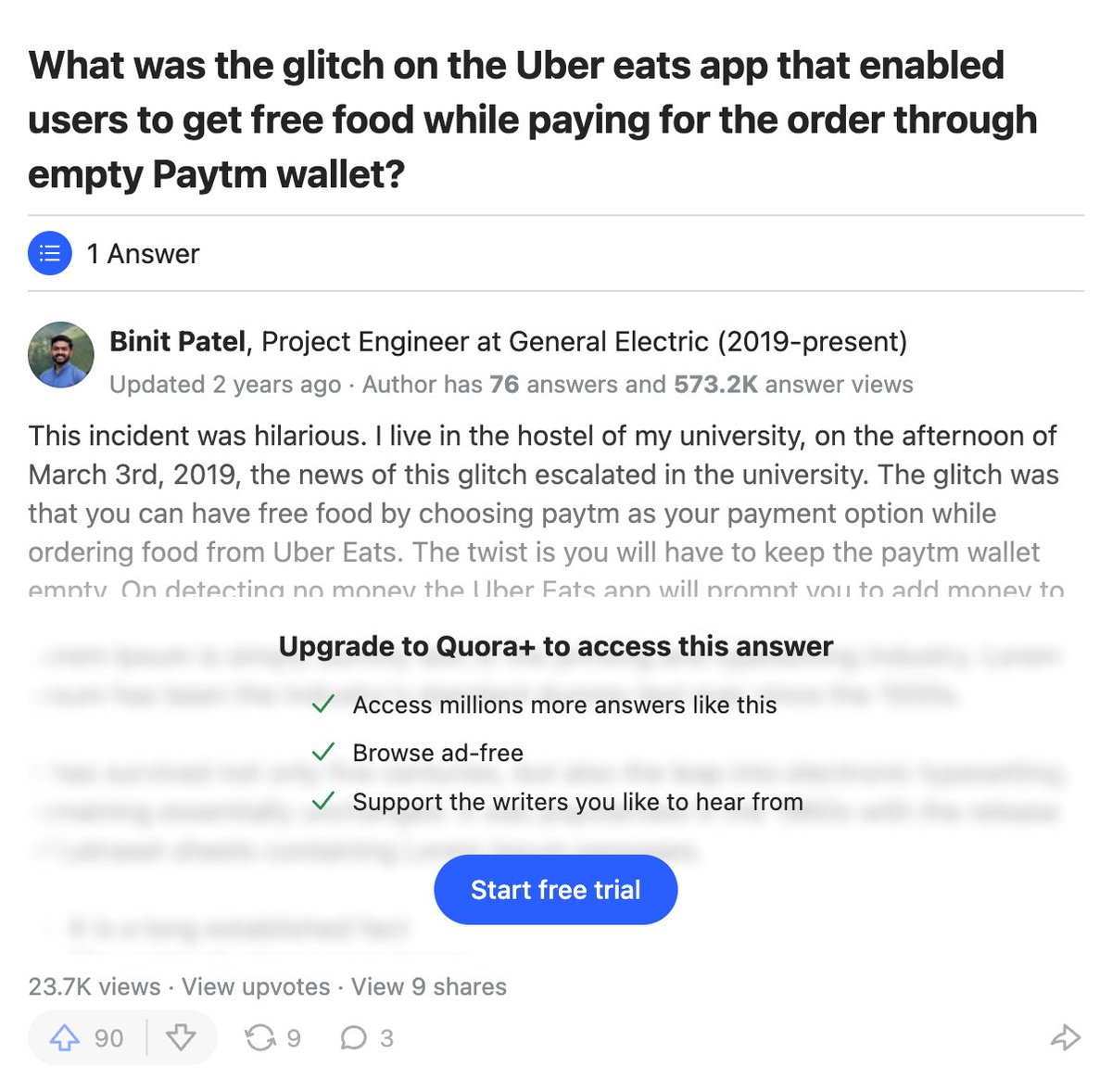
As it's been ~3 years, figured I'll answer "What caused the Uber Eats glitch that allowed ordering free food for a weekend in India?"
This was an outage on my watch. Given Quora is paywalled - can't post the answer w/o a sub - here's the story on idempotency & breaking changes:
60 Hz refresh rate is common in monitors. That means a screen is refreshed 60 times in a second.
JavaScript code blocks have 1000/60 = 16.6ms to execute before UI gets rerendered. We have 16ms for running the largest synchronous loops before customers can start feeling.
Your founder journey or your journey as a startup exec or employee may accelerate and decelerate and accelerate again with these cycles... don't second guess this, it is natural. Roll with the punches, keep going...
A 🧵 on one of my favourite design patterns - control plane & data plane. Once you see it, you'll find its relevance everywhere. There's even an example for web3 folks, if you read through to the end.