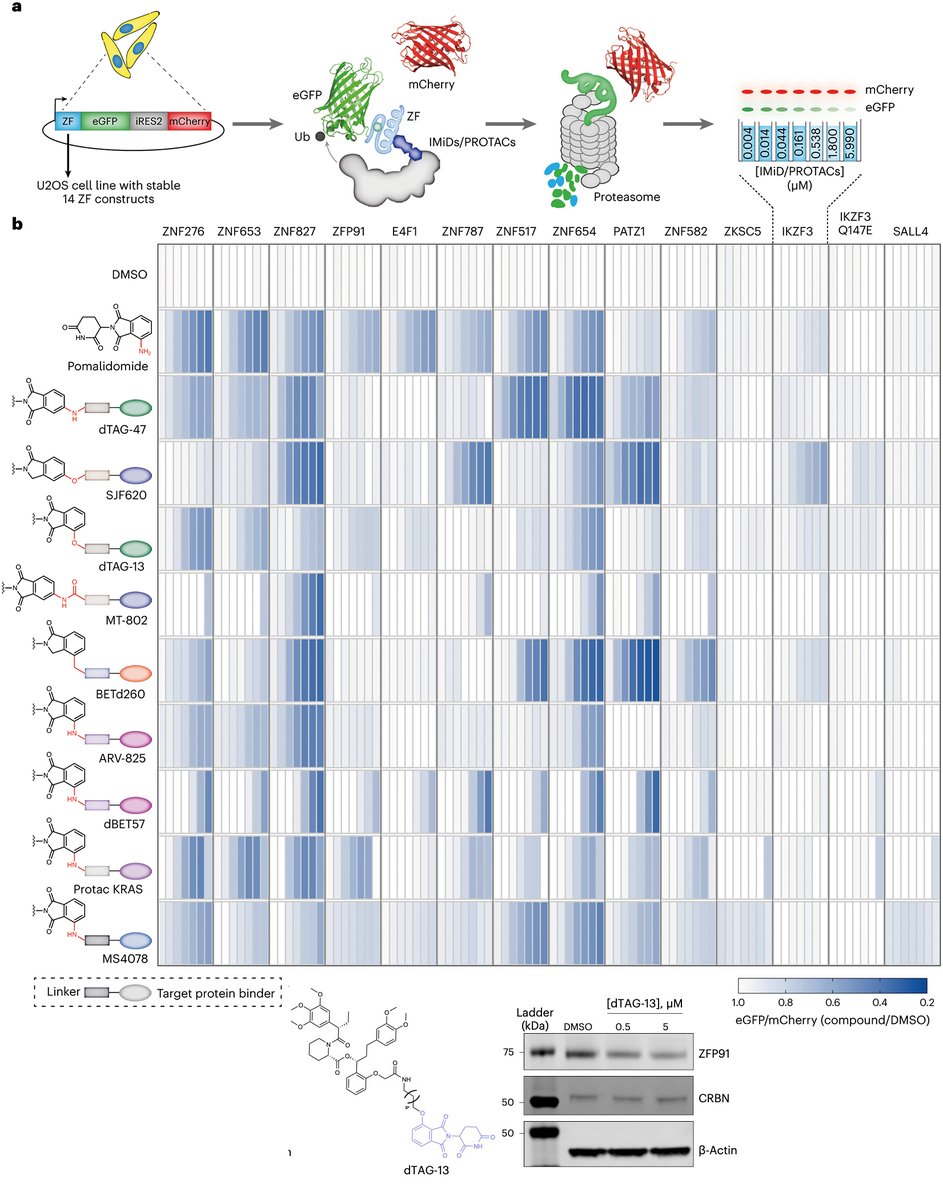
We expand the range of zinc finger transcription factors that can be targeted by degraders via CRBN. Once thought undruggable, our work shows how functional genomics uncovers new targets missed by proteomics and reveals rules for the structure–activity relationship of compounds.
We mapped the zinc‑finger (ZF) “degrome.” High‑throughput ZF reporters + glutarimide analogs → new CRBN‑recruited degrons and design rules for degraders.
🧩 New paper out in Nature Communications!
"Unveiling the hidden interactome of CRBN molecular glues"
Huge thanks to our incredible team and collaborators who made this possible!
📖 Read the full open-access article here: https://t.co/iuTyDM24Vs
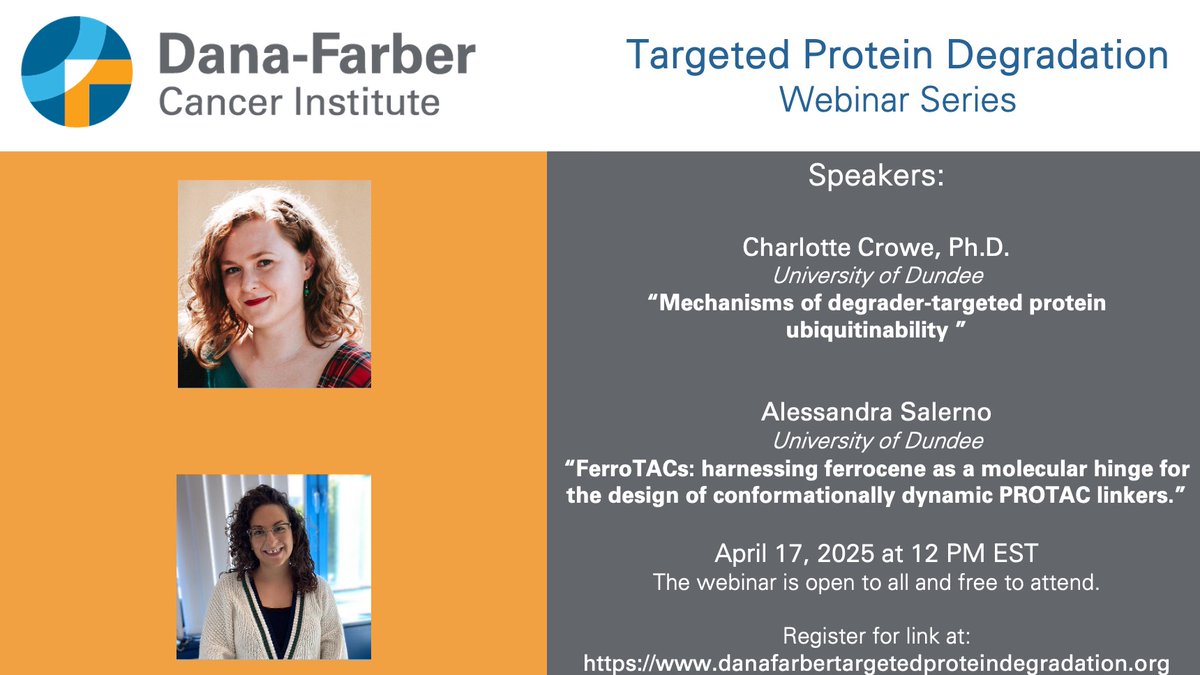
Join us on April 17th for an exciting double seminar from the University of Dundee @UoDCeTPD: @CharlCrowe on "Mechanisms of degrader-targeted protein ubiquitinability" and @ales_salerno on "FerroTACs."
Details: https://t.co/h4et0Ym9bh
Very excited for our next seminar this Thursday (March 20th): Martin Schwalm (@thesgconline, form. Knapp lab) will discuss UPS inhibitors and @DeanClift1 (@TRIMTECHtx) will share insights on hijacking TRIM21!
👉Join us at 12 PM EST/ 5 pm CET (‼️US/EU daylight saving mismatch‼️)
Very excited for our next seminar next week! Yuh Min Chook(@yuhminchook) at UTSW will share an intriguing allosteric mechanism of drug-induced XPO1 degradation, mediated by the CRL5-ASB8 E3 ligase complex.
Join us at 12 pm EST (Feb 20th).
Preprint - https://t.co/RgI0QWfNjS
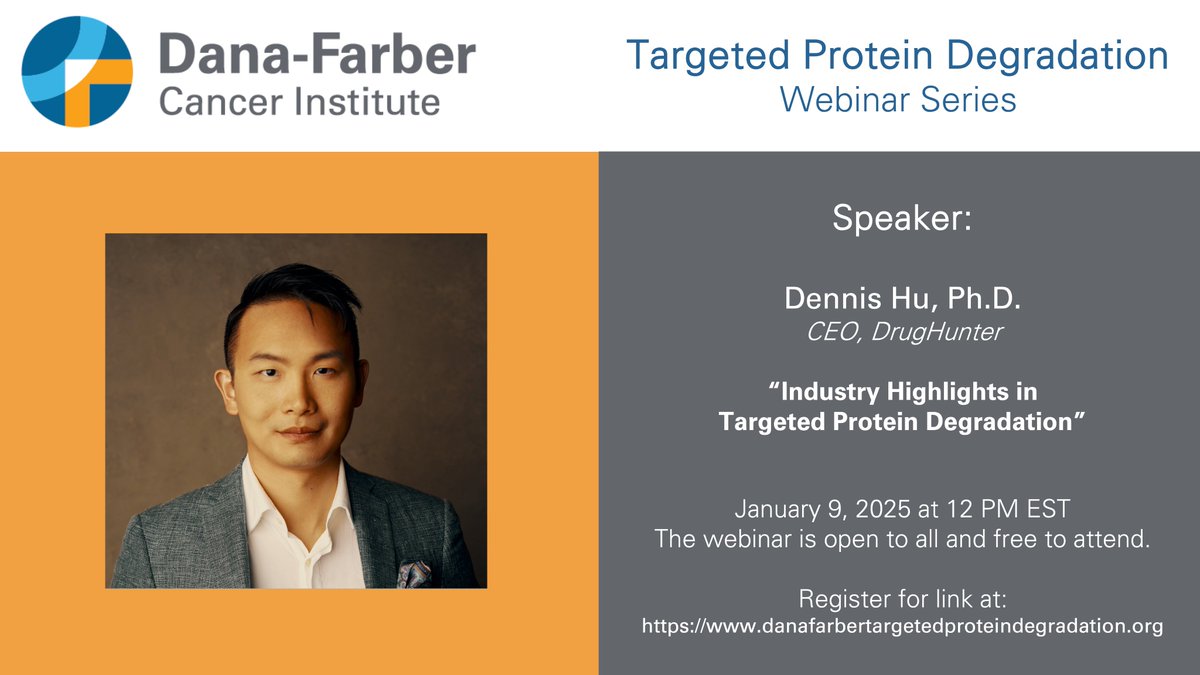
For the first TPD webinar of 2025, we are thrilled to welcome @DennisWhom from @drughuntersite to share industry highlights in targeted protein degradation & induced proximity.
🗓️ Jan 9 | 🕛 12 PM EST
Open to all, register for free at: https://t.co/eUffvS1yeQ
Join us for the final TPD webinar of 2024 on 12/19.
@FleurMFerguson & @eswang01 - "ZBTB11 Degraders Target Metabolic Vulnerabilities in K-Ras Inhibitor Resistant PDAC"
Slava Ziegler - "Targeting IDO1 by monovalent degraders exploiting the native IDO1 degradation mechanism"
We are thrilled to have @georg_e_winter @CeMM_News return to the DFCI TPD webinar this Thursday! Georg will talk about how inhibitors can supercharge endogenous degradation mechanisms. Very much looking forward!
👉Join us at 12 PM EST/ 6 pm CET (hybrid format)
Very excited for our next seminar this Thursday:
Derek Bartlett (formerly @pfizer, now @UNC) will share insights on PK-PD modelling for TPD and Kyle Mangano (@Amgen) will present how VIPER-TACs co-opt viral E3s.
👉Join us at 12 PM EST/ 6 pm CET (back to original schedule)!
We are happy to share our new preprint @biorxivpreprint "Unveiling the hidden interactome of CRBN molecular glues with chemoproteomics" led by @KheewoongBaek and Rebecca Metivier of @fischerlab1
https://t.co/Zua4LnrYlJ
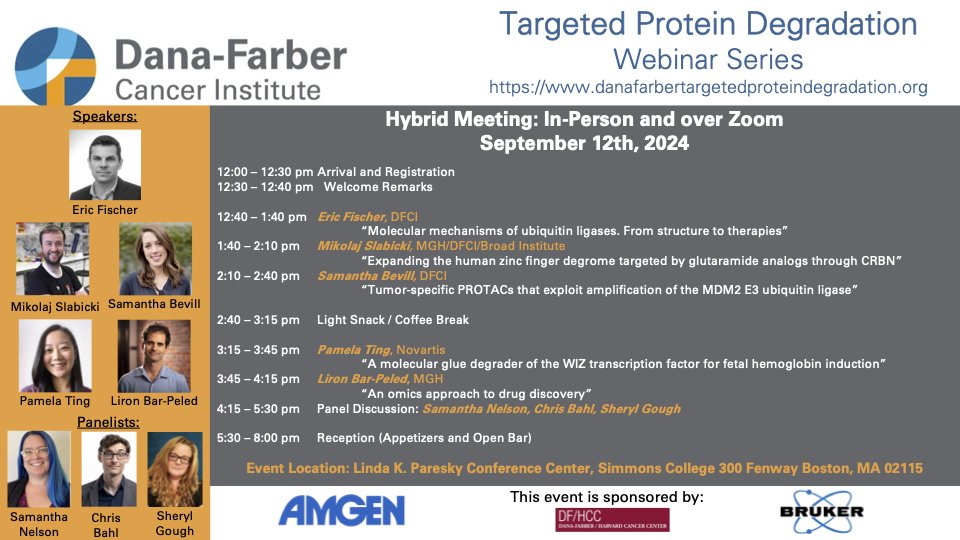
Extremely excited about our next in-person TPD event. If you are in Boston on September 12th - sign up and join us for a half day of science and networking!
Registration link: https://t.co/B1pIYkUtun
Amazing discovery on how some transcription factors self-polymerize to function. Opens the door for yet another ligandable way to target the function of these "undruggable" proteins. Congrats on making the cover Paul Park and @jihojasonpark!
Excited to share our story on polymerization in ZBTB transcription factors, which was published in the July 11 issue of @MolecularCell! https://t.co/qlzxfF0PR4 1/n
Just in time for #HumpDay: Our study Targeting DCAF5 suppresses #SMARCB1-mutant #cancer via stabilizing SWI/SNF is online now in @Nature. Congratulations 🎉 to co-first authors Sandi-Radko-Juettner and @HongYue88665668 and all co-authors on this story! 1/
https://t.co/f3fJfiPjiM
Having enjoyed the paper from @davidrliu, @fischerlab1, and @ChoudharyLab in @ScienceMagazine this week, we have now posted our own, complementary, taken on a bump-and-hole approach to develop an orthogonal bumped IMiD-degron pair: https://t.co/drgAHGo5zx.
@moritzhunkeler Yeah, several months spent purifying different constructs in different expression systems to isolate the ZnF. Turns out the first bacterial tagged construct we had was good enough. Funny how these things work out.
Thanks for your comments, Jay. To answer your question:
1) dTag uses FKBP12-F36V, which is 108 amino acids (324 bp). Unfortunately this size is too large to be directly and scarlessly installed using prime editing; we tried as part of our TwinPE studies (https://t.co/E7Wf39V1JC) but could only precisely install ~1/3 of the FKBP12 gene efficiently.
2) dTag small molecules degrade off-target ZF proteins, as shown in the attached figure from https://t.co/yK9t15Kax8
3) The dTag system requires heterobifunctional molecules consisting of AP1867—linker—IMiD, and thus are subject to hook effects as you showed in your beautiful NCB paper.
I appreciate that #2 and #3 might be addressed with dose-finding though it would be preferable to avoid the issues all together. You could install dTag or other larger degron tags with HDR though generally with lower efficiency, higher byproducts, and the consequences of making chromosomal breaks.
A new PACE-based system generates protein degradation tags that interact with an otherwise-inert small molecule to trigger the rapid breakdown of a cell’s native proteins, with molecular glue systems that can become useful new research tools. https://t.co/QUhXSYr1RG
And to @CancerResearch for funding this moonshot project of making potent degrons that can act as post-infusion switches in the next generation of engineered cell therapies.
6/6
We engineered a new tool to interrogate biological pathways and validate cancer dependencies! This new degron can be fused to your protein of interest at its genomic locus to degrade it within an hour using a clean compound. https://t.co/jTcTpOE7Jg
1/6
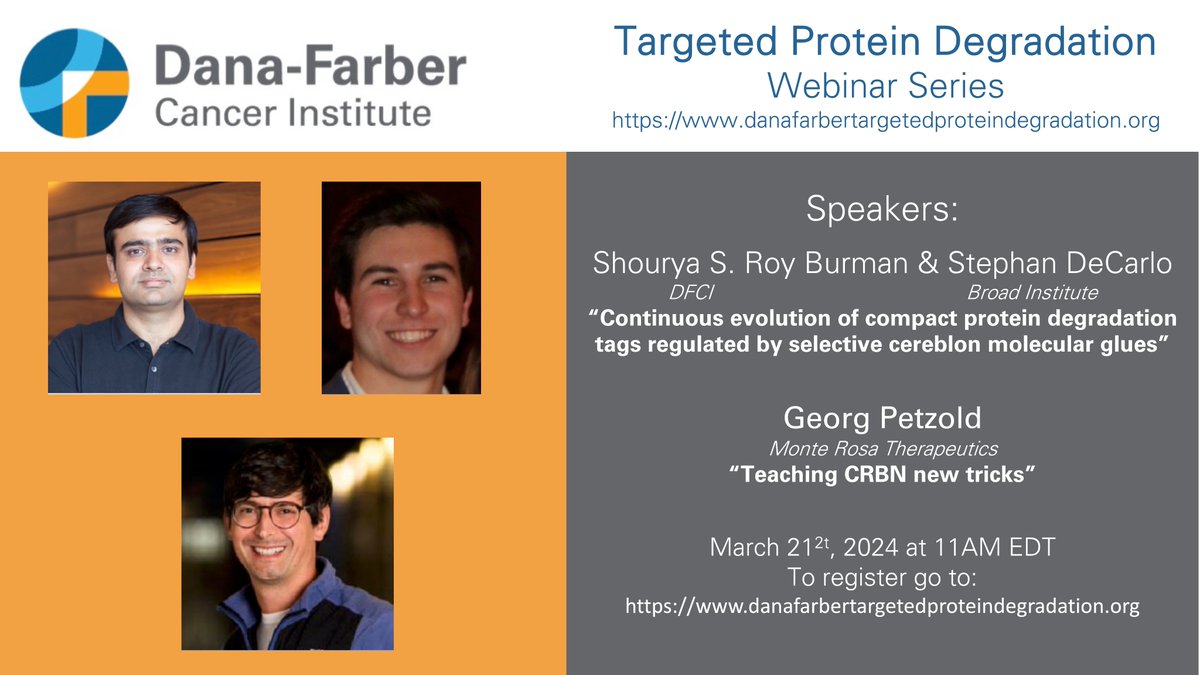
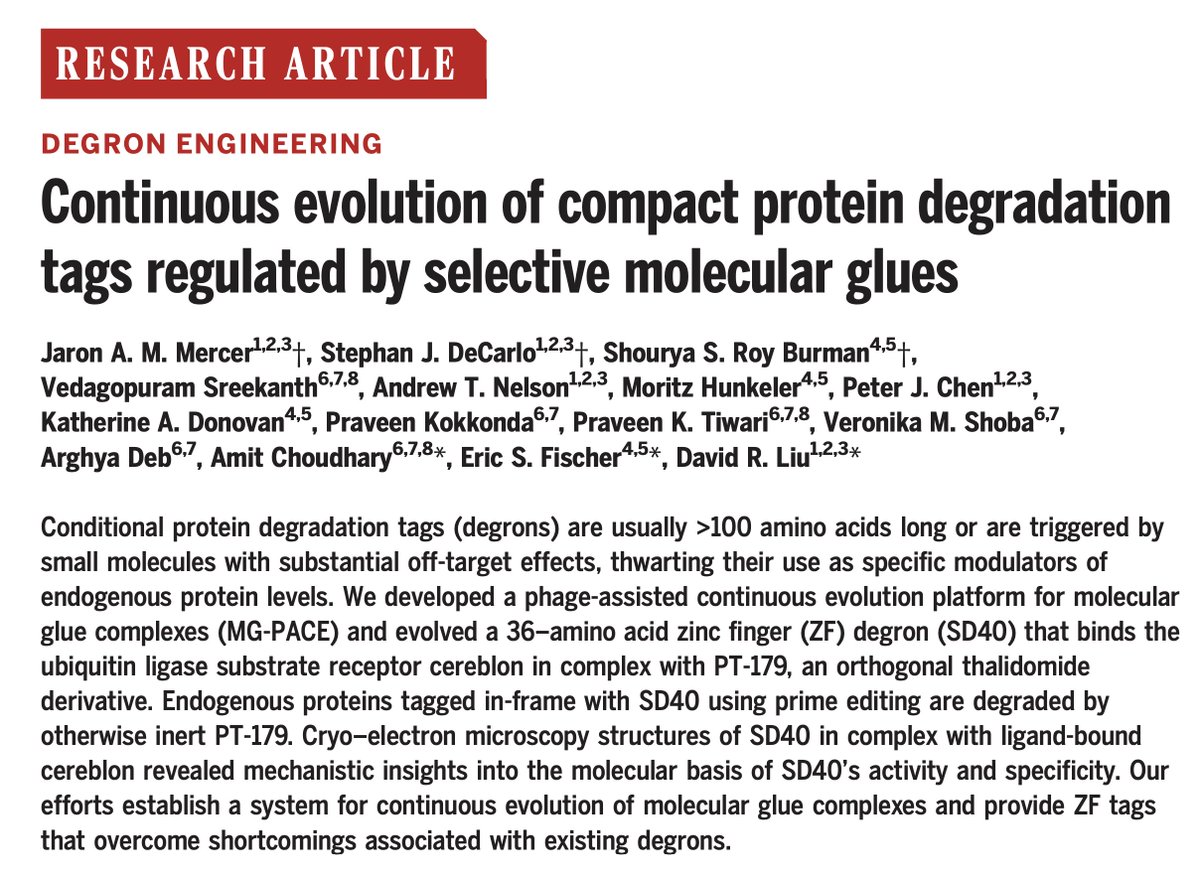
Today in @Science_Magazine we report the laboratory evolution of compact degrons that enable targeted protein degradation triggered by an otherwise-inert small molecule, a multidisciplinary study that integrates organic chemistry, molecular glues, protein evolution, genome editing, and structural biology.
PDF: https://t.co/cCVLKL0w8Y
1/13