Wavelength is now live on mainnet! 🌊
Humans and agents can now send and receive bitcoin payments with the Wavelength SDK.
A few API calls, self-custodial from the first command, with no node or liquidity to manage.
Read more and start building: https://t.co/gyXUMKVMlo
Shared UTXO wallets can be very powerful for AI workflows because you can scope the spend logically by super cheaply making very small wallets that are LN connected. That way when you get an AI oopsie the scope of the financial damage can’t possibly be more than the wallet size.
We're hiring a leader in Business Development!
Want to work with a team of brilliant devs bringing bitcoin to billions? Passionate about financial freedom and decentralization?
Can you work autonomously to ensure Lightning is adopted as global, programmable money? Do you excel at designing and implementing business strategies across AI, bitcoin, fintech, infra?
If this sounds like you, apply here: https://t.co/55tWNcXrBs
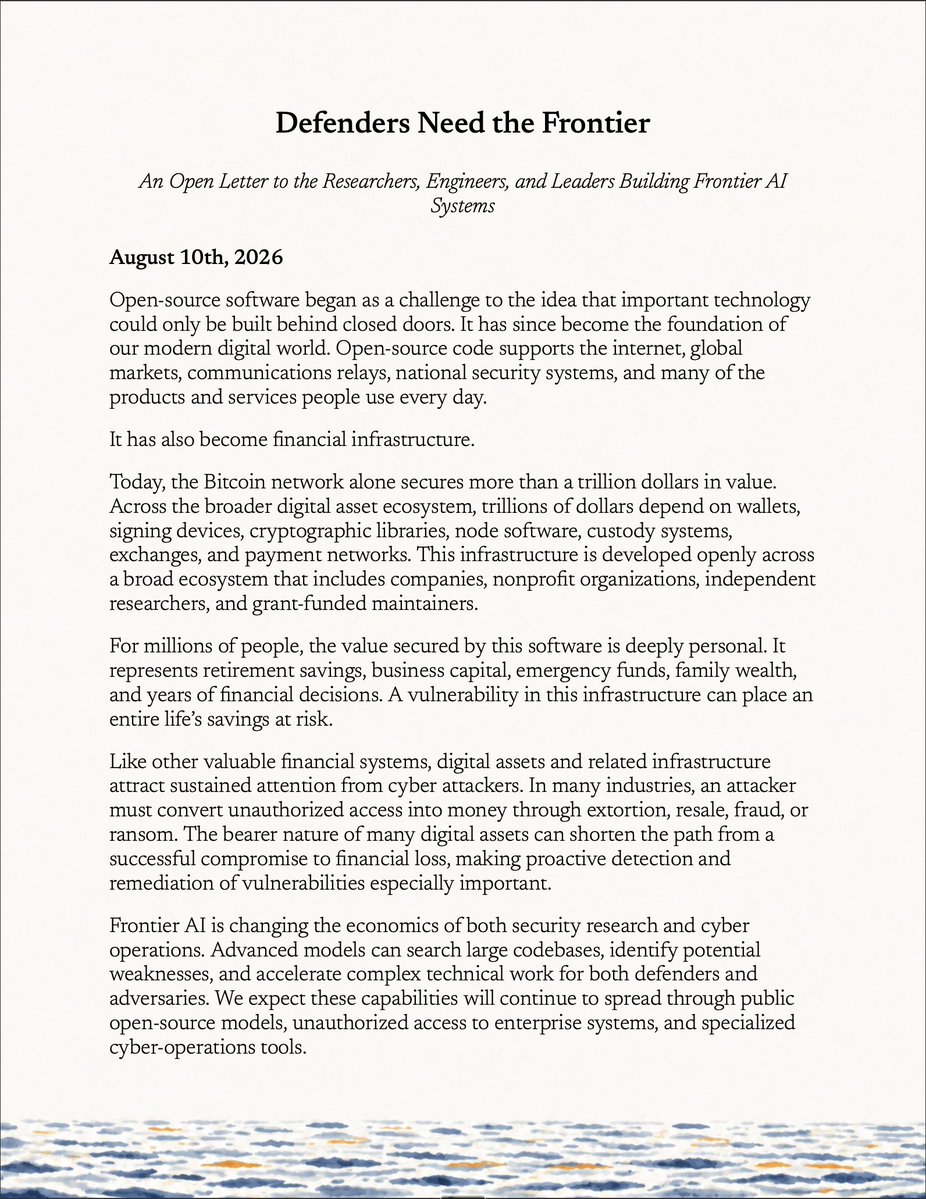
Today, Bitcoin Policy Institute and a broad coalition from across the digital-asset ecosystem are publishing an open letter calling on the world’s leading AI labs to provide qualified open-source defenders with trusted access to frontier AI models.
The past several weeks have made the need for this abundantly clear. The people defending digital-asset infrastructure and open-source software need access to the latest AI capabilities to perform comprehensive security reviews and stay ahead of increasingly sophisticated adversaries.
The coalition includes open-source development organizations, major custodians, treasury companies, payment services, security firms, capital allocators, and others whose businesses and customers depend on the integrity of open-source infrastructure and libraries.
Open-source defenders often occupy the least privileged position in the AI security landscape. They have limited access to the strongest internal cyber models and are frequently blocked by guardrails when using publicly available frontier systems for legitimate security research. As a result, they often resort to less capable open-weight alternatives.
We are urging frontier AI labs to establish a clear, trusted pathway for qualified open-source and digital asset defenders to access their strongest capabilities, with sufficient compute and secure environments to conduct meaningful security reviews. Frontier AI could become one of the most powerful defensive technologies ever developed, but only if defenders get fair access to those systems.
It’s time to give defenders the tools they deserve.
Read the open letter, add your organization, or sign as an individual on our website at https://t.co/cUTwQ5ugXJ
Announcing the new L402 site! https://t.co/sYrBhvv9Ta
With L402, agents can pay with bitcoin and natively authenticate. No accounts, no intermediaries, no humans involved. Instant, high volume, low fee. The protocol for machine-to-machine commerce on Lightning.
Start building the AI economy today. 🤖⚡
zooming out the application side of things, Wavelength makes it super easy to embed into your application via the:
* Wavelength Typescript/WSAM SDK: https://t.co/72TIi4TynW
* Wavelength Mobile SDK (native Kotlin+Swift bindings): https://t.co/jP6qMn0voF
yep vtxo expiry is still part of the system
users can manually do lower level things like join rounds, or do direct vtxo spends, etc -- but the main API is high level and focuses on send/recv
on-chain addrs created automatically board into the system
there's a single unified LN invoice that handles normal LN payments, and also payments within Wavelength (no new address!)
payments between two Wavelength users (OOR via Ark), use a vHTLC system which unifies all the off-chain payment paths
with OOR you inherit the existing security model where it's basically zero conf until you refresh into a new vtxo
the next major version will support further unification by adopting normal LN channels 1st class into the system: https://t.co/2ZYpGyEor2
this is nice as easier to support smaller amts, and you don't need a large OOR chain, you'd re-use the HTLC constructs used everywhere else in the system to recv/send from your channel
this also helps w/ refresh/expiry fees as payments incrementally settle into the channel, so you don't have a long OOR chain which can increase exit costs
this also enables alternative refresh modes like sending your entire balance into a new channel, which starts to resemble traditional Timeout Trees a bit more (h/t @sputn1ck)
we have some other design changes to base ark that reduce server costs while maintaining atomicity we'll roll into future versions
tech blog post coming 🔜!
users are set up to auto refresh in a zone where the liquidity fee is very low or essentially free (server incentive to free up capital)
architecture supports an async, connection-less mailbox system (a combo of CDC https://t.co/lkXFRWqoJO and durable queues w/ at-least-once delivery semantics), which is perfect for background async wakeup/actions
we're toying with a future version where we embed LN channels as normal, which enables a type of refresh more similar to traditional Timeout Trees (you send your LN balance to a new channel, atomic transfer): https://t.co/2ZYpGyEor2
@otaliptus@lightning No haha there's another project out there with that name. Plus the idea was to make it broader as many of the Ark elements are under the hood and largely abstracted away.
The goal is a simple non-custodial API/SDK for devs/agents/vibe coders to use Lightning.
yep vtxo expiry is still part of the system
users can manually do lower level things like join rounds, or do direct vtxo spends, etc -- but the main API is high level and focuses on send/recv
on-chain addrs created automatically board into the system
there's a single unified LN invoice that handles normal LN payments, and also payments within Wavelength (no new address!)
payments between two Wavelength users (OOR via Ark), use a vHTLC system which unifies all the off-chain payment paths
with OOR you inherit the existing security model where it's basically zero conf until you refresh into a new vtxo
the next major version will support further unification by adopting normal LN channels 1st class into the system: https://t.co/2ZYpGyEor2
this is nice as easier to support smaller amts, and you don't need a large OOR chain, you'd re-use the HTLC constructs used everywhere else in the system to recv/send from your channel
this also helps w/ refresh/expiry fees as payments incrementally settle into the channel, so you don't have a long OOR chain which can increase exit costs
this also enables alternative refresh modes like sending your entire balance into a new channel, which starts to resemble traditional Timeout Trees a bit more (h/t @sputn1ck)
we have some other design changes to base ark that reduce server costs while maintaining atomicity we'll roll into future versions
@yasu0x1@callebtc You can think of it like Ark under the hood, where some of the complexity is abstracted via the use of Lightning and invoices. End users don't need to understand the Ark part.
announcing Wavelength, our solution to make self-custodial Bitcoin payments easy for humans and agents alike!
Wavelength serves as a standalone daemon (and library!) that makes it easy to instantly send+recv Bitcoin payments 😎 λ
it seamlessly operates on/off-chain, w/ off-chain payments using a normal BOLT 11 invoice we all know and love!
https://t.co/vWUlQ5qoP3