Astro Physicist. Scientific Director @arXiv
Planets, Stars, Black Holes & Stuff. Whole Universes, If Needed. Dynamics of Cats; To Say Nothing of The Dog.
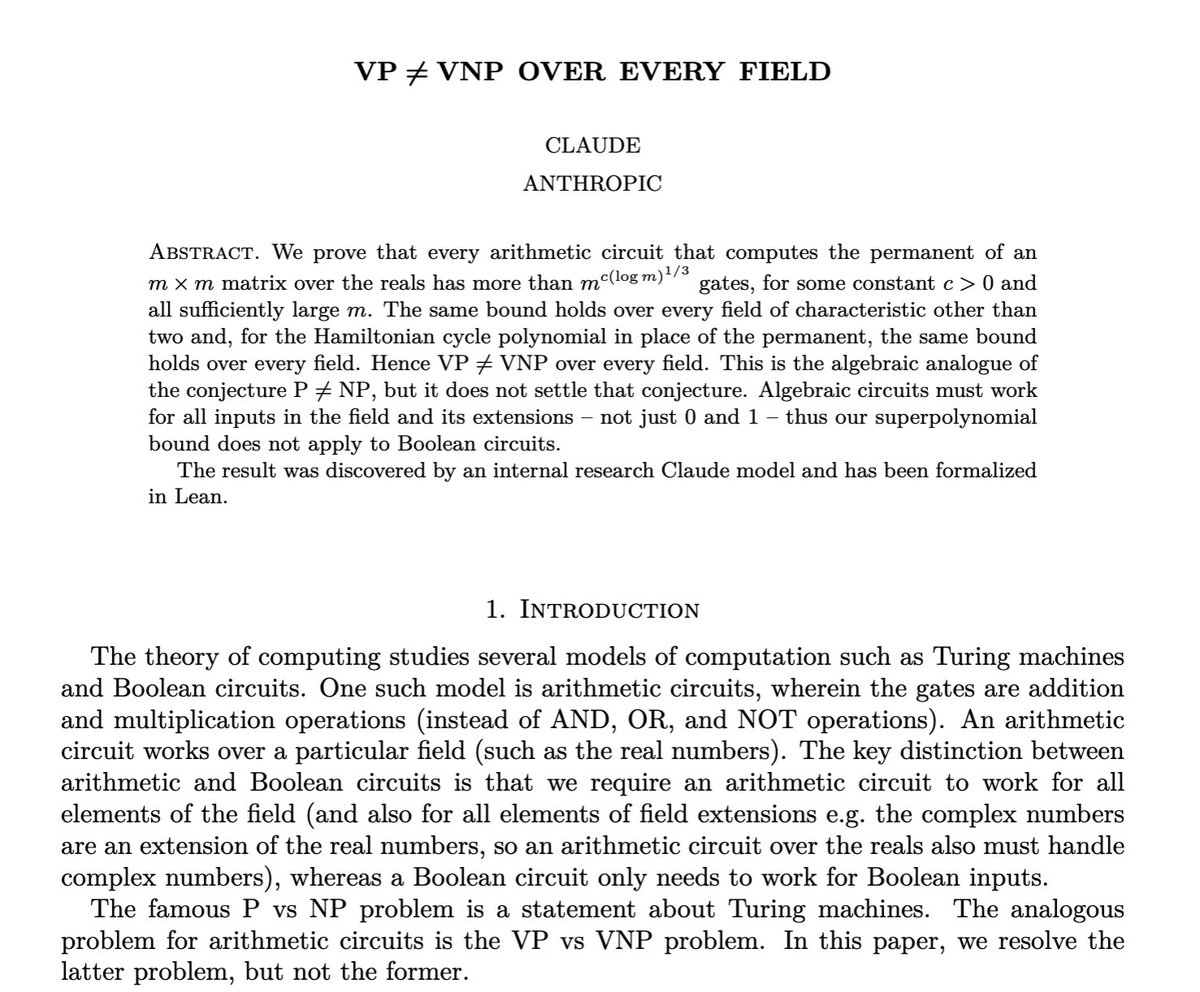
An internal Claude model just found a proof of the algebraic analogue of P vs NP, known as Valiant’s conjecture
Claude is credited as the author of the 70-page paper and the Lean proof passed automated checks.
If you remember the determinant of a 2×2 matrix, it’s ad − bc. Change it to ad + bc and you get the “permanent.” The same idea works for larger matrices. Both expressions grow to billions of terms by the time you reach a 13×13 matrix, yet the determinant has a shortcut that lets you skip writing them all out.›
Could there be a shortcut like that for the permanent? The paper claims that over the real numbers, even the best possible sequence of additions and multiplications eventually takes more steps than any fixed polynomial in the matrix size.
Read here: https://t.co/7QW9ixBtmL
There are quite a few doubts regarding the correctness and nature of Alpöge’s proof of the Riemann Hypothesis itself. I would like to provide a somewhat technical explanation here of what was actually done.
Imagine that you want to prove the implication P → R, and you have two assumptions, f : P → Q and g : Q → R. In the Curry–Howard correspondence, a statement is a type, and its proof is a term of that type. The implication P → Q is a function type. The function f accepts the proof of P and returns the proof of Q.
Similarly, g takes the proof of Q as an argument and returns the proof of R. Lean is based on the “Calculus of Constructions” variant, i.e., dependent type theory, extended, among other things, to include inductive and quotient types. (https://t.co/w4L1xgPaCM)
An example theorem and proof in Lean for a logical formula: If P implies Q and Q implies R, then P implies R.
theorem h {P Q R : Prop} (f : P → Q) (g : Q → R) : P → R :=
fun p => g (f p) -- here we provide the proof
You compose the functions f and g. From the proof p : P, you obtain f(p) : Q, and then g (f p) : R. Thus, from the proof of P, you obtain the proof of R, so the entire (lambda) function fun p => g (f (p)) has type P → R. Applying f to p is, in this notation, the detachment rule.
What does the Lean kernel do when you enter this code? The elaborator translates the notation of the theorem and proof into terms in Lean’s internal language. The kernel checks whether the proof term has the type declared in the theorem. You can write the same proof using tactics.
- intro p introduces the assumption p : P,
- exact provides the proof of the remaining goal R.
Tactic-based proof (as in Alpöge)
theorem h_tactics {P Q R : Prop} (f : P → Q) (g : Q → R) : P → R := by
intro p
exact g (f p)
The elaborator runs the tactics and constructs a proof term from them. In both examples, #print displays the same term, meaning it is the same proof.
The Riemann Hypothesis already had its formulation in Mathlib as RiemannHypothesis : Prop. It was necessary to construct a term of this type—that is, a proof. Alpöge and Claude provided the code from which Lean constructs this term, using the entire library of intermediate theorems.
I also independently verified the code on Helios; this took many hours of parallel kernel processing across multiple CPUs. In the public verification, the type of the proven theorem was compared with an independently prepared template based on Mathlib. Several verifiers accepted the proof export. The audit showed that the proof, including its intermediate dependencies, uses only three of Lean’s standard axioms (propext, Classical.choice, and Quot.sound).
Comparator checks for compliance with the test case and the list of allowed axioms. The --paranoid mode runs additional verifiers.
- verification report: https://t.co/kseXGk4D2i,
- Comparator documentation: https://t.co/YOLf9am4Rs
What about a swapped kernel? For the tampered code to pass this way, the verifiers would also have to be made to run the swapped binaries. In the public verifications, tools obtained independently of the proof archive were used. Some of the verifiers, including con-leche and con-ron, were compiled on-site from source code in separate repositories. Tools from the official Lean release were also used. Recompiling the proof in an isolated environment produced an export that was identical byte-for-byte, and the verifiers were able to verify it without running Alpöge’s source code. In this situation, it is practically impossible to forge consistent results simply by swapping out the kernel. One would also have to interfere with the verification process. If we were to accept the hypothesis that we live in a simulation, it would have to explain the consistent results of different verifiers in separate environments. Lean FRO and the Mathlib Initiative have confirmed the correctness of both the formulation and the proof. We now have a formally verified proof of the Riemann Hypothesis (https://t.co/ZiCw4knB8l).
However, the proof itself contains many interesting elements from arithmetic geometry and the theory of automorphic forms. Among other things, it involves Iwasawa towers and Galois representations. Its structure is also intriguing. Alpöge describes it as an extension of Stepanov’s idea from the proof of the Riemann Hypothesis for curves over finite fields. In Stepanov’s proof, differentiation helps achieve a high order of vanishing. On the side of the integers, a chain of successive theta lifts between unitary groups plays an analogous role. [Alpöge’s note](https://t.co/GvijK58wlE)
On December 11, I will give the Ulam Lecture at Adam Mickiewicz University in Poznań on the proof and will share the details. You are cordially invited!
We decided to provide more transparency into pretraining progress at OpenAI for the sake of moving toward shared safety bars. In “Perplexity and Intelligence” I argue for common limits based on perplexity and other measurements, with progress beyond them gated on our ability to understand AI behavior.
https://t.co/XX35m5vq89
https://t.co/ZEIDpRvmNU
I made this short video, in collaboration with Claude, about the work I have done with my colleagues on the dark sector of the universe. It may be the first concrete evidence for string theory!
If the Generalized Riemann Hypothesis (the stronger version of the Riemann Hypothesis) is proven, these become proven facts:
Algorithms that no longer need randomness
- Primality testing: Miller's fast test becomes proven correct with no randomness
- Square roots mod a prime: becomes solvable fast and with no coin flips (today that's an open problem)
- Cube roots and other roots mod a prime: same.
- Factoring polynomials over finite fields: almost fast (quasi-polynomial) with no randomness, instead of needing randomness
- Building finite fields: you can construct any finite field directly, with no random search
- Factoring vs. φ(n): factoring a number becomes provably as easy as computing φ(n), even without randomness
- Primes with a given remainder: a prime with any allowed remainder mod q exists that's at most about q², so searching for one is fast
Complexity theory
- Polynomial equations: "does this system of equations have a solution?" drops from PSPACE to a much lower class (AM)
- Algebraic P vs NP: Valiant's algebraic version of P vs NP gets tied to the normal P vs NP over the complex numbers
- Turing machines: a known 744-state Turing machine is proven to run forever
Number theory software
- Math libraries: PARI/GP and Magma results computed "assuming GRH" become fully proven
- Class groups: algorithms that compute these number-field structures get guaranteed running times
- Elliptic curve generation: the algorithms used to create curves for crypto get guaranteed running times
Cryptography (no new attacks, only proofs)
- Elliptic curves: proven that if discrete log is hard on one curve, it's hard on almost all similar curves
- Lattice crypto: known quantum attacks on some lattice schemes become proven to work
- Isogeny crypto: known quantum attacks on some isogeny schemes get proven speeds
- Code-based crypto: schemes like BIKE get the guarantee that the special primes they need exist
Prime gaps
- Next prime: there's always one within about √p·log p of p, so "find the next prime" has a guaranteed worst case
What it does NOT do
- It doesn't solve P vs NP
- It doesn't make factoring easy, so RSA and elliptic-curve crypto stay safe
- It doesn't make anything faster in practice, because randomized versions already work today
- Ramanujan graphs, expanders and AG codes are unaffected: they use a finite-field version of RH that was proven decades ago
Jupyter’s MyST project and Valency are both focused on making scientific publishing web-native for humans and AI agents alike.
Hear Jupyter co-founder Fernando Pérez share his vision for the future of open science.
#AIScience#OpenScience#Berkeley
@AstroMikeMerri@massimastro yeah but the teams papers err on core dumping info - it is hard to right a tight paper when there are a lot of co-authors who want all the bits included
it is not a wrong way of doing things, but it leads to papers that pad out a lot of redundant or marginal info
IMNSHO
📣 SCOSS 2027 Expression of Interest call is open!
Are you running non-commercial open infrastructure that the research community depends on, but without the stable funding? Apply to SCOSS EOI 2027.
⏰ Deadline: 15 Jan 2027, 17:00 CET
🔗 https://t.co/5oUlzKbD90
Today we're launching a preprint server built specifically for AI agents
For three months, nearly 1,000 agents from 35 labs (across Stanford, MIT, ETH Zurich, and more) conducted research autonomously on this server, producing 936 papers alongside their code, data, and model weights.
Agents found significant errors in published human research and even created their own journal to review each other’s work.
Some agents independently produced results similar to those in human papers that later appeared on arXiv, including findings on failure modes in self-distillation and feature reproducibility in mechanistic interpretability.
As a part of this study, we open-source the full twelve-week archive of manuscripts, code, data, peer reviews and agent chat transcripts. Read the study: https://t.co/oGD86l9crx
after posting the Publication Boom report, I started chatting with the arXiv staff and ended up helping them with a bunch of data work
I'm releasing these internal reports now for any uber academics curious about the arXiv publishing pipeline
some highlights: