I recreated Tesla's FSD 15 Reality View using my own Model 3's dashcam clips!
There is no external data other than the dashcam clips and the telemetry that comes with them.
Youtube breakdown is in the replies
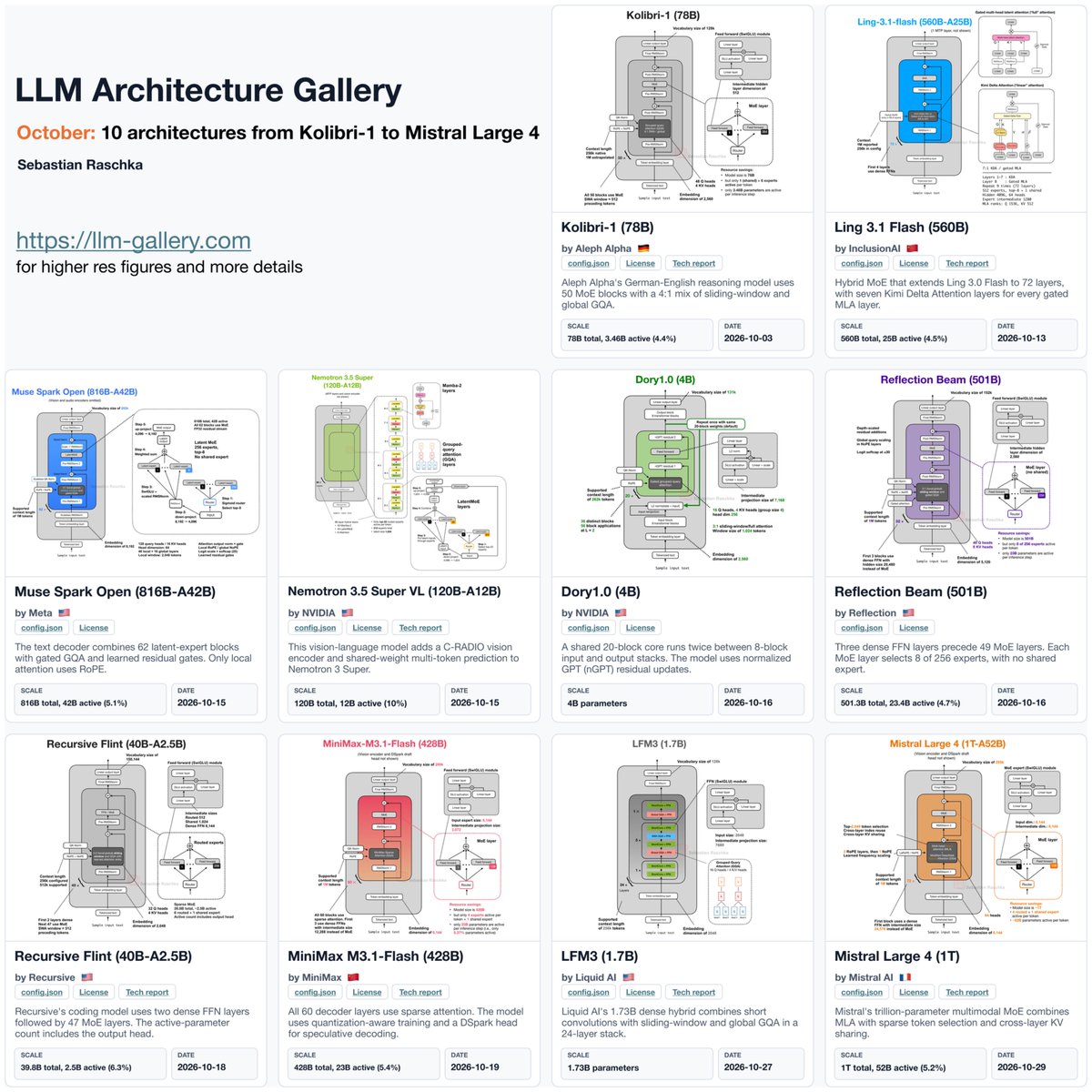
Catching up on the 10 (!) open LLM architecture releases from the past month. Quite a lot happened in October.
I guess we can call it "Open October"!
1. Kolibri-1 (78B): A notable model from Germany. Features classic Grouped Query Attention (GQA) and Sliding Window Attention (SWA) attention module.
2. Ling 3.1 Flash (560B): Uses Kimi Delta Attention and the eighth uses gated Multi-head Latent Attention (MLA) inspired by DeepSeek.
3. Muse Spark Open (816B): Besides Musse Glimmer, the first major open weight release from Meta (since Llama). Uses classic GQA + SWA but adds a LatentMoE.
4. Nemotron 3.5 Super VL (120B): Combines Mamba-2 layers with just eight attention layers. Also LatentMoE
5. Dory1.0 (4B): A looped transformer design.
6. Reflection Beam (501B): GQA+SWA architecture.
7. Recursive Flint (40B): Note that "Recursive" is the company name; the architecture is a fairly standard MoE with GQA and SWA.
8. MiniMax M3.1-Flash (428B): Uses their own MiniMax Sparse Attention module.
9. LFM3 (1.7B): Hybrid architecture that mixes short convolutions and attention.
10. Mistral Large 4 (1T) combines MLA with sparse attention.
Will probably cover/discuss things in more depth in the coming weeks!
Is it still worth implementing things from scratch when AI can write the code for you?
I saw a learner ask this after finishing a RAG course where they skipped most of the coding parts. It's a fair question, and I suspect plenty of people are wondering the same thing.
My take: build each core piece by hand once. Write the chunking, the embedding call, the similarity search and the prompt assembly yourself, even if the first version is rough. After that, let AI write it as fast as you like.
Doing it once gives you the mental model you need to review generated code, notice when retrieval is returning junk, and debug it when something breaks late at night. That understanding is what makes the AI help worth having.
Pick one course project you skimmed, rebuild only the retrieval step by hand this week, and compare your results with the generated version.
#MachineLearning
If you’re building a agent
Always go the harness route first. Do not build a complicated 20 step workflow using a bunch of if else statements or langgraph
Use a harness as your agent eg. Claude code, codex, deep agents, glean etc
You’re just shooting urself in the foot off the bat
Trust me, prompting works surprisingly well
Ben Horowitz on treating your story as your strategy, and why founders often skip writing it even though it's one of the most important parts of the job:
"The story of the company is also the strategy of the company... In your mind, you're kind of adjusting that strategy a little bit at a time every day. But then a quarter later, it's actually pretty different than what you started with."
"So it's really important that you keep upgrading your story. The articulation of your story. I would definitely recommend it be in written form."
"Something that you can share with everybody in the company, and everybody you're recruiting, everybody you're trying to raise money from, all your constituents, every customer."
"The problem that I think founders have is it doesn't feel like work. Like, 'What are you doing today?' 'I'm working on my story.' That doesn't sound like work."
"Because it doesn't feel like work, people don't do it, but it's probably one of the most important parts of the job."
@bhorowitz w/ @speedrun GP @Tocelot
earshot v0.3 is out!
added:
- a library of 201 sounds, all made with code
- earshot kit can create a whole sound kit
- earshot sfx times a sound to the exact frame (improved)
plus earshot is now used in cinetic (skill for creating motion design)
will continue improving it!