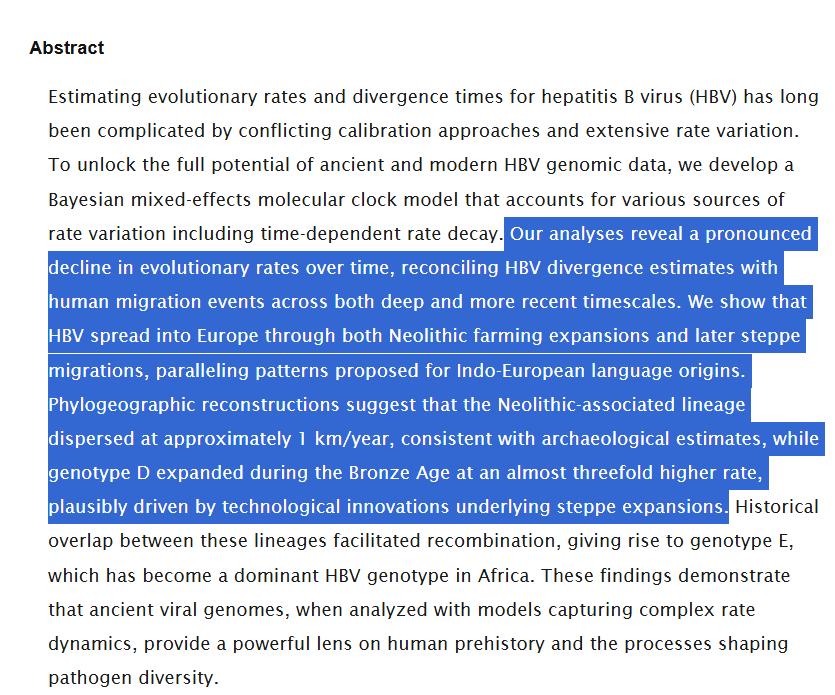
HBV (hepatitis B virus (HBV) spread into Europe through both Neolithic farming expansions and later steppe migrations, paralleling patterns proposed for Indo-European language origins.
https://t.co/GNS9n7YKiY
Why is cannibalism both one of humanity's strongest taboos and something that keeps reappearing across human history?
Our new paper in @pnas argues the taboo may be public health in disguise. [1/7]
Genome sequencing plus RNA-seq uncovered a pathogenic PKD1 splice defect created by two adjacent benign variants, highlighting how hidden non-coding mechanisms can solve long-standing diagnostic mysteries. https://t.co/UNFqvKNmLx #GIMO#ComplexAllele#PKD1RNASplicing
Which variants are common in your ancestry but rare globally?
New on hg38: SNV Frequencies. Over 1.2 billion variants pooled from ~1.5M people across 30+ cohorts, including population references, biobanks, and disease case/control studies.
Learn more: https://t.co/LzJBbu8p7H
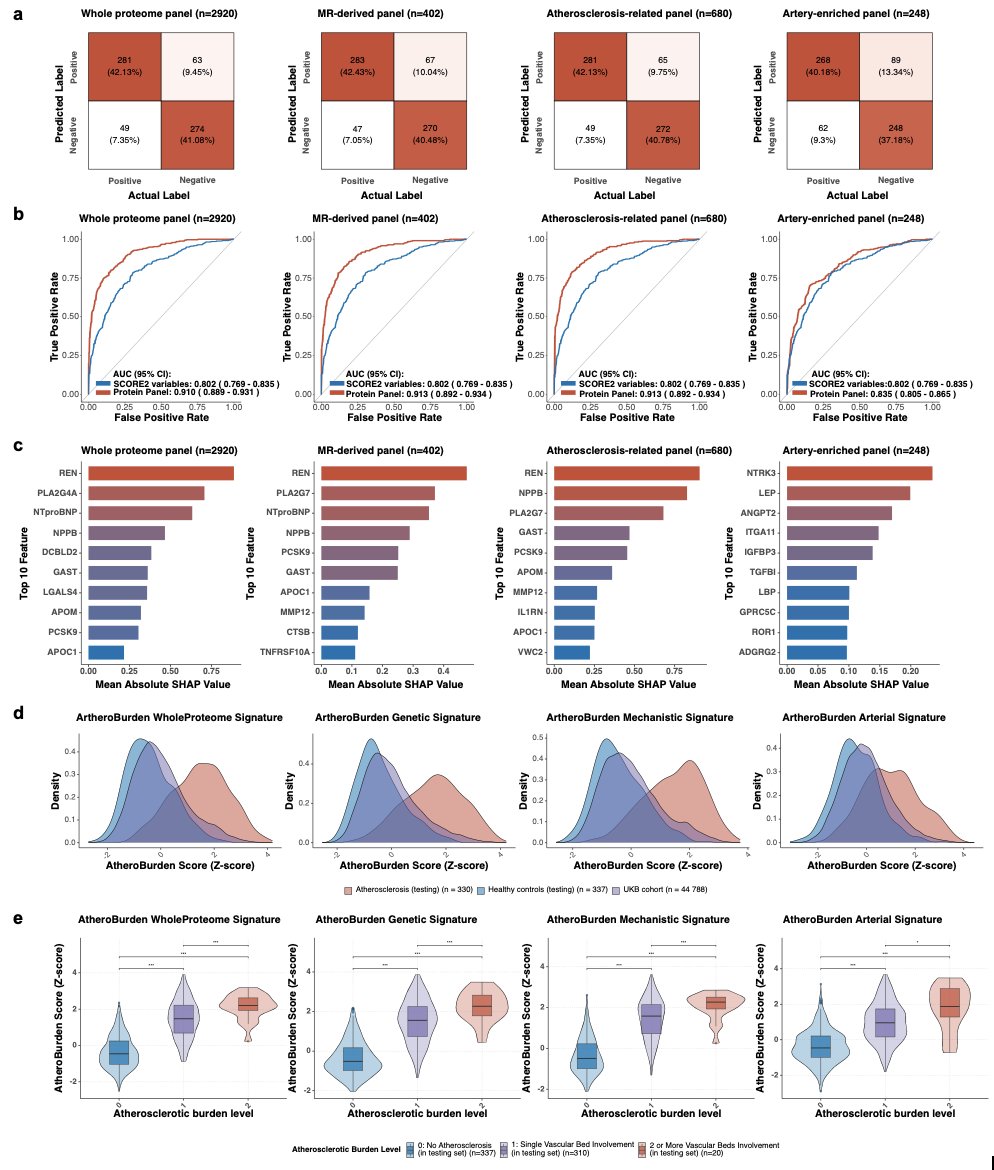
We describe the development of 4 Olink-based scores that
👉 discriminate prevalent clinically diagnosed atherosclerotic disease
👉 change according to the number of clinically affected vascular beds
👉 are associated with carotid ultrasound–measured plaque burden
Are pseudogenes just "genomic fossils"? Our latest preprint says no! By analyzing 244 high-quality vertebrate genomes from VGP, we show that processed pseudogenes (retrocopies) are actually dynamic substrates for evolutionary innovation. Full study here: https://t.co/NCoe57hMRh
This evening in @TheFP, I tell the astonishing story of how ancient books were charred in the ash of Vesuvius, unearthed by a Bourbon monarch, thrown in the trash, hung from silken threads, cut to pieces, bombarded with x-rays, and now—with the help of machine learning—digitally unfurled to reveal their secrets at last. Vesuvius Challenge might be my favorite use of AI in the humanities to date. Despite many misfires and mistrust among lit types and tech types, it really is possible for machine learning to enrich the human soul if we’re smart and humble about it.
🧬The largest collection of newly generated genetic data from late Neanderthals was published in @Nature.
Some of the most interesting findings:
- No evidence of recent close inbreeding
- No signs of recent gene flow from Homo sapiens
- No increase in genetic load
- The analysed remains from Goyet were not from a single family group
- Neanderthals from Belgium and nearby France formed a distinct regional population different from other known Neanderthal groups
One genome was sequenced at high coverage becoming only the fifth high quality Neanderthal genome available today.
https://t.co/hKF1wbRHpA
#Neanderthals #aDNA #inbreeding #mtDNA
Hominins got larger over time, according to an analysis of 386 specimens across 21 taxa. There’s strong evidence for a marked body mass increase for all late Homo species, except Homo habilis. In PNAS: https://t.co/NhtWjlhIJj
After 4 years, it's rather nice to finally present our work on genetic's model trait, height, in >1.4M WES/WGS samples led by @doc_locke, @Mar_ferreira17, & @gabecasis where we found 207 genes [amongst many other results].
A thread of findings below⬇️
https://t.co/964iJO664A
Remarkable.
Recovered traces of ancient human mitochondrial and nuclear DNA, unaccompanied by faunal DNA, from a pigmented calcite crust at Escoural Cave (Portugal), as well as from an unpigmented cave wall sample from the same site.
It also shows that traces of human DNA can persist on cave walls for thousands of years.
“Investigating ancient human DNA preservation on cave walls and in rock art”
https://t.co/QvK3zx1EtN
The evidence does seem to be converging on twin studies substantially overestimating the heritability of educational attainment.
But the difference with sib-regression estimates doesn't seem that large for height, bmi, etc.
Jury still out on IQ.
🧬New today!
📄Individuals who deviate from polygenic expectation are enriched for damaging variants in genes linked to rare disease
🧑🤝🧑 @NikBaya@astheeggeggs & co
https://t.co/WkzORxZW0U
New meta analysis of Human Chimp speciation suggests that the molecular divergence estimates are converging to an older date of around 8 mya, which is more in line with fossil based estimates
Interesting paper. They took 10,272 writing prompts and gave each one to a human author and to five AI models: Claude, GPT, Gemini, DeepSeek, and Kimi. From these, they generated 61,608 stories, at around 5,000 words each to see if there was divergence at a narrative level. From the analysis, they found that they could identify a human-written story from an AI-generated one nearly 93% of the time.
Left: Each story is a dot. The story’s 304 dimensional narrative feature vector has been projected down to two dimensions using Linear Discriminant Analysis (LDA). Brown dots are human.
Right: Each story gets scored on how rare its narrative feature profile is, then mapped to a percentile: approximate 1.0 means highly unusual relative to the reference set. The models reliably produce narratively “average” stories, while humans more often into unusual territory
https://t.co/M4rLx734rC
Improving genetic diagnostic yield in familial and sporadic cerebral cavernous malformations: detection of copy number and deep Intronic variants
https://t.co/nd6I2EY3gY
I have uploaded a paper to bioarchive for the first time ever! This is a very cool paper where we use PTEN-Halo9 to measure the lifetime of PTEN in vivo and perform live imaging of PTEN in growing neurons. https://t.co/naHx8ryrfr






![misiak_mchl's tweet photo. Why is cannibalism both one of humanity's strongest taboos and something that keeps reappearing across human history?
Our new paper in @pnas argues the taboo may be public health in disguise. [1/7] https://t.co/znIyx5iWpd](https://pbs.twimg.com/media/HMN55nwWEAA58Cb.png)




![jakphd's tweet photo. After 4 years, it's rather nice to finally present our work on genetic's model trait, height, in >1.4M WES/WGS samples led by @doc_locke, @Mar_ferreira17, & @gabecasis where we found 207 genes [amongst many other results].
A thread of findings below⬇️
https://t.co/964iJO664A https://t.co/oASmxGF5q6](https://pbs.twimg.com/media/HLmuIKvXEAA8mwo.jpg)


