During WNFM last week, Jonathan Hinze, president of @UxC_Nuclear stated that based on the 'known' growth of nuclear capacity (~400GW today to ~500GW ~2032) he is concerned about the supply chain. When pressed on this, he stated that he is most concerned about "uranium." (1/x)
🚨ICYMI: First test reactor in President Trump’s Pilot Program hits milestone to ramp up American nuclear power — a month ahead of schedule.
All we needed was a new President, to unleash the American Nuclear Renaissance! https://t.co/YOBWUrLU0z
President Trump is unleashing the American Nuclear Renaissance—aiming to have multiple nuclear reactors critical by July 4th on our nation's 250th anniversary.
@SecretaryWright: “This summer you will see multiple next generation nuclear reactors running...America is back!"
VOGTLE IS BEING USED AS A WEAPON AGAINST NUCLEAR RIGHT NOW.
The argument: $36.8 billion. Seven years late. Case closed.
That framing ignores what Vogtle actually proved.
Utilities were rate-based. Contractors were fixed-price. When costs rose, incentives diverged. No single entity owned the outcome.
That is a partnership structure failure. Not a nuclear failure.
The reactor itself works. Units 3 and 4 are online. They are now the largest source of carbon-free power in the United States. They will run for 60 to 80 years.
The critics are pricing the construction. They are not pricing the asset.
This is exactly why the collaboration model I referenced matters. You cannot fix a broken incentive structure after groundbreaking. You have to build it right before you start.
The lesson of Vogtle is not that nuclear cannot be built. It is that nuclear cannot be built wrong.
$CCJ $BAM
NUCLEAR ISN'T JUST AN ENERGY STORY. IT IS A GENERATIONAL ONE.
I have children. I think about the world they will inherit.
A strong domestic nuclear supply chain helps America remain a global power. It creates real opportunity for the next generation. Past generations built the foundation I stand on. I intend to do the same.
That is why I pay close attention to who is actually building this future.
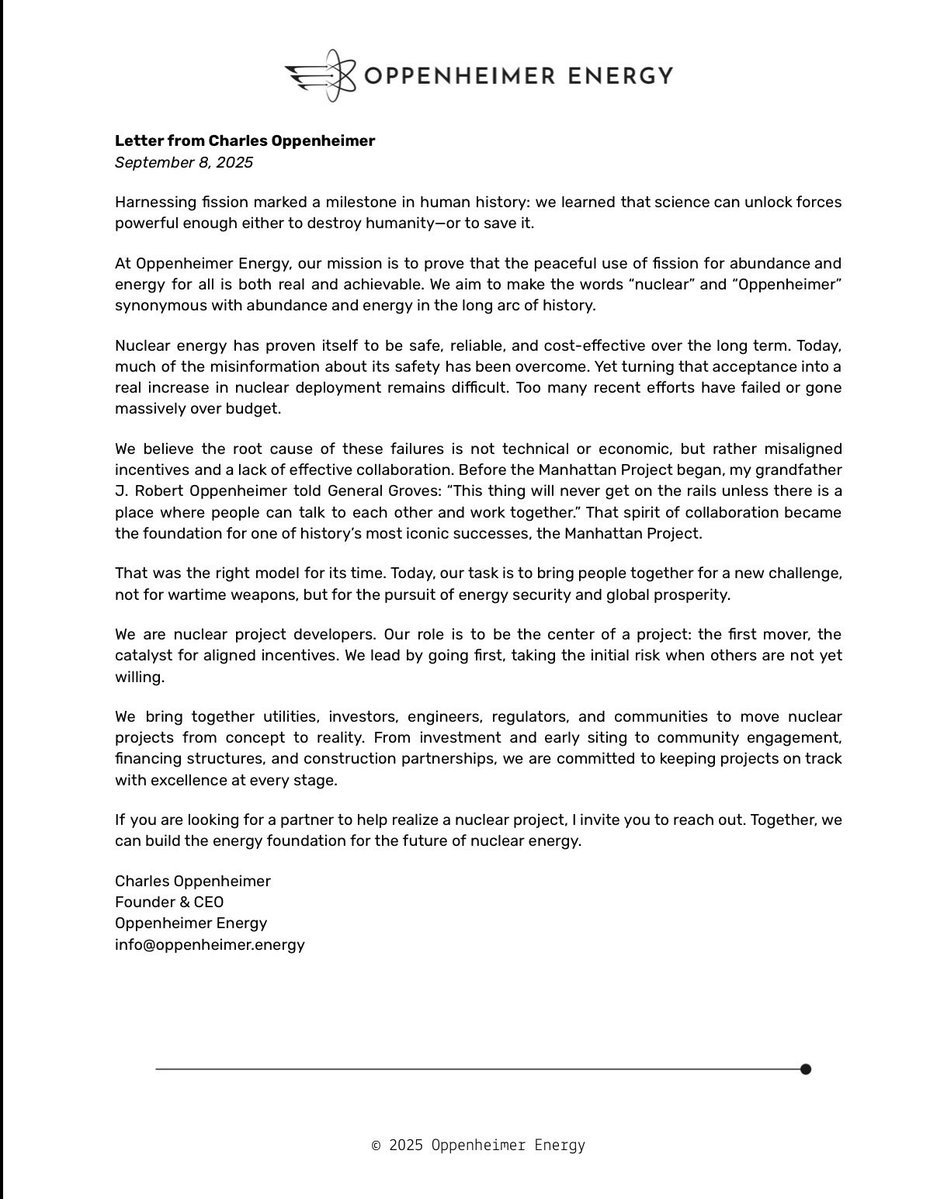
Charles Oppenheimer is making the case that recent nuclear project failures are not technical or economic failures.
They are collaboration failures.
Oppenheimer Energy is positioning itself as a first-mover catalyst that brings utilities, investors, engineers, regulators, and communities together before projects stall.
The Manhattan Project succeeded because people were put in a room and told to work together.
That model still applies.
Worth watching.
🚨 SOMEONE JUST KILLED THE REAL ESTATE INDUSTRY
A guy scanned an entire house with his phone. Uploaded it.
Now anyone on Earth can walk through it in a browser tab. No app. No VR. No agent. No appointment.
Click → you’re inside. Every room. Every angle. Every shadow. Photoreal.
The numbers are insane:
- Agent fee on a $500k home: $15,000
- Cost to make this scan: ~$200
- Time to “tour” 50 houses: one evening
- File size: smaller than a TikTok
The science is wild too:
It’s called 3D Gaussian Splatting instead of polygons (how games render), it uses millions of tiny glowing “splats” of color and depth.
AI reconstructs reality from your photos. The result loads on a phone and looks like you’re THERE.
The grift opportunity is even wilder:
Freelancers are already charging $300–$800 per scan for realtors, Airbnbs, venues, car dealers, museums.
One person + one phone + one weekend = a business.
100% Open source. Built on PlayCanvas.
Uranium went from $30 a pound to $98 a pound in 6 years.
The mining stocks did 5x to 7x in the same window.
Microsoft and amazon just signed deals to power their AI data centers with nuclear. The uranium they need does not exist in the global supply…
Most people have no idea what's happening with uranium in 2026.
AI data centers consume 8-12x more power than traditional data centers. The biggest tech companies need 50+ gigawatts of new power capacity by 2030. Renewables can't run a data center 24/7. Natural gas is politically blocked. The only path is nuclear.
Microsoft just signed a 20-year deal to buy nuclear power from Three Mile Island. Amazon signed with Talen Energy. Google signed with Kairos. Meta is in talks.
50 gigawatts requires roughly 9,000 tonnes of uranium per year.
Current global uranium mining: 50,000 tonnes a year. Current demand pre-AI: 65,000 tonnes a year. The supply deficit was already 15,000 tonnes a year before the tech companies showed up.
Add the AI demand and the deficit triples.
The fastest way to position on the structural shortage is the 5-position nuclear stack.
I started buying uranium in 2020 at $30 a pound. NXE was a $0.95 stock when i bought it. It's at $7.85 today. Total time managing the position: 15 minutes a quarter.
Move 1. Pick the 5 names. CCJ (Cameco, the largest western producer). NXE (NexGen Energy, the biggest undeveloped high-grade deposit). DNN (Denison Mines). URA (Sprott Uranium Miners ETF). URNM (North Shore Uranium ETF).
Move 2. Set the allocation. 35% CCJ. 20% NXE. 15% DNN. 15% URA. 15% URNM.
Move 3. Track long-term contract pricing weekly. Uranium has 2 prices: spot and term. Term is 70% of all volume. Currently $84 a pound. Above $100, marginal mines come back online and supply restarts. Free at uxc. com.
Move 4. Watch the hyperscaler PPA announcements. Set google alerts for "data center nuclear PPA" and "small modular reactor agreement." Every announcement is a 20-year demand commitment.
Move 5. Watch the kazakhstan situation. Kazakhstan produces 43% of global uranium. Russia transports the conversion services. The supply chain has 2 chokepoints. When russia restricts uranium exports (already happening), CCJ runs.
Move 6. Quarterly rebalance. 15 minutes.
The asymmetry nobody talks about.
S&P 500 on $50K: $7,000 a year average.
Energy ETF on $50K: $4,800 a year. Diluted by oil majors.
Nuclear stack on $50K: CCJ +112% over 24 months, NXE +208%, DNN +156%, URA +89%. Blended 124% over 24 months. $62,000 in pure capital appreciation.
Plus the AI demand cycle has not peaked. The structural shortage has 6+ years of runway.
i run 6 sub-portfolios across 6 account types. They've appreciated 89% in 18 months while i barely look at them. 8,000 of my goat academy students hold positions in these names. Combined exposure: over $1.1B.
The 2026 NRC small modular reactor approvals will trigger another leg up. Window: 6-12 months.
I'll probably regret posting this. Once CNBC starts running uranium segments, the spot price runs to $150 and the miners overshoot.
(the entire western world bet its energy security on solar panels made in china. the AI data center build-out hit. the only reliable carbon-free baseload power is nuclear. the only fuel for nuclear is uranium. the only major mining companies are in canada, australia, and kazakhstan. the supply chain runs through russia. nobody planned this. somehow we're going to have to figure it out anyway.)
This is my once in a lifetime FREE webinar.
I'm walking through the exact 5-position nuclear stack live. Plus the uxc term-price tracker and the hyperscaler PPA calendar.
I started buying when uranium was unfashionable. The window to be early is closing.
Limited spots. Link in comments: https://t.co/1j7Dmb4qHR
Las Vegas, Nevada
Francine Maric goes head to head with a blackjack dealer, she occupies all five places in the pit, betting $10 K, $2000 at each position, going ahead to head her odds are
1:73…if the dealer throws herself a weak up card (doesn’t) the odds change dramatically, she came fully prepared to do this as many times necessary until she wins.
WINNER she was the one out of 73 on the first round of blackjack…I wish I had that kind of luck.☘️