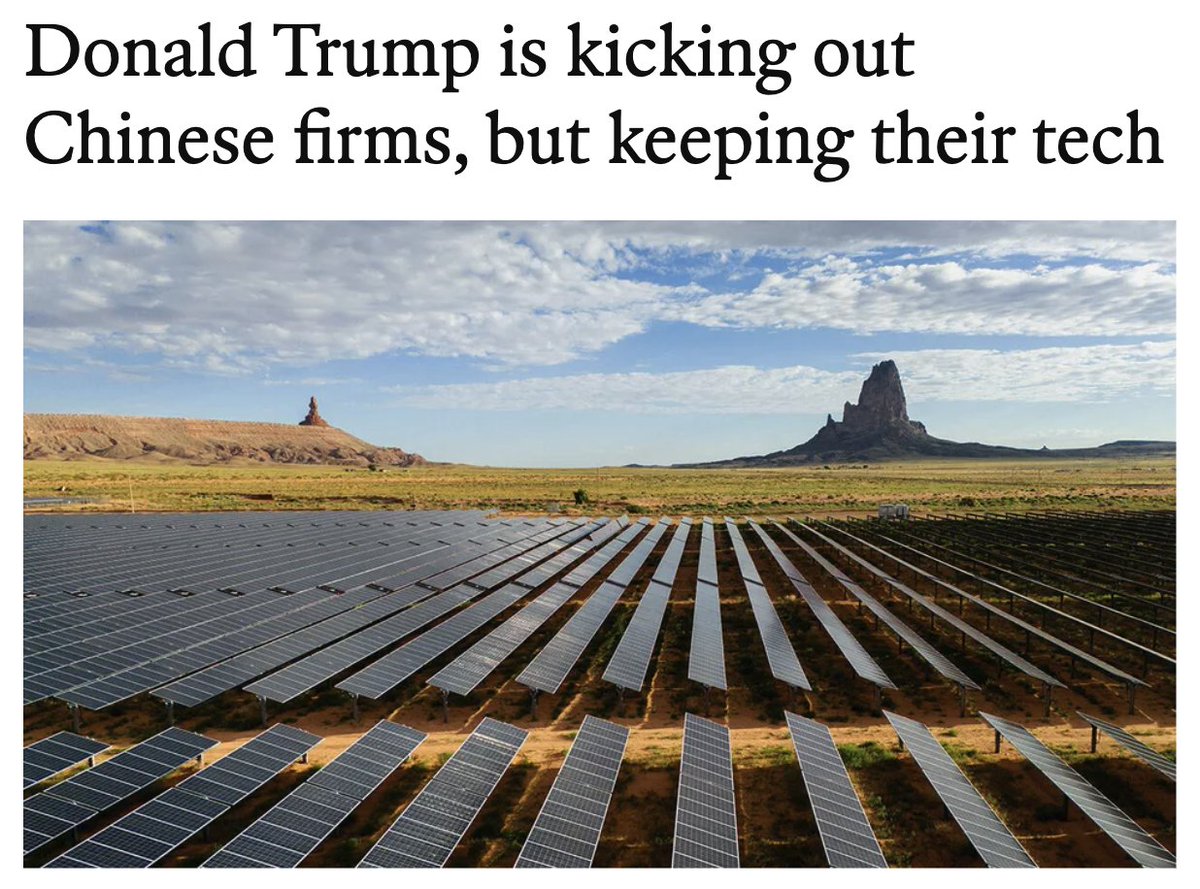
The Economist has published a revealing little story about the US’s clean-energy sector that neatly captures the whole logic of the tech war.
Over 2022–24, Chinese firms poured some $15.5 billion into US solar and battery manufacturing, building state-of-the-art factories that Americans could not build themselves. Then, in July 2025, Trump’s “One Big Beautiful Bill” barred any company with Chinese links from the subsidies that make the sector viable, and designated Chinese firms “Foreign Entities of Concern”, alongside Iran, North Korea and Russia.
As a result, Chinese investors have been forced into fire sales: nearly $9 billion of assets cancelled, paused or sold off, some at massive discounts, snapped up by North American financiers.
So a Chinese-built solar plant in Dallas now flies the stars and stripes, while an executive effuses: “Never bet against the United States’ engineering and innovation.” It’s quite a boast to make about a factory you didn’t design, built with technology you didn’t invent, on assembly lines – as the Economist notes – “full of Chinese technology”.
US media never stops going on about Chinese companies “stealing” American technology, but the reality is the opposite. And of course it won’t have the desired effect. You can expropriate a factory, but you can’t expropriate the decades of patient state investment, industrial planning and accumulated know-how that produced it. The proof is in the detail the article can’t avoid: China still makes 95 percent of the world’s polysilicon, and the very executives celebrating US “innovation” are now demanding higher tariffs on Chinese inputs so they can “be globally competitive”.
Incredible. Having helped themselves to the fruits of Chinese investment, they now need protection from Chinese competition. That is not the confidence of a technological leader; it is the anxiety of a rentier.
Anthropic Engineer Andrej Karpathy:
"Everyone builds agents on a model they've never seen. I deleted the framework to look underneath."
In 23 minutes he strips the framework Claude runs on and rebuilds it in raw C with zero dependencies.
What Karpathy actually did:
step 1 → Strip every abstraction. No autograd, no compiler, just float arrays that hide nothing.
step 2 → 2,000 lines train a GPT from scratch on a potato, then 60 strangers push it 20% past PyTorch.
The framework was never the hard part. Understanding what it hides was.
Watch the talk, then save the breakdown below.
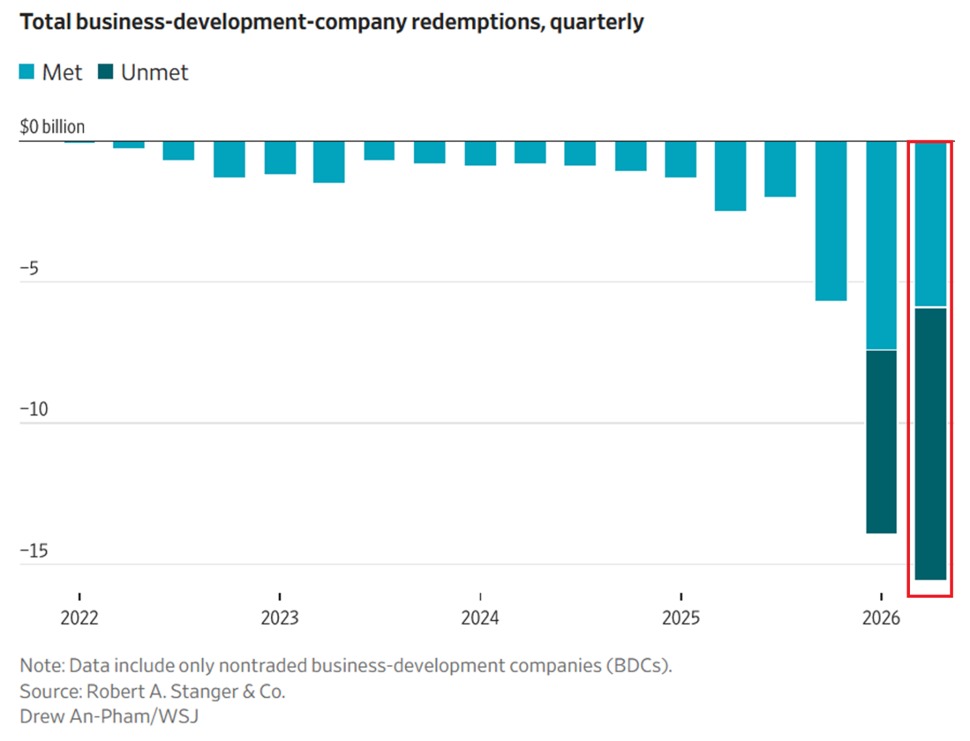
Stress in the US private credit market is intensifying:
Investors requested a record -$15.6 billion in redemptions from private credit funds in Q2 2026.
This marks the 3rd consecutive quarterly increase by a total of +$13 billion, or +500%.
Furthermore, just 38% of these requests were met, down from 53% in Q1 2026, leaving $9.7 billion in unmet redemptions, the largest backlog on record.
Blue Owl's flagship fund, Blue Owl Credit Income, was the most impacted at 19% of shares outstanding, with 14% unmet, the highest redemption rate among its large competitors.
This was followed by Apollo, at 16% requested with 11% unmet, and Ares, at 14% requested with 9% unmet.
Meanwhile, inflows into the private credit industry declined -75% since January to ~$500 million in May, the smallest monthly intake in at least 18 months.
The private credit crisis shows no signs of slowing.
Jeffrey Gundlach told everyone his exact portfolio: 40% non-US stocks, 25% fixed income, 15% commodities, the rest cash
The DoubleLine CEO doesn't do clickbait - and he just put recession odds above 50% for 2026
1 hour on US debt, the private credit bubble, and gold going to $4,000
bookmark & watch - required viewing before you touch your allocation
Alex Karp on the only way to build true alpha:
"what’s valuable is doing something no other enterprise in the world can do, pairing your tribal knowledge with efficiencies no one else has."
most companies try to copy their competitors. they buy the same off the shelf software, hire the same expensive consultants, and expect to magically outperform the market. but if you use the exact same tools as everyone else, your edge is zero
Karp knows that real alpha cannot be bought via subscription. it is built. you take the deep, unwritten expertise of your best people and you arm them with ruthless, custom technology
stop trying to fit into the industry standard. the standard is mediocre. build a system that only you understand, and only you can run
bookmark and watch the archive interview here
David Tepper on why you never fight the money printer:
"i don't love the us markets on a value standpoint, but i sure as heck won't be short... you can't be short anything."
most guys love to play the hero. they see a chart that looks overbought, read some doom threads, and step right in front of a moving train just to prove they are smart
they will sit there in a massive underwater short, paying heavy fees, while central banks literally print cash and hand it to buyers
Tepper built his track record on knowing when to step aside. he knows that when governments push easy money into the system, you do not overthink the valuations
when the liquidity taps turn on, you do not stand in the way. you either buy the cheapest assets on the board, or you just stay out
stop trying to short a market that is floating on free cash. do not fight the fed
bookmark and watch the archive here
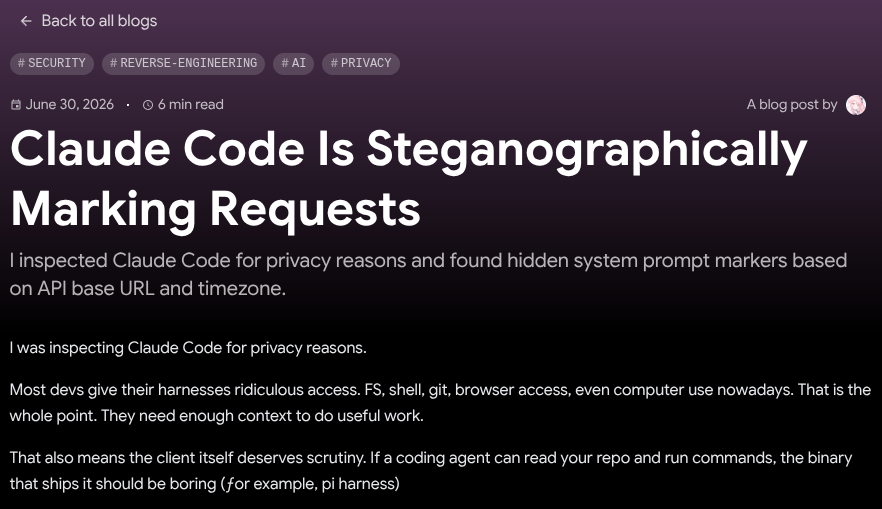
Claude Code is vibecoded and full of spyware, it's possible Anthropic doesn't even know what's in there. After reading this report, we are banning it from our systems and strongly encourage other enterprises to do the same. It is an unacceptable security risk.
The adoptive father told him his whole life: "You'll never amount to anything"
At 33, he stole an idea from the CIA and built an empire on it.
"My family called me a loser. And that really stung me and gave me a powerful push forward," says Larry Ellison.
Today Oracle stores the data of almost the entire world.
The company's market capitalization is over $475 billion, and Larry himself is one of the richest people on the planet.
When he was just starting out, he had no degree, no money, no connections.
IBM, HP and Microsoft all turned him down.
He lived on a modest sailboat and took any programming job he could find.
he accidentally saw secret CIA documents and realized: that's it.
He stole the idea from the secret service, rewrote it from scratch and named the company Oracle.
If someone told you that you'd never amount to anything - watch this video. It's incredibly motivating.
My guest today is Paul Tudor Jones (@ptj_official), one of the greatest macro traders of all time.
He correctly predicted the 1987 stock market crash and shorted the Japanese bubble in 1990. For over 40 years, his flagship fund has had a negative correlation to the S&P 500. 100% of his returns are alpha.
He says today's market has so many similarities to 2000, "the easiest bear market I've ever seen in my whole life."
He makes the case for going long dollar-yen, why Bitcoin beats gold as an inflation hedge, and why he was wrong about Warren Buffett.
But what I'll remember most from this conversation is Paul's zest for life. He's 71 and still wakes at 2:30 every morning to trade the London open. He works out for two hours a day. He walks with his wife every evening. He travels the country chasing peak spring and peak fall. He's so excited about the songs picked for his funeral that he wishes he could be there to hear them.
Paul has lived five lifetimes in one. He's one of the most entertaining and interesting people I've met, and the conversation will leave you searching to be as passionate about what you do as he is about what he does.
Enjoy!
Timestamps:
0:00 Intro
1:00 The Kindest Thing
13:19 Trading vs. Investing
17:33 Lessons from Warren Buffet
22:24 The Existential Risks of AI
29:54 The Nature of Trading
31:46 Bitcoin
35:55 Bubbles
42:08 A Day in the Life of PTJ
46:00 Information Overload
47:07 Passion for Markets
50:49 The Robin Hood Foundation
54:18 The Workless World
56:03 Journalism
1:00:00 Principal Components of a Great Life
1:05:06 Kill Them With Kindness
I recently spent a month in Asia, including 10 days in China, where I met with senior policy makers in several countries, and I found that over the past few months, there has been a big shift in the world order. I share my perspective in my latest article.
As always, I welcome your questions and thoughts.
Paul Tudor made $100M in one day, Stan Druckenmiller made 1 trade that broke the Bank of England
on one RobinHood stage two $10B+ hedge fund CEOs gave a 30-minute trading masterclass
completely free - two of the greatest traders in history will show you the most important rules of trading
bookmark & watch - this is better than any paid course from fake traders