It’s wild how Meta - a company going all-in on AI - somehow missed the memo on how AI can generate images and videos that renders “take a selfie of yourself” verifications utterly useless
So now Instagram accounts hacked at scale. 2FA also fully bypassed - by Meta’s own design
Transgender non-binary migrant without legal right to work in the UK gets elected as new Member of the Scottish Parliament.
“I am a transgender Tamil immigrant. My pronouns are they/them.”
He will now earn £77,711 ($105k) a year despite not having the right to work in the UK.
The American Revolution was bankrolled by one man. The richest in America. He died broke in debtor's prison.
Robert Morris.
In 1781, he raised $1,400,000 on his own personal credit to march George Washington's army to Yorktown. The Continental Congress had no money. The states refused to send any. France had stopped. The final $20,000 came from Haym Salomon, a Polish-Jewish broker who personally underwrote the rest. The richest man in the country put his balance sheet behind the war and ended it.
AOC said this week that "the American Revolution was against the billionaires of their time."
The math doesn't survive the source documents.
Morris signed the Declaration of Independence. He signed the Articles of Confederation. He signed the Constitution. One of only two founders to sign all three. He served as Superintendent of Finance from 1781 to 1784, ran the Continental Navy as Agent of Marine, and chartered the Bank of North America. The financial machinery of the United States was built by the merchant who had spent the prior decade running the largest shipping firm in Philadelphia.
John Hancock was the wealthiest man in Boston. George Washington owned 8,000 acres at Mount Vernon. The signers were merchants, planters, and lawyers at the top of colonial society. The complaint was taxation without representation, levied by a Crown an ocean away. The Stamp Act and the Townshend Acts hit merchants hardest. That's why merchants funded the war.
Then the math finished Morris off.
He owed nearly $3 million by 1798. He sat in Prune Street debtor's prison for three years. George Washington visited him there. Congress passed the Bankruptcy Act of 1800 in part to secure his release. Morris died in 1806 with a five-line obituary in the Philadelphia papers.
$1.4 million in personal credit. $3 million in personal debt. The richest man in America bankrupted himself funding the war AOC says was fought against him.
And climate hysteria continues to haunt the European psyche. Without confession, without forgiveness, the secular circus of degrowth keeps clowning the old world. Pantomiming hell with apocalypse theatrics.
🚨 After Ilhan Omar failed to produce documents requested by the Minnesota House Fraud and Oversight Committee, Chair Kristin Robbins (R) moved to subpoena her.
Democrats unanimously blocked the effort, protecting Omar.
The fraud runs deep in Minnesota.
Terence Tao is answering a fundamental question regarding the safety and reliability of modern AI: "How can we use a tool that is powerful, but unreliable?"
W = ∑(wᵢ ⋅ xᵢ) + b
AI isn’t just about “smart”; it’s about the probability of *looking* right. We’ve built systems where the weights (wᵢ) are optimized for plausibility, not veracity.
This creates a “convincing mirror” that confidently serves dangerous advice in medicine or finance. The gap between “convincing” and “correct” is the most critical variable we need to solve for.
205 years ago today, Napoleon Bonaparte died on a tiny British prison island in the middle of the South Atlantic. He was 51. He had ruled most of Europe. And he changed the world so thoroughly that you are still living inside the systems he built.
Start with the obvious one. The Napoleonic Code. He commissioned it in 1800, sat in on the drafting sessions personally, argued with the lawyers, and pushed it through in four years. Equality before the law. Property rights. Religious freedom. The end of feudal privilege. It is still the basis of civil law in France, Belgium, the Netherlands, Italy, Spain, Portugal, most of Latin America, Quebec, Louisiana, and chunks of the Middle East and Africa. About a third of the planet writes contracts using rules a Corsican artillery officer wrote between battles.
He sold Louisiana to Thomas Jefferson in 1803 for 15 million dollars. Roughly four cents an acre. It doubled the size of the United States overnight. Without that deal there is no St. Louis, no New Orleans as an American city, no Lewis and Clark, no Manifest Destiny. The American century starts with Napoleon needing cash for a war.
He invaded Egypt in 1798 with an army and, weirdly, 167 scientists, mathematicians, and artists. They found the Rosetta Stone. That single slab is the reason we can read hieroglyphs at all. Egyptology as a field exists because Napoleon brought scholars to a war.
He built the Bank of France, which still runs French monetary policy. He created the lycée system that still educates French teenagers. He shoved the metric system across Europe at sword-point until it stuck. He emancipated the Jews of every territory he conquered, tearing down ghetto walls in Rome, Venice, Frankfurt. He abolished serfdom in Poland. He standardized road networks, civil registries, and tax codes that European governments still operate from.
And then there's the soldiering. He fought around 60 major battles and won most of them. Austerlitz, in 1805, against the combined Russian and Austrian empires, is still taught at West Point as one of the closest things to a tactically perfect battle ever fought. He was outnumbered, baited the enemy onto ground he had pre-selected, and broke them in a single afternoon. Three emperors took the field that morning. Only one walked off it on his own terms.
He slept four hours a night. He read constantly, dictated letters to four secretaries at the same time, and personally signed off on everything from cavalry boot specs to the seating chart at the Comédie-Française. Wellington, the man who finally beat him at Waterloo, was asked decades later who the greatest general in history was. He answered without hesitating. "In this age, in past ages, in any age, Napoleon."
He lost, in the end, because he could not stop. Russia in 1812 swallowed his army whole. Six hundred thousand men marched in. Maybe a tenth came back. He abdicated in 1814, escaped from Elba, ruled France again for 100 days, and lost it all for good in a wheat field in Belgium in June 1815.
The British shipped him to St. Helena, a volcanic dot 1,200 miles off the African coast, and waited. He spent six years there dictating his memoirs, gardening, complaining about the dampness, and quietly rewriting his own legend so effectively that Europe spent the next century arguing about him.
He died on May 5, 1821, during a storm so violent it ripped up the willow tree he liked to read under. His last words trailed off into fever. France. The army. Joséphine.
Nineteen years later France brought him home. Two million people stood in the snow to watch the coffin go by.
He was a tyrant. He was a reformer. He started wars that killed somewhere between three and six million people. He also wrote the rulebook that a third of humanity still lives under.
Most people who try to conquer the world are forgotten inside a generation. Napoleon has been dead for 205 years and we are still arguing about him because we are still using his furniture.
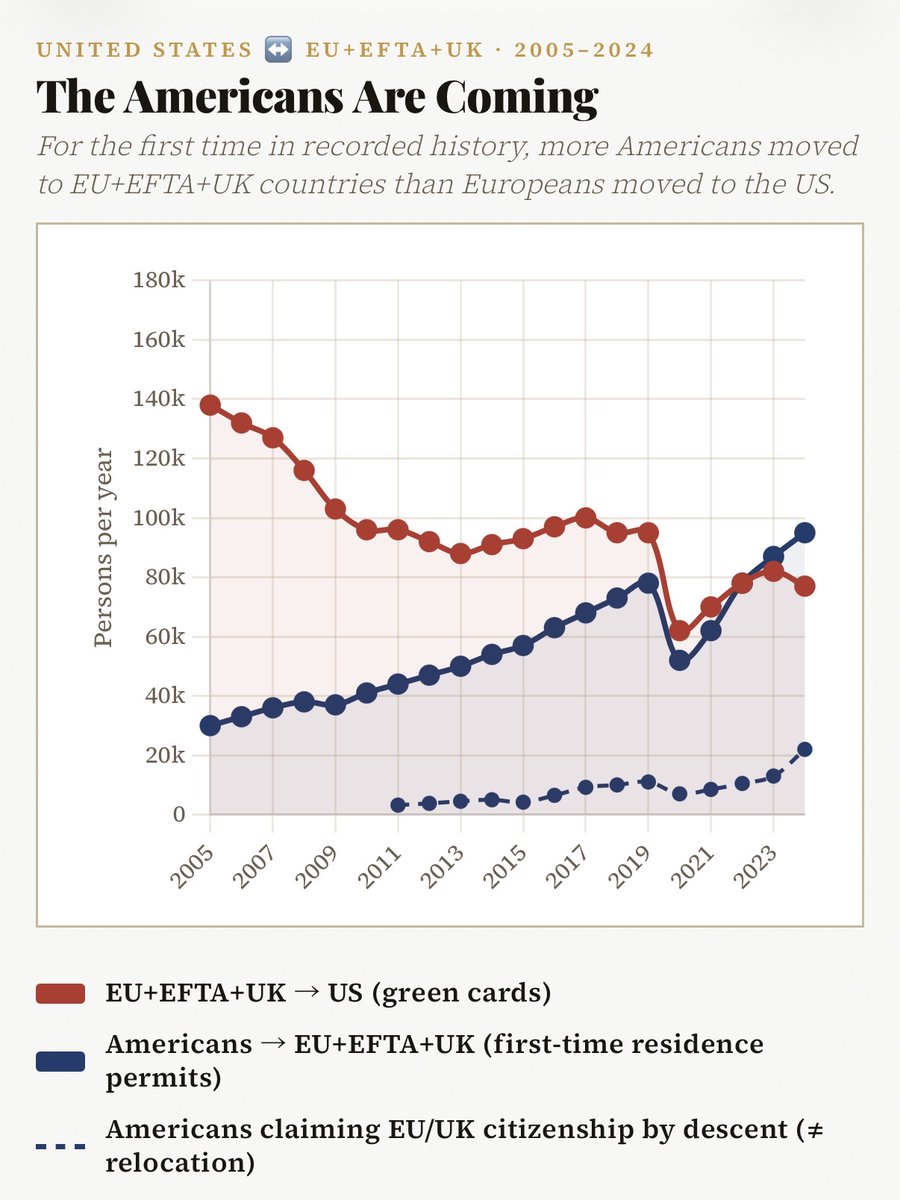
For the first time in recorded history, more Americans are moving to 🇪🇺🇨🇭🇬🇧 EU+EFTA+UK countries each year than Europeans from those places are moving to the 🇺🇸 US.
The ratio was 4:1 in favour of the US in the early 2000s. It crossed parity around 2022.
This is new.
Nvidia CEO Jensen Huang says don't listen to CEOs with a god complex on AI (lol, Dario) $NVDA
On AI destroying jobs: "these kind of comments are not helpful .. somehow they became CEOs, you adopt a god complex and before you know it, you know everything"
"ground ourselves to talking about the facts" AI will "generate hundreds of thousands of jobs .. trillions of dollars [to the U.S. economy]"
The Mayor of Seattle is 43 years old.
Never had a real job until just before being elected mayor.
Her mom and dad still pay for her childcare (her husband chooses not to work either).
And now she mocks the business community and those who want to keep what they earned.
🖕
This is the most OUTRAGEOUS deal I've seen in my 45 years on Wall Street.
SpaceX just disclosed Musk's new compensation package:
He gets up to 200 million super-voting shares if SpaceX hits a $7.5 trillion valuation, establishes a permanent human settlement of at least ONE MILLION people on Mars, and deploys roughly 100 terawatts of space-based computing power.
Let me put the 100 terawatts in perspective:
The entire electricity generation capacity of the United States is around 1.2 terawatts. The comp plan asks Musk to build more than 80x America's entire power grid... in orbit.
This is a science fiction screenplay that somehow landed in front of the SEC.
But here's why it actually matters for your portfolio...
The S-1 reportedly claims a $28.5 trillion total addressable market, with over 90 percent attributed to AI. CapeFearAdvisors flagged this one cleanly: when Palantir went public, it disclosed a $119 billion TAM and the SEC reviewed and accepted it.
SpaceX is claiming a market roughly 240x BIGGER.
Now let's talk about what is actually being sold here:
Reported 2025 revenue is approximately $15.5 billion. Starlink delivers around $11 billion of that with healthy margins, and the launch business is genuinely dominant. The problem is xAI - the AI piece doing all the heavy lifting in the trillion-dollar valuation pitch.
xAI generated just $210 million of revenue in the first 3 quarters of 2025 while burning through $9.5 billion in cash.
Ben Brey and Rupert Mitchell - a former Fidelity portfolio manager and a former head of equity capital markets at Goldman and Citi between them - ran a serious discounted cash flow on the actual operating businesses and arrived at roughly $400 billion. Lawrence Fossi covered their work recently and the math holds up.
The IPO is being marketed at $1.75 TRILLION.
The gap between what these businesses support and what Musk is asking the public to pay is roughly $1.35 trillion of pure narrative.
Then layer on what we just learned last week...
The New York Times investigation revealed Musk personally borrowed $500 million from SpaceX between 2018 and 2020 at rates as low as 1%, while bank prime rates sat around 5%. The same SpaceX has been used to bail out SolarCity, prop up Tesla during cash crunches, and absorb xAI when the AI losses became unmanageable.
This is the same playbook he's run for two decades.
Use a privately controlled entity as a personal piggy bank, and when the bills come due, find new investors to absorb the losses.
The IPO is structured to keep that game going FOREVER.
The Texas reincorporation strips away Delaware's fiduciary protections. Controlled-company status on the Nasdaq eliminates independent board requirements. And retail is being offered up to 30% of the offering (3x the normal allocation) because the institutions who actually do the math are quietly stepping away.
Here is the part that finishes the case for me:
Roughly $40 billion of the IPO proceeds are already spoken for before a single dollar reaches operations. About $23 billion retires SpaceX debt. Another $17 billion retires the high-interest debt sitting on xAI and X.
This raise is not funding the future. It's just plugging existing holes that retail investors will now own.
In my 45 years I've never seen a deal where the comp hurdle is colonizing another planet.
I've never seen a disclosed TAM that exceeds verified comparables by two orders of magnitude.
I've never seen a company asking the public to fund the retirement of debt incurred by separate private entities controlled by the same individual.
Every red flag I've watched precede a major bust over four decades is sitting in this prospectus, in plain sight.
The Tesla mispricing is being repeated on a far larger scale.
And this time the bag is being handed directly to retail.
Don't be the one holding it.
Bangladeshi MP Akhter Hossen says exit polls showing BJP victory in West Bengal is a big worry for Bangladesh.
He says if BJP wins, illegal Bangladeshis will be thrown back to Bangladesh creating crisis for them.
Now understand why Bangladeshis love TMC
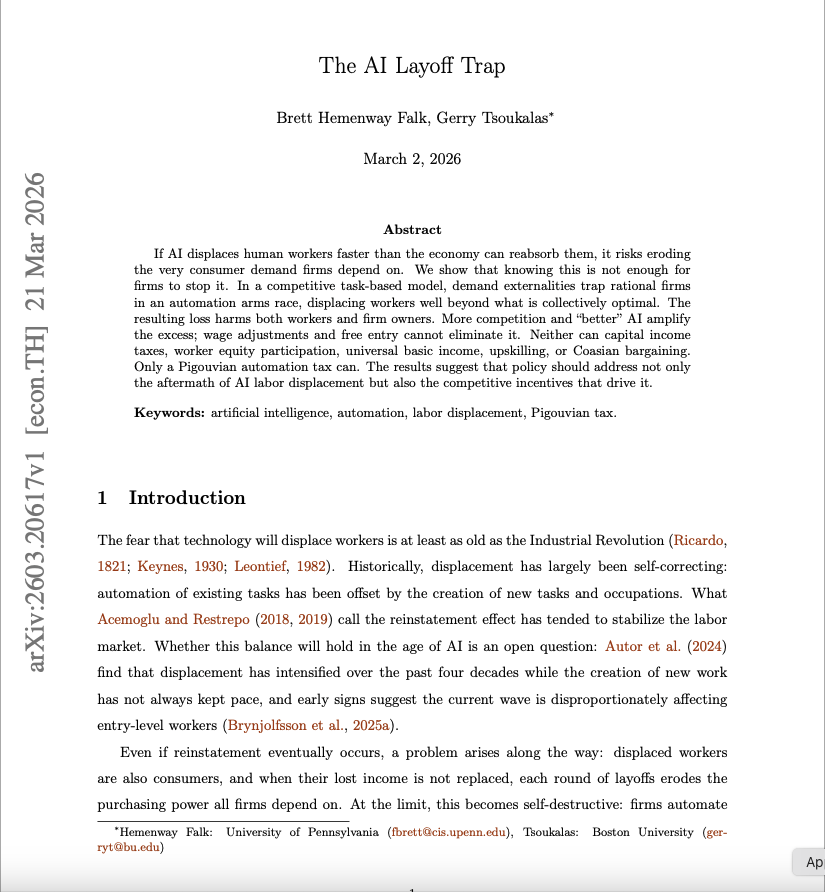
Two economists just published a mathematical proof that AI will destroy the economy.
Not might. Not could. Will — if nothing changes.
The paper is called "The AI Layoff Trap." Published March 2, 2026. Wharton School, University of Pennsylvania. Boston University. Peer reviewed. Mathematically modeled.
The conclusion is one sentence.
"At the limit, firms automate their way to boundless productivity and zero demand."
An economy that produces everything. And sells it to nobody.
Here is how you get there.
A company fires 500 workers and replaces them with AI. A competitor fires 700 to keep up. Another fires 1,000. Every company is behaving rationally. Every company is following the incentives correctly. And every company is building a trap for itself.
Because the workers who were fired were also customers.
When they lose their jobs faster than the economy can absorb them, they stop spending. Consumer demand falls. Companies respond by cutting costs — which means automating more workers — which means less spending — which means more falling demand — which means more automation.
The loop has no natural exit.
The researchers tested every proposed solution. Universal basic income. Capital income taxes. Worker equity participation. Upskilling programs. Corporate coordination agreements.
Every single one failed in the model.
The only intervention that worked: a Pigouvian automation tax — a per-task levy charged every time a company replaces a human with AI, forcing them to price in the demand they are destroying before they pull the trigger.
No government has implemented this. No major economy is seriously discussing it.
Meanwhile the numbers are already tracking the curve. 100,000 tech workers laid off in 2025. 92,000 more in the first months of 2026. Jack Dorsey fired half of Block's workforce and said publicly: "Within the next year, the majority of companies will reach the same conclusion."
Nobody is doing anything wrong. Companies are following their incentives perfectly. That is exactly the problem.
Rational behavior. At scale. Simultaneously. With no mechanism to stop it.
Two economists built the math. The math leads to one place.
Source: Falk & Tsoukalas · Wharton School + Boston University ·
https://t.co/4m8E9jQNYm
Warren Buffett, in his first sit-down since stepping down as Berkshire CEO, gave the cleanest indictment of legalized gambling in a decade. He called it a tax cut for the wealthy. The math proves him exactly right.
Americans wagered $165 billion at legal sportsbooks in 2025. They lost $16 billion of that. FanDuel pulled $6 billion of the losses. DraftKings pulled $5.3 billion. Every state with legal mobile sports betting collected a tax on the bettor side. New York alone took in over $1.2 billion in 2025 sports betting tax revenue.
Layer the lottery on top. State lotteries generate over $90 billion a year. The bottom half of income earners account for roughly 70% of total spend. The average lottery player makes $38,000. A household earning $20,000 spends three times more on tickets than one earning $30,000. The implicit tax rate, meaning whatever the state keeps after prizes, runs 30 to 50% depending on the game. No other revenue source in America has that base and that rate.
The structural design is the engine. A single straight sports bet carries a hold of 4 to 5%. A four-leg parlay carries a hold above 30%. FanDuel and DraftKings spent five years rebuilding their apps to make parlays the default product. FanDuel's blended hold rate hit 11.4% in 2025, up from roughly 7% in 2022. The product got worse for the customer and the customer wagered more anyway.
Now look at the substitution. Nine US states have no state income tax. Seven of those nine run state lotteries. Seven of those nine have legalized sports betting. The states most committed to never taxing wealth are the same states running the largest extraction machines on people who cannot afford to lose. Read it as policy.
Here is what Buffett is actually pointing at. The state needs revenue. It can raise income tax on the top decile, or it can run a lottery plus a sports betting tax. The second option raises the money from the people who can least afford it. The first option becomes politically optional. New York's $1.2 billion in 2025 sports betting tax is $1.2 billion the state did not have to ask of someone earning $5 million.
DraftKings and FanDuel sell a privatized collection mechanism for a regressive tax that the state never has to defend at the ballot box again. Voters approve legalization once. Collection runs forever. The state takes a cut. The wealthy get a quieter top bracket. The bettor's cut shrinks every quarter as the parlay menu gets pushed harder.
The function of a government, Buffett said, is not to play its people for suckers.
Thirty-nine state governments now do.
We’re interested in how AI models could affect commercial exchange. (You might recall Project Vend, in which Claude ran a small business.)
Economists have theorized about what markets with AI “agents” on both sides might look like. So we created one.
https://t.co/7jU3hFO63R