You can’t outwork the whole world. There’s always going to be someone somewhere willing to work as hard as you. Someone just as hungry. Or hungrier.
Assuming you can work harder and longer than someone else is giving yourself too much credit for your effort and not enough for theirs. Putting in 1,001 hours to someone else’s 1,000 isn’t going to tip the scale in your favor.
What’s worse is when management holds up certain people as having a great “work ethic” because they’re always around, always available, always working. That’s a terrible example of a work ethic and a great example of someone who’s overworked.
A great work ethic isn’t about working whenever you’re called upon. It’s about doing what you say you’re going to do, putting in a fair day’s work, respecting the work, respecting the customer, respecting coworkers, not wasting time, not creating unnecessary work for other people, and not being a bottleneck. Work ethic is about being a fundamentally good person that others can count on and enjoy working with.
So how do people get ahead if it’s not about outworking everyone else?
People make it because they’re talented, they’re lucky, they’re in the right place at the right time, they know how to work with other people, they know how to sell an idea, they know what moves people, they can tell a story, they know which details matter and which don’t, they can see the big and small pictures in every situation, and they know how to do something with an opportunity. And for so many other reasons.
So get the outwork myth out of your head. Stop equating work ethic with excessive work hours. Neither is going to get you ahead or help you find calm.
[The Outwork Myth — It Doesn't Have To Be Crazy At Work, 2018]
Dear managers: Stop dumping extra tasks on people who love their jobs.
5 studies: Managers mistakenly assume that if you're intrinsically motivated, you'll happily do more without burning out or expecting more pay.
Joy shouldn't come at a cost. It's time to end the passion tax.
Shopify CEO Tobi Lutke explains Goodhart’s law and why he doesn’t like KPIs or OKRs
“Goodhart’s law is real. The moment a metric becomes a goal, it’s no longer a useful metric… No metric by itself is a complete heuristic for a complex business. There’s a million different tensions in a company, and you can’t keep all of them in harmony by optimizing for one thing.”
For this reason, Shopify doesn’t use KPIs or OKRs. But as Tobi explains, this doesn’t mean they don’t value data and metrics.
“We are extremely data informed. We have invested enormous amounts of money and time into systems that give us basically everything at our fingertips… But what Shopify attempts to do is just not over-fit for what’s quantifiable.”
People love optimizing for highly-quantifiable things because there’s immediate gratification that comes from seeing a number go up. But Tobi thinks that the most important aspects of a product are rarely quantifiable:
“The overlap of the most valuable things you can do with a product and the things that happen to be fully quantifiable are like maybe 20%. Which leaves 80% of a value space unaddressable by the people who only look at quantifiable things.”
He continues:
“Shopify is comfortable with unquantifiable things like taste, quality, passion, love, hate… The sort of deep satisfaction that a craftsperson feels when they’ve done a job well is actually a better proxy if you allow it to be.”
They then have robust analytics systems that tell the company if something’s wrong or a new rollout breaks something.
“We think about it as a cockpit for a pilot. The decisions are still made by pilots, and we think this leads to better results… I think there needs to be more acceptance in business of unquantifiable things… And then metrics take a support function.”
Source: @lennysan (Feb 2025)
I'm glad to see /goal becoming the new primitive for long-running tasks.
The model does not naturally persist across turns, context windows, sandboxes, process crashes, or days of work so it needs the help of the harness.
I also love how simple it is. An "initializer agent" turns fuzzy user intent into durable workspace structure with a plan.md then "worker agents" make bounded progress against that structure and a "Judge agent" decide whether the stated completion condition is actually met or it will keep running.
Once again the abstraction is moving up the stack.
- 2024: you wrote your own while loop.
- 2025: you wrote prompt files and hooks (Ralph Wiggum)
- 2026: the loop is becoming a product primitive.
Major life hack: Don't complain, ever. Nobody likes a complainer. They drain the energy of everyone around them. It's exhausting spending time around someone who constantly complains about things outside their control. If it’s within your control, go do something about it. If it’s not, you’re just wasting energy thinking about it. Complaining gives too much power to the thing. Take back that power.
Jeff Bezos reveals the moment an early Amazon executive told him he had enough ideas to destroy Amazon:
"Early in Amazon's history, Jeff Wilke came to me one day and said, Jeff, you have enough ideas to destroy Amazon. You have enough ideas per minute, per day, per week to destroy Amazon."
"I was like, what do you mean?"
"He said, you have to release the work at the right rate that the organization can accept it."
"Every time I released an idea, I was creating a backlog, a queue, work in process. It was just stacking up, it was adding no value. In fact, it was creating distraction."
"So I started prioritizing the ideas better, keeping lists of them, keeping them to myself until the organization was ready for the ideas."
Software engineers before vs. after agents :)
If this is you: try Cloud agents (they're pretty good!) or at least Amphetamine to keep your Mac from sleeping when the lid is closed.
this is simultaneously awesome work (as always) and a strong signal into why every team should maintain their own eval sets tailored to their use cases!
anecdotally for myself and tons of people on X, these charts aren’t mapping onto experience for how good gpt-5.5 is for coding and knowledge work tasks
but this makes sense! the whole point is that every eval set captures some large distribution of abilities that will never perfectly capture what you want your agents to do in production at your company + your use cases
public eval sets are a broad signal of ability, but if that eval set doesn’t capture what your team needs your agent to do, then it’s not very useful
it takes human review and effort but bespoke Evals is probably the highest leverage thing teams can invest in today to improve their agents! related is turning on Tracing so you can see what your agent is doing
OVERRATED: running tons of agents in parallel; working on too many things at once; perpetual context-switching; opening lots of low-quality PRs that may never land.
UNDERRATED: using one or two agents at a time; focusing on the task in front of you; thinking deeply; finishing stuff; making your code works in prod.
BE ACTION ORIENTED
A different way of framing what @pmarca says below - but one that reaches the same conclusion - is that the state of mind most conducive to success is action orientation.
Psychologists have studied the states of mind that tend to make us more successful, whatever the challenge. There are at least two we can adopt: action orientation and state orientation.
Adopting an action orientation means focusing on the task ahead with no thought to your current emotional or physical state. A state orientation means you’re thinking principally about yourself: how prepared you feel in that moment, the worry you feel over a text left unanswered, the light prickling at the back of your throat.
Adopting an action orientation, it turns out in studies, makes it much more likely that you accomplish the task.
Arnold Schwarzenegger is the epitome of action orientation. In his biography on Netflix,
one of the things that stands out across all three episodes is his relentless focus on action. He says, “When I wake up in the morning, I don’t ask myself, ‘How am I today,’ [or] ‘Do I feel sad today’?” In other words, he doesn’t ruminate on how he feels on a daily basis. He adds, “If you’re busy all the time, you don’t have time to think about this stuff. Let’s just move forward. Move. Move. Move. Move.”
Classic action orientation.
the orchestration layer is the new interface layer.
as we spend our day coordinating agent workflows (in a model agnostic fashion, local and cloud) and validating outputs (human in the loop, and resolving issues), the ultimate layer to own is where coordination takes place.
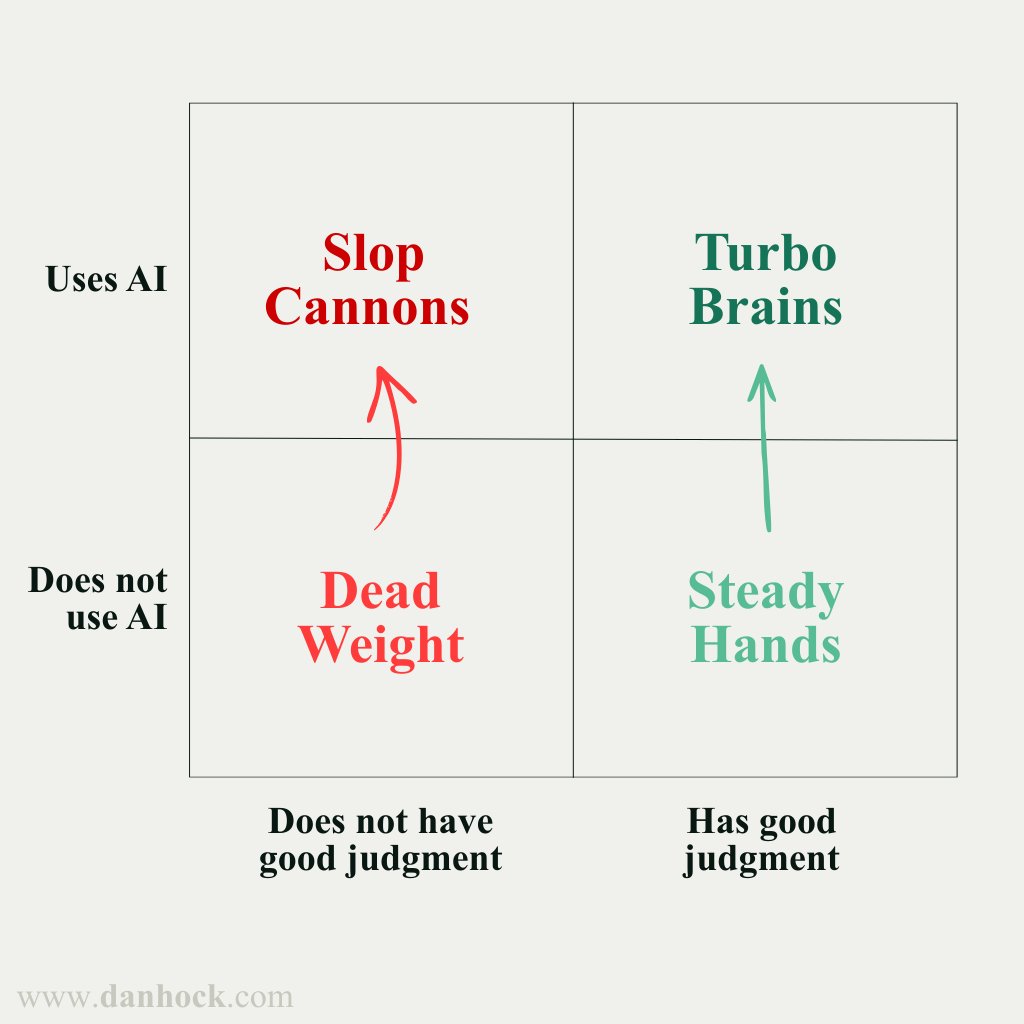
Four types of people at every company now
yes, people get 10x better when the go from bottom right to top right
but also, people get 10x worse when they go from bottom left to top left
I too am 37. One of the biggest things I’ve discovered is that the path to peace is not intense introspection, it’s activity. One full, productive day results in better emotions than hours of self-exploration
$NFLX Co-Founder @reedhastings on the klndest thing that anyone's ever done for him:
"I went into the office at 4:35 in the morning, walked in, went into the bathroom, and there was my CEO washing coffee cups."