investor/builder of cos at the intersection of sftwre and analytics, hopeful golfer, wine and sctch enthusiast, co-founder of 2 grt kids @HarvardHBS @iitbombay
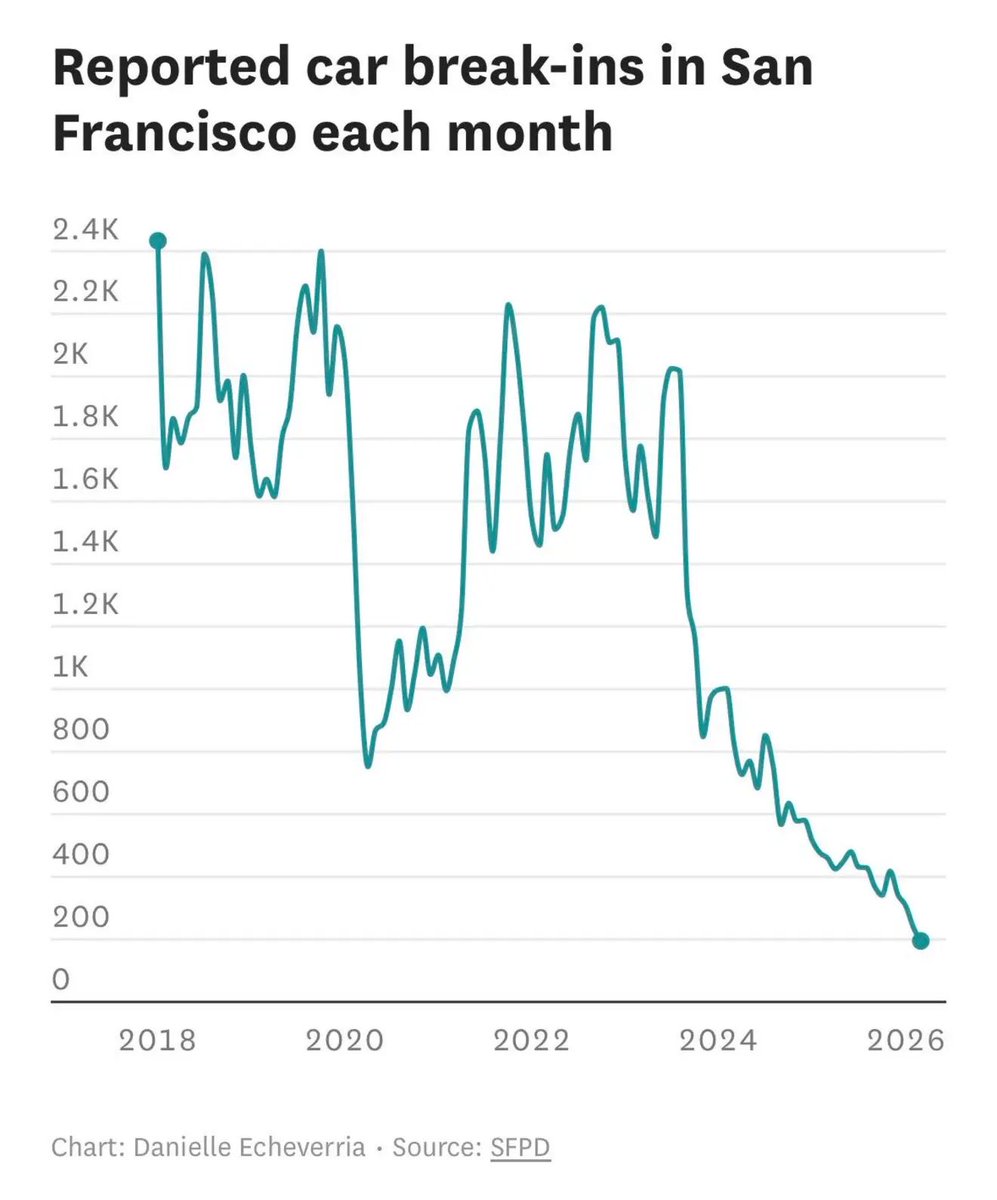
San Francisco is now a model for how to fight crime.
A few years ago it averaged 86 car break-ins per day. Today: 15.
SF did two things:
1. Got a DA that prosecutes criminals: Following the successful recall of Chesa Boudin, DA Brooke Jenkins started prosecuting prolific offenders and said so loudly. Crime dropped every year since she took office.
2. Put tech to use: In 2024, SF activated 400 license plate readers and deployed 80 drones citywide. This tech feeds officers live intelligence on suspects in motion. Drones alone have assisted in 1,000+ arrests since then. The technology lets authorities solve crimes as they happen rather than depend on much more intensive, legally perilous post hoc investigations (which ironically are often more intrusive than using tech).
The results:
- Car break-ins down 85%
- Robbery down 30%
- Burglary down 33%.
- Homicides hit their lowest level since 1954.
Plate readers, drones, a prosecutor who prosecutes. That's the whole formula!
Austin has the opposite approach. License plate cameras are effectively banned. Jail bookings are down despite repeat offenders victimizing innocent people regularly. Bond violations went from 37 in 2020 to 250 last year.
SF proved crime is a choice. Austin, so far, keeps making a different one.
I am a proud US citizen and founder of a successful startup that employs 94 employees in the US and 180+ employees globally. I was in Dubai on a business trip meeting with financial institutions to help them fight financial fraud in the region, but now I am stranded.
I expected the @usgov to do something to get US citizens out but I haven't seen any meaningful action.
After 4 days of adrenalin and constant fear, I feel demoralised and abandoned by our government. It’s difficult watching other countries – UK, Israel, Spain, Italy and India – repatriate their citizens or ensure that commercial flights continue operating to bring them home.
I became a naturalized US citizen because I believe in the American dream, and the idea that in a crisis, America never leaves its citizens behind. I see that American dream being shattered not just for me, but for tens of thousands of other Americans left stranded.
I have 3 requests of our government:
1. Can the @usgov ensure the commercial airlines don't cancel US bound flights? I've booked a dozen flights to leave Dubai and ALL of them got canceled, even as flights to other countries continue operating.
2. If that is not possible, can the USG organize planes, commercial or military, to evacuate Americans out of Dubai and the surrounding region?
I saw a very hopeful note from the Assistant Secretary of State for Global Public Affairs which states, “the US State Dept is in touch with 3,000 Americans and that we should call 1-202-501-4444 for assistance with departure options.”
But that is unfortunately not accurate. I am enrolled in Step and have only received generic messages. Further, on calling that number, the message you get is:
"Please don't rely on the USG for assisted departure or evacuation at this point. There are currently no evacuation flights at this time."
3. With funding cuts to the US consulates and with attacks on US embassies in the region, there’s no one that Americans can reach out to in the broader GCC region.
Can we set up an emergency hotline within the US that actually works, and that has someone who is taking down more details?
@SecRubio just stated that there are 1500 Americans who have contacted asking for assistance to evacuate. How did they do that because I am completely at a loss on who to call? I called up 1-202-501-4444 and all I got is a generic message.
Myself and other Americans need help getting back home.
California started with the Gold Rush and might end with the Golden Exit.
it has been underreported how much wealth has left CA because of the asset seizure tax being proposed.
a private poll was conducted amongst affected individuals a few days ago and 80-90% surveyed said they have already left CA in 2025 or will leave in 2026 if the ballot measure looks likely to pass.
$2-2.5T of assets gone, representing about $20B of annual revenue for the state government. and likely hundreds of thousands of jobs now at risk.
less reported is the bigger exodus underway from folks who are NOT directly affected but worry (as they should) that this law will quickly transition from billionaires to everyone else...
the initiative actually gives CA legislators the right to take anyone's post-tax assets anytime in the future based on a majority vote. this isn't about billionaires. it's a new "tax system" that simply destroys private property rights in America.
all private property is now public property.
even after paying your taxes, it's not legally your property anymore. it's the government's, you're just borrowing it.
legislators will decide what you get to keep and temporarily use each year.
countless founders, CEOs, and other business leaders are actively looking to move their companies out of state. not just tech, not just AI, not just billionaires, but the core engine of California's prosperity since 1847 is unraveling.
and here is how this initiative risks unraveling America:
- ~10 states have explicit or implicit prohibitions against an asset seizure tax...
- individuals affected in CA (and other states trying to do the same) will move to these states that endow private property rights.
- CA already has a $20-30B annual budget deficit, an unfunded ~$1T pension liability for public employees/unions, and $500B of debt outstanding. the state can not afford to borrow much more and will launch more asset seizures to meet its obligations.
- asset seizures will first transition to "millionaires" and eventually to the entire middle class as more asset seizures drive more people to leave the state.
- the deficit, debt, and job loss will spiral. the Golden Exit.
- no US state has ever declared bankruptcy. in addition to CA, dozens of other states face similar fiscal crises - legislators promised future benefits that can't be paid or theft and waste have been allowed to run rampant and unabated for years.
- struggling states will eventually request federal government assistance, as they always have in times of fiscal crisis, effectively "federalizing state debt".
- states not in crisis will declare "enough is enough", individuals in those states will refuse to pay their federal taxes (why pay for other people's mistakes?), some states may try to secede from the Union, and a constitutional and civil crisis will erupt.
this may seem far-fetched but it is the obvious domino effect of selectively deleting private property rights for some people in some states.
i am not a billionaire and this CA bill does not affect me, but i care about the country and the state of CA. i want both to thrive. it's obvious that there are people in CA in desperate need of support and assistance, and inequities may exist that need to be rectified, but eliminating private property rights is the wrong path for everyone.
a few alternatives to consider first:
1) with a $350B annual budget, CA can cut programs that result in theft and little-to-no benefit for citizens. $50B per year is likely recoverable.
2) if more taxes are needed, tax loans against unrealized capital gains (very few objections will arise), eliminate tax-free rollover of certain appreciated assets (real estate industry will fight), create a step up in basis on inheritance (some will fight but most will support). likely $10Bs of incremental revenue can be realized.
3) restructure all public retirement programs from Defined Benefit to Defined Contribution. eliminating the unfunded retirement liabilities ($1T+) will be the release valve on the future the state so desperately needs.
we must address what ails us without dividing and destroying our state, our nation, our home.
ignore the rhetoric, these are the facts.
Met with a number of IT execs this week and the conversation was all about the future of AI Agents in the enterprise and lessons for companies going AI-First. Here are a few takeaways around best practices that are starting to emerge.
* Focus on accelerating processes, not just cost savings. A much more interesting metric than just dollars saved is how much time the process got reduced by. While these are correlated, speeding up a process actually open up way more use cases and ideas than just dollars saved.
* Don’t obsess about ROI too early in the journey. There are plenty of cost savings to be had with AI, but overly obsessing on classic ROI metrics at this stage in deployment just limits the potential creativity around AI. It’s much better to broadly enable AI tools for employees and then see what use cases stick to drive early wins that you can replicate.
* Everyone is still hiring “junior” employees. The ability for an incoming employee to get productive is so much greater than ever before, that hiring of these roles is still a focus. Now there’s even a new reason: these new employees can help shake up the traditional work styles of the company.
* The long pole in the tent is the culture change in organizations. AI is moving faster than any organization’s ability to change how it works, and so it still takes plenty of time for use cases and lessons to propagate throughout the organization. Prompt libraries, internal sharing, letting teams explore on their own, and more are all critical to making that happen.
* Security of agents still a critical factor in adoption. Getting data architectures and permissions right is a critical dependency for AI Agent adoption. One simple rule is “AI Agents can’t keep a secret” so you need your security to be fully in place and not rely on agents to prevent any leakage or access to data.
* Interoperability still one of the top topics. One of the biggest fears for any IT organization is having data locked into one particular environment, and not being able to access it from multiple systems. AI Agents will be the same dynamic, and enterprises will need continued progress on MCP and Agent2Agent across the industry to get comfortable here.
Many other critical topics being discussed right now, but fascinating to see what the earliest adopters of AI Agents are thinking about.
This is an idea I can't stop thinking about:
Winner's Game vs. Loser's Game
In the 1999 tennis book, Extraordinary Tennis for the Ordinary Tennis Player, author Simon Ramo broke down the difference between amateur and professional tennis:
Amateur tennis is a Loser's Game. 80% of points are lost on unforced errors. You win by avoiding errors and waiting for your opponent to make errors.
Professional tennis is a Winner's Game. 80% of points are won on incredible shots. You win by hitting incredible shots.
I don't play tennis, but this is an idea that extends well beyond the confines of the court into every area of life.
There are two core insights here:
1. You have to know what game you're playing.
There's no point trying to hit magnificent shots if you're playing a Loser's Game.
You're better off keeping it simple and avoiding unforced errors.
Similarly, there's no point trying to play conservatively and avoid unforced errors if you're playing a Winner's Game.
You're better off trying to hit the elegant shots.
2. The game you're playing might change as the levels change.
What starts out as a Loser's Game can become a Winner's Game.
Example:
Your early career years may be defined as a Loser's Game. You just need to avoid big mistakes and get the work done.
Your later career years may be defined as a Winner's Game. Outsized rewards go to those who hit the magnificent shots.
I can't stop thinking about this idea. Ever since I came across it, I feel like I'm seeing it everywhere.
Three questions I'm asking myself as a result:
1. What type of game am I playing? Am I being compensated for avoiding mistakes or for executing beautifully?
2. Is that the type of game I want to be playing based on my skillset?
3. How might the game change as I rise through the levels?
Consider these questions and the idea of the Winner's Game vs. Loser's Game in the months ahead.
I promise it will change how you look at the world.
Good markets, bad markets, founders should resist most Twitter noise (except mine!). A pre-revenue founder friend asked me for advice this week on on a term sheet that would value her > $500M that she didn't think she deserved, but felt pressured to take!
Today marks the 100th day since my cousin Danny was wrongly detained in Myanmar simply for doing his job as a journalist. Today, we call on Myanmar to release Danny on humanitarian grounds, and allow him to come home to us. 1/6 #BringDannyHome
Just witnessed a car break-in on the Embarcadero in San Francisco. Guy on a bike smashed a Tesla window and took some things from the back seat. Parking lot attendant told me he’s seen five smashed windows today.
This city is a fucking mess.
As the father of a bipolar son who went through the terribly painful and enormously rewarding journey of saving my son from self-destruction due to mental illness (1/7)
@DMC_Ryan@elonmusk Obviously I want in, but how about a super simple and fair method of just sending it to the people who paid for FSD longest ago? And for people who initially bought with FSD, sort by time of deposit. I lined up in person for FSD 5 years ago - why does anyone have it before us?
After @chesaboudin cancelled his appearance on @theallinpod, I challenged him to a debate.
Mr District Attorney, we can choose a time, place and format that is respectful and mutually acceptable to you. Do you have the guts to face me?
RT if you want to this to happen.