Have journalists mastered the fine art of moving markets?
"The government would be very imprudent to cut the duty on precious metals within three months of increasing it."
On 13th May 2026, the Government raised gold and silver import duty from 6% to 15%. Nine percentage points in one shot. Steepest hike on record. Official reason: stop the dollar bleed.
Three months later, with the festive season at the door, @moneycontrolcom drops an “exclusive” that the same duty may be walked back to 6%.
26 August, 4:05 pm. Adrija Chatterjee, Priyansh Verma, Zoya Springwala. Three journalists put out this story (link below) with no named government official, no on-record quote from any department, and no PIB statement. Just enough sensation to do the job.
And the job got done.
Within minutes, Indian gold and silver fell 5–7%. LBMA didn’t follow. COMEX barely flinched. We collapsed. Thousands of stop-losses got hit. Small retail players will have lost a fortune.
If you write a market-moving copy on bullion in this country, we all know what 4 pm on MCX does. If this were true, every dealer and jeweller who had stocked up for the festive season around the corner would take an immediate mark-to-market hit. In a gold-obsessed country like India, the panic can be colossal. The losses even more so.
Anyone who needed an exit on the short side would have got one. Convenient.
Now look at the lawmakers - because this is where it gets interesting.
This is not one tweak. Gold duty in India has been ping-ponged for fourteen years - 2, 4, 6, 8, 10, 12.5, 10.75, 15 - then slashed to 6 in the July 2024 Budget to “kill smuggling.” Imports then exploded. FY26 gold bill hit a record $72 billion. So on 13 May they slammed it back to 15% and called it 'in the national interest'.
What did 15% duty buy us? Officials said monthly volumes fell from 75–100 tonnes to 25–30. The dollar bill still rose - May $3.41 billion, up 34%; April–May $9 billion; Q1 about $11 billion, up 47%.
July already doubled again to $4.16 billion as the trade restocked for festivals. And smuggling did what it always does at 15% plus GST:
Lok Sabha data showed gold seizures up 186% after the hike, silver up ten times. Same movie as 2022. High duty, smuggling. Low duty, the import bill blows up. We have run both experiments. Repeatedly.
So if the government now cuts it again in August 2026, 100 days after they raised it, they are telling the market one of two things. Either the May call was panic, and they will not stand behind it. Or policy is a seasonal product - hike when the rupee coughs, leak a cut when jewellers and festivals start shouting. That is not a framework. That is a mood.
No importer, no jeweller, no bank can plan a book when the levy is 15 in May and “maybe 6” in August on the strength of three unnamed sources. The tax is not only the 15%. The tax is the uncertainty.
A government that really meant this duty cut would not leak it through three reporters and then go missing.
Surendra Mehta of @IBJA1919 said it without the poetry: Zero merit in reversing now. Silver is still under licence. So either the Finance Ministry has lost the plot, or it never said this.
China is still buying gold. Someone with size has been stacking December COMEX calls at $10,000, $15,000 and $20,000 strikes while the metal sits near $4,600. That is not a jewellery restock. That is someone paying for a world in which $4,600 looks cheap. Against that, this Indian “duty may be cut” note reads less like reporting and more like a flush.
So I’ll ask the three journalists directly. Who were the sources? Or was it a desk that needed an exit from its shorts? I am sure you couldn't have had a personal vested interest.
Why was no official named in the same story? Why no follow-up the next morning saying you called the ministry and they declined? You moved the Indian bullion market on a whisper and hid behind “sources said” and “no decision yet.” That last line is not caution. It is cover. Where is the follow-up?
I am not alleging that the three of you personally traded the print. I am saying the print still moved the market. If the cut is real, the government should say so - and then explain what changed since May. If it is not, the market still moved on your story. Either way, the responsibility is yours.
@adrijac , @PriyanshVerma4 , @ZoSpringwala : you do not owe us the sources by name. You do owe the public a named official, or a clear line that the ministry declined comment. “Sources said” and “no decision yet” are not enough when Indian gold and silver gap 5–7% in minutes and London does not. That is not a request for a scalp. It is a request that a market-moving exclusive carry the same weight as the damage it did.
And if the government does walk the duty back within a quarter of raising it, that embarrassment is theirs to own. Until they speak, the chaos and the uncertainty belong to the story that created it.
https://t.co/foVVGB9UIv
#gold #silver #preciousmetals #mcx
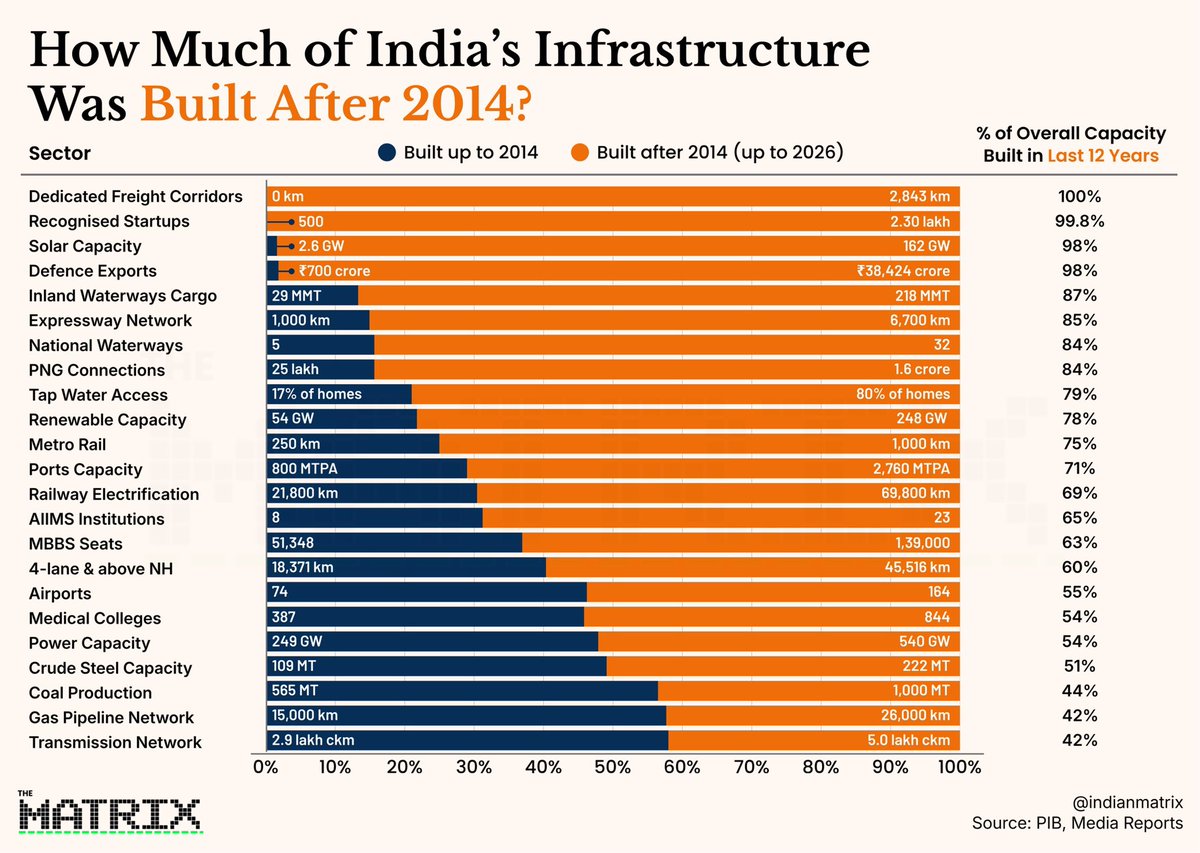
How much of India's infrastructure was built after 2014?
• 100% of Dedicated Freight Corridors
• 98% of Solar Capacity
• 85% of the Expressway Network
• 79% of Tap Water Access
• 75% of Metro Rail
• 71% of Port Capacity
• 69% of Railway Electrification
• 60% of 4-Lane National Highways
Infrastructure is built over decades.
But some decades build more than others.
#shilpamedicate#concordbiotech
The Patent Cliff Is Coming — Here's What It Means for Your Pharma Portfolio
If you invest in Indian pharma stocks, there's one story you should understand right now: a wave of the world's best-selling drugs is about to lose patent protection. When that happens, cheaper copies (generics and biosimilars) flood in, prices crash, and someone has to make all those cheaper copies. That "someone" is very often an Indian company.
This is called a patent cliff. It's happened before, but the one coming between 2025 and 2030 is the biggest in over a decade. Here's what's expiring, who stands to gain, and — importantly — which smaller, less obvious companies are also in the game.
First, the size of the prize
Roughly ₹22–23 lakh crore worth of drug sales (in the US market alone) are set to lose patent protection between 2025 and 2030. Just the top 20 drugs on that list are worth about ₹16.9 lakh crore a year today.
Indian companies won't capture all of that — most estimates say India could realistically capture around ₹29,000–48,000 crore a year once you account for how much prices collapse after a patent expires. That's still a meaningful, multi-year growth opportunity for the sector.
The drugs going off patent (and why they matter)
Keytruda (Merck) is the world's best-selling drug, bringing in roughly ₹2.8–3.1 lakh crore a year treating various cancers. Its core US patent is expected to expire around 2028. Because it's a biologic — a complex protein, not a simple chemical pill — copying it requires a "biosimilar," which is far harder and costlier to develop than a regular generic.
Eliquis (Bristol Myers Squibb / Pfizer) is a blood thinner doing around ₹1.15 lakh crore a year. Generic versions are expected in the US from around 2028. Being a simple pill, it should be much easier and faster for generic makers to copy once the door opens.
Stelara (Johnson & Johnson) treats immune conditions like psoriasis and Crohn's disease, worth about ₹96,000 crore a year. Biosimilar competition has already begun since 2025.
Opdivo (Bristol Myers Squibb) is another major cancer immunotherapy, at roughly ₹86,000 crore a year, expected to lose US protection around 2028–29. Like Keytruda, it's a biologic.
Xarelto (J&J / Bayer), a blood thinner worth about ₹67,000 crore a year, faces US patent expiry around 2026 — one of the more closely watched pill-based cliffs.
Farxiga (AstraZeneca), used for diabetes and kidney disease, does roughly ₹67,000–74,000 crore a year, with key patents starting to lapse from 2025.
Entresto (Novartis), a heart-failure drug worth about ₹58,000 crore a year, already saw its first US generics launch in July 2025.
Ibrance (Pfizer), a breast cancer pill worth ₹52,000–61,000 crore a year, is expected to face generic competition around 2027.
Enbrel (Amgen / Pfizer), an immune-disease biologic worth about ₹52,000 crore a year, is expected to lose protection around 2028.
Prolia/Xgeva (Amgen), used for bone health, brings in ₹38,000 crore-plus a year; its US patent already expired in 2025 and biosimilars are launching.
Januvia/Janumet (Merck), diabetes pills worth ₹21,000–36,000 crore combined, lose protection in 2026.
Why the "pill vs. biologic" distinction matters: simple pills (Eliquis, Xarelto, Entresto, Ibrance, Farxiga) are easy for Indian generic companies to copy — that's the business they've done for 20+ years. Biologics (Keytruda, Stelara, Opdivo, Enbrel, Prolia) are complex proteins grown in living cells — copying them ("biosimilars") is much harder, much more expensive, and only a handful of Indian companies can actually do it. That difference matters when you're deciding which stock is a "safe, obvious" beneficiary versus a "harder, higher-payoff" bet.
The large caps everyone already knows about
If you follow pharma investing, these names will sound familiar as the "usual suspects" for this theme:
Biocon — India's most established biosimilar player, already selling multiple biosimilars globally, roughly a fifth of the US insulin glargine market.
Dr. Reddy's Laboratories — has partnered with Alvotech to develop biosimilars for both Keytruda and Prolia/Xgeva.
Zydus Lifesciences — has licensed a pembrolizumab (Keytruda) biosimilar candidate and is racing to be an early filer.
Cipla — investing heavily in biosimilar R&D, plus a strong existing US generics business.
Sun Pharma — India's largest pharma company, a potential contender in the Keytruda biosimilar race.
Aurobindo Pharma — doubled its biosimilar R&D budget, has a large US generics/injectables base.
Lupin — building out its own biosimilar pipeline alongside complex generics.
Torrent Pharmaceuticals — was among the first to launch a generic version of Entresto in the US.
Natco Pharma — known for winning tough, litigation-heavy "first-to-file" generic opportunities, especially in oncology.
These are the names that show up in every analyst note on this theme. If you want simple, liquid, well-covered exposure to the patent cliff, this is where most investors start.
The less obvious part: small and micro-cap names
This is where it gets more interesting — and riskier. Most of the coverage on this theme focuses on the big names above. But a few smaller companies are directly involved, and some are actually named in company announcements and analyst calls.
Shilpa Medicare — the clearest small-cap story here.Shilpa Medicare is officially classified as a small-cap stock (around ₹11,000–12,000 crore market cap). Its subsidiary, Shilpa Biologicals, just signed a deal with Finland's Orion to co-develop and supply a biosimilar version of Opdivo (nivolumab) for Europe — Opdivo being one of the exact drugs on our patent-cliff list above (~₹86,000 crore in annual sales). This isn't a vague "we're exploring biosimilars" statement — it's a named molecule, a named partner, and a named market. That makes Shilpa one of the few small-cap stocks with a specific, real bet on this exact theme, not just thematic exposure.
Concord Biotech — the "picks and shovels" small cap.Also SEBI-classified as small cap (~₹11,000–14,000 crore). Concord makes fermentation-based APIs (the raw ingredients) used in immunosuppressant and oncology drugs. It doesn't own a branded biosimilar itself, but brokerage Antique Stock Broking recently resumed coverage with a "buy" rating, specifically pointing to the 2026–2028 patent cliff (around 90 drugs, worth roughly ₹5.1 lakh crore) as a long-term tailwind for domestic-focused generic ingredient makers like Concord.
A few mid-caps worth knowing (bigger than "small cap," but still smaller than Sun Pharma/Cipla-scale names):
Neuland Laboratories (~₹23,000–25,000 crore) — management has openly called GLP-1 peptide manufacturing (used for diabetes/weight-loss drugs going off patent) a "key growth driver," and is building a dedicated commercial peptide facility for it.
Sai Life Sciences — a contract manufacturer whose management has confirmed on an earnings call that it has "clinical assets in the GLP-1 space."
Anthem Biosciences — went public in 2025 and has since grown into large-cap territory, but PL Capital (Prabhudas Lilladher), which initiated coverage with a "BUY," specifically flagged its specialty ingredients business benefiting from a GLP-1 API ramp-up from the second half of CY26, alongside biosimilar launches, as named growth drivers.
Why you won't find many true micro-caps here
If you were hoping to find a tiny, under-the-radar stock with huge upside on this theme — that's genuinely hard to find, and here's why: making a biosimilar costs roughly ₹100–150 crore per molecule and requires specialized biologics manufacturing know-how. That's simply out of reach for most very small companies. So at the smallest end of the market, the real exposure usually comes through supplying ingredients or manufacturing capacity to the bigger players — not through a tiny company owning its own branded biosimilar. Shilpa Medicare is the exception that proves the rule, and even it required years of investment to get there.
What this means for an investor
1. The opportunity is real, but it's not evenly spread. Simple-pill generics (Eliquis, Xarelto, Entresto-type drugs) are lower-risk, lower-reward — almost any decent generic company can make these. Biosimilars (Keytruda, Stelara, Opdivo-type drugs) are higher-risk, higher-reward — only a few companies can actually pull them off, but the payoff is bigger if they do.
2. Big names = safer, more diversified exposure. Biocon, Dr. Reddy's, Cipla, Sun Pharma, and peers are unlikely to "blow up" your portfolio, but they also won't 10x on this theme alone — it's one growth driver among many for a large, diversified business
3. Smaller names = concentrated, higher-conviction bets. Shilpa Medicare's Opdivo biosimilar deal, or Concord Biotech's ingredient-supply tailwind, are the kind of bets where a single deal or launch matters a lot more to the stock price — which cuts both ways.
4. Patents don't just expire on schedule — companies fight to delay them. Merck alone has reportedly filed around 300 patents around Keytruda to push out competition. Litigation, patent extensions, and settlements can delay these dates by years. Don't assume the calendar dates above are locked in.
5. Biosimilar sales don't collapse to zero overnight the way pill generics do. Doctors and patients switch to biosimilars more slowly than they switch to a generic pill, so even a "successful" biosimilar launch takes longer to show up in a company's revenue.
Bottom line
The 2025–2030 patent cliff is one of the more durable, multi-year growth stories in Indian pharma — real demand, real numbers, and real company-level evidence (deals, concall commentary, capacity build-outs) backing it up. The big names give you steady, diversified exposure. Shilpa Medicare and Concord Biotech give you smaller, more concentrated ways to play the same theme, with more company-specific risk attached. Either way, this is a theme worth tracking company announcements and quarterly concalls for — because the winners here will be decided by execution, not just being in the right sector.
[Not investment advice, DYOR]
18 women in Nagpur, Maharashtra complained about kidney problems to their doctors in the span of two years. Doctors saw a pattern and checked that all of them were using this pakistani cream sold by many Instagram pages and meesho.
FDA Maharashtra took the cream samples. Sent to lab and found out that it has 752x mercury present in it above the legal limits. yes, 752x.
Yes, This mercury (poison in this case) can make you goree in 15 days because it blocks the cell that makes melanin. But in reality thats a chemical damage that looks like fairness. And guess what, our skin absorbs mercury and keeps getting deposited in kidney all the time.
I know you might not be using this cream or meesho, but please check around, especially with your house help and your family members back in hometown, if they are using this cream, please ask them to throw it RIGHT AWAY!!!
Supriya Shrinate, I just watched your 12-second masterclass in Congress-brand secular cosplay where you casually dropped “Imam-e-Hind” on Lord Shri Ram and then launched into your greatest hits of dilution. Bravo. Let’s go point by point and laugh at every single one, because this wasn’t a speech it was performance art in historical revisionism and vote-bank gymnastics. Sit down, this is going to take a while.
Watch this 7 part rebuttal point by point 🧵 thread.
@FI_InvestIndia These people are most likely in their late 30's or early 40's. Household income would be upwards of 1.5cr pre-tax conservatively or may have generational wealth.
Quite sure they would value the educational pedigree over the 75k monthly SIP.
I wanted to check: did any ace investor spot India's nuclear theme BEFORE the Fast Breeder Reactor went critical?
So I went through the Dec 2025 shareholding data of every major portfolio. Here's what came up.
Mukul Agrawal quietly built a 4-stock nuclear basket without anyone noticing.
✍️ HCC (Hindustan Construction Company) This is the company that built 60% of India's nuclear power capacity. Tarapur, Kakrapar, Kudankulam. Every major reactor, HCC did the civil construction.
✍️ PTC Industries Specialised alloy castings for reactor internals. Precision components that go inside the core. Niche. Hard to replicate. Years of qualification needed.
✍️ WPIL Ltd Pumps for reactor cooling systems. NPCIL is a direct client.
✍️ KRN Heat Exchanger Heat exchangers are critical for reactor thermal management. Every new reactor needs them.
4 companies. All in the nuclear supply chain. All in one portfolio. All bought BEFORE the PFBR achieved criticality on April 6, 2026.
A ₹7,000 crore portfolio doesn't take 4 bets on one theme by accident.He saw the nuclear capex cycle coming before the headlines did.
Now here's the bigger picture of what's ahead:
🔸 8.18 GW installed today → 100 GW target by 2047
🔸 ₹20,000 Cr Nuclear Energy Mission
🔸 Atomic Energy Act amendments opening the sector to private players for the first time
🔸 3.8 GW of fast breeder capacity planned by BHAVINI
🔸 ₹18,000-20,000 Cr PLI scheme coming for nuclear component makers
Defence went 5-10x after the capex cycle began in 2020. The smart money is now front-running the same playbook in nuclear.
Why is the money flowing now & not 20 yrs ago?
Uttar Pradesh is the only state in India building a Hexagonal Connectivity Grid. By 2026, it will have ~50% of India's total expressway network. In logistics forensics, Time is the only currency.
The Ganga Expressway & Bundelkhand Expressway are Data & Power Corridors, not just roads. By placing industrial clusters at the interchange points (the nodes), UP has reduced the Factory to Port time from 72 hrs to less than 24. For a global CEO, that 48 hr difference is the difference b/w a Proposal & a Grounding.
Also, look at the Noida International Airport (Jewar). It is designed to be India's largest airport, but its forensic value is not just for passengers but for High-Value Cargo.
UP is playing a Land-Locked Paradox game. Since they have no sea coast, they are building the maritime port of the air. This has triggered a Silicon Valley style land grab in the Yamuna Expressway Authority region.
Companies like Samsung & Microsoft are not investing in UP cos of momentum; they are investing cos they want to be within a 15 min flight-radius of their supply chain.