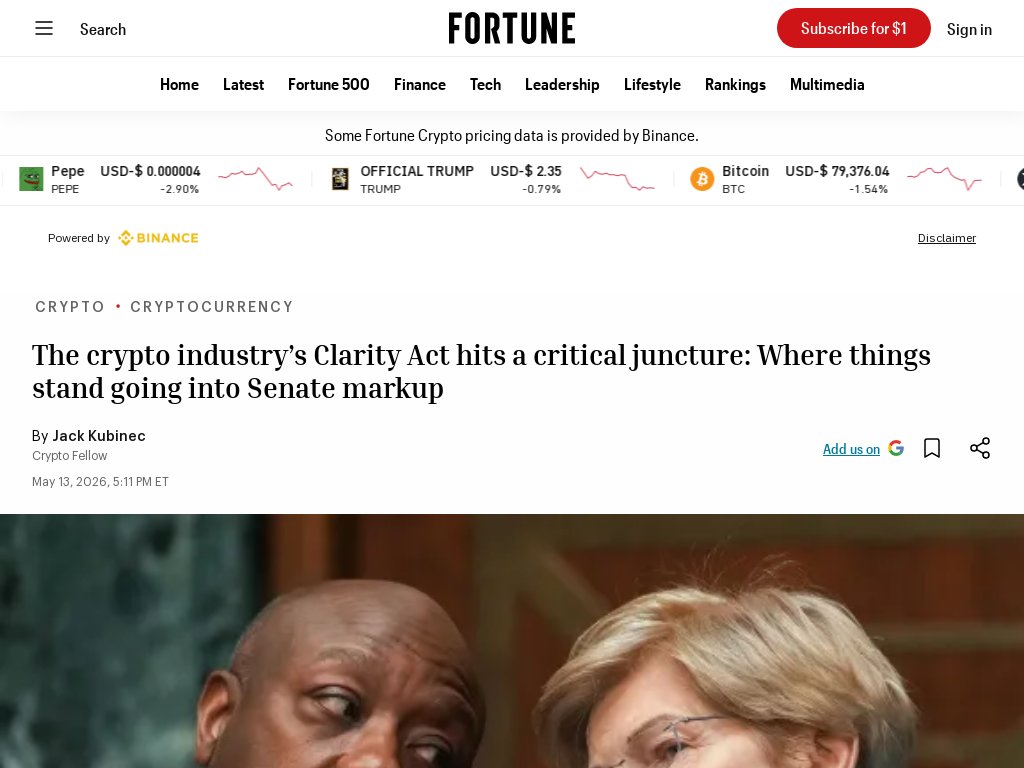
Etherealize general counsel @syelderman on the Clarity Act in Fortune:
“I think it’s going to pass, based on all the great progress that has been made on both sides of Congress, and the support this bill is getting from the White House,” Steve Yelderman, general counsel of Ethereum-focused advocacy organization Etherealize, told Fortune. “That said, it’s Washington, and anything could happen.”
Etherealize general counsel @syelderman on the Clarity Act in Fortune:
“I think it’s going to pass, based on all the great progress that has been made on both sides of Congress, and the support this bill is getting from the White House,” Steve Yelderman, general counsel of Ethereum-focused advocacy organization Etherealize, told Fortune. “That said, it’s Washington, and anything could happen.”
What makes blockchain technology neutral infrastructure (like a highway) and what makes it a regulated intermediary (like a bank)?
The debut episode of Proof of Research is now live feat. @SMULawSchool Professor @Prof_CarlaReyes & @Etherealize_io General Counsel @syelderman 🎙️
Today we’re introducing a new Legal Agent in @Microsoft Word, built to support the precision and rigor legal work demands. Every clause matters. Every redline tells a story. That’s why this agent was built to follow the structured workflows lawyers use while keeping them fully in control.
Early in my career, I asked for a computer on my desk because I believed technology could change how lawyers work. It did. Today, I believe this next generation of tools will do the same, grounded in trust and responsible use.
Last week, @TheDRC_ hosted Policy Day at @EYnews 10th Annual Global Blockchain Summit, and the takeaway was clear: digital asset policy is entering a consequential phase.
The conversation is no longer about whether digital assets are here to stay. It’s about whether policymakers and regulators can deliver rules that provide clarity, support innovation, and preserve the core benefits of decentralized technologies.
Grateful to join @_jikim, @Advocate4Web3, and @SH_Brennan to discuss the latest on the CLARITY Act and what meaningful market structure legislation could unlock.
We also heard strong insights from @syelderman and @fundstrat on institutional adoption, @MarinaMarkezic on EU regulatory developments, and @dao_officer and @kkirkbos on the barriers facing L2s and their critical role in the ecosystem.
I was especially glad to host Taylor Lindman for his first public engagement since becoming Chief Counsel of the @SECGov's Crypto Task Force, where we discussed the SEC’s new interpretive guidance and regulatory agenda.
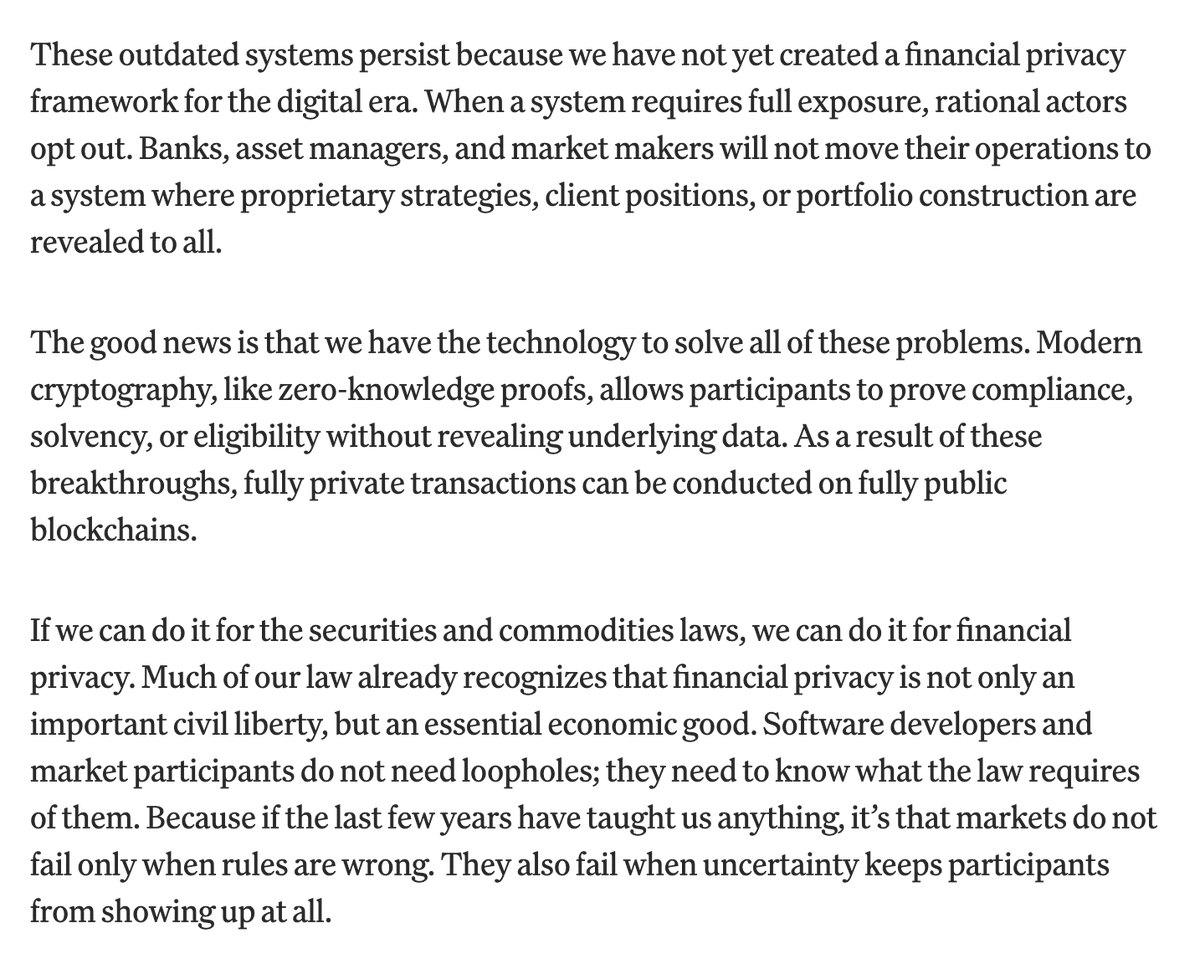
New Op-Ed from Etherealize General Counsel @syelderman in @CoinDesk on why privacy is the next regulatory frontier to onboard banks, asset managers and market makers.
"Much of our law already recognizes that financial privacy is not only an important civil liberty, but an essential economic good. Software developers and market participants do not need loopholes; they need to know what the law requires of them."
my friend at Anthropic said they’re routing your requests specifically to the dumbest model (his name is Steve and they made him by distilling a CVS receipt)
Surrounding yourself with sycophants leads to:
* Dunning–Kruger effect
* Less critical thinking
* Loss of touch with reality
Never forget that most LLMs are explicitly trained to be sycophantic, because humans love feeling flattered. It's basically the AI industry's nicotine.
@ViktorBunin Even in the US we massively tax human employment - directly through payroll and indirectly through workers comp, employment litigation, etc. New Deal Accelerationism.
I predict recipe subscriptions and actual recipe books are going to boom in the next few months / years. No one wants to cook literal slop suggested by AI.
This is counterintuitive for some, which is why there’s a paradox named after it. But if you lower the cost of something that was previously supply constrained, demand for that thing goes up. Software engineering is just one of the easiest examples to contemplate.
The process goes like this: every small business, every IT team, every large enterprise sees that engineering can now drive vastly more output. They then start to consider all the new things they can build or automate. They even test building prototypes themselves.
They only get so far with that approach because they realize there are still 50 other tasks that go into building software and maintaining it. So they start to hire more engineers to do that work. All of this for work they never would have considered automating or having software for if AI didn’t exist.
So yes, automating tasks, in plenty of fields, will lead to demand for experts, not less.
6/ This is the AI hype cycle I worry about. If we overbuild a few data centers, so be it. But if we hand over the keys and abandon human expertise in places that matter, we may not appreciate what we’ve lost until it’s too late.
https://t.co/PaHJsOk3SF
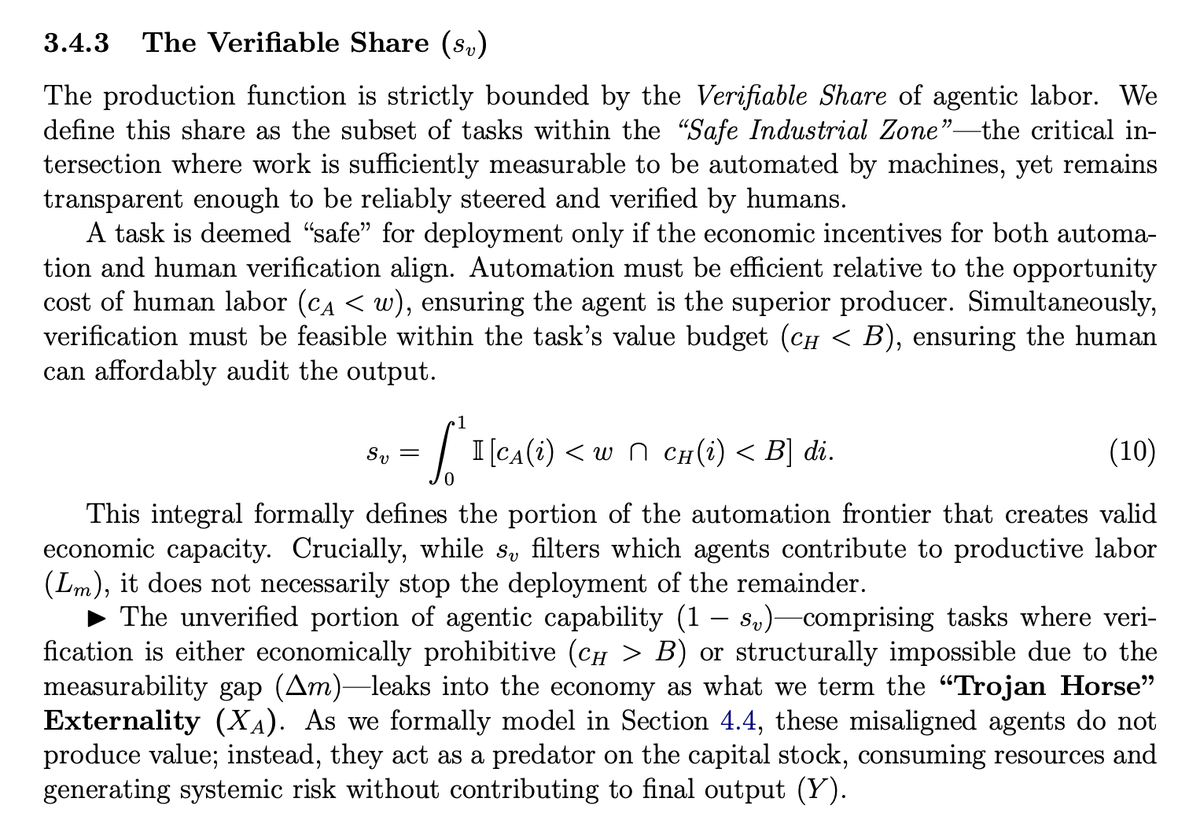
@claudeai 34/ Runaway Risk Zone—cheap to automate, but unaffordable to verify. This is where the structural danger lives. And as the Measurability Gap widens, more of the economy migrates here.
1/ A brilliant insight: Execution is no longer the most important constraint on our output. Rather, it’s the ability to verify that work has actually been done correctly. It’s an inversion of scarcity between doers and supervisors. https://t.co/4QNrAt7rKv
21/ Verification is the ultimate complement to abundant intelligence—and it is structurally scarce. In the agentic economy, durable advantage belongs not to those who generate output but to those who can certify it.
5/ Now take that and replace your doctor, accountant, kid’s teacher, therapist, etc. Without an ability to measure performance, we are throwing ourselves to the wolves.
https://t.co/RD1E6lCqDX