Research coach for PhD & Master's students | Methodology, lit reviews & stats (SPSS·R·NVivo) | You do the work — I make sure it's sound | Manchester PhD
@pash22@alexolegimas An interesting title. Papers that propose a framework are strongest when they state which empirical predictions would show it to be wrong.
@edenhofer_jacob Price controls are a good test case for survey design. Wording and information about trade-offs can change support substantially, so report them.
@kanawakakasuga Good advice. Starting from a problem you want to explain, then narrowing by population, setting and time, usually makes the topic workable.
@ProfEmilyOster The Bayesian bootstrap is a good teaching tool. It makes uncertainty intuitive and offers a smooth alternative when small samples make the standard bootstrap unstable.
@blekhman This raises a real norm question. Journals may need clear policies on AI-generated text, so reviewers know what is expected before accepting.
@changmyung1981 An important distinction. Profiling tRNAs engaged in translation, not just those present, could change how we interpret codon usage and expression.
@oprydai A good intuition. Holding other variables fixed is the key idea, and plotting slices of a surface helps students see what each partial derivative means.
@emollick Useful data. Time saved on routine steps matters most if researchers reinvest it in design, checking and interpretation, which still need human judgement.
@WithBukky Teaching what you read is a strong way to test understanding. Writing a short summary in your own words after each study shows where gaps remain.
@JuanluCaba_Unex Well put. Choosing alpha should reflect the cost of each error type, and effect sizes with confidence intervals show whether a result matters.
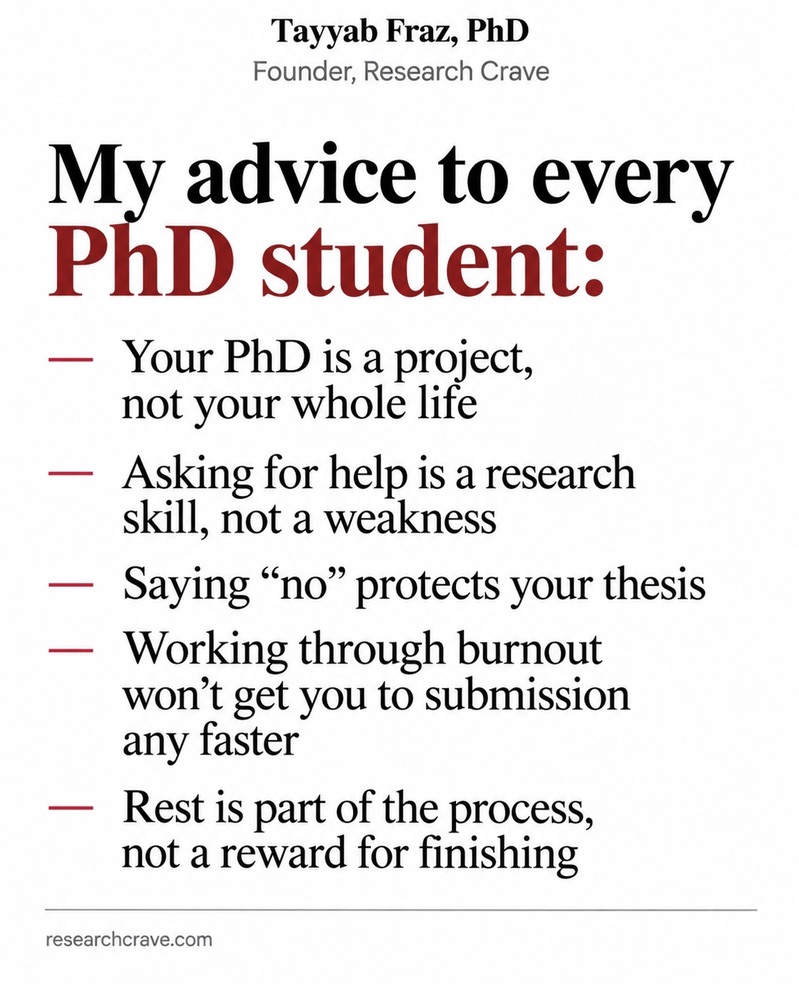
A PhD is a project, not your whole life.
Ask for help early. Say no when you must. Rest before burnout, not after.
A thesis is finished by people who last, not people who push through everything.
Which of these do you need to hear today?
@Zen_with_AI Good chapter to revisit. Making thinking visible through routines, such as asking students what makes them say that, helps it transfer to research.