You don't understand how BIG this Hermes "Judgement Release" update actually is.
This is a major workflow upgrade for agents that learn, remember, verify, and execute in the background.
→ MoA is first-class now. You can run model committees like any model and watch reasoning + final aggregation live.
→ /learn turns URLs, workflows, and directories into reusable skills fast.
→ /journey + memory graph makes agent memory visible and editable. No more blind trust.
→ self-verification + completion contracts means done = tested + logged evidence.
→ background subagent fan-out + Projects gives real parallel execution in desktop.
Translation: This is Hermes moving from a cool open-source demo to a system you can actually run serious work on.
We're so early.
I wouldn't frame it this way. But I would say that in the current AI industry, no single layer of the stack (hardware, compute, model, application) is enough to give you a moat.
Almost all players in the space have started expanding from their initial position to other layers of the stack.
OpenAI went from models to applications and now hardware.
xAI went from models and applications to compute and is now effectively a hyperscaler selling compute capacity to other AI labs.
Nvidia started with hardware but is also making interesting moves in the open source LLM space (with the Nemotron family).
You need a serious foothold in at least two layers of the stack.
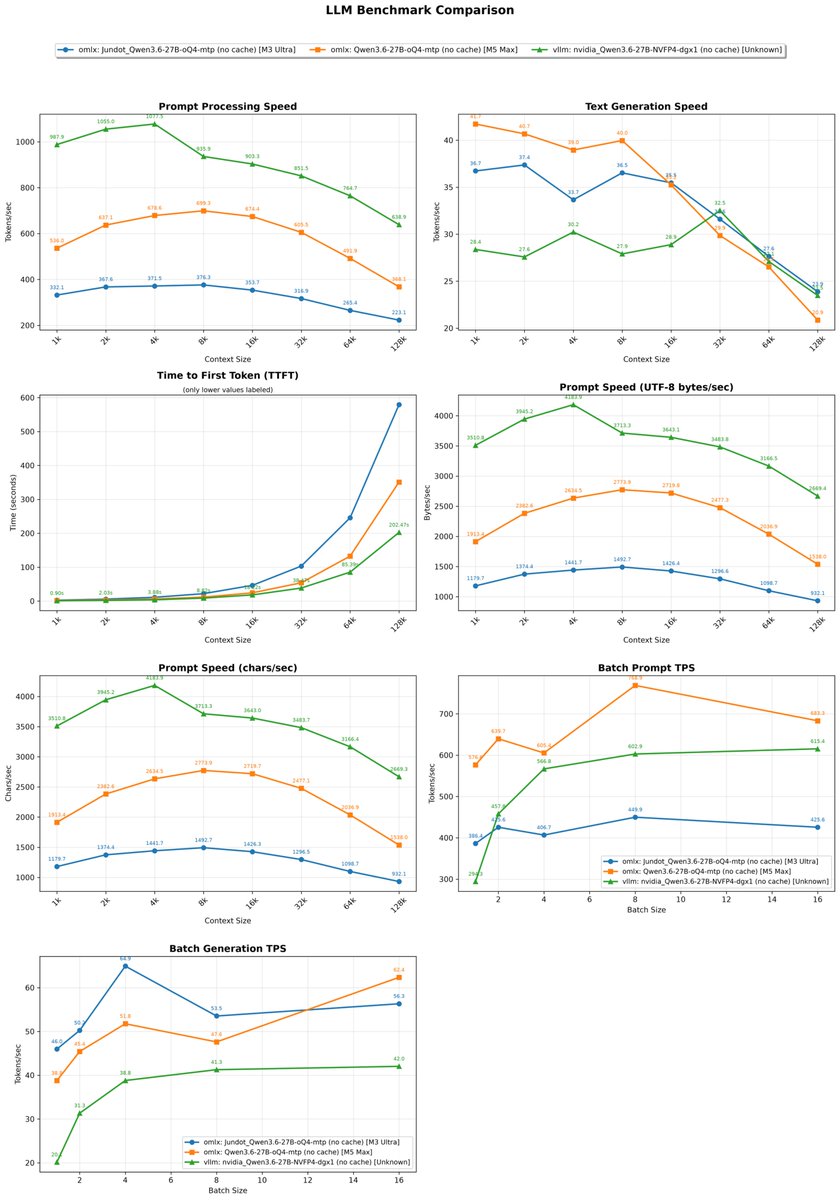
Qwen3.6-27B MTP Context Benchmark on DGX Spark, M3 Ultra and M5 Max 🔥
Quantization: nvfp4 vs oQ4
Sofware: vllm 0.24.0 DGX, oMLX 0.4.5dev1 (without cache) on Apple Silicon
DGX Spark is the winner on Prefill/Promp Processing
Apple Silicon on Decoding/ Text Generation
Details of each run 👇
What’s great about current AI services is that you can effectively track and study your competition.
It makes the competitive landscape quite open and accessible, though often aggressive.😅
There will surely be a rise in demand for skilled software engineers, especially if you have experience fixing sloppy and poorly structured code.
As companies grapple with the reality that "it's AI agents all the way down" was kind of a pipe dream and they need human engineers to steer and manage the AI agents, they will hire more.
Also, with software engineers being able to do more with less, the price of software will drop and more industries will be able to enter the software market.
I also predict the rise of customized software as a service (CSaaS), where a small team of software engineers with AI will be able to service several customers and build and maintain bespoke applications for them.
The humans will still be there. The AI builds on top of human skills.
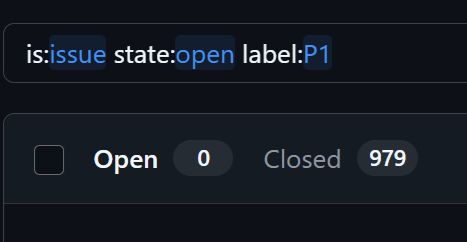
Super proud to say that the team and I put almost all our effort into resolving every P0 and P1 issue and PR in the entire Hermes Agent repo over the last week and a half, and as of 5 minutes ago, after an all-nighter, we've resolved 100% of them all!
Extremely special shoutout to @Kshitijjkapoor who's been burning them away with me day and night!
We aim to keep all of them 0 forever from here 🫡🫡
There’s a lot of disinformation going around about $META “cutting capex” because they “overbuilt”.
This is an “if” they have excess capacity.
And it looks like the opposite right now:
Hyperscalers like $GOOGL are so compute constrained that they had to cut allocations to Meta back in March.
Since Meta was using too much for internal projects.
Meta was immediately constrained so it looks like they were forced to immediately sign massive $48B+ contracts with Neoclouds like $CRWV and $NBIS.
Meta is selling excess capacity if there’s any, especially since their large contracts are take or pay from the Neoclouds.
If anything, I’m expecting their guided capex to go up as they build out more independent capacity.
I handed one cheap AI model a screenshot of a dashboard and said "build this."
3 minutes and about 50 cents later, it had read the screenshot, pulled live crypto prices off the web itself, and shipped a working app.
One small model did the seeing, the searching, and the coding.
How it ran, below.
reminder
Scientists just created 100× Faster Infrared-Guided nanorobots for precision drug delivery.
Researchers developed NIR-IIb magnetic nanorobots that use 1600 nm infrared fluorescence for real-time "GPS-like" navigation inside living bodies.
In live mice, the nanorobots were successfully steered through the liver, spleen, hindlimb, peritoneal cavity and lower gastrointestinal tract using external magnetic fields.
Loaded with the anti-inflammatory drug 5-aminosalicylic acid (5-ASA), they stayed stable in pH 2 gastric fluid for over two weeks, moved 100× faster and delivered drugs with 30% higher efficiency than previous approaches.
A glimpse of a future where doctors guide medicine directly to diseased tissue instead of exposing the entire body to unnecessary drugs.
“China will crash the US stock market this year.”
by releasing open source models that are almost as good as frontier labs, at a fraction of the price.
if Anthropic and OpenAI can’t justify the prices, they can’t justify their valuation.
that’s how a bubble pops.
Alleged spyware-like hidden backdoor in Claude Code: analysis claims it checks timezone/region/proxy signals and injects them into system prompts through heavily obfuscated binary logic paths.
Anthropic now generates nearly 2x more revenue than OpenAI, with only a fraction of ChatGPT's users.
When they started, Anthropic's primary target was Software Engineers and high-end working professionals.
This created a very premium brand image.
While OpenAI started with targeting the general audience now moving towards high end professionals.
Very different strategy of scaling a business.
people are still underestimating Grok
xAI was behind in coding, but then news came out that Cursor had trained on xAI super colossus data center, and i already had a feeling elon might try to buy them out
composer 2.5 is really good, and with this partnership, xAI can catch up
My favorite part of our recent essay on AI's impact on software engineering is this figure. It succinctly describes the *irreducible complexity* of software predicts how software engineering will evolve.
The most impactful AI-based software will adopt this mental model to empower SWEs for decision-making and delivery, while taking on a bigger chunk of execution. @lateinteraction's work (such as on @DSPyOSS) is a perfect early example.