House Speaker Johnson argues that $200K isn’t enough for members of Congress to support their families, so they should either get a raise or be allowed to trade individual stocks. Otherwise, he says, America won’t attract qualified people to serve.
Whether Republican or Democrat, I think we can agree they’re in office to SERVE, it is called being a public SERVANT, and we don’t need them doing it for decades. One or two terms, max. After that, they get so captured by special interests they’ll do whatever it takes to stay in office. No thanks.
As for stock trading, the evidence is overwhelming that people picking individual stocks underperform the market. The only way a member of Congress beats it is with inside information, which both parties have shown, repeatedly, they’re willing to use and make unearned, unethical profits on the backs of the American taxpayer.
There should be no raises and no stock trading allowed for anyone in Congress.
I've spent the past few weeks reading 100s of public data sources about AI development. I now believe that recursive self-improvement has a 60% chance of happening by the end of 2028. In other words, AI systems might soon be capable of building themselves.
after reading the appendix, I'm not sure what to take away from this. 1PL IRT collapses capability vectors into one scalar, but capability clearly isn't one-dimensional, even in their own data. multidimensional IRT is better but won't give one easy number. this use of elo has caught on and I think it compresses too much.
Some metrics Chinese AI models have fallen further behind*. Other metrics show they've closed the gap. On Artificial Analysis, Kimi 2.6 is 3 months behind the US frontier and the gap has shrunk.
* - Even on CAISI's chart, Deepseek V4 is ~8 months behind. In any other industry, we'd call that hypercompetitive.
Big scoop from me: Anthropic's Mythos AI model -- the cybersecurity model it says is so powerful it can enable dangerous cyberattacks -- is being accessed by unauthorized users. Gift link!
https://t.co/eBqNtS7bRJ
Donna was diagnosed with pancreatic cancer at age 66 when she and her husband were visiting one of their daughters in Australia. When they returned to the U.S., they immediately came to MSK for care, where she learned she was eligible for an investigational vaccine trial, to prevent pancreatic cancer from returning after surgery.
MSK hepatopancreatobiliary surgeon Dr. @Jeffrey_Drebin, physician-scientist @TheVinodLab, and medical oncologist @EileenMOReilly walked Donna through each step.
“They described how they would take part of my tumor to make a personalized vaccine, and it sounded amazing,” Donna says. “My husband and I had a moment of concern about delaying chemotherapy, but all the doctors made me feel so comfortable that we took the leap of faith and said, ‘Go for it.’”
Over the next few months, Donna received an immunotherapy drug and eight doses of the vaccine, followed by chemotherapy, and then a final vaccine dose.
Today, Donna is 72 and recently celebrated her 50th anniversary with her husband in Sicily and spends as much time as she can with her daughters and six grandchildren.
Learn more about this clinical trial, presented at the 2026 American Association for Cancer Research Annual Meeting: https://t.co/C0IwK11OaA
#AACR26
Video of a humanoid robot chasing wild boars out of a Warsaw neighborhood and into the woods — and then waving goodbye — has gone viral in Poland. https://t.co/L2uJ9nwVOO
"For the first time in the history of this war, Ukraine has captured an enemy position using only ground robots and drones. The occupiers surrendered. The operation was carried out without infantry participation and with zero losses on our side." - Zelenskyy.
"I am a flawed person in the center of an exceptionally complex situation, trying to get a little better each year ... We are all learning about something new very quickly; some of our beliefs will be wrong ... It will not all go well." — Sam Altman https://t.co/SB0MVHqy6a
world models are a sexy misnomer.
@ylecun , @nvidia , and @drfeifei
are all building world models. they are not building the same thing.
lecun is working on cognitive architecture: a system that builds causal models of reality and plans inside them. nvidia is building simulation infrastructure: physics-based environments that train, evaluate, and run physical AI systems at scale. fei-fei li is building spatial intelligence: systems that understand and reason about physical space. same term. three different bets. three different timelines.
bundling them into one category inflates the hype. it also hides where value actually accumulates.
the simulation moat is the most obvious. native physical interaction data was scarce. synthetic environments filled the gap. but as robotics companies accumulate real interaction data at scale, that scarcity could end. the world model framing was a data poverty artifact.
the spatial intelligence bet is the most grounded. fei-fei li is trying to give machines a persistent, accurate model of physical space: where things are, how they move, what they afford. narrow, reliable, deployable. the timeline is shorter.
the cognitive architecture bet is the longest. what lecun is actually building requires three components: a causal model of how the world works, a forward simulator that imagines possible futures, and a pruning mechanism. a prior over which futures are worth simulating at all. that third component does not exist in any current system. it is the difference between prediction and genuine planning.
three definitions. three timelines. three completely different implications for where value accumulates.
For people who want to start learning neural network and backpropogation, I highly recommend the lecture 3 on Stanford CS224(NLP with deep learning) by Dr. Manning, I think it is the most clear, detailed, and beginner friendly lecture for the neural network.
what a beautiful, unique soulful experience late last night with this homeless man in Las Vegas. he called my name as I walked by. I was surprised so I stopped to say hello and help him out with a little cash. He told me a story how he was at the launch of the #vanhalen #1995 balance Tour in #pensacolaflorida he told me what I was wearing that night, things I said. Remembered #jonstewart introducing us. this man was intelligent, kind, spiritual, and elegant. We talked for a while, and it was enlightening for me to realize how many people like him, families, etc., that have become #homeless I can see it. I just don't know what to do about it.
I'm quoted in this piece so let me provide my full comment to the reporter:
The most striking thing about the government's filing are the things it *doesn't* mention. It doesn't mention anything about Anthropic hesitating to allow Claude to be used to defend an incoming hypersonic missile, for instance -- one of the many bizarre things alleged by @USWREMichael.
The focus on foreign national employees is an indicator of how thin the DoW's case is. It is also an extremely fraught line of argument to go down.
Every leading US AI company employs a substantial number of foreign nationals. In FY 2025, Amazon, Microsoft, Meta, Google, Apple, Oracle, Cisco, Intel, and IBM all appeared in the top 50 employers by number of granted H-1B visas, ranging from a few hundred to over 6,000. Meta alone had 5,123 approved H-1B petitions in 2025.
(See:
https://t.co/73XKGkvRAQ )
This is an undercount, of course, as there are many other visa pathways as well as greencard holders and dual nationals.
The share is also higher in AI. A large plurality of the core research and engineering talent at every frontier AI lab is foreign, reflecting the global nature of the race for top AI talent. One talent tracker shows Chinese-origin researchers constitute roughly 40% of top AI talent at US institutions. Total foreign nationals likely constituting 50-65% of research teams specifically. This is certaintly true to my experience on the ground.
(See: https://t.co/thzLgLeybL )
So the first point is that employing foreign nationals, including Chinese nationals, is not unique to Anthropic. The more important question is what measures are taken to protect against insider threats.
Ironically, within the industry Anthropic is widely considered to be the most serious and proactive about policing insider threats from foreign nationals and otherwise. They were early adopters of operational security techniques like compartmentalization and audit trails, in part because they were early to partner with the IC and DoW, but also as a reflection of their leadership's strong convictions about the future power of the technology.
They were audited last year on these points: the compliance review found Anthropic employs role-based access control, just-in-time access with approval workflows, multi-factor authentication for all production systems, and quarterly access reviews.
(See: https://t.co/Q9lMy6Gcra )
Anthropic is known for its security mindset more generally. Last year they famously disrupted a Chinese espionage effort occuring on their platform, banned the PRC from their services, and worked with the NSA and others to share intel.
I can't speak to every other company, but the contrast is perhaps most stark with xAI. X employees famously slept in tents to work around the clock, are disproportionately Chinese, and have at least one case of an employee walking out with tons of sensitive data. See: https://t.co/T5irwL0IN3
Anthropic is also famous for its remarkable employee retention, which is another important vector for IP theft and security leakages.
It's important to underscore just how precarious the DoW's case is, both on the legal merits, and as a potential precedent for the US AI industry. If employing foreign nationals is treated as a prima facie supply chain risk, *no* major US AI company would be eligible to contract with the DoW, along with most of the tech sector.
Insider threats are a genuine and tricky concern. Many defense companies are ITAR restricted, meaning they can *only* hire US citizens. If that were the standard in AI, we would destroy all our frontier companies in an instant, and then scatter that talent around the world for our adversaries to scoop up.
So in short, the DoW's argument is both ridiculous and playing with fire.
This was the biggest robotics funding PR week I've seen, ever. As in the number of companies that announced raises of over $100m.
I'm going back 25 years and haven't seen anything like it.
@arxiv is recruiting a CEO who will lead the organization as it becomes an independent non-profit. This is an exciting opportunity to improve the infrastructure for open science! The job advert is here: https://t.co/kWIrEivCJP
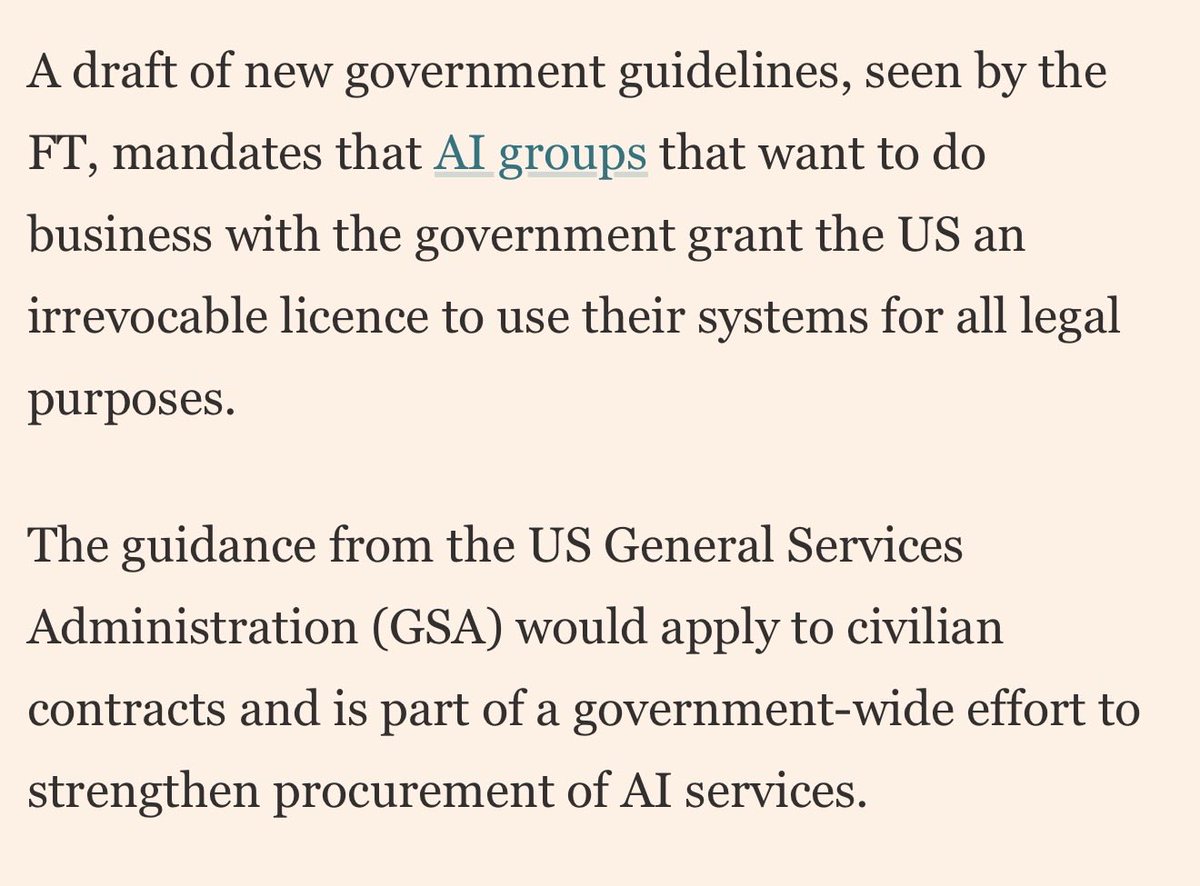
The Financial Times is reporting that GSA has drafted new guidelines requiring AI companies to grant the government an “irrevocable license” to use their systems for “any lawful” purpose.
This is not the Pentagon—this is the civilian side of federal procurement. If the reporting is accurate, this is a far bigger procurement law problem than the coverage suggests.
GSA is the federal government’s central commercial buying agency, including through the Multiple Award Schedule.
The FAR’s commercial acquisition framework is designed to anchor these deals in customary commercial practice, not government-unique terms (absent limited waiver authority).
Under that framework, contractors generally are not required to grant the government broader usage rights than those customarily available in the commercial marketplace. An irrevocable all-lawful-purposes license is *not* a customary commercial market term.
I have (many) questions about this, but I will limit this to two:
The first question is process: what mechanism is GSA using, and does it have the authority to impose this through it?
The second is substance: what does “irrevocable” mean when the product is a cloud-hosted AI service that depends on ongoing hosting, compute, maintenance, and operational controls? What exactly is the government claiming a perpetual right to use?