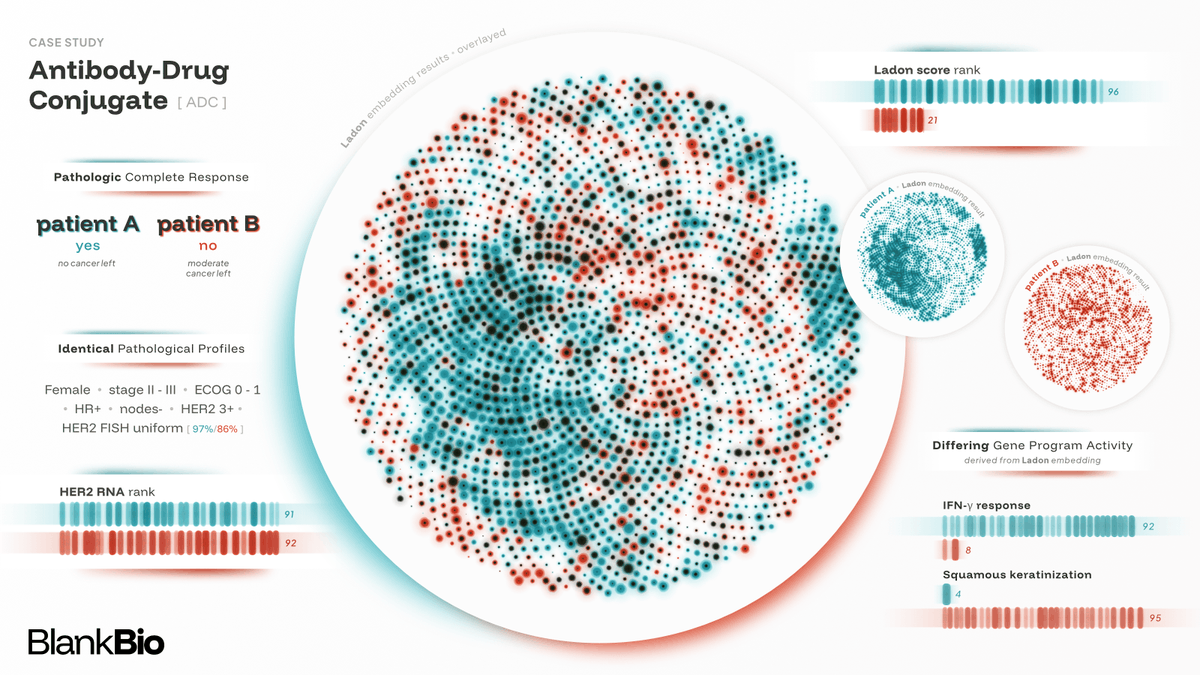
Today, we are excited to introduce Ladon, a state-of-the-art biological foundation model that predicts disease trajectory and treatment response in patients. There is immense complexity in the individual biology of every patient. Two patients can have the same diagnosis and receive the same treatment, yet have very different outcomes: one responds well and lives for years, while the other’s disease continues to progress. Understanding and resolving this heterogeneity to predict outcomes is how we accelerate our delivery of medicines for patients and unlock clinical trial abundance.
Ladon is our first step towards this future: one where we can learn more from every patient enrolled so that we can run smaller, faster trials with higher success rates. We built it to give drug developers quantitative support on billion-dollar clinical trial decisions. Today we're excited to share Ladon's capabilities in our blog and technical report.
Ladon is a 3B parameter model trained on millions of RNA-seq samples spanning decades of technical and biological variation across tissues and species. Ladon beats gene expression baselines, established biomarkers, and existing RNA foundation models at predicting patient prognosis and therapeutic response in 140+ oncology tasks, including external validation on past clinical trials. This is significant because clinical trials are fundamentally generalization problems. We show that Ladon-derived predictions are robust across indications, treatments, and sequencing platforms.
Reach out if you’d like to get started with the model today!
Read more about Ladon in the blog: https://t.co/dpDCYE4wRv
Find more technical details in the white paper: https://t.co/dpDCYE4wRv
Standard PG analysis requires "all-iterate coverage" ie bounded π*/π_t ∀𝐭. What if we only assume it at 𝐭=𝟎 (eg base model has nontrivial success rate on all prompts)?
Ans: 𝐞𝐱𝐩𝐨𝐧𝐞𝐧𝐭𝐢𝐚𝐥 complexity due to "coverage collapse". https://t.co/K3oQqoznV1
What is TMLR doing under a 300% increase in submissions?
- Suspensions of >150 authors
- Publicly naming major violations
- Submission quotas distinguishing slop patterns
- Desk rejections 6% → 53%; focus on clarity
- AI reviews evaluating soundness
https://t.co/TCFt0TB9RU
🧪Can AI agents take a scientific paper and write a meaningful follow-up to it?
We introduce Into the Unknown, an AI agent benchmark of 15 open scientific research problems. Each problem comes from a scientist currently or formerly at US DOE National Labs:
@LosAlamosNatLab@SandiaLabs@BerkeleyLab@AmesNatLab@PPPLab@Livermore_Lab
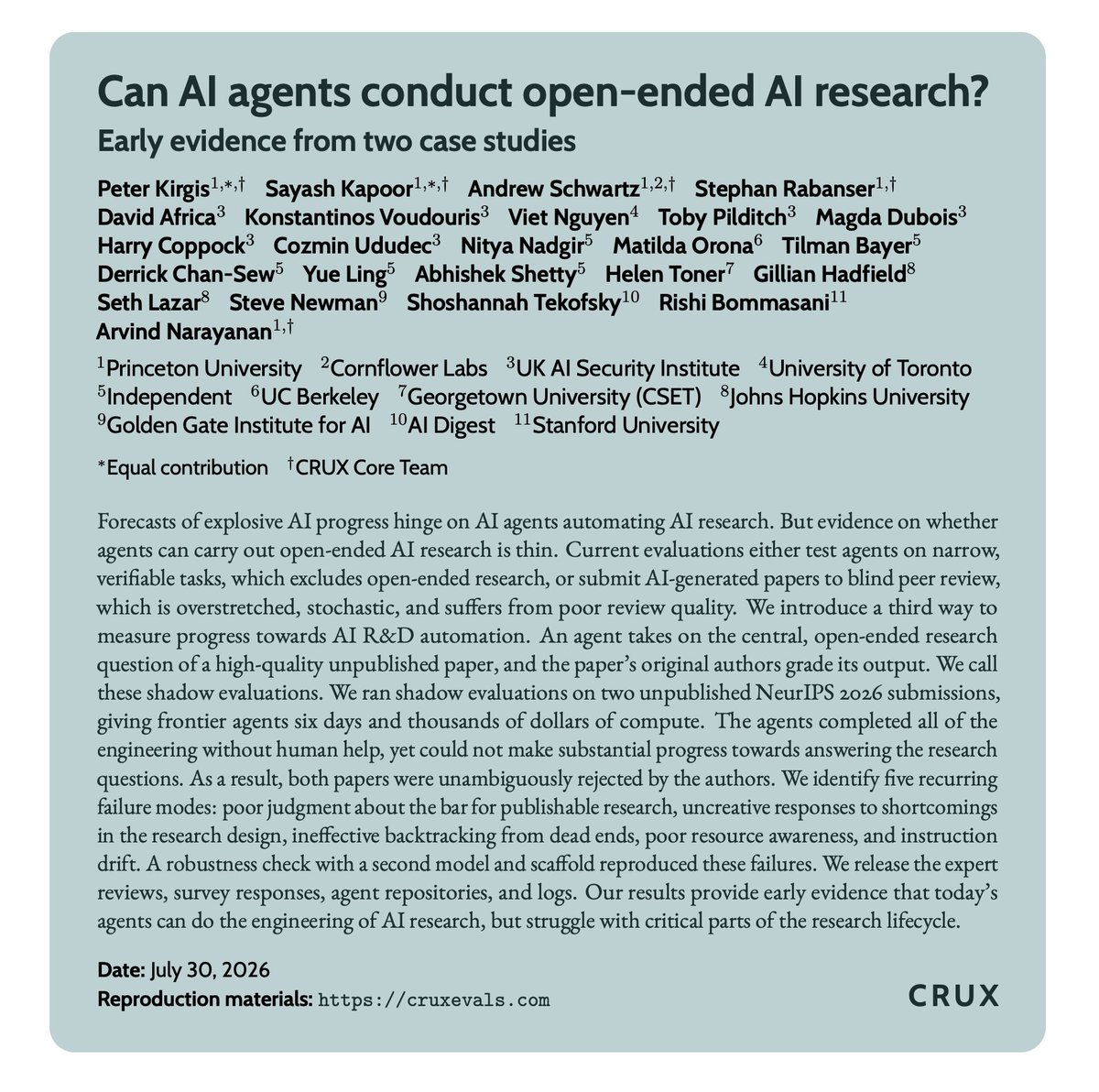
We’ve been hard at work on CRUX 2, the latest iteration of our research stream for open-world evaluations of frontier AI. With growing excitement around recursive self-improvement, we assessed progress toward automated AI R&D using a new method we call shadow evaluations.
📄Paper: https://t.co/l4zyI29lgl
🕸️Web page with artifacts: https://t.co/qzKEaRRWvb
Joint work with:
➡️@PKirgis, @sayashk, Andrew Schwartz, @random_walker from the CRUX core team; ➡️@DavidDAfrica, @KozzyVoudouris, @defo_not_gpt3 as the authors of the original papers;
➡️Toby Pilditch, @nityndg, @matilda_orona, @tilmanbayer, @dchansew, Yue Ling, Abhishek Shetty who helped with our extensive log analysis;
➡️@DubMagda, @HarryCoppock, @CUdudec, @hlntnr, @ghadfield, @sethlazar, @snewmanpv, @shostekofsky, @RishiBommasani from our extended set of CRUX collaborators.
Are you a PhD student struggling to get a job or internship? Jealous of the success of your more-cited peers? More concerned with your career than doing good science? Here is a thread of eight invaluable techniques to "improve" your publication and citation metrics.
vv 🧵🧵🧵 vv
Instead of showing R < A + B + C and bounding each component one after the other, why do people bound the components separately first using magical numbers out of nowhere, and combine them together some 5 pages later into the proof where the numbers chosen FINALLY make sense?!