Massive stars form inside dense, crowded protoclusters, where molecular clouds fragment into smaller clumps, cores and finally compact condensations, the immediate “seeds” from which individual stars or close multiple systems can form.
A key question has been whether magnetic fields still control the shape and collapse of these very small structures, or whether chaotic turbulent motions become more important at that stage.
Using @almaobs dust-polarization observations from 30 high-mass star-forming regions in the Milky Way, the MagMaR survey has provided the largest statistical view so far of magnetic-field structures around these compact condensations.
The result is striking: on larger scales, gas structures are often elongated perpendicular to magnetic fields, as expected if collapse is strongly guided by ordered magnetic fields. But at the much smaller scale of about 0.01 parsec, ALMA finds that the condensations tend to be elongated parallel to their local magnetic fields.
That reversal matters because it suggests a change in the physics that dominates star formation with scale. The team compared the ALMA data with magnetohydrodynamic simulations. When the simulations began with magnetic fields dominating turbulence, the condensations were shaped mainly perpendicular to the field.
But when turbulence dominated, the simulated condensations showed the same kind of parallel alignment seen by ALMA. This implies that, in the small dense seeds of massive star clusters, turbulent gas motions may be more important than magnetic fields in shaping the material that will later feed massive stars.
The finding does not mean magnetic fields are irrelevant. They may still be crucial on the larger scales of molecular clouds and clumps, helping to organize gas, regulate collapse and build the reservoirs from which stars form. What changes is the balance of power. The study suggests that magnetic fields may dominate the large-scale architecture, while turbulence becomes increasingly influential in the compact, dense condensations where individual stars or multiple systems begin to assemble.
The researchers also found signs that magnetic fields may be misaligned with the rotation axes of some condensations, which could reduce magnetic braking and make it easier for large protostellar disks to form around massive young stars.
👉 https://t.co/OkaedloytM
.@ESA_Euclid has captured the largest and most detailed visible-light image ever made of the Milky Way’s central region, revealing more than 60 million stars packed into the galactic bulge.
Although Euclid was built mainly to study dark matter and dark energy by mapping billions of distant galaxies, this observation shows how powerful its wide-field visible camera is when turned toward our own Galaxy.
In about 26 hours, on 23 March 2025, Euclid produced a mosaic from nine pointings, each covering an area of sky larger than the full Moon. The result is not just visually impressive; it is scientifically valuable because Euclid can separate individual stars in one of the most crowded regions of the sky without being overwhelmed by the brightness and density of the field.
The main scientific value of this image is exoplanet research through gravitational microlensing. Microlensing occurs when one star passes in front of another from our line of sight and its gravity temporarily magnifies the light of the background star. If the foreground star has a planet, the planet can add a small distortion to that brightening.
This is especially useful in the direction of the Galactic centre because the density of stars makes these chance alignments more likely. ESA notes that almost 300 exoplanets have already been found this way over the last 20 years, all with ground-based telescopes and all toward the centre of the Milky Way. Euclid’s new image includes 51 known planetary systems and will help scientists study many more.
Euclid’s observation was too short to discover new microlensing events by itself, because such events require monitoring the same stars for more than 20 days. Its importance is different: it provides a very sharp reference image of the region before future alignments occur. When NASA’s Nancy Grace Roman Space Telescope detects microlensing events in the same area, astronomers will be able to compare Roman’s data with Euclid’s earlier image. That comparison can help separate the lensing star from the background star, measure their relative motion, confirm whether a planet is really present and estimate its mass.
This is also a good example of how a mission designed for cosmology can produce high-impact Galactic science. Euclid was launched in 2023 and is intended to build a vast 3D map of the Universe over six years, tracing the influence of dark matter and dark energy through the shapes, distances and motions of galaxies. But here it has turned into a powerful tool for studying stars, dust, brown dwarfs, binary systems and cold exoplanets inside the Milky Way itself.
In my view, the most interesting part is not only the scale of the image, but the fact that it becomes a time capsule: a precise record of how this crowded stellar field looked before future microlensing events happen. That makes it far more than a beautiful picture. It is a baseline dataset that future planet searches will return to repeatedly.
👉 https://t.co/Fg9zupVUSZ
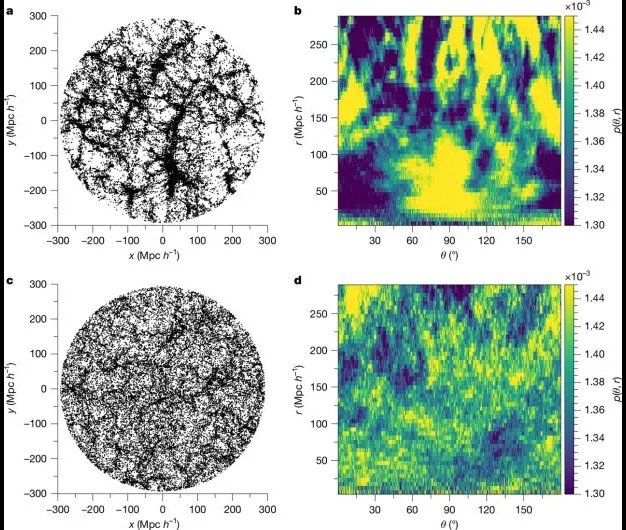
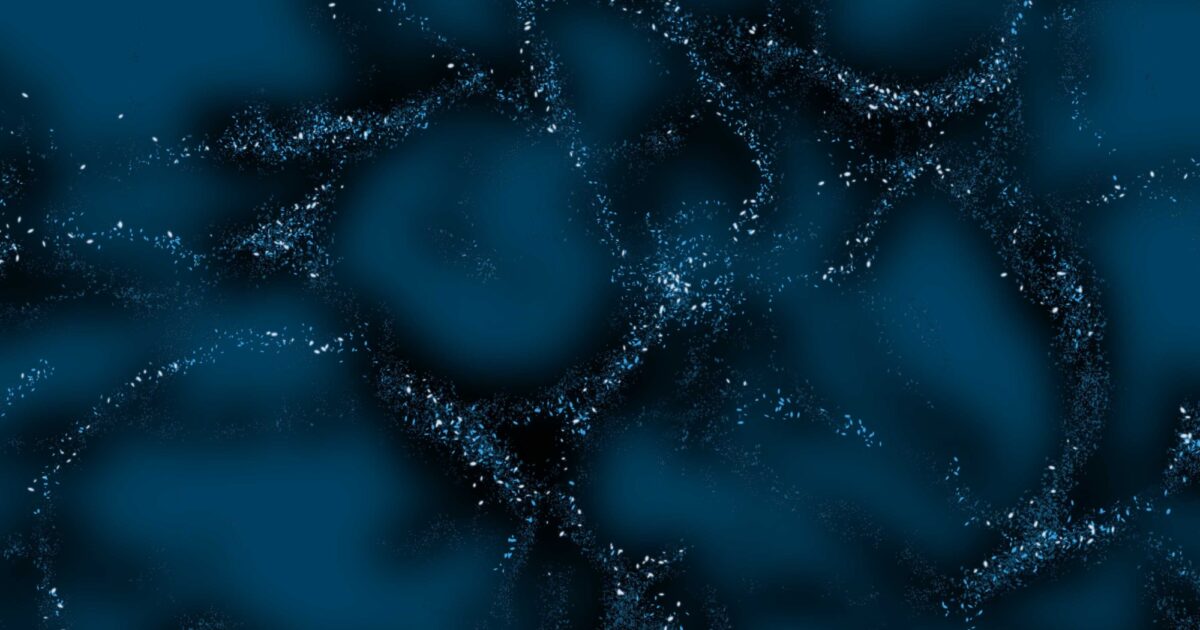
The new DESI analysis tests one of the basic working assumptions of modern cosmology: that, on sufficiently large scales, the Universe should become statistically homogeneous and isotropic, meaning that its matter distribution should look roughly the same in every direction. This does not mean the Universe is smooth on small or intermediate scales. Galaxies, clusters, filaments, walls and voids clearly form a cosmic web. The standard expectation is that these irregularities should average out when we look across very large volumes.
Astronomers used DESI galaxy data to examine whether that averaging really happens. Instead of looking only for one preferred cosmic direction, they used a statistical method called the Angular Distribution of Pairwise Distances, or ADPD, which studies how galaxy separations vary with direction and distance.
Their result suggests that anisotropic structures persist out to scales of about one gigaparsec, far larger than the scales at which such directional structure is usually expected to fade in the standard cosmological picture.
In a new paper, they report signals stronger than those found in isotropic control samples and geometry-matched ΛCDM mock catalogues, with conservative significance above 3 sigma.
If correct, this does not mean that Earth occupies a special place in the Universe. The result can still be compatible with the Copernican principle, because it does not require us to be privileged observers.
What it challenges more directly is the usual formulation of the cosmological principle, especially the assumption that the Universe becomes statistically isotropic and homogeneous at the scales normally assumed in ΛCDM cosmology.
The important point is caution. This is not yet a collapse of standard cosmology, and it does not by itself explain the origin of the possible anisotropy. It may reflect real large-scale structure, limitations in modelling, survey geometry effects, statistical subtleties, or something deeper about how cosmic structure evolved.
The authors argue that, if confirmed independently, the finding would motivate broader cosmological models that allow large-scale inhomogeneities, backreaction effects, or modified mechanisms of structure growth.
This is scientifically interesting, but it should be treated as a serious tension rather than a revolution for now. Cosmology has several large-scale anomalies that are intriguing but difficult to interpret cleanly, because survey geometry, selection effects and statistical choices matter enormously.
The strongest version of the claim will need confirmation with independent catalogues, alternative statistics and careful mock comparisons. Still, if gigaparsec-scale anisotropy survives those tests, it would be a significant problem for the simplest reading of the cosmological principle.
👉 https://t.co/mbj7l2ipHI
C'est un grand honneur d’avoir reçu cette semaine l'insigne d'officier de l'Ordre national du Québec.
Merci @CFrechette pour la remise de cette distinction. Il reste beaucoup de chemin à parcourir pour s’assurer que l’IA soit développée pour le bien commun et c’est encourageant de pouvoir compter sur le soutien du Québec dans cette mission.
La plus puissante Ariane jamais lancée vient de décoller avec près de 22t de charge utile à son bord.
C'est aussi le premiers vol des boosters P160C, presque identique avec le premier étage de Vega-C (qui, elle, ne volera pas avant 2028).
What if dark matter is made of ultra-light waves?
Dark matter is one of the most successful ideas in modern cosmology, and also one of the most frustrating.
We can see its gravitational effects everywhere. Galaxies rotate too fast to be held together by visible matter alone. Galaxy clusters behave as if most of their mass is invisible. Gravitational lensing bends light more strongly than stars and gas can explain. The cosmic microwave background and the large-scale structure of the universe also point to a missing component that does not emit, absorb, or reflect light.
But after decades of searching, we still do not know what dark matter is.
The WIMP Problem and the Rise of the Axion
For a long time, one of the favorite candidates was the WIMP: a weakly interacting massive particle. The idea was elegant. A new heavy particle, interacting only faintly with ordinary matter, could have been produced naturally in the early universe and survived until today. Many experiments have searched for WIMPs, but so far, no confirmed detection has appeared.
That does not mean dark matter is not a particle. It may simply mean we were looking in the wrong mass range.
This is where axions enter the frame.
Axions were not invented to explain dark matter. They were originally proposed to solve a different problem in particle physics: why the strong nuclear force seems to respect a symmetry that it could, in principle, violate. This is known as the strong CP problem. In simple terms, the equations of quantum chromodynamics allow a kind of asymmetry that should show up in the neutron, but experiments find it to be incredibly small or absent. The axion was introduced as a natural way to make that unwanted effect disappear.
Then physicists realized something remarkable: if axions exist, they could also be dark matter.
Unlike WIMPs, axions would be extremely light. Depending on the model, they could be so light that thinking of them as tiny particles flying through space is not always the best picture. In some scenarios, axion dark matter would behave more like a vast, coherent field spread across galaxies. It would still be made of quantum particles, but on large scales it could resemble a wave.
This wave-like nature is exactly what makes axions so compelling.
They offer a completely different way to imagine the dark matter halo surrounding a galaxy. Instead of a cloud of heavy particles, the halo could be an enormous sea of ultra-light particles whose quantum nature matters on astronomical scales. In some versions, especially so-called fuzzy dark matter models, the particle mass would be so tiny that its wavelength could be comparable to astrophysical distances. This could affect the internal structure of small galaxies and perhaps soften some tensions between simulations and observations.
This is not the same as saying axions are magic.
Any dark matter candidate must pass a brutal test: it must reproduce what dark matter already explains. It must help galaxies form. It must match the cosmic microwave background. It must behave correctly in galaxy clusters. It must allow the cosmic web to grow. It must remain effectively invisible to light while still gravitating. The standard cold dark matter picture works extremely well on large scales, so any alternative particle candidate has to preserve that success.
Axions can do that in many models.
The reason they are difficult to detect is the same reason they are attractive as dark matter: they interact very weakly with ordinary matter. They may pass through Earth constantly without leaving an obvious trace. But “weakly” does not mean “impossible.” Many axion searches rely on the idea that axions can convert into photons in the presence of strong magnetic fields. Others look for tiny effects in precision measurements, resonant cavities, condensed matter systems, or astrophysical environments.
The hunt is not just one experiment. It is a whole experimental landscape.
That is important because axions are not a single fixed particle with one known mass. They are more like a family of possibilities. Some models predict axions with masses close to the traditional QCD axion range. Others involve axion-like particles, which share similar behavior but are not necessarily tied to the strong CP problem. This broad parameter space makes the search difficult, but it also makes axions remarkably flexible.
Two Mysteries, One Idea
There is another reason axions feel different from many dark matter candidates: they connect two mysteries at once.
The first mystery belongs to particle physics: why does the strong nuclear force not seem to violate CP symmetry in the way the equations allow?
The second belongs to cosmology: what is the invisible matter shaping galaxies and the cosmic web?
The axion may not solve both. Nature is under no obligation to be elegant. But the possibility that one new field could explain a deep problem in quantum chromodynamics and provide the missing mass of the universe is one of the reasons physicists take axions seriously.
Still, the evidence is not there yet.
We have not detected axions. We do not know whether dark matter is made of them. We do not even know whether the axion exists at all. It remains a hypothesis, but a well-motivated one. That distinction matters. Axions are not speculation in the loose sense. They emerge from a real theoretical problem and make contact with real experimental searches.
If dark matter is made of axions, the universe would be stranger than the old picture of invisible heavy particles.
It would mean that galaxies are embedded in an immense, faint quantum field. The Milky Way would not just sit inside a dark matter halo. It would move through a cosmic ocean of barely interacting waves, shaping the motion of stars while remaining almost completely hidden.
That image is beautiful, but beauty is not evidence.
The next step is detection.
A real axion signal would transform both cosmology and particle physics. It would tell us that dark matter is not just an astronomical mystery, but a new field woven through the universe. It would show that the invisible mass holding galaxies together may come from one of the deepest unresolved questions in the physics of the atomic nucleus.
Until then, axions remain one of the most elegant possibilities for dark matter: elusive, mathematically motivated, experimentally pursued, and still waiting to reveal whether they are part of reality or just one of physics’ most seductive wrong turns.
The Jiangmen Underground Neutrino Observatory, known as JUNO, has released its first major scientific results, and they show that the detector is already performing at the level needed for precision neutrino physics.
JUNO is a huge underground experiment in southern China, built to study neutrinos, the extremely light, electrically neutral particles often called “ghost particles” because they interact so weakly with matter. In this case, JUNO is mainly detecting electron antineutrinos produced by nearby nuclear reactors.
These antineutrinos travel about 52.5 kilometres before reaching the detector, where a tiny fraction of them interact inside 20,000 tonnes of liquid scintillator and produce faint flashes of light. By measuring those flashes with very high precision, scientists can reconstruct the antineutrino energy spectrum and study how neutrinos change flavour as they travel.
The first analysis used only 59.1 days of data collected after the detector began operation in August 2025, but even with that short exposure JUNO made one of the most precise measurements so far of two key neutrino oscillation parameters: the solar mixing angle, written as sin²θ12, and the solar mass-squared difference, Δm²21.
The reported values are sin²θ12 = 0.3092 ± 0.0087 and Δm²21 = 7.50 ± 0.12 × 10⁻⁵ eV², assuming normal mass ordering.
According to the paper, this improves the precision by a factor of 1.6 compared with the combination of all previous measurements.
That is the central result: not that JUNO has solved the neutrino mass-ordering problem yet, but that it has already shown it can measure neutrino oscillations with exceptional accuracy.
This matters because neutrino oscillations are direct evidence that neutrinos have mass, something not included in the simplest version of the Standard Model of particle physics.
Neutrinos come in three flavours, but those flavour states are quantum mixtures of three different mass states. As they move through space, the mixture evolves, so a neutrino produced as one flavour can later be detected as another.
Measuring the exact pattern of that transformation allows physicists to determine the parameters that govern neutrino mixing and mass differences.
These parameters are essential for testing whether the standard three-flavour picture is complete or whether there are hints of additional physics beyond it.
JUNO’s broader goal is to determine the neutrino mass ordering, meaning whether the third neutrino mass state is heavier than the other two or lighter than them. The first results do not settle that question, but they validate the detector design, the calibration strategy and the analysis method.
They also show that JUNO can resolve the subtle oscillation structure in reactor antineutrinos well enough to become one of the leading experiments in the field. With more data, JUNO should be able to improve global fits of neutrino properties, test the three-flavour framework more tightly, and study not only reactor antineutrinos but also solar neutrinos, supernova neutrinos, atmospheric neutrinos and geoneutrinos from inside Earth.
👉 https://t.co/AKJe6gzWhW
What looks as if it is going to swallow the great Pillars of Creation?
The Eagle Nebula (M16) is not a bird, a plane, or Superman. M16 is actually a combination of several celestial objects.
NGC 6611 is the young star cluster that appears to peak out beneath the Eagle’s “wings”. The ultraviolet light from these stars ionizes the surrounding gas, creating the emission nebula IC 4703. The Stellar Spire is seen reaching towards the Pillars of Creation from the left.
Both are structures of cold gas and dust that are optimal for star formation. Some astronomers previously thought the Pillars of Creation had been evaporated away by a supernova. Because M16 is 6,000 light years away, we would not be able to see the Pillars’ destruction for thousands more years.
However, there is no conclusive evidence of the theorized supernova, so the Pillars of Creation will likely continue to create stars for millions of years.
Image Credit & Copyright: Emmanuel Delgadillo
Text: Keighley Rockcliffe (NASA GSFC, UMBC CSST, CRESST II)
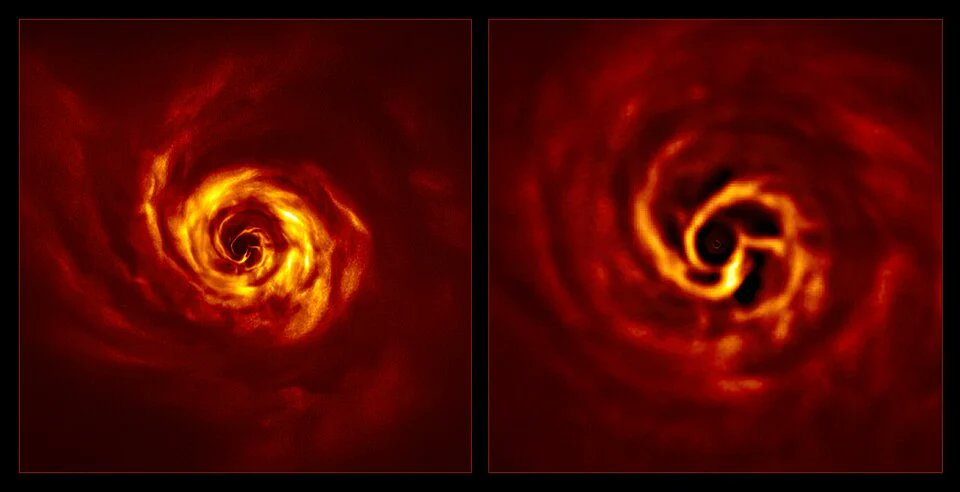
Astronomers have directly observed the rotation of a protoplanetary disk in real time for the first time, focusing on the young star AB Aurigae, a nearby system where planets are still forming inside a broad disk of gas and dust.
Protoplanetary disks are the raw material from which planetary systems emerge, but until now their motion had mostly been inferred through indirect methods or through gas observations.
In this case, researchers used the SPHERE instrument on the European Southern Observatory’s Very Large Telescope to track the movement of dust structures in the disk over several years, allowing them to see how the disk itself evolves and rotates.
The disk around AB Aurigae mostly follows the expected Keplerian motion: material closer to the star moves faster, while material farther away moves more slowly, as gravity predicts. However, the observations also revealed important deviations from this simple pattern, especially in the inner regions of the disk.
Some structures appear to move in ways that do not fully match standard theoretical models, suggesting that the disk is being disturbed by complex internal processes. One strong possibility is that forming giant planets are interacting gravitationally with the surrounding material, shaping spirals, shadows, clumps, and accretion zones as they grow.
This is especially interesting because AB Aurigae has already been considered one of the best laboratories for studying planet formation. Previous observations had identified spiral structures and possible protoplanet candidates, including AB Aurigae b, a massive object still embedded in the disk.
The new observations add a dynamic dimension to that picture: instead of seeing the disk as a static image, astronomers can now follow how its structures move over time. That makes it possible to test whether suspected planets are really responsible for the observed distortions.
The study also found rapidly moving shadows cast across the surface of the disk. These shadows may be produced by opaque dust clumps or by forming planetary bodies orbiting close to the star.
Their motion suggests that the inner disk is not a simple, flat, orderly structure, but a disturbed and evolving environment where several bodies or dense accumulations of material may be interacting at once.
In some regions, the disk appears to rotate more slowly than expected, which may indicate that the forming planets are not moving in the same plane as the main disk or may be following inclined or elliptical orbits.
The importance of this observation is that it gives us a more direct way to study planet formation as an active process. Instead of only identifying gaps, rings, or spirals and then inferring the presence of planets, we can now watch how those structures change with time.
This makes it easier to connect disk dynamics with the hidden objects that may be shaping them. The result shows that planetary nurseries are more complex than idealized models suggest, and that planets may form in environments that are tilted, unstable, shadowed, and dynamically disturbed.
👉 https://t.co/fjvrAlcnWA
https://t.co/IwwAQp1Idr Edgar Morin s'est éteint à l'âge de 104 ans. À travers ce documentaire hommage, plongez dans le parcours d’une "tête bien faite" qui a traversé un siècle d'histoire avec une insatiable curiosité.
🇫🇷 ✨️ Restaurée, l'œuvre de Delacroix "L’Entrée des croisés à Constantinople" se révèle au public !
Après un important travail d’étude — comparaisons, analyses scientifiques, radiographies — la restauration a permis de retrouver la lisibilité de l’œuvre, longtemps obscurcie par des couches successives de vernis et de dépôts.
Le public saura ainsi apprécier la maîtrise technique et chromatique d’un Delacroix arrivé à pleine maturité ; suite à cette restauration des grands formats d'Eugène Delacroix engagée depuis 2019.
📍A redécouvrir dès maintenant, salle 700, aile Denon.
...
🌎 ✨️ Restored, Delacroix's "The Entry of the Crusaders into Constantinople" is revealed to the public!
After extensive research—comparisons, scientific analyses, and X-rays—the restoration has restored the painting's legibility, long obscured by successive layers of varnish and deposits.
The public will now be able to appreciate the technical and chromatic mastery of a Delacroix at the height of his powers, following this restoration of Eugène Delacroix's large-format works, which began in 2019.
📍Rediscover it now in Room 700, Denon Wing.
Minerals on Mars are helping scientists better understand the red planet’s ancient climate. See what they’ve learned from samples collected by NASA’s Curiosity Rover: https://t.co/c6p0Cbwepu
Gravity is one of the most familiar forces in daily life, yet one of its most basic numbers remains surprisingly difficult to pin down.
The gravitational constant, usually called Big G, appears in Newton’s law of universal gravitation and tells us how strong the gravitational attraction is between masses.
Newton introduced the idea in the 17th century, and although physics has changed enormously since then, this constant is still central to how scientists describe gravity.
In Newtonian physics, Big G controls the strength of the force between two objects. In Einstein’s general relativity, gravity is no longer treated simply as a force, but as the curvature of spacetime caused by mass and energy.
Even there, Big G survives: it helps determine how easily spacetime bends. A smaller value of G would mean spacetime is harder to deform; a larger value would mean mass curves it more strongly.
The problem is that Big G is the least precisely known of the fundamental constants. That is not because scientists have ignored it, but because gravity is incredibly weak compared with the other fundamental forces. Measuring the tiny gravitational pull between objects in a laboratory is extremely difficult.
Unlike electric or magnetic effects, gravity cannot be shielded. Every object in the room, the building, the ground, and even distant surroundings contributes some gravitational influence. That makes it very hard to isolate the signal being measured.
The first serious laboratory measurement was made by Henry Cavendish in 1798 using a torsion balance, which allowed him to detect the tiny attraction between lead spheres. Since then, experimental techniques have improved enormously, but measurements of Big G still do not agree with one another as well as they should. There are multiple high-precision measurements, yet their values scatter more than expected.
For metrology, the science of measurement, that is deeply unsatisfying.
A recent effort tried to reduce human bias in the measurement process. The researchers used a blind method: an unknown offset was added to the masses used in the experiment, and the true correction was sealed away until the team had finished checking the internal consistency of the data. Only then was the envelope opened. This was designed to avoid the subtle tendency to stop adjusting an experiment when the result starts to match an expected value.
Even with that careful approach, the new result did not resolve the problem. The measured value was close, but still differed from the currently recommended value. The mystery is not that gravity itself is unreliable, but that our best laboratory measurements of its fundamental coupling constant still fail to converge perfectly.
After more than three centuries, Big G remains a reminder that even the most familiar force in the universe can hide a very difficult experimental problem.
👉 https://t.co/ESN8WRukgD
Using the #JWST, astronomers have studied Abell2744-QSO1, a tiny and extremely distant galaxy whose light has taken more than 13 billion years to reach us.
This object existed only about 700 million years after the Big Bang, and it belongs to the class of so-called “Little Red Dots”, compact red sources that Webb has been finding in the early Universe.
What makes QSO1 especially valuable is that it is magnified by the gravity of the galaxy cluster Abell 2744, also known as Pandora’s Cluster, which acts like a natural telescope and makes this faint ancient object easier to study.
The result is remarkable because Webb has provided the first direct mass measurement of a black hole from the first billion years of cosmic history. Instead of estimating the black hole’s mass indirectly, the researchers used Webb’s NIRSpec instrument to map how hydrogen gas moves around the centre of QSO1.
The gas follows Keplerian motion, meaning it orbits as if most of the mass is concentrated in one central object, just as planets orbit the Sun. From those gas velocities, the team calculated that the black hole has a mass of about 50 million Suns. Even more striking, this black hole appears to make up roughly two-thirds of the total mass of its tiny host system.
That proportion is completely unlike what we see in nearby galaxies, where supermassive black holes usually represent only a very small fraction of the galaxy’s total mass. In QSO1, the black hole seems too massive for the galaxy around it.
The surrounding gas is also extremely primitive, made mostly of hydrogen and helium, with very little oxygen or other heavy elements. That matters because heavy elements are produced by stars, so their scarcity suggests that QSO1 had not yet built a rich stellar population. In other words, this does not look like a mature galaxy that slowly grew a giant black hole through generations of stars, gas accretion and mergers.
The finding strengthens the idea that at least some supermassive black holes in the early Universe may have been born already massive. They may have formed as “heavy seeds”, either from the direct collapse of huge primordial gas clouds or, more speculatively, as primordial black holes linked to conditions in the very early Universe. This helps address a long-standing problem: astronomers keep finding very massive black holes at extremely early cosmic times, but it is difficult to explain how they could have grown so quickly if they began as ordinary stellar-mass black holes. QSO1 suggests that in some cases the black hole may have come first, with the galaxy forming around it later.
The result does not mean that every galaxy formed this way, nor does it close the debate on supermassive black hole origins. But it gives strong observational support to scenarios in which early black holes did not always need a large, already-formed galaxy to grow inside. Webb is now making it possible to test these ideas directly by measuring the structure, chemistry and gas motions of objects from the cosmic dawn. If more Little Red Dots show the same pattern, the classical picture of galaxy-first black hole growth may need to be revised.
👉 https://t.co/yFKeOKLuB1
Frank Drake, un jeune radioastronome passionné par la recherche de vie extraterrestre, a eu l'idée d'écouter les étoiles avec les radiotélescopes en plein développement dès la fin des années 50. Une idée audacieuse pour son époque. #Radioastronomie#SETI
Earth is not moving through empty space.
Right now, the Solar System is passing through a thin region of gas and dust called the Local Interstellar Cloud, and a new study suggests that this cloud still carries the chemical fingerprint of an ancient supernova.
The evidence comes from traces of iron-60 found in Antarctic ice. Iron-60 is a rare radioactive isotope that is mainly produced inside massive stars and released into space when those stars explode, so finding it on Earth is a way of detecting old stellar debris that has drifted into our Solar System.
Researchers analysed Antarctic ice dating from about 40,000 to 80,000 years ago and found that it contains small but measurable amounts of iron-60. This matters because previous studies had already found iron-60 in younger snow and in deep-sea sediments, but the origin of that material was still uncertain.
There are no known recent nearby supernovae that could easily explain it. The new results strengthen the idea that the source is not a fresh explosion, but the Local Interstellar Cloud itself, which may have preserved supernova material for a very long time. As the Solar System moves through this cloud, Earth slowly collects tiny amounts of that ancient cosmic dust.
The pattern is also important. The team found that less iron-60 reached Earth between 40,000 and 80,000 years ago than reaches us today. That suggests either that the Solar System was previously moving through a region with less iron-60, or that the Local Interstellar Cloud is not uniform and has strong internal variations in density and composition.
In other words, Antarctic ice may be recording the structure of the interstellar environment around us, almost like a geological archive of the Solar System’s journey through space.
The measurements were extremely difficult. Researchers processed around 300 kilograms of Antarctic ice and reduced it to only a tiny amount of dust, then used accelerator mass spectrometry to search for just a few atoms of iron-60 among trillions of ordinary atoms. The detection shows how sensitive modern techniques have become: they can now identify the remains of stellar explosions not by looking through telescopes, but by reading faint radioactive traces preserved in Earth’s ice.
The broader significance is that this gives scientists a new way to study our local galactic neighbourhood. If the Local Interstellar Cloud contains material from an ancient supernova, then the cloud surrounding the Solar System may itself have been shaped by past stellar explosions. Future studies of even older ice cores could help reconstruct what the Solar System was moving through before it entered this cloud, and how our cosmic environment has changed over tens or hundreds of thousands of years.
👉 https://t.co/oNhxO3GCng
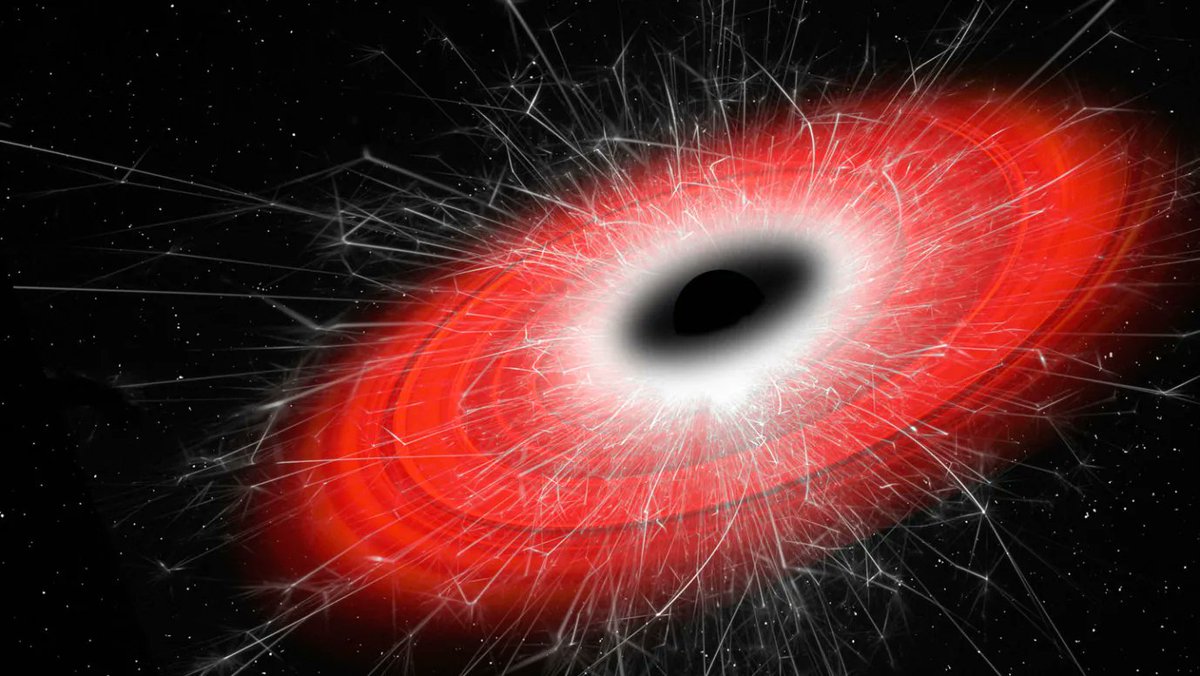
Black holes are not completely black. According to Stephen Hawking’s 1974 prediction, they should emit an extremely faint stream of particles known as Hawking radiation.
This radiation is central to some of the deepest problems in modern physics because it sits at the boundary between general relativity, which describes gravity and spacetime, and quantum physics, which governs particles and information.
The problem is that Hawking radiation is far too weak to observe directly from real astrophysical black holes, so physicists need indirect mathematical ways to study it.
A new set of studies suggests that one of those tools may be the “double copy,” a mathematical relationship that links certain calculations in particle physics with calculations in gravity.
The double copy works almost like a translation dictionary between two languages of physics.
On one side is the Standard Model, which describes particles and forces such as electromagnetism and the strong and weak nuclear forces. On the other side is general relativity, which describes gravity.
These theories look very different, but the double copy shows that, in some cases, gravitational phenomena can be written as if they were built from two copies of simpler particle-physics structures.
This has already helped physicists simplify difficult gravity calculations, and now researchers have shown that it can also be applied to Hawking radiation.
Several teams have independently found a particle-physics analogue of Hawking radiation. In this translated picture, the emission of a Hawking particle by a black hole corresponds mathematically to a charged particle scattering from a collapsing spherical shell of charged matter.
This does not mean that black holes literally work like charged shells in ordinary space. It means that the equations describing both situations share the same mathematical structure. That is the important point: a process normally associated with curved spacetime and quantum fields near a black hole can be studied through a more familiar framework from particle physics.
This matters because Hawking radiation is not just a theoretical curiosity. It leads directly to the black hole information paradox. If black holes emit radiation, they gradually lose mass and may eventually evaporate. But if everything that fell into the black hole disappears with it, then information appears to be destroyed, which conflicts with a basic principle of quantum mechanics.
By translating aspects of Hawking radiation into the language of the Standard Model, physicists may gain new tools to explore what happens to that information and whether the radiation carries subtle traces of what the black hole absorbed.
The result is not a final solution to black holes, quantum gravity, or the information paradox. It is more like a new technical route into a problem that has resisted direct attack for decades.
Researchers are especially interested in whether the same double-copy approach can help describe the event horizon itself, the boundary beyond which nothing can escape. If that can be translated into particle-physics language too, it could offer a clearer mathematical bridge between quantum theory and gravity.
For now, the advance shows that Hawking radiation, one of the most mysterious predictions in theoretical physics, may be accessible through a surprising connection between the physics of particles and the physics of spacetime.
👉 https://t.co/KEcKgVSpEG
Astronomers may have identified the most massive pair of black holes ever found in the process of moving toward a merger.
The system lies about 4.4 billion light-years away, at the center of a galaxy called Abell 402-BCG, and the two black holes together may contain around 60 billion solar masses. That would make the pair at least twice as massive as the next most massive known black hole duo.
The clue was a strange dark cavity in the galaxy’s center, about 3,200 light-years across. When it was first noticed in 2018, astronomers thought it might simply be a dust cloud blocking the light from stars behind it.
But new observations with the JWST and the Very Large Telescope suggest something more interesting: the region is not just hidden by dust, it appears to be genuinely depleted of stars.
The proposed explanation is that two ultramassive black holes are orbiting each other there after a past galaxy merger. When large galaxies collide, their central black holes gradually sink toward the common center. As they interact gravitationally, they can fling nearby stars out of the central region, carving out a stellar cavity. That seems to be what may have happened in Abell 402-BCG.
The black holes have probably been paired for only a few tens of millions of years, which is relatively recent on cosmic timescales.
If confirmed, this system would be especially valuable because it captures a rare stage in the growth of the largest black holes. We know that galaxies merge, and we expect their central black holes to merge too, but catching such an enormous pair before the final coalescence is difficult.
Eventually, these two black holes are expected to merge into a single object that would rank among the most massive black holes known in the universe. The discovery could therefore help astronomers understand how often these extreme mergers happen, how ultramassive black holes grow, and how violently they reshape the centers of their host galaxies.
👉 https://t.co/S2T39f4NJK
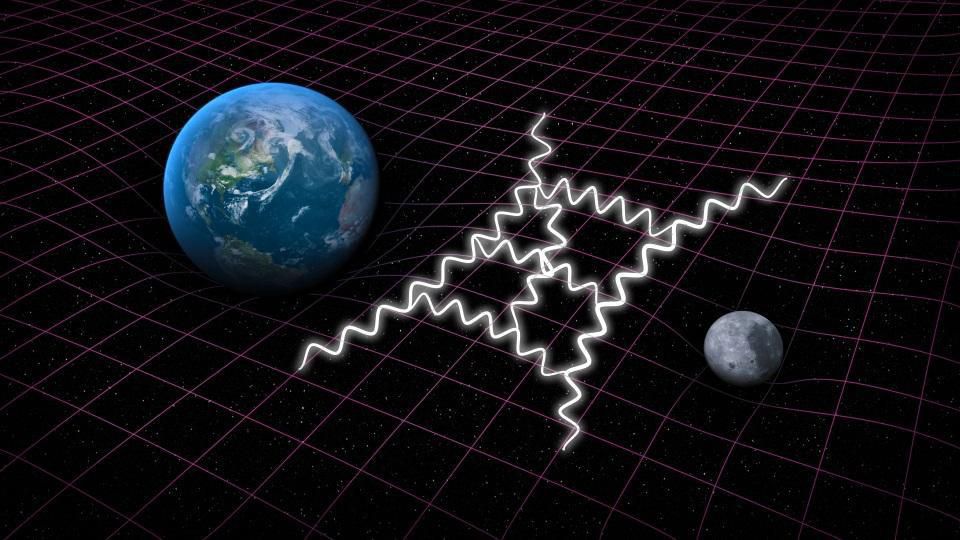
Quantum gravity remains difficult because the usual tools that work so well in quantum field theory do not transfer cleanly to gravity.
In ordinary quantum theory, physicists often deal with infinities through renormalization: instead of treating the infinite background as physically meaningful, they calculate measurable differences from that background.
This works in flat, Euclidean-like settings, but gravity changes the problem because spacetime itself is dynamic. In general relativity, energy and matter curve spacetime, and that curvature affects the behavior of quantum fields.
So when physicists try to quantize gravity in the same way they quantize electromagnetism or the nuclear forces, the calculation feeds back on itself: quantum fluctuations curve spacetime, curved spacetime changes the fluctuations, and the whole structure becomes mathematically unstable.
Loop quantum gravity tries to avoid part of this problem by treating geometry, matter, energy and spacetime as one quantum system, rather than placing quantum particles on top of a fixed spacetime background. But even there, the cosmological constant remains troublesome.
In cosmology, the cosmological constant is commonly associated with dark energy, the component driving the accelerated expansion of the Universe. In loop quantum gravity calculations, it can amplify the mathematical sums and make them diverge again. One way to proceed is simply to assign the cosmological constant a fixed value, but that has always felt more like a workaround than a deep explanation.
A new study suggests that this fixed behavior may not be arbitrary. The authors draw a parallel with the quantum Hall effect, where a material’s conductivity does not vary continuously but becomes locked into specific, discrete values.
In the classical Hall effect, the induced voltage can change smoothly depending on the magnetic field and current. In the quantum Hall effect, however, the system settles into quantized states.
The study proposes that, in a particular loop quantum gravity framework called the Chern-Simons-Kodama state, the cosmological constant may behave in a similar way: instead of being easily shifted by every secondary quantum fluctuation, it may become locked into discrete allowed values.
That matters because it could explain why the cosmological constant can be treated as fixed without being destabilized by small quantum corrections. If the analogy holds, quantum fluctuations may simply be too small or too unlikely to push the cosmological constant from one allowed value to another.
In that sense, the constant would not merely be “put in by hand”; its stability could emerge from the quantum structure of spacetime itself. This does not solve quantum gravity, and the result depends on a specific model that still needs further work.
But it offers a potentially important clue: the cosmological constant may be protected by a quantum effect, much like conductivity is protected in the quantum Hall effect.
👉 https://t.co/LMQ1SpZNg1
I took 1.7 million photos over 6 days to catch this photo of a commercial jet in front of the sun.
The moment it happened, TWO floating prominences were visible, making this not just my best aircraft transit photo, but one of the luckiest of my career! Videos of the transit 👇