Following the amazing reaction to the Marble Curriculum yesterday, we've decided to make it open source 🛰️👇
Everything a child learns in primary school. 1,590 concepts. 3,221 connections across 8 subjects, from Math and Science to Computing and Life Skills. Anchored in the US and UK curriculums, standard by standard (NGSS, Common Core, DfE).
What you will find in the repo: every concept as structured JSON with its age band and the evidence a child must show to master it. Every prerequisite link marked hard or soft, with a written rationale. It's a true DAG you can compute learning paths on. Open license, you can build whatever you want with it.
Now is a unique time in history to be building in education. Getting AI and kids education right is likely one of the hardest and most important problems to crack over the next decade and we need as many smart and creative minds behind it.
We think a common solid basis, accessible to all and that can be built upon, is critical to move fast. That's why we're making this curriculum open source.
It's not perfect but we know it's a robust basis, and we believe that sharing it openly is the fastest way to progress in this field. If you're building in education, share this around you and tell us in comments if you find this useful and if you want to contribute.
We'll keep working and investing on it @withmarbleapp. Credit goes to @guillaume_boni for building this. I just made it look pretty.
Links below 👇
Gatekeepers (Reddit mods, Google, Meta, etc) are the new hurdle for getting useful SAAS to people in need. Particularly in education focused projects (at least in my experience). Increased noise from increasing options also an issue. Need an AI to sort through it all for the masees.
@jon_beougher@amasad@patrickc Likewise, thank you for the opportunity to build something with the potential to change and benefit many lives. Good Journey.
Harvard SEAS prismatic architected metamaterial: extruded cubic cells (24 faces, 36 edges) tessellated via snapology origami.
Reconfigures volume, shape, and effective stiffness on demand through hinge folding; scale-independent from nano to meter.
the original TurboQuant paper tested on A100 with models up to 8B.
6 days later, a bunch of strangers on the internet had it built and running on:
- Apple Silicon M1 through M5
- NVIDIA 3080 Ti through DGX Spark Blackwell
- AMD RX 6800 XT and 9070
- a 10-year-old Tesla P40
- an 8GB MacBook Air
- models from 3.8B to 70B across 6 architecture families
- 30+ independent testers
along the way we found new optimizations the paper didn't cover and failure modes it didn't test.
the fact that a loose group of people across the world can read a paper, build implementations from scratch, stress-test across hardware none of us could individually afford, and push the research further in under a week is genuinely one of the best things about this era. the tools and the community make it possible.
open source is something else.
Just saw something that actually feels like a real leap in robotics hardware.👋
@AllonicRobotics built a robot hand using 3D Tissue Braiding,basically weaving high-strength fibers around a minimal rigid skeleton the way human connective tissue wraps around bone.
No hundreds of screws, bearings, cables or fiddly joints.
Instead,a continuous automated process that creates the tendons, soft tissue & compliant structure all at once.
The outcome is wild:
»strong yet naturally soft & safe for close human interaction
»surprisingly dexterous
»produced from digital design→physical part in minutes
»cost drops so much that you could eventually swap end-effectors like disposable gloves
This is starting to feel like the moment robotic bodies get their own “3D printing revolution”.
Hardware iteration speed finally approaching software speed.
If this scales, it could be one of the missing pieces that lets dexterous humanoid robots move from lab → factories → homes.
(Oh, and the company just raised $7.2M Pre-Seed,largest ever in Hungary. Budapest-based with US HQ. Led by Visionaries Club + angels from OpenAI, Hugging Face, ETH Zurich, Northwestern etc.)
Prototype hand looks insane,the woven fiber texture is unreal.
Don't worry about being the most interesting person in the room, just try to be the most interested person in the room.
The interested person asks about others and leaves a good impression because people like talking about themselves. The interested person is genuinely curious about someone's craft and learns a lot about how things work. The interested person engages with more people and—because opportunities come through people—is more likely to catch a lucky break.
In general, the interested person learns more and tends to be well-liked. And in the long run, it's hard to keep down someone who is well-learned and well-liked.
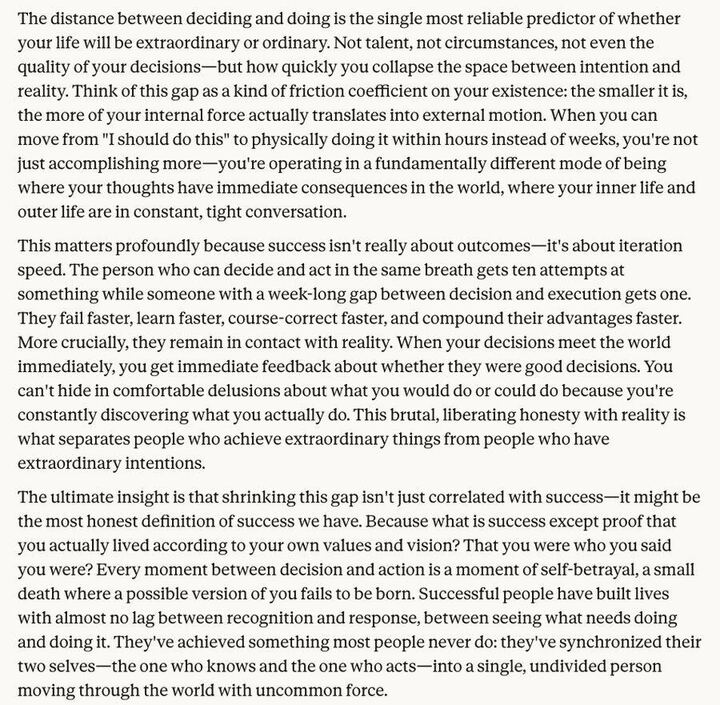
“The distance between deciding and doing is the single most reliable predictor of whether your life will be extraordinary or ordinary.”
These three paragraphs will change your life: