Antmicro supports the @NVIDIA Jetson ecosystem with accelerated end-to-end product development building around its Yocto-enabled open source hardware and frameworks for OTA (RDFM), factory testing (Protoplaster), AI (Kenning) and more. Read our #NVIDIAGTC Taipei at #COMPUTEX Press Release: https://t.co/yPz0zo53KI @NVIDIARobotics@yoctoproject@linuxfoundation
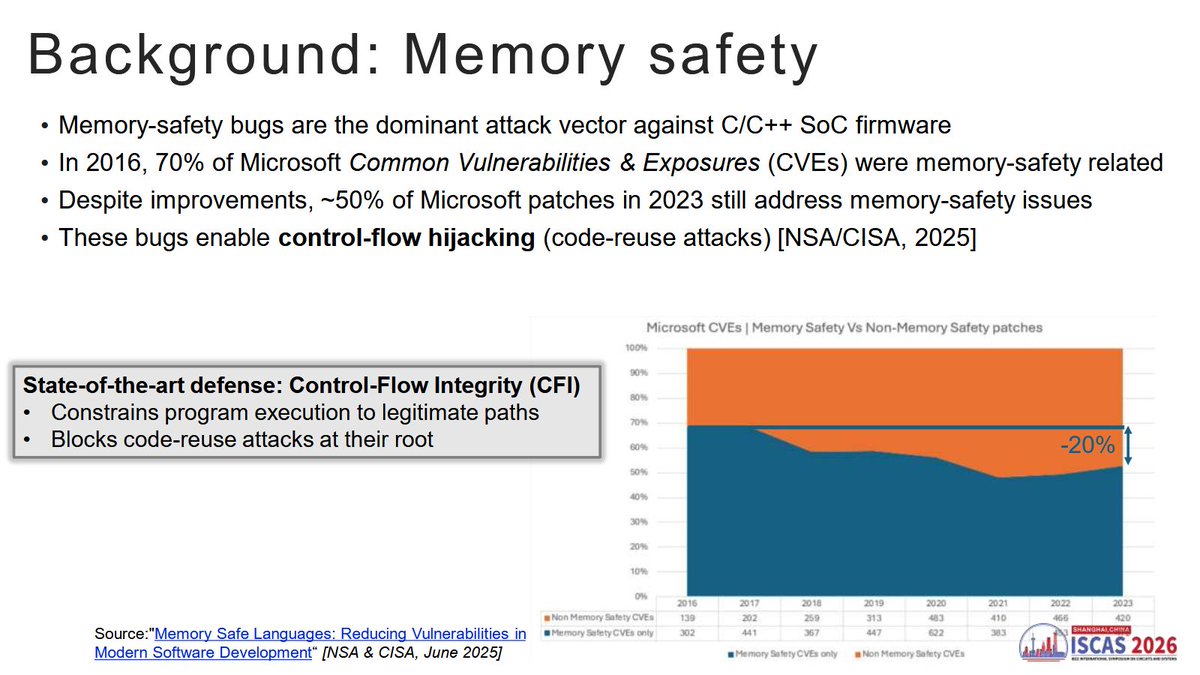
More from PULP at #ISCAS2026 in Shanghai with our Simone who presented "CVA6-CFI: A First Glance at RISC-V Control-Flow Integrity Extensions". Check out his slides https://t.co/YEhgj68Sr3 & the paper: https://t.co/C77aGqG9Tc
A continuing implementation of Doom on CV-Wally - thanks Juan!!! Improvements are coming daily - https://t.co/OORJF1yS5W - Also check out our new textbook, if you have not seen https://t.co/7dB3WJ8tfu --> CV-Wally DOOM https://t.co/CdlRHGXRQZ
📣 PRESS RELEASE: The #LoRaAlliance has announced its technical roadmap outlining near-term plans for how it will support new #LoRaWAN application integrations, extensions, and other enhancements.
Read the PR here: https://t.co/UbL7EG5cux
💡 What happens when human expertise orchestrates multiple AI agents?
Francesco Pham explores how #Oniro used AI-assisted “vibe coding” to port Ionic/Capacitor and Tauri to OpenHarmony, accelerating complex software integration.
📖 Read the article 👉
https://t.co/NCDX9pkLTO
🌿 What if AI could help protect wildlife deep inside remote forests?
Gavindu Achintha built WildLife AI using a Raspberry Pi 5, our XIAO ESP32C3, LoRa, GPS, and YOLO-based object detection to monitor unusual activity in wildlife zones — all running locally without cloud dependency.
Check out the full project on @Hacksterio 👉 https://t.co/UORr5NVNd2
USB 3.0 camera board based on @WCH_TECH CH32H417 RISC-V MCU
https://t.co/b7L7OIVbEZ
XPU Labs’ Petros CH32H417M Alef is a Raspberry Pi Pico-sized board based on the CH32H417M dual-core RISC-V MCU with 896KB SRAM and 960KB Flash. It leverages the MCU's USB 3.0 and DVP camera interfaces using a 40-pin B2B connector for a 2MP OV2640 camera module, and also features 20-pin GPIO headers that follow the Raspberry Pi Pico’s pinout.
There's currently no specific code sample for the board, but we noticed the CH32H417 C SDK comes with a USB 3.0 UVC DVP camera sample that should convert it into a standard webcam.
Introducing the Zephyr Sensor Anomalies library for embedded devices running @ZephyrIoT. Learn how our lightweight tools can help you train and evaluate AI anomaly detection models when paired with Kenning: https://t.co/PTaEYh1Okm @linuxfoundation
Our K3 now native support for Ubuntu 26.04 LTS.
We’re at Ubuntu Summit 2026 in London, sharing how we’re working with Canonical to make Ubuntu 26.04 available on native RISC-V hardware.
K3 is our RISC-V AI CPU platform and the first mass-produced chip compliant with the RVA23 profile, for native RISC-V build, test, and exploration on real hardware.
Ubuntu 26.04 image for K3 is now available:
https://t.co/Q1RvKV93q4
#RISCV #SpacemiT #Ubuntu #Linux #OpenSource #RVA23
Eclipse 4diac 3.1 makes large IEC 61499 projects easier to evolve, restructure, and maintain.
From improved refactoring and structured data handling to runtime modularisation in 4diac FORTE, this release strengthens the entire engineering toolchain.
📖 Read the article in our community newsletter:
https://t.co/Vnb5hHpdFI
#EclipseFdn #Eclipse4diac #opensource
.@WCH_TECH BLE Analyzer Pro USB Bluetooth LE sniffer is now supported in Linux with pcap output compatible with Wireshark.
https://t.co/hl9ZNLxYV3
The hardware features three CH582F Bluetooth LE RISC-V microcontrollers and a CH334 USB hub, supports Bluetooth Low Energy (BLE) 4.0/4.2/5.0, and connects to the host through its USB-C port.
So far, WCH has only provided software for Windows 7 to 11, but the USB protocol has been reverse-engineered, and Linux software is now available.
ESP32-C5 board uses 5.9 GHz WiFi 6 to monitor signals from traffic lights, public transportation...
https://t.co/w0IKp1IVvP
OpenTrafficMap ESP32-C5 C-ITS receiver open-source hardware board relies on the ITS-G5 protocol built on top of 802.11p V2X (Vehicle-to-Everything).
It handles incoming wireless signals, decodes C-ITS (Cooperative Intelligent Transport Systems) messages, and feeds the data into OpenTrafficMap for live monitoring of traffic lights, buses, trams, cars.... It costs about 20 Euros.
By bringing Ionic/Capacitor and Tauri to OpenHarmony, developers can now reuse existing web and Rust-based applications with far less friction.
Discover how this work helps bridge ecosystems and accelerate adoption for OpenHarmony and Eclipse Oniro 👉
https://t.co/sJ8avOXShs
Double your LoRa range with the right antenna! 📡
Our new Meshtastic Antenna Pairing Guide tells you exactly which antenna to use with your Seeed device for maximum performance.
From the XIAO Dev Kits to the SenseCAP Solar Node, we’ve got the perfect match for every build.
Read the guide: https://t.co/UBKglPd6QM
#SeeedStudio #theAIHardwarePartner #theIndieCommunicationSystem #Meshtastic #LoRa
🎉 Spotlight on Ege Korkan, Project Co-Lead of Eclipse Thingweb and committer to Eclipse EdiTDor!
Ege plays a key role in advancing open, interoperable IoT technologies through his work on the Web of Things and semantic interoperability.
#opensource#IoT#committer