Anthropic engineers just showed how to build agentic systems that run for days using "loops."
"At Anthropic, >30% of our code is already written by loops - that's how we ship so fast.
in this 40-minute workshop, they reveal the whole stack:
agent loop + harness + memory + sub-agents.
Worth more than any $500 vibe-coding course.
Watch workshop today, then read article below.
Lots of people asked how I used Fable to edit its own launch video so I made a video about that!
TLDR it wrote a lot of code & tool calls to use transcription services, ffmpeg, do colorgrading, use the figma mcp, make remotion UI and render it.
I didn't touch a video editor.
ANDREJ KARPATHY IS THE GODFATHER OF MODERN AI
He doesn’t use Notion. He doesn’t use Roam. He doesn’t use Obsidian plugins.
He built his own second brain from scratch.
I copied him exactly.
The result:
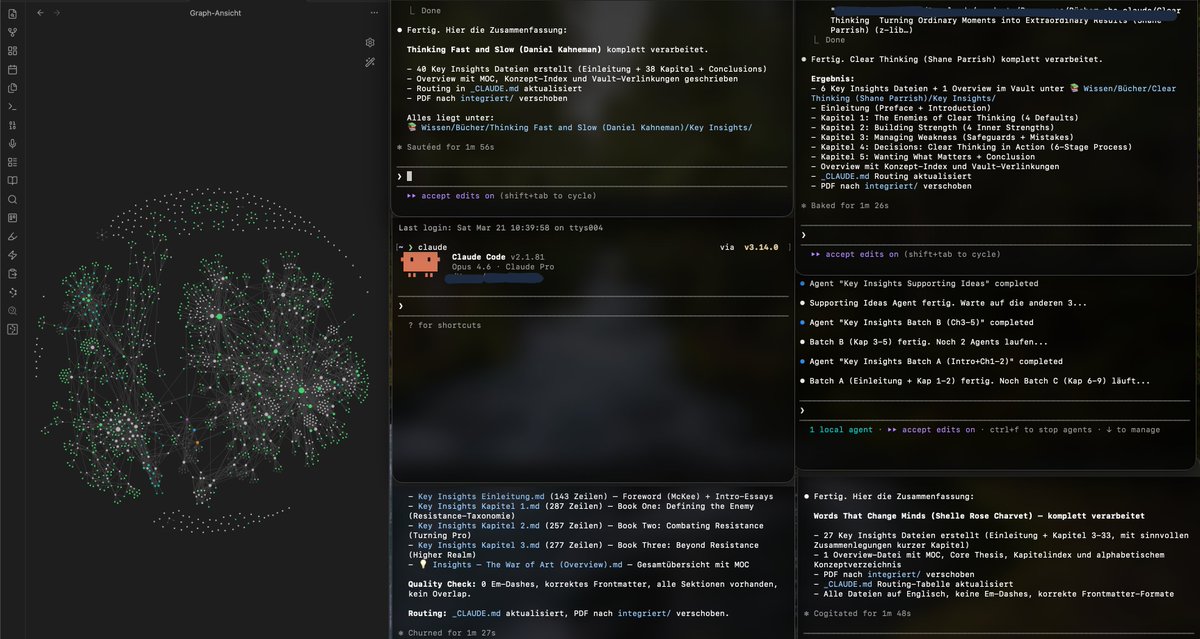
→ 378 notes
→ 1,854 nodes
→ 3,856 edges
→ One custom 3D knowledge galaxy that thinks back at you
This isn’t note-taking.
This is a second nervous system.
Click any node - AI surfaces every hidden connection.
Zoom out - you see your entire mind as a universe.
Zoom in - you see why Fischer beating Spassky in 1972 connects directly to your trading edge today.
ChatGPT forgets you in 2 hours.
This remembers everything. Forever.
Notion users are building filing cabinets.
Roam users are building spreadsheets.
Obsidian users are building graveyards.
I built a galaxy.
The gap between people who consume knowledge and people who compound it isn’t talent.
It’s architecture.
Karpathy knew this before anyone.
Now you do too.
how to use Google's NEW open source Design.md + AI Skills to make your startup look like a $100 million company in 1 hour:
1. Design.md is an open source file from Google that captures the soul of a design. Typography, colors, spacing, all in one markdown file. You attach it to your prompt and your agent builds beautiful things every time.
2. Think of it this way. The HTML is the finished dish. The design.md is the recipe. The skills are the ingredients. Put them together and everything you build looks consistent and professional.
3. Don't create a design system from scratch. Find a brand you love. Linear, Stripe, Vercel, whatever resonates. Study it. Use ChatGPT or Claude to help you extract the design language into your own design.md file.
4. Build skills on top of your design.md. A landing page skill. A mobile app skill. A motion design skill. A slide deck skill. Each one references the same design.md so everything looks like it came from the same designer.
5. The biggest mistake people make: they nail one screen and then everything else looks generic. Design.md solves this. One file keeps every page, every format, every medium consistent.
6. Use it across everything. Your landing page. Your app. Your pitch deck. Your promo videos. Same DNA. Same taste. Same system. That's what separates a startup that looks real from one that looks vibe-coded.
7. Build a second brain for design inspiration. When you see something beautiful in the real world or online, capture it. Save it. When you're building something new, reference it. Taste is developed, not downloaded.
8. It's obvious but the difference between a product people trust and a product people bounce from is how it looks and feels. Design.md gives you that edge.
you can watch below
https://t.co/Am1BdxLtzM
shoutout to @mengto for coming on @startupideaspod and walking through his full workflow.
if you want to use AI to actually build gorgeous designs, you'll want to use see this.
watch
15 AI related accounts you should follow on Twitter:
1. @karpathy
His tweets already create LLMs narratives that you later see on linkedin in 2 months.
2. @fchollet
posts thoughtful research on intelligence, benchmarks, and AI limitations. Keras creator + ARC-AGI
3. @ylecun
Yann LeCun is Deep learning pioneer & Meta Chief AI Scientist; big-picture research takes and critiques (and drama).
4. @AndrewYNg
Andrew Ng is AI education legend; practical ML advice, courses, and real-world implementation. creator of deeplearning ai
5 @rasbt
Sebastian Raschka posts on Practical ML/LLM implementations, "build from scratch" tutorials, and books.
6. @dair_ai
Weekly ML/AI paper threads and accessible research explainers (high-signal for staying current).
7. @lilianweng
Lilian Weng is ex-OpenAI and her Lil'Log-style threads are good. has In-depth LLM research breakdowns
8. @jeremyphoward
posts interesting takes on AI/crypto news, and works on democratizing practical deep learning and accessible education.
9. @simonw
Simon post Practical LLM tools, takes, experiments, prompting, and engineering breakdowns. django co-founder
10. @_akhaliq
Curates the latest arXiv papers, model releases, and open-source AI drops.
11. @ID_AA_Carmack
AGI/low-level optimization takes that makes you think about the problem.
12. @gwern
Really high-quality long-form AI research notes and essays.
13. @goodside
LLM evaluation, prompting research, and real capabilities testing
14 @drfeifei
Computer vision pioneer; human-centered AI and spatial intelligence research
15 @demishassabis
Been following his work for 9 years. Demmis is my hope against google usurpating their power with AI. Demmis is google DeepMind's CEO
Let me know who I missed guys
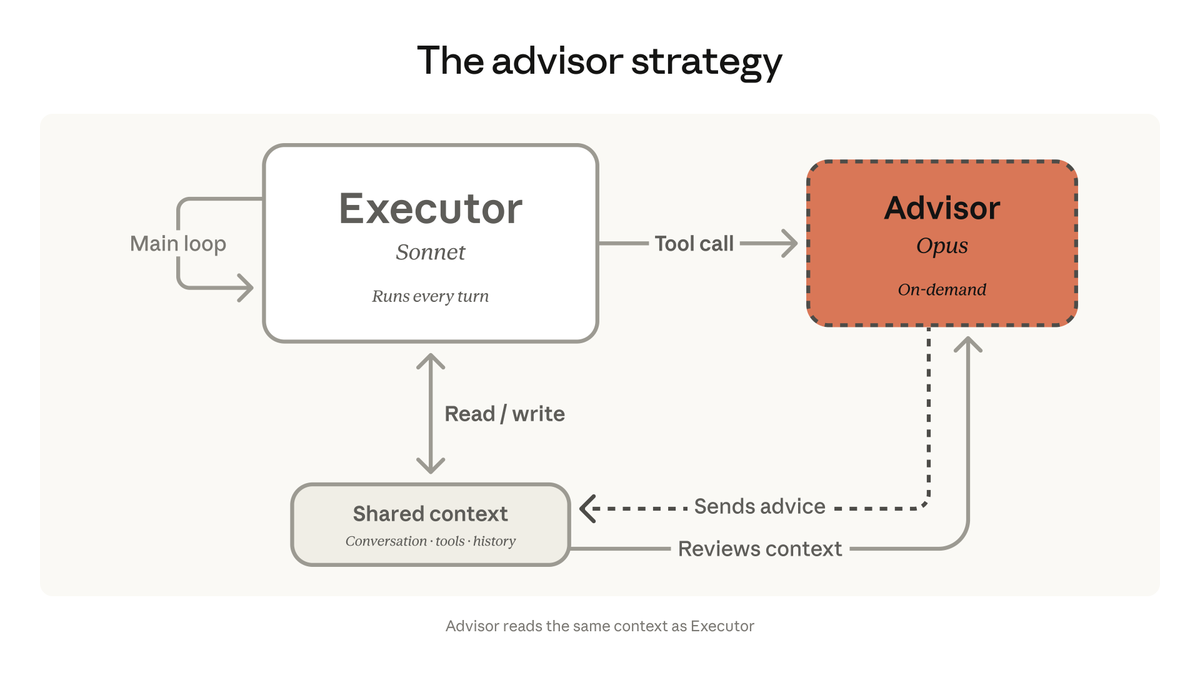
We're bringing the advisor strategy to the Claude Platform.
Pair Opus as an advisor with Sonnet or Haiku as an executor, and get near Opus-level intelligence in your agents at a fraction of the cost.
The clearest explanation of Claude Managed Agents you'll find.
Everyone's talking about it. Nobody's explaining it well.
In 12 minutes we cover:
- What it actually is (platform as a service for AI agents)
- Who it's for and who should avoid it (4 personas)
- Live console walkthrough (sessions, analytics, costs)
- Real cost breakdown ($2.58 to fulfill a $1,000 service)
We also built a free Google Doc that deploys your first managed agent when you hand it to Claude Code.
You can grab it in the podcast show notes (Build With AI podcast) or YouTube description (video link below).
Alright, let's get into it. This is my bulletproof 2026 Meta campaign structure, and yes, I'm dropping it for free because I genuinely don't care, this is what gurus are charging you 20K courses for 😂
Before I even get started: I already know what's coming in the comments. Some nerd is going to show up and start preaching about the 1CBO Consolidated structure like. Cool. Maybe it works for your little $500/day account. But let me be very clear, I have never, not once, seen a brand sustain $500K+ per day consistently on a single CBO at scale. Not one. If you have receipts, slide in. Until then, sit down.
This structure isn't theory. It's not something I read in a course or saw in some guru's carousel post. It was built in the trenches, tested across multiple accounts, multiple verticals, real money on the line, and it has allowed me to scale brands faster than most people think is possible while actually staying profitable.
That last part matters more than the scaling, by the way. Scaling broke is easy. Scaling with margin is the game.
I'm not going to tell you what products, what brands, what niches, or what creative angles I'm running. Those questions will be ignored. Not because I'm gatekeeping, but because the structure is the structure. It works. The variables are on you.
Comments are open. Smart questions only. If you come in with something basic, don't expect a response.
Do with this what you want. THANK YOU FOR YOUR ATTENTION TO THIS MATTER — SCALESURFER OUT🤙
I met the guy behind Paperclip. he won't show his face, but he just built one of the FASTEST growing open-source projects in AI.
how to use Paperclip to hire AI agents to ACTUALLY run a startup with 0 employees:
1. with paperclip, you hire a team of AI agents like CEO, engineer, QA, video editor, content strategist and manage them from one dashboard.
it works with Claude Code, Codex, OpenCode, or any model on OpenRouter. you're not locked into one provider.
2. your AI agents wake up capable but with zero memory. they don't know who they are, where they are, or what they're supposed to be doing. kinda like that movie memento from back in the day
you need to leave them Polaroids like heartbeat checklists, persona prompts, written context. that's how you keep them on track.
3. when an agent makes a mistake, you don't rewrite everything. you add one rule to their persona prompt.
"always define a success condition for every task."
"always pass work to QA before closing." you're training them like you'd train a junior hire. one correction at a time.
4. skills extend what your agents can do. want a video editor who can produce animated content? install the Remotion skill. want security reviews? there's a skill for that.
5. the biggest lever for quality is encoding your own taste. AI can do everything except know your values. design sensibility, brand voice, success criteria but you have to write it down.
6. don't one-shot your startup. agentic design patterns matter. the simplest one: after the engineer builds something, QA reviews it. structure prevents compounding errors. one-shotting an entire app is fun for 30 minutes, then it falls apart.
7. Paperclip tracks every token spent and every task completed. you can use your existing subscriptions (Claude, Codex) so spend shows as $0, or hook into API credits for real dollar tracking.
8. importable companies are coming. Gary Tan's G-Stack, a full game studio, 300+ agent repos... you can "acqui-hire" a proven agent team into your Paperclip instance instead of building from scratch. the future is downloading a tested org that actually works.
9. routines let you automate recurring work. "every day at 10am, read what was merged into the main branch and write a Discord update celebrating community contributors." it runs, you review, you improve. every task is traceable.
10. maximizer mode is next. you tell the CEO "build this game" and it does whatever it takes and hires who it needs, keeps pressing until it's done. no token anxiety. just outcomes.
use @ideabrowser for startup ideas/trends to get started
thank you for @dotta for doing this podcast and breaking down exactly how people can hire ai agent teams with paperclip
you won't find an episode like this anywhere else
episode is live on @startupideaspod on your fav platforms (follow for more)
is this not the greatest time in history to be building?
im rooting for you
now go watch my frien
Ecom owners, take this (free) and have it forever.
I bundled some of our most valuable internal resources - the exact frameworks, breakdowns & test libraries we use with 8-figure brands.
This isn’t surface-level inspiration.
It’s plug-and-play CRO intelligence.
If you run an Ecom brand, you’ll find something in here you can implement immediately.
Here’s what’s included:
Tests & Case Studies:
↳ Top 50 Tests from 8-Figure Brands
↳ 26 Proven A/B-Test Ideas
↳ A/B Tests Megafile
↳ SNOCKS Case Study
↳ How Fashion E-Com Brands Go From 1.5% CR to 4% in 6 Months
Funnel Breakdowns:
↳ HexClad Funnel Breakdown
↳ Ralph Lauren x Hugo Boss Funnel Breakdown
↳ Starlink Funnel Breakdown
↳ Jacquemus Funnel Breakdown
↳ Rimowa Funnel Breakdown
↳ Adidas x Salomon Funnel Breakdown
CRO Libraries & AI Resources:
↳ 200+ Top 1% DTC Landing Pages
↳ 600+ Proven CRO Ideas
↳ Supplement Ecom Bundle
↳ AI Claude Prompt Library for Ecom Managers
This is the exact type of material we use internally to turn leaking funnels into scalable revenue systems.
𝗜𝗳 𝘆𝗼𝘂 𝘄𝗮𝗻𝘁 𝗶𝘁 (𝗳𝗿𝗲𝗲):
1. Like this post
2. Comment “ECOM”
(Must be following me!)
and I’ll send it to you.
P.S. Repost for priority access!
Introducing: Browser Use CLI 2.0 🔥
The most efficient browser automation CLI tool
> 2x the speed, half the cost
> Easily connect to running Chrome
> Uses direct CDP
Try it now 🔗↓
claude code is the best thing that has happened to me in 2026. it's really like a game and i get every day new ideas about what to build in the future
if you are not using claude code you are not gonna make it ...
obsession + intensity + delusional optimism + claude code = unlimited leverage