Reminder for all young parents:
You only get:
- 1 Summer with your baby
- 3 with your toddler
- 9 with your child
- 5 with your teenager
This time is precious. Don’t rush it.
A Chicago philosopher wrote one book in 1940 proving that 95% of the books you have read in your life, you didn't actually read, and Charlie Munger has been telling people to read it for 50 years.
His name was Mortimer Adler.
He spent 40 years at the University of Chicago, ran the editorial board of the Encyclopædia Britannica, and built his entire career on one uncomfortable observation about the people around him.
Most adults who called themselves well-read had not actually read a book in the real sense even once. They had run their eyes over the pages, registered the words, formed a vague impression, and put it back on the shelf.
The book had passed through them without ever entering them.
In 1940 he wrote How to Read a Book. It has stayed in print for 86 years.
Charlie Munger recommends it. Naval Ravikant recommends it. Fareed Zakaria recommends it.
Every serious thinker who builds a career on absorbing information eventually finds their way to this book, and the reason is that Adler had isolated something nobody else was naming clearly.
There are four levels of reading. Almost everyone is stuck on the second one. The fourth level is so different from what most people call reading that you have probably never done it in your entire life.
Level one is elementary.
You learn it as a child. You decode the letters into words and the words into sentences. You finish the sentence and understand roughly what it said. This is reading the way a 7-year-old reads, and almost every adult on earth has stopped developing past this point in some quiet way.
Level two is inspectional.
This is skimming. You move through a book quickly to figure out what it is broadly about. You read the back cover, scan the table of contents, glance at a few paragraphs, and form an opinion. Most adults who claim to have read 50 books a year are actually doing this. They are inspecting books, not reading them. They walk away with a vague sense of the argument and almost none of the evidence that supports it.
Level three is analytical.
This is the level Adler said most people have never properly experienced. You take one book and you wrestle with it for as long as it takes. You identify the question the author is trying to answer. You map their argument from front to back. You write your disagreements in the margins. You force yourself to articulate, in your own words, what the author is claiming and why. The point is not to finish the book. The point is to argue with it as if the author were sitting across the table from you. Most people never do this once in their life, because it is exhausting and slow and feels nothing like the reading they were taught as children.
Level four is the one almost nobody knows exists. Adler called it syntopical reading. The word means "across topics," and the technique is something closer to running a small private research lab in your own head.
You pick a single question that actually matters to you. How does power corrupt people. Why do civilizations collapse. What makes a marriage last. How does a person change their own mind. Then you assemble five or ten or twenty books from different authors, different centuries, different traditions, all of them taking a swing at the same question.
You do not read any of them cover to cover. You move between them. You find the chapter in book three that addresses the same question as the chapter in book seven. You force those two authors to argue with each other inside your own head.
The book stops being the unit of reading. The question becomes the unit. And the authors become voices in a conversation you are now hosting.
This is the level where reading stops being consumption and starts being construction.
You are no longer absorbing what someone else thinks. You are building a position of your own out of the friction between people who disagreed.
Adler argued that this is the only level of reading where you stop being a passive receiver of other people's ideas and start being someone who can produce ideas of their own.
The reason Charlie Munger has been recommending this book for 50 years is that this is exactly how Munger has always thought. He calls it building a latticework of mental models. The technique he is describing is just syntopical reading applied for a lifetime.
You take the strongest insight from psychology, the strongest insight from biology, the strongest insight from economics, and you stack them against the same problem until something new falls out the bottom.
The reason most people never reach level four is not that it is intellectually difficult. It is that it is logistically uncomfortable. It requires you to keep multiple books open at once.
It requires you to take notes that nobody is going to grade. It requires you to abandon the goal of finishing books and replace it with the goal of answering questions.
This is also why AI just changed everything Adler was teaching.
NotebookLM, Claude, and tools like them let you do syntopical reading at a speed that would have looked like magic to a Chicago philosopher in 1940.
You upload 10 books on the same question. You ask the AI to surface every place those authors agree and every place they contradict each other.
The technique Adler said almost nobody on earth had reached can now be run on a Sunday afternoon by anyone with a laptop and one good question.
The technique was always the unlock. The bottleneck used to be time. The bottleneck is now curiosity.
Most people will keep reading the way they always have. A book at a time. Eyes over the pages. No question driving it. No other authors in the room. Adler called that level two for a reason.
You are not behind on your reading list.
You are behind on the level you are reading at.
Nothing will shape your worldview as much as simply reading how humans from the past thought.
You realize very quickly that our time is a radical anomaly in human history.
This is it.
Everything learned spending millions on longevity.
From: Your Immortal Unc and Auntie.
To: Our Immortal nieces and nephews.
0. Sleep is the world's most powerful drug.
1. Be in your bed for 8 hours
2. Same bedtime every night, any time before midnight
3. Don’t eat right before bed
4. Calm foods for dinner
5. No screens 1 hour before bed
6. Avoid added sugar (be aware it’s in everything)
7. Avoid all things in an American convenience store
8. Avoid fried foods
9. Shoes off at the door
10. Eat whole foods, particularly veggies fruits nuts legumes berries
11. Walk a little after meals or air squats
12. Get your heart rate high routinely
13. Lift heavy things
14. Stretch daily
15. Water pik, floss, brush, tongue scrape, morning and night
16. Make an effort to drink water
17. Get sunlight when you wake up (UV is low)
18. Protect skin in midday sun
19. Stand up straight
20. See at least one friend once a week
21. Avoid plastic where you can (in all things)
22. Circulate air in rooms
23. When stressed, breathe, learn to calm your body
24. Go to the dentist
25. Avoid sitting for long times
26. Protect your hearing, the world is too loud
27. Alcohol is bad for you
28. Finish coffee before noon
29. Avoid bright lights after sunset
30. If obese, look into a GLP
31. Sleep in a cold room
32. Texting while driving is dangerous
33. Turn off all notifications
34. Limit social media use
35. Don’t smoke anything
36. If you struggle to sleep, read a physical book before bed
37. 1 hour before bed have a calm wind down routine: bath, read, light walk, listen to music
38. The body is a clock and loves routine. Have a daily morning and evening schedule.
39. Avoid long distance travel where you can
40. Baby steps first: incorporate new things slowly
41. Do less… most things don’t work.
Bonus points if you get your blood checked.
Start here, it will change your life.
I used to think I needed $100 million to be happy.
Everything I did was in service of that goal. I bet on myself. I built an 8-figure company. The crazy part is that it worked.
Until it didn't.
I sold my company for a life-changing amount of money. It wasn't a hundred million, but it was a damn good start. For most of my life, I was like a greyhound chasing a rabbit. But like the greyhound, once I caught it, I didn't know what to do with myself.
The day the wire hit my account was the best day of my life. And the feeling faded faster than I ever imagined. A few weeks later, I woke up and realized I was still the same person.
So I bought a failing company. I needed to prove to myself that my first exit wasn't luck.
It was an unmitigated disaster. Two years after my exit, I was losing $100,000 a month on a turnaround that was never going to work, and there were days I didn't even want to get out of bed to face the ever-tightening noose.
I knew there was no way out. My external life looked successful, but inside, I was drowning.
I took the L. When the dust settled, I had lost $1.5 million inside of 18 months.
And it was the best thing that ever happened to me.
In losing what I thought was wealth, I found something that money could never buy. The loss forced me to see through the bargain I had made with reality.
For my entire life, I had made my peace conditional on external success. As long as I had a goal to chase, I was okay not being okay.
In that moment, surveying the wreckage of my life, I realized that external conditions can never give you the thing you want. It can only come from within.
Money might make your life easier, but it will not deliver the thing you are actually after. True wealth is the ability to stop running long enough to notice that you are already here, in this moment, with everything you actually need to feel alive.
The feeling I spent my whole life chasing, it turns out, is available for free, right now, in this very moment. It is not contingent on any external condition.
If you are on your way up right now, keep building. The building is a worthy endeavor. But you don't have to wait for the destination to be happy. Because the destination never comes. It's right in front of you, like your eyelash - so close you can't see it.
I am rich now.
But the richness isn't in my accounts. The richness is in the noticing.
Every writing teacher who told you "be concise" accidentally murdered your best ideas.
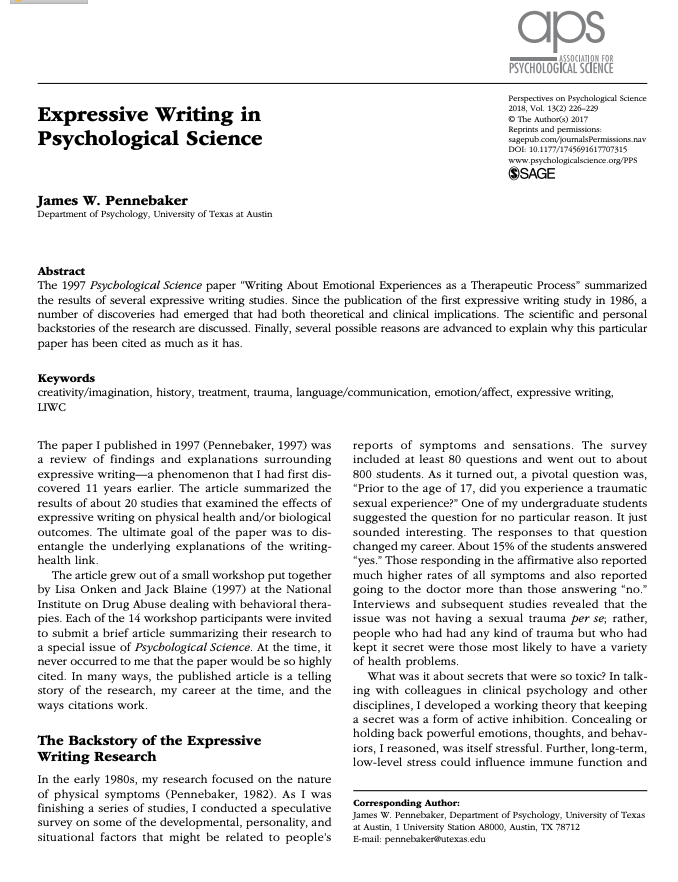
In 1987, psychologist James Pennebaker ran an experiment that broke every assumption about how human creativity works. He divided college students into two groups and gave them the same creative writing prompt. Group A had to write for 15 minutes without stopping, elaborating on every thought that surfaced. Group B had to write concise, polished responses in the same time frame.
The elaborate writers didn't just produce more ideas. They produced fundamentally different types of ideas. Brain scans showed their prefrontal cortex entered a state resembling REM sleep, where distant neural networks suddenly started talking to each other. The concise writers showed patterns identical to focused problem-solving mode, which actively suppresses creative connections.
Six months later, Pennebaker tested both groups again. The elaborate writers had continued generating novel solutions to unrelated problems at twice the rate of the concise group. The act of elaborative writing had permanently rewired their associative thinking patterns.
The advice sounds logical. Cut the fat. Trim the excess. Get to the point faster. What they missed is that ideation and communication are completely different cognitive processes, and optimizing for one destroys the other.
When you write elaborately, your brain enters what cognitive scientists call "divergent thinking mode." Each additional sentence forces your mind to find new angles, make unexpected connections, discover relationships between concepts that would never surface in a stripped-down version. The elaboration itself becomes the thinking tool.
Watch what happens when you try to explain a simple concept in 2000 words instead of 200. Your brain refuses to repeat itself. It starts mining deeper layers, pulling up examples you forgot you knew, connecting dots that seemed unrelated five minutes ago. The constraint of length becomes a creativity multiplier because your mind has to work harder to fill the space meaningfully.
Most people reverse this process. They think first, then write down the conclusions. They treat writing as a documentation tool for thoughts that already exist. This kills the discovery mechanism completely.
Real creative thinking happens during the writing, not before it. The elaborate sentences force your brain to search its entire knowledge network for supporting ideas, contradictory evidence, parallel examples, deeper implications. Every time you expand a thought, you're asking your neural pathways to surface material that stays buried when you think in headlines.
Professional researchers figured this out decades ago. They don't brainstorm in bullet points. They write massive exploratory documents where every paragraph spawns three new questions. They let themselves ramble across pages because they know the rambling is where breakthrough insights hide. The connections emerge in the elaboration, not despite it.
There's another layer most people miss. When you write elaborately about a topic, you're not just exploring what you already know about it. You're discovering what you didn't realize you knew about it. The act of expansion forces you to reach into adjacent knowledge areas, pull connections from unrelated experiences, surface insights that were sitting just below conscious awareness.
Pennebaker's follow-up studies revealed something even stranger. Students who wrote elaborately about completely unrelated topics showed improved creative problem-solving across all domains. The cognitive muscle of elaborative thinking transfers. Train it on one subject, and it enhances your ability to find novel solutions everywhere else.
Your brain was designed to think in stories, not summaries.
Feed it complexity and watch creativity multiply.
All roads lead back to 9 PM bed time, 5 AM wake up, 4 hours of deep, focused work creative work first thing, work out mid day to break it up, admin & calls in the afternoon, hang with friends and loved ones in the evening, repeat forever.
A handful of things that are worth the money:
- Eight Sleep
- One $5000+ watch
- Blackout curtains
- Bamboo sheets
- Uber Black
- Home espresso machine
- 1:1 skill tutoring
- High-level masterminds
- Standing desk
- Herman Miller chair
- Specced out MacBook Pro
- Home sauna & cold plunge
- Second work phone
- AirPod Pros
- Flying your friends in
- Grass fed ribeyes
- 1:1 personal training
- The whole tab at group dinners
- Home mobility station
- The person behind you’s coffee
- Flowers for your mom and girlfriend
- Carbon steel pans
- High-quality chef’s knife
- Fresh socks every quarter
- Premium gym membership
- Luggage that doesn’t break
- Max speed WiFi
- Walking desk treadmill
- A+ talent team members
- Paid ads
- Muji pens & journals
- Maxxed out AI tools
- New running shoes often
- Sports massages
- The newest iPhone
- TSA PreCheck
- Weekly house cleaner
- Bedroom air purifier
- Personal meal prep chef
- Prescription blue light blocking glasses
- Executive assistant
- VIP tickets at music festivals
- Full bloodwork panels 3x per year
- Weekend getaways in dope Airbnbs
- Weekly date nights
- Tax strategist
- Drafted a blog post
- Used an LLM to meticulously improve the argument over 4 hours.
- Wow, feeling great, it’s so convincing!
- Fun idea let’s ask it to argue the opposite.
- LLM demolishes the entire argument and convinces me that the opposite is in fact true.
- lol
The LLMs may elicit an opinion when asked but are extremely competent in arguing almost any direction. This is actually super useful as a tool for forming your own opinions, just make sure to ask different directions and be careful with the sycophancy.
I have to say this interview changed my life. Hearing how Boris thinks about software spurred me to work much harder on releasing my own way of doing things and on iterating fast on how I build. Hard to believe it has only been a month since this one.
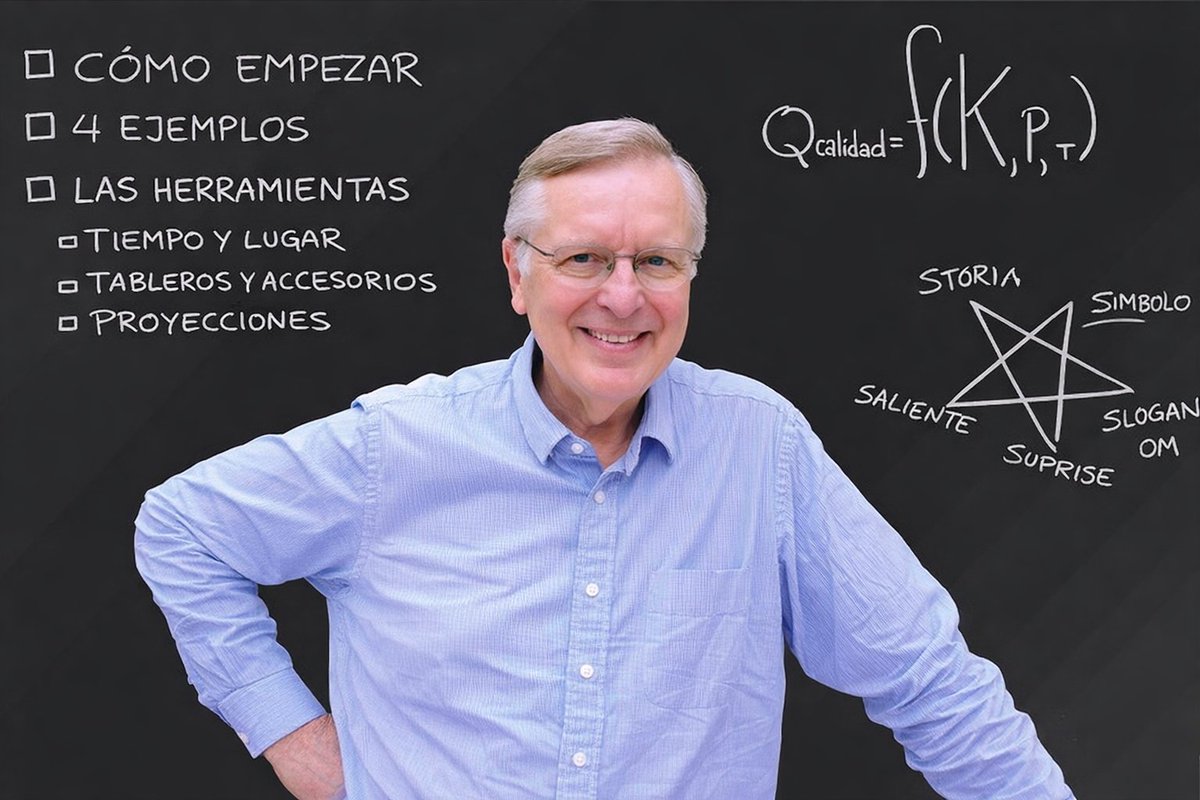
Un profesor del MIT dio la misma conferencia cada enero durante 40 años, y cada una de las veces no cabía ni un alma en el aula.
La vi a las 2 de la mañana y cambió por completo mi forma de entender la comunicación.
Su nombre era Patrick Winston. La conferencia se titula "Cómo hablar" (How to Speak).
Su frase de apertura te golpea como un camión: "Tu éxito en la vida vendrá determinado en gran medida por tu capacidad para hablar, tu capacidad para escribir y la calidad de tus ideas, en ese orden".
Ni tu nota media, ni tus títulos, ni tu coeficiente intelectual. Cómo hablas es lo que separa a las personas que son escuchadas de las que son ignoradas.
Este es el esquema que inculcó a los estudiantes del MIT durante cuatro décadas:
1) Nunca empieces con un chiste: Empieza diciendo a la gente exactamente qué es lo que va a aprender. "Prepara la bomba antes de verter nada". Él lo llamaba la "promesa de empoderamiento": dales una razón para no levantarse del asiento en los primeros 60 segundos.
2) La regla de las 5S: Para que una idea se quede grabada debe ser: Símbolo, Slogan, Sorpresa, Saliente (relevante) e Historia (Story). Cualquier idea que valga la pena recordar cumple al menos tres de estas.
3) La técnica del "casi acierto" (Near Miss): Esta parte me dejó alucinado. No te limites a mostrar lo que está bien; muestra lo que parece estar bien pero no lo está. Ese contraste es lo que hace que el cerebro registre algo de forma permanente.
4) Su regla final: Termina con una contribución, no con un resumen. No recapitules lo que ya dijiste. Dile a la gente qué les has dado que no tenían antes de entrar por la puerta.
He usado este esquema en ventas, entrevistas y presentaciones desde que lo vi, y los resultados no son sutiles.
Patrick Winston falleció en 2019, pero esta clase sigue siendo gratuita en el OpenCourseWare del MIT. Una hora, vista por millones de personas, y no cuesta absolutamente nada.
Video: "How to Speak", Patrick Winston, MIT OpenCourseWare, RES.TLL-005, January IAP 2018.
Fuente: MIT OpenCourseWare.
Licencia: CC BY-NC-SA.
Términos: ocw. mit. edu/ terms
The secret of life is to approach it playfully.
Everything can be approached with a sense of lightness, joy, and ease.
Doesn't matter what you're doing. Working at a cafe. Meeting someone new. Going out to dinner. Taking a work call. Writing a tweet. Going on a crazy travel adventure.
The illusion is that things are meant to be taken seriously.
This morning, I caught myself racing against time.
I had a friend arriving in Thailand.
I wanted to work out, jump in the ocean, and get coffee before he got here.
I was stressed and tense — battling against reality instead of flowing with it.
But everything changed with one mindset shift.
It's what I have tattooed on my arm:
"It's all play."
I decided to see the entire situation as a scene out of a movie to experience — rather than something to control and fight.
Ripping my motorbike through town, jumping in the ocean, and grabbing a cappuccino became an electric experience to enjoy rather than something to rush through.
My friend arrived, and the rest of the day flowed magically because my vibrational state shifted from tension to flow.
So whenever you're rushing, tense, or way too serious — a red flag should go up in your mind.
Life is not meant to be taken so seriously.
Reality is not meant to be controlled and fought against.
This is meant to be a game, a movie, an exploration in consciousness, and a journey your soul chose to experience through the character of you.
Sink into that state of awareness and watch your life play out more magically than you could have ever controlled from a tense, rigid mind.
It's all play.
"Getting Your Attention Span Back" starter pack:
step 1: find boredom first. pure unadulterated boredom. no work, no phone, no stimulation
step 2: notice where your mind naturally drifts
step 3: list the topics/themes/questions your brain keeps returning to
step 4: find the best books in the world on those topics/themes/questions. use your own metric of "best"
step 5: find a cozy spot and read those books
step 6: feel free to drop books that don't resonate. this step is important
step 7: write about what you're reading. this is not because you want to "optimize" the learning process (lol), but because you want to discover your mental/emotional/spiritual reactions to what you're reading
step 8: cultivate a dislike for everything shallow, superficial, and speedy. the best way to do this is by cultivating a love for deep things
step 9: engage with things that don't wanna monetize your attention. like sunsets and old public domain books
congrats! you've regained your attention span now. don't lose it again, and if you do, just come back to this list
Thoughts on "AI and Education"
I am not a fan of the “let’s teach our 8-year-olds how to use OpenClaw, run businesses, or make PPTs” trend I see in some schools. In the age of AI, I think children need less of that, not more, especially before age 10.
As someone replied to an earlier post I wrote on education, if we use the OpenClaw metaphor, build the soul.md file first for your child. That is the layer that is actually important and defining.
My instinct is that the years from 4 to 10 should be used to teach explicit frameworks for understanding the world. For me, that means subjects like philosophy, history (especially the history of religion), cosmology, psychology and biology (bc they help explain why humans behave the way they do), and math, meaning logic and rigor. I want to very consciously shape my child’s underlying epistemic and philosophical architecture.
Because otherwise, what do you get? A generation of children who seem smart, but are mostly just hyper-optimized for whatever the current system rewards. Right now, that often means attention, polish, and precocious performance. But those are not the same thing as depth. They are not the same thing as judgment. They are certainly not the same thing as wisdom.
What matters is not raising children who can outrun whatever happens to be fashionable at the moment. It is raising children with enough internal structure, understanding, and comprehension to recognize what actually matters in life. I want them to see beyond the systems and incentives that happen to be in vogue today, to understand why things are the way they are, and to operate within constraints without being defined by them.
Of course they need to learn the rules of the game. But I do not want them to be led by those rules. I want them to understand it clearly enough to participate in it without mistaking it for reality. As a friend said to me recently, there is the game of life, and there is Life. I think it's important for my kids to know how to operate within systems and social constraints, but not confuse those constraints with truth, meaning, or purpose. The point is not to raise children who are expertly optimized for the current moment or environment, but to raise children who can tell the difference between what is enduring and what is transient, and know how to compromise between the two in a way that is authentic and fulfilling.
I don't think any of this is at all controversial btw. Where I probably differ from some is how truly essential and foundational I think this is and how early it can be introduced, reinforced, and actually comprehended and practiced by the child. I already started at 3.5. Going well so far. Core concepts this month has been wisdom vs knowledge and the yin-yang symbol and what it means. You'd be surprised how quickly they picked up on the former, quite instantaneous really and very solid understanding. The latter is still more of a toy concept at the moment but probably because I am not explaining it well!
You're going to screw up your kids
Not in a traumatic way (hopefully), but in little ways you won't even realize until they're 25 and mentioning it casually.
"Yeah, Dad was always on his phone at dinner" or "Dad never really asked about my day."
Here's the thing most dads get wrong:
They think parenting is about AVOIDING mistakes.
It's not.
It's about preventing the BIG damage while accepting the small stuff comes with the territory.
THE BIG DAMAGE YOU CAN PREVENT:
• Feeling unloved
• Feeling unsafe with emotions
• Feeling like a constant disappointment
• Feeling unheard or dismissed
These aren't small quirks. These are the wounds that shape your kids' entire adult lives.
Their marriages. Their self-worth. Their ability to trust.
This is the damage that matters.
HOW TO PREVENT IT:
• Tell them you love them. Daily. Even when they're driving you insane.
• Don't explode unpredictably. If you do, apologize like a man.
• Praise effort over outcomes. Always.
• Put your phone down when they're talking.
• Never make them feel like their emotions are "too much."
None of this is complicated. But it requires something most dads don't have: energy and presence.
You can't be patient when you're exhausted.
You can't be present when you're mentally checked out.
You can't show up emotionally when your body is running on fumes.
This is why your health isn't selfish. It's the foundation for everything.
THE SMALL STUFF YOU CAN'T PREVENT:
→ Missing some of their events
→ Your weird household rules
→ Being stricter than other parents
→ Working long hours sometimes
They'll survive this. They might even joke about it someday.
But here's the difference:
A kid whose dad missed events but was LOCKED IN when present? Fine.
A kid whose dad attended everything but scrolled through his phone? Not fine.
Your kids won't remember every game you attended.
They'll remember if you were actually THERE when you showed up.
They won't remember every dinner.
They'll remember if you cared about their lives or just lectured them.
They won't remember every gift.
They'll remember if they felt SAFE coming to you when they messed up.
Presence isn't about quantity. It's about quality.
And quality requires a version of you that's rested, healthy, and mentally sharp.
THE REAL LITMUS TEST:
Before you react to something, ask:
"Will this help them or hurt them 20 years from now?"
Enforcing bedtime because they need sleep? Helps.
Screaming that they're "being ridiculous" because you're tired? Hurts.
Making them apologize for hitting their sibling? Helps.
Telling them "you're always causing problems"? Hurts.
You won't get it right every time. I don't.
But if your kids grow up knowing they were loved, heard, and safe with you?
You did the job.
And that job starts with being healthy enough to show up for it.
this is a really good tweet...not all books are equal.
one book written by a true polymath = 100 books, maybe even 500 or 1000.
I can only think of three, bc minds like those, you only get a few of them each century... ones that are genius-level in EVERY arena: literature, science, history, physics, philosophy, human nature, love, art, music, theology.
if you and me devoted our entire lives to just one of those, we'd be unlikely to get there. its really the combo of science + art + a deep understanding of human nature, that you NEVER come across in one soul.
the books are one thing -- its more just absorbing the worldview of someone who, in ~30 years of life, somehow uploaded 10,000 years of knowledge/wisdom into their head.
a true polymath transports you across time and space, fluent in all subjects of all eras, as they connect ideas, individuals, and eternal truths of the human condition in ways that are otherwise inaccessible...the ability to tie it all together is what instantly cements them as one of history's greatest thinkers.
1. Schopenhauer's "World as Will and Representation"
2. Will Durant's "Story of Civilization" (Series)
3. Bertrand Russell's "History of Western Philosophy"
all can be thick/dense, which is to be expected of any 1000-book book
other names that get tossed around are Goethe, Nietzsche, Shakespeare, Voltaire, Rousseau, prob others...but none have a singular work I'd direct you to.
in the modern era, no man or woman exists who belongs in the same breath as any of these ppl.
bonus recs/10-book books:
-Seneca's "Moral Letters to Lucilius"
-Montaigne's "Essays"
-Plutarch's "Moralia"
-Emerson - "Self-Reliance and Other Essays"
-Pascal's "Pensees"
-Francis Bacon's "Essays"
-Lord Chesterfield's "Letters"
-La Rochefoucauld's "Maxims"
-Balzac - Lost Illusions
-Tolstoy - A Confession
-Erasmus - Adagia
-Samuel Johnson - Rasselas
and for good measure...King Solomon - The Book of Ecclesiastes.