China's crude imports alre collapsing.
The world's largest oil buyer is being shut out by the same crisis closing Hormuz.
For a decade: 7-12 mb/d.
The anchor of global oil demand growth.
From this year a sharp decline in imports.
The reason is simple.
China sources most of its crude from Saudi Arabia, Iraq, UAE, Iran.
Every barrel transits Hormuz.
When Hormuz became a war zone, the supply chain didn't just get expensive it got physically disrupted.
Tankers rerouted.
Insurance exploded.
Cargoes cancelled.
Full analysis in my latest article.
Link in the comments 👇
L’estate italiana non sarà immobile.
Questa settimana l’Anticiclone delle Azzorre continuerà a influenzare buona parte dello scenario tra Europa centro-occidentale e Mediterraneo, ma con una dinamica tutt’altro che piatta. La sua espansione e successiva parziale ritirata verso ovest aprirà infatti la porta a un passaggio più instabile tra mercoledì 10 e venerdì 12 giugno.
Il meccanismo è abbastanza chiaro, lungo il bordo orientale dell’alta pressione scivolerà un impulso più fresco e instabile di origine nord-atlantica. I primi segnali si vedranno già domani al Nord, soprattutto tra Alpi e Prealpi, dove nel corso della giornata aumenterà il rischio di rovesci e temporali. Poi, tra mercoledì e giovedì, l’impulso tenderà a muoversi rapidamente verso il Nord-Est e il versante adriatico, favorito anche da un nuovo aumento della pressione da ovest. Alta pressione che spinge da una parte, aria più fresca che scivola dall’altra, e in mezzo l’Italia attraversata da una fase più vivace.
Le aree più coinvolte sembrano quindi Nord-Est, Adriatiche e parte del Centro-Sud esposto alle correnti orientali. Al Sud l’afflusso di aria più fresca dai quadranti orientali potrebbe insistere anche nei giorni successivi, mantenendo un clima meno caldo e più ventilato almeno fino al weekend. Le temperature tenderanno a calare soprattutto al Nord-Est, sulle zone adriatiche e successivamente anche quelle joniche, anche se l'aria atlantica avrà un debole-moderato impatto sulle minime anche sul resto della Penisola.
Quando l’estate non è schiacciata da una cupola subtropicale continentale, può ancora respirare e questa settimana lo farà.
Louise Perry made a sharp observation: many feminists tried to replace the husband with the state.
In her interview with John Anderson, she pointed out that while the state can provide money and daycare, what most women actually want is to raise their children with the support of committed adults, not institutions.
After reviewing history, she concludes that monogamous marriage, despite its imperfections, has consistently produced the best outcomes for mothers and children. Every major experiment with communal living or fully socialized families has ended with worse results.
Decades of research show children raised by married biological parents have significantly better outcomes across the board, lower rates of poverty, higher educational attainment, better mental and physical health, and lower involvement in crime.
These advantages hold even after controlling for income and education. Alternative family structures and state-heavy models have repeatedly shown higher instability and poorer long-term results for kids.
With marriage rates declining and child mental health struggling, we need to be honest about which systems actually support families best instead of clinging to nice-sounding theories that keep failing.
Do you think stable monogamous marriage is still the best system we have for raising kids, or do you see better alternatives?
“The real surprise from the OECD’s subsidy numbers is that it cost China less than $18bn in sectoral support over 15 years to build an industry that can now provide more clean power than the world can readily absorb.”
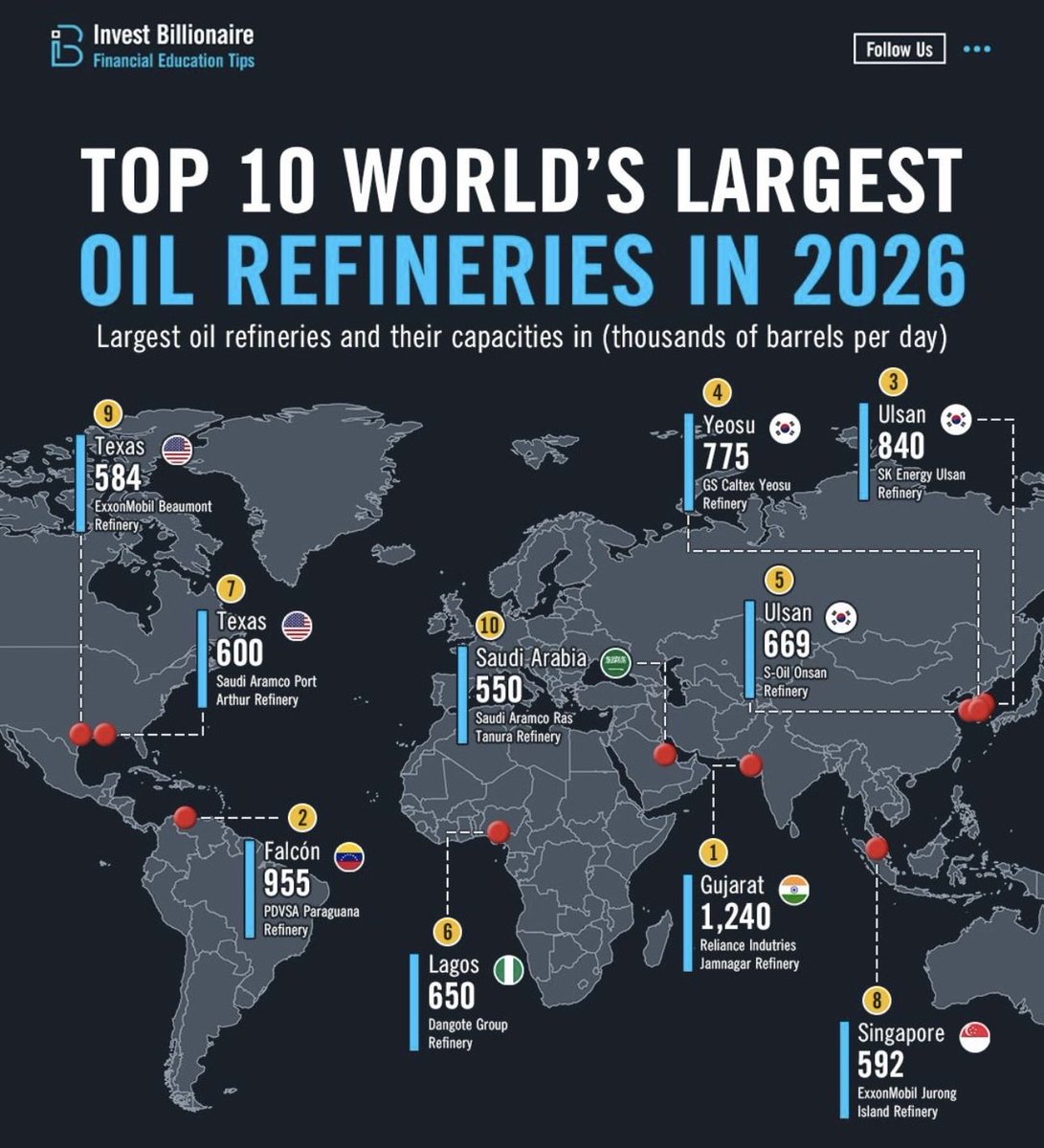
Refining Capacity Is Strategic Power🛢️🏭
Crude oil only matters if you can turn it into usable products.
That is why refineries are so important.
-Gasoline
-Diesel
-Jet fuel
-LPG
-Naphtha
-Petrochemicals
The world’s largest refineries are not just industrial assets.
They are strategic chokepoints in the energy system.
India, South Korea, the US, Nigeria, Singapore, Saudi Arabia, and Venezuela all show the same thing:
Energy security is also about having the capacity to process it.
C’è una zona dell’Atlantico che sembra andare controcorrente rispetto al resto del pianeta.
Mentre gran parte degli oceani accumula calore, nel Nord Atlantico subpolare, tra Groenlandia, Islanda e Regno Unito, persiste da decenni una grande anomalia fredda. Si chiama cold blob e non è una semplice macchia blu su una mappa.
Gli studi più recenti indicano che quel segnale non riguarda solo la temperatura superficiale del mare, ma il contenuto di calore dell’intera colonna d’acqua, in altre parole, lì non si raffredda solo "la pelle" dell’oceano, il segnale entra più in profondità. E' importante perché proprio in quell’area passa una parte fondamentale dell’AMOC, la grande circolazione oceanica atlantica che contribuisce a trasportare calore verso nord. Se quel trasporto di calore si indebolisce, una zona del Nord Atlantico può raffreddarsi anche mentre il pianeta, nel complesso, continua a scaldarsi e un’AMOC più debole può influenzare la distribuzione del calore nell’Atlantico, la posizione delle correnti atmosferiche, alcuni regimi di pioggia e temperatura tra Nord America, Europa e fascia tropicale atlantica.
Il cold blob non va liquidato come una curiosità. Non significa che la Corrente del Golfo si fermerà domani, non significa che l’Europa entrerà automaticamente in una nuova era glaciale e non autorizza scenari da film catastrofico. Significa però che l’Atlantico sta mostrando una redistribuzione anomala del calore e nel clima, a volte, non sono solo le zone rosse a parlare. A volte il segnale più interessante è una macchia fredda nel posto giusto.
🚨 SCIENTISTS ARE LEARNING HOW TO CONTROL MAGNETISM AT THE SCALE OF INDIVIDUAL ATOMS.
Not materials.
Not circuits.
Atomic spin itself.
Researchers are advancing a field known as spintronics, where information is stored and processed using the quantum spin of electrons rather than relying solely on electric charge.
Why this matters:
• Electron spin can store information using far less energy
• Tiny magnetic structures called skyrmions can act as ultra-stable data carriers
• Information may be moved without the same heat losses seen in conventional electronics
• Future memory devices could store far more data in far less space
• Spin-based computing could dramatically improve energy efficiency
The breakthrough:
Inside magnetic materials, scientists can create nanoscale magnetic whirlpools known as skyrmions.
These structures behave almost like particles.
They can be created, moved, manipulated, and detected while consuming very little power.
Some are only a few nanometers across.
Yet they can reliably store information.
The deeper implication:
For decades, computing has been built around moving electric charge through billions of transistors.
But charge creates heat.
Heat creates limits.
Spin offers another path.
Instead of forcing more electrons through smaller circuits, future technologies may manipulate the quantum properties of matter itself.
The result could be computers that are faster, denser, and dramatically more energy efficient.
The future of computing may not be built from smaller transistors.
It may be built from controlling quantum magnetism itself.
What do you think could spintronics become the technology that succeeds traditional silicon computing?
Follow for more frontier science and technology discoveries.
We simply do not know what will be required by the job market in the coming decades. What matters most is the capacity to remain flexible, and to have a wide range of skills – intellectual, physical and social.
In 1880, a reclusive, self-taught telegraph operator with no university degree went to war with the greatest scientific minds in the British Empire.
He won, changed the mathematics of physics forever, and quietly built the foundation for the entire modern electrical grid.
Yet today, almost no one outside of electrical engineering and applied mathematics even knows his name.
His name was Oliver Heaviside.
The story of how he solved one of the hardest engineering problems in human history is a masterclass in why book smarts fail where deep, messy intuition succeeds.
In the late 19th century, the world was trying to lay massive underwater telegraph cables across the Atlantic Ocean. But they had a crippling problem: the signals kept distorting. You would type a message in London, and by the time it reached New York, it was a smeared, unreadable mess of electricity.
The top physicists of the day, using traditional university math, said the solution was simple: make the cables purer and reduce resistance. They spent millions of dollars trying to make the lines perfect.
It didn't work. The signals still broke.
Heaviside looked at the exact same problem from his messy, self-taught perspective and realized the elite academic establishment was blind.
They were treating an electrical wire like a water pipe. They thought the electricity was inside the copper.
Heaviside figured out that electricity doesn’t flow inside the wire; it flows in the electromagnetic field around the wire.
Then, he did something that made mainstream mathematicians furious. He invented a bizarre shortcut called operational calculus. Instead of spending weeks solving complex, multi-page differential equations to map these fields, he treated calculus like basic algebra.
To the professors at Cambridge, this was a sin. They called his math clumsy, unrigorous, and nonsense.
Heaviside didn't care. His famous response to them was: "Should I refuse my dinner because I do not fully understand the process of digestion?"
He used his illegal math to propose a mind-bending solution: to fix the distorted signal, engineers didn't need to make the cable cleaner. They needed to deliberately add more corruption to it. He suggested wrapping the cables in iron wire to introduce "inductance", intentionally fighting one distortion with another.
The establishment ignored him for years. But when AT&T finally tried his method, the results were instant. Long-distance communication was solved.
Heaviside wasn't trying to pass a math exam or impress a peer-review board. He wanted to solve a real-world problem.
In the process, he took James Clerk Maxwell’s famously complex 20 equations of electromagnetism and condensed them into the 4 beautiful formulas that every single physics student is forced to memorize today. Heaviside did the heavy lifting, but Maxwell got the name.
The lesson Heaviside left behind is a philosophical blueprint for navigating a complex world:
The people who memorize the proper formulas are excellent at solving textbook problems. But they are entirely dependent on the rules staying the same.
The people who understand the underlying system don't care about the rules. They break them to find what actually works.
Most of us approach our life's problems like the 19th-century British establishment. When something goes wrong in our career or relationships, we try to make our existing wire purer. We try harder at a broken method.
But sometimes, the problem isn't that you aren't trying hard enough. The problem is that you are looking inside the wire instead of looking at the field around it.
What is a distortion in your life right now that you keep trying to fix with the standard advice? What happens if you stop trying to follow the textbook formula and start looking at the hidden forces causing the noise?
A food crisis in the making
- We lost 50% of all seaborne traded urea
- 25% of global ammonia trade
- Both are key ingredients for nitrogen fertilizer
- Nitrogen fertilizer is responsible for 50% of food production
When you apply less fertilizer than the crop removes, you gradually deplete key nutrients from the soil, which leads to lower yields.
Lower fertilizer application rates don't just impact the current harvest... they can also reduce soil fertility and future crop yields.
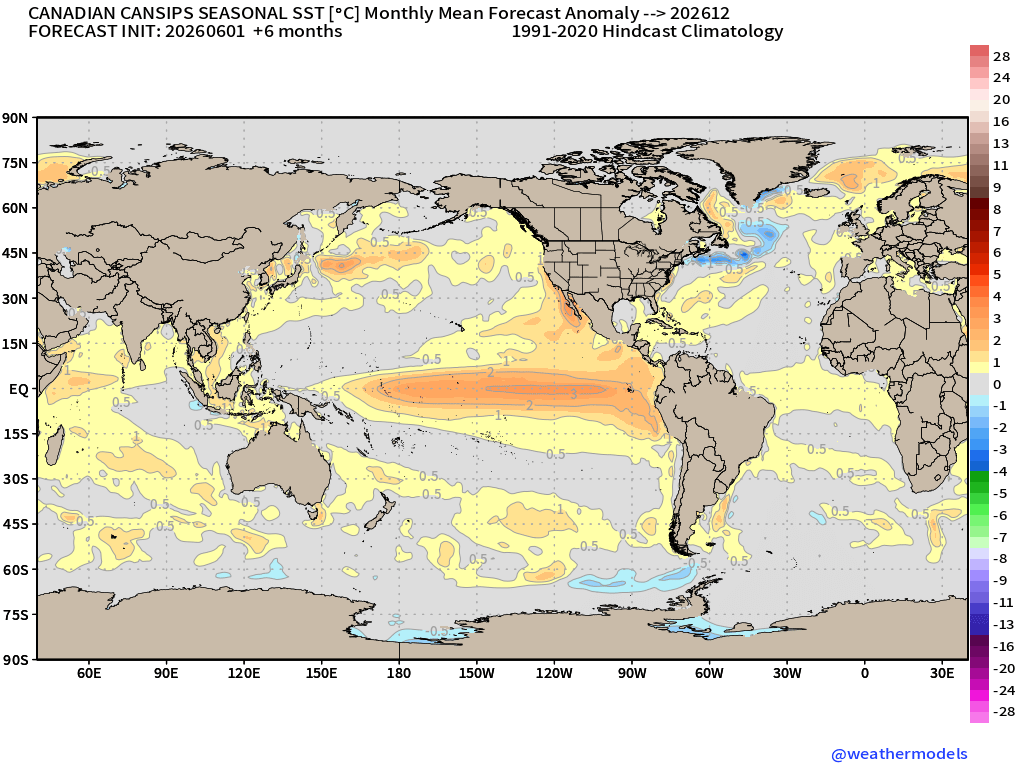
🚨 A Super El Niño is now taking shape.
The latest CANSIPS seasonal forecast paints a dramatic 12-month outlook for the planet.
Pacific Ocean temperatures surge toward +2.66°C Niño 3.4 by December 2026 — firmly in Super El Niño territory.
What could this mean? 👇
🌊 Niño 3.4 Index Forecast (Jun 2026 → May 2027)
• Jun: +1.46°C
• Jul: +1.98°C
• Aug: +2.16°C
• Oct: +2.26°C
• Dec peak: +2.66°C 🔥
• Still elevated into Spring 2027
That’s an extremely powerful warm event.
Expected global fingerprints:
☀️ Very dry conditions projected across:
• Central America
• Philippines
• Indonesia
• Maritime Continent
🌧️ Tropical rainfall patterns shift eastward as the Pacific atmosphere reorganizes.
🌀 Atlantic tropics?
Forecast signal looks weak — potentially a suppressed / dry Atlantic basin, a classic El Niño hurricane-killer setup.
Meanwhile, most other global oceans stay near normal…
meaning the tropical Pacific becomes the main driver of global climate disruption.
History shows strong El Niño events can reshape:
⚠️ Monsoons
⚠️ Heatwaves
⚠️ Droughts
⚠️ Wildfire risk
⚠️ Tropical cyclone activity
If this forecast verifies, late-2026 into early-2027 could become one of the most consequential ENSO periods in years.
#ElNiño #Climate #ENSO #Weather #ClimateCrisis
China now has 109 car brands. These are at all price points. Of course, many will eventually fall by the wayside. But some of these will become global successes. The global auto industry seems to be in for a real churn. Signal to short the European auto majors?
Stabilizing the relations between US and China following the US-China summit and agreeing on managed confrontation is the best geopolitical news for 2026. Similarly to the stabilization of India-China relations following Modi-Xi Jinping meeting in 2025. This is key to less chaos.
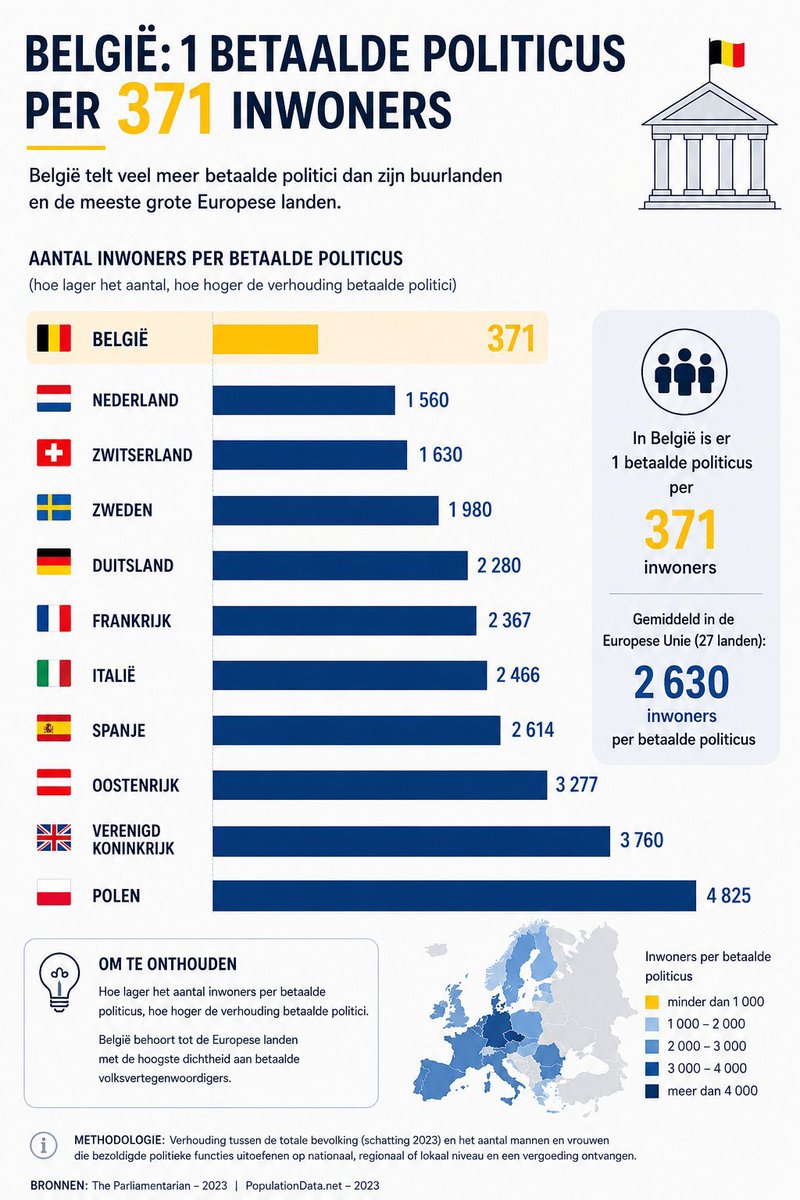
België: 1 betaalde politicus per 371 inwoners. Zwitserland: 1 per 1.630 inwoners.
Dat is geen democratie meer, dat is een politieke parasietenindustrie.
In Zwitserland doen de meeste parlementsleden hun job als bijbaan. Ze hebben een écht beroep, betalen zelf belastingen en blijven met beide voeten in de realiteit.
Geen fulltime graaiers die hun hele leven op de overheidsfles leven.
In België hebben we een leger van 10.000+ betaalde mandatarissen die met z’n allen aan de staatskassa hangen.
Van gemeenteraadsleden tot Europarlementsleden, allemaal met riante vergoedingen, pensioenen en extraatjes.
Resultaat? ✅ Zwitserland: lage belastingen, directe democratie, politici met gezond verstand ❌ België: hoogste politieke dichtheid van Europa, torenhoge belastingen en een kloof met de burger die steeds groter wordt
Dit is geen “vertegenwoordiging van het volk”. Dit is een zelfbedieningsbuffet voor de politieke klasse.
De Zwitsers hebben het begrepen: politiek moet een dienst zijn, geen carrière.
In België blijven wij betalen voor deze
incompetentie. Tijd om dat systeem eens grondig te ontmantelen.
They interviewed the founder of Dubai, Sheikh Rashid, about his country's future.
He said:
"My grandfather rode a camel, my father rode a camel. I drive a Mercedes, my son drives a Land Rover, and my grandson will drive a Land Rover, but my great-grandson will have to ride a camel again...”
"Why?"
“Hard times create strong men, strong men create easy times. Easy times create weak men, weak men create hard times. Many won't understand, but we need to raise warriors, not parasites
THE FED IS ABOUT TO CUT WHILE THE ECONOMY BOOMS.
🇺🇸 New Fed Chair Kevin Warsh: AI is "structurally disinflationary." Per his WSJ op-ed.
Same pattern. Different decade.
1995: Greenspan saw the productivity boom. Let the economy run hot. Cut rates anyway.
Result: 7 years of risk-on. Nasdaq up 1,132%.
Musk, Altman, Bezos, Druckenmiller all agree: AI is deflationary.
Warsh just took the chair. June 16: his first FOMC.
The next few years are going to be insane.
Beeld je in: je stapt het vliegtuig in en je neemt plaats in business class. Ruime zetel en onmiddellijk champagne. Een menu met drie gangen. Je strekt je benen, leunt achterover, en denkt: zo hoort het leven te zijn. En het mooiste van al? Je betaalt maar de helft van je ticket. De andere helft? Die wordt betaald door je kinderen. Alleen: ze weten het zelf nog niet. Ze waren er niet bij toen de boeking werd gemaakt. Maar de steeds verder oplopende rekening staat wel op hun naam. Welkom aan boord van de Belgische welvaartsstaat.
Concreet: elk kind dat wordt geboren krijgt per onmiddellijk een schuld van zowat 50.000 euro mee. Geen pamperrekening maar een pamperfactuur. Bovendien dreigen alleen al de rentelasten tegen 2028 nog te verdubbelen tot 18 miljard euro per jaar. Miljarden die zullen gaan naar schuldeisers - niet naar scholen, lagere belastingen of betere infrastructuur. Dat is de prijs van de business class voor de happy few.
Tientallen jaren lang heeft elke Belgische regering meer uitgegeven dan er binnenkwam - jaar in, jaar uit. Het was comfortabel én populair. Iemand anders zou later wel de rekening betalen. Die iemand anders heeft een naam: Emma, Jack, Youssef of Mathis. Ze zitten vandaag in economy class betalen mee voor het comfort vooraan.
De regering vraagt om een inspanning: strengere regels voor langdurig zieken, minder indexering, hervorming van pensioenen, snoeien in subsidies. En dus wordt er geprotesteerd. Vakbonden. Mutualiteiten. Gepensioneerden. Middenveld. Ze zijn goed georganiseerd, ze zijn luid en ze zijn aanwezig. Decennialang boven je stand leven creëert namelijk gewoonten die beginnen aanvoelen als rechten. Stuk voor stuk zijn het passagiers in business class.
De jongeren die de rekening betalen worden nooit uitgenodigd. Ze hebben geen vakbond of lobby die voor hun toekomst onderhandelt. Ze zijn te jong, te verspreid, te druk bezig met spelen, studeren of met beginnen aan hun loopbaan.
Laat ons de sanering eens omdraaien. Niet als een aanslag op de rechten van business class. Wel als het mooiste cadeau dat we de volgende generatie kunnen geven.
We zouden bijvoorbeeld de pensioenen niet meer volledig kunnen indexeren. En de vrijgekomen middelen te besteden aan jongeren. Verlaag de belastingen op de laagste lonen. Meer overhouden van je eigen inspanning is meer rechtvaardigheid. Geef jongeren een groter fiscaal voordeel om zelf meer te sparen voor hun eigen pensioen. Het geeft hen een aansporing én ruimte om meer te werken, te sparen en te investeren in hun eigen toekomst.
Een land wordt namelijk niet groot door wat het vandaag uitgeeft. Wel door wat het morgen achterlaat. Het mooiste cadeau dat we de volgende generatie kunnen geven is een schone lei. Een land dat zijn facturen betaalt. Een arbeidsmarkt die loont. Een woonmarkt die bereikbaar is. Een pensioenlandschap dat eerlijk is. Maar vooral: de overtuiging dat elke generatie de plicht heeft om dit land sterker achter te laten dan ze het aantrof.