Ian Cameron, chair of Parliament’s Portfolio Committee on Police, says Senzo Mchunu has received more than R3.16 million in remuneration while on special leave, while acting Police Minister Firoz Cachalia has received a further R3.02 million.
Cameron says the combined R6.19 million raises serious questions about policing priorities, noting that Mchunu’s remuneration alone is equivalent to the annual salaries of about 13 experienced Constable-ranked detectives.
He says the money could instead strengthen stretched Family Violence, Child Protection and Sexual Offences units, and is calling on President Cyril Ramaphosa to explain how long Mchunu’s special leave will continue and what the end point is.
@IanCameron23
48%.
That is the effective tax burden on someone earning R30,000 a month in South Africa. Same rate as someone earning R432,000 a month in a top European country.
The numbers sound wrong. They are not.
Where the 48% comes from.
PAYE is what people see on the payslip. It is not the whole picture.
VAT - 15% on almost everything. Every swipe. Every fill-up. Most people do not think of VAT as a tax. It is the largest single source of government revenue after income tax.
Fuel levy - built into every litre. Petrol at R26.92 inland includes roughly R3.80 in fuel levy and Road Accident Fund levy. That is a tax on getting to work.
Then there are the charges that look like fees but function like taxes. E-tolls. Municipal surcharges. Electricity tariffs with embedded levies.
Add the visible and the invisible - you get 48%.
The key difference with Europe.
In the Netherlands. In Denmark. In Germany. High taxes come with a social contract.
Free tertiary education. Universal healthcare that does not require medical aid. Childcare subsidies. Paid parental leave that covers an actual year. Robust unemployment support.
You pay 45%. And you get services back.
In South Africa you pay 48%. And then you pay again - privately.
Medical aid because public healthcare is collapsed. Security because policing is broken. Private schools because public education cannot be trusted. Solar panels or a generator because Eskom cannot guarantee power. Water tanks because the municipality cannot guarantee supply.
The middle-class earner pays twice. Once in tax. Once in escape.
Who actually pays.
There are about 8.3 million personal income taxpayers in South Africa. A relatively small slice of the population. The top earners supply most of the revenue.
Corporations optimise. The wealthy structure. Offshore trusts. Semigration. Emigration. The R30,000 earner cannot escape - it comes out before they see the money.
The base is narrow. The burden is concentrated. The services are not.
Why it accumulated this way.
No one designed this system. It grew.
Income tax funds the general budget. VAT funds the general budget. Fuel levy funds roads and the general budget. Each mechanism made sense when it was introduced. Each one expanded quietly.
Raising income tax visibly upsets people. Raising VAT is less visible - it is embedded in the price. Raising fuel levy is buried in the pump price. Municipal charges are non-negotiable.
The objective was not fairness to the middle class. It was revenue extraction with minimum political friction.
The uncomfortable part.
This is not a policy failure. It is a policy success. The system extracts efficiently. It offends quietly. And the people who carry it do not have the means to opt out.
The question is not whether 48% is too high.
It is how long the R30,000 earner can pay twice - once in tax and once in escape - before something breaks.
You don’t even get to process one kind of extreme violence before you’re exposed to the next one. Twenty seven people were killed last night in two mass shootings. I don’t know how we’re supposed to compute that.
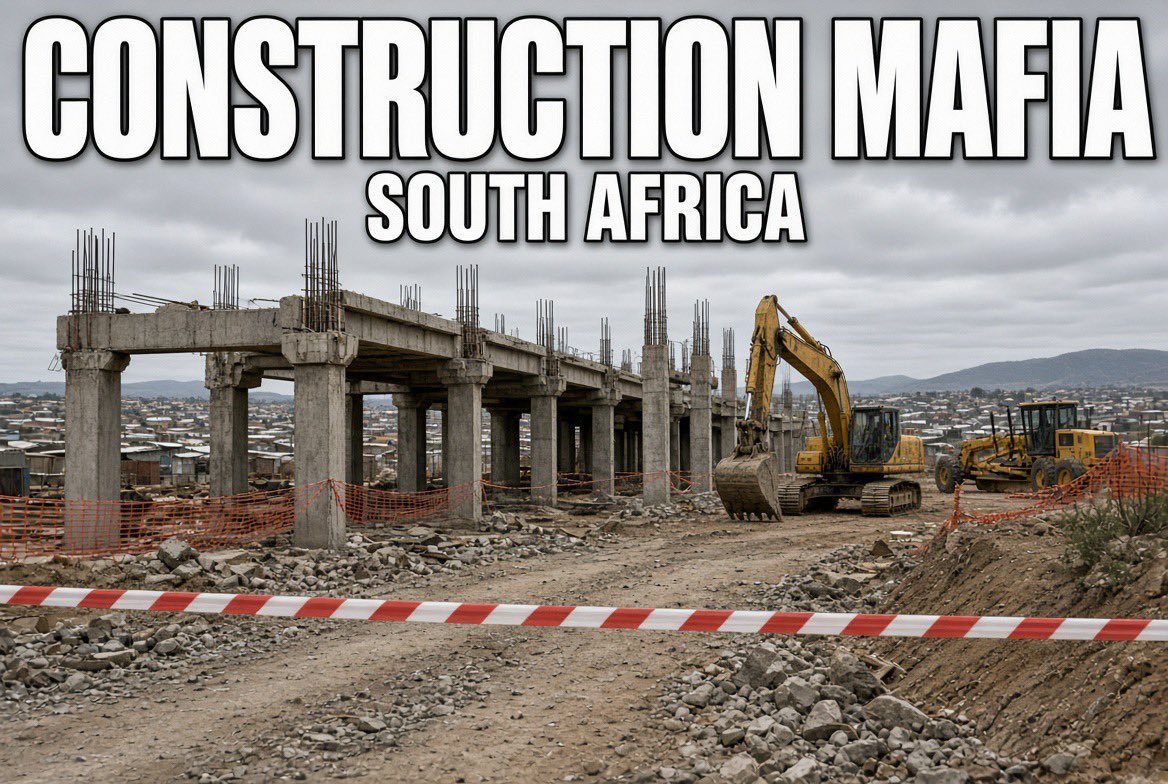
The “Construction Mafia” in South Africa is no longer a localised provincial site invasion. It has become a national extortion economy affecting public infrastructure, inflating project costs, and deciding which schools, roads, clinics and water works get built.
It began in KZN as armed “business forums” demanding cuts of contracts. It now sits in procurement, subcontracting, plant hire, security and, in some metros, and the municipal supply chain itself.
Government estimates the direct cost in lost economic output to about R17 billion a year, “with billions more lost before a project gets off the ground.”
In 2024, Department of Public Works and Infrastructure said 164 of 206 of its own infrastructure projects were delayed (79%), with R1.3 billion spent that year and R2.9 billion over several years still incomplete. Causes included late client payments, weak project control, contractor default and site disruption.
The scams:
1. Groups arrive armed, claim to represent “the community,” and demand 30% of contract value, nominated subcontractors, or cash. Work stops until they are paid or given a stake.
2. A 30% demand of local partners. National Treasury has confirmed the 30% rule does not apply to private contracts and is not a licence to extort. The syndicates treat it as one.
3. Forced labour and dummy SMMEs. Contractors are compelled to put forum-linked companies on the books. Many exist only on paper. Unqualified labour is forced onto site. Quality collapses; costs rise.
4. Equipment theft and sabotage as collection. Graders, generators and copper are stolen or sites are vandalised until protection money is paid.
5. Front companies and recycling. After blacklisting, directors resign, the entity is renamed, family members become new directors, and the same network bids again.
2014-2015: Origin: Two KZN township groups - Delangokubona Business Forum and KwaMashu Youth in Action - began invading sites. They later formed the Federation for Radical Economic Transformation, subsequently renamed the Black Business Federation. Delangokubona still operates separately in a loose alliance. The method was copied into Gauteng from 2017-18 and then into the Western Cape and Eastern Cape.
2015-2019: As specialised policing and prosecution capacity across the state thinned during the State Capture years, the forums professionalised. Industry accounts say almost all major construction sites in KZN were affected in this window. In January 2019 Aveng–Strabag terminated a R1.65 billion Mtentu Bridge contract on the N2 Wild Coast after 84 days off site following armed threats and protest action. A R11 billion Montrose Mega City housing project in Randfontein, launched in 2017, stalled after 2017-18 with contemporaneous accounts citing “forum demands” and “failed bulk services”. The site was later stripped.
2019 : SAFCEC and GI-TOC put 183 infrastructure projects worth more than R63 billion as disrupted by that year. Public Works and National Treasury still use it as the official baseline - roads not built, clinics delayed, water schemes stalled.
2020-2024: Extortion cases nationally (all sectors) ran at 6 056 reported between April 2019 and March 2024, with 2 389 arrests and only 178 convictions. Construction remains the primary subset.
Links with taxi associations as enforcers were now being recorded.
At the Lower uMkhomazi water project an altercation left a ward councillor and two security guards dead.
2024 onwards: The Durban Declaration between Public Works, Treasury and SAPS created hotlines, economic-infrastructure task teams and a blacklisting push with more than 770 cases reported.
There is still no official figure for what the “construction mafia” itself took in cash, dummy subcontracts or protection fees. Treasury and Public Works put more than 180 projects worth R63 billion as disrupted since 2019 - the value of sites hit, not money stolen - while estimating about R17 billion a year in lost output.
Billions of rand generated through informal businesses, including spaza shops, may be moving out of South Africa through unregistered financial channels, according to a new report examining migrant communities and the informal economy in Tshwane.
Read on https://t.co/jEATVRarKr
#SpazaShops #FinancialCrime #MoneyLaundering #news #IOL
The Freedom Front Plus's mayoral candidate for the Nelson Mandela Bay Metropolitan Municipality is a former apartheid-era police officer who spent almost 14 years in prison for the 1991 murder of ANC activist Mbongeni Jama.
Read on https://t.co/zFWvWkGvp9
#BillHarington#FFPlus #NelsonMandelaBay #LGE2026 #SouthAfricaPolitics #IOLNews
WATCH | The South African Policing Union is demanding the reinstatement of National Police Commissioner Fannie Masemola after four PFMA charges linked to the R360-million SAPS medical tender were withdrawn. The NPA says there are no reasonable prospects of a successful prosecution.
People are trying their best to make it seem as if ANC is worse than their beloved Apartheid Govt 😂.
Those people were heartless killers and killed people for fun. It was State sponsored oppression unlike anything the world has seen.
Some of us will never fall for propaganda!