HiHolo is one of three winners of Constructor Start Batch 4, out of 16 finalists at Demo Day in Bremen. Thank you to the team, jury and mentors.
Holo Engine is deterministic, explainable AI for robots: LLMs propose, Holo checks and executes.
@hiholoai
Freud's uncanny is the familiar turning strange. I feel it less at polished demos and more when a robot fails like a person would: a pause, a second grip, a small correction. That's when people stop calling it a trick https://t.co/a9qtEC9cvn
Recent experiences with agentic robotics and the Riemann results feels like we're entering a new phase of the Uncanny Valley; in particular the phase that Freud related to magic where something once dismissed as impossible might actually be real.
Good welders steer by the sound and the look of the puddle as much as by the hand. If welders are training this biped hands-on, I'd want to know what gets recorded besides arm motion. That's what a first commercial site will test https://t.co/VdnhIBef7U
Persona AI’s HD Hyundai welding biped is in Korea. US and Korean welders are training it hands-on.
They say it cleared enterprise-grade quality checks in September and are targeting the first commercial site by year-end. It has to run a standard welder plus a ~15 kg wire feeder, and manage the cable tangling itself.
---
(Skilled workers will be the next scarce, real-world data source to be vied for.)
9+ months: the reported wait for machines that cut harmonic drives, per a supplier field report on the Optimus ramp.
Robotics X keeps calling it an intelligence problem. A smarter policy still needs a precise gear in most joints.
Models scale in weeks. Machine tools don't.
Say the AI-assisted Riemann proof holds. Math had what robotics lacks: a checker. Lean accepts or rejects every step.
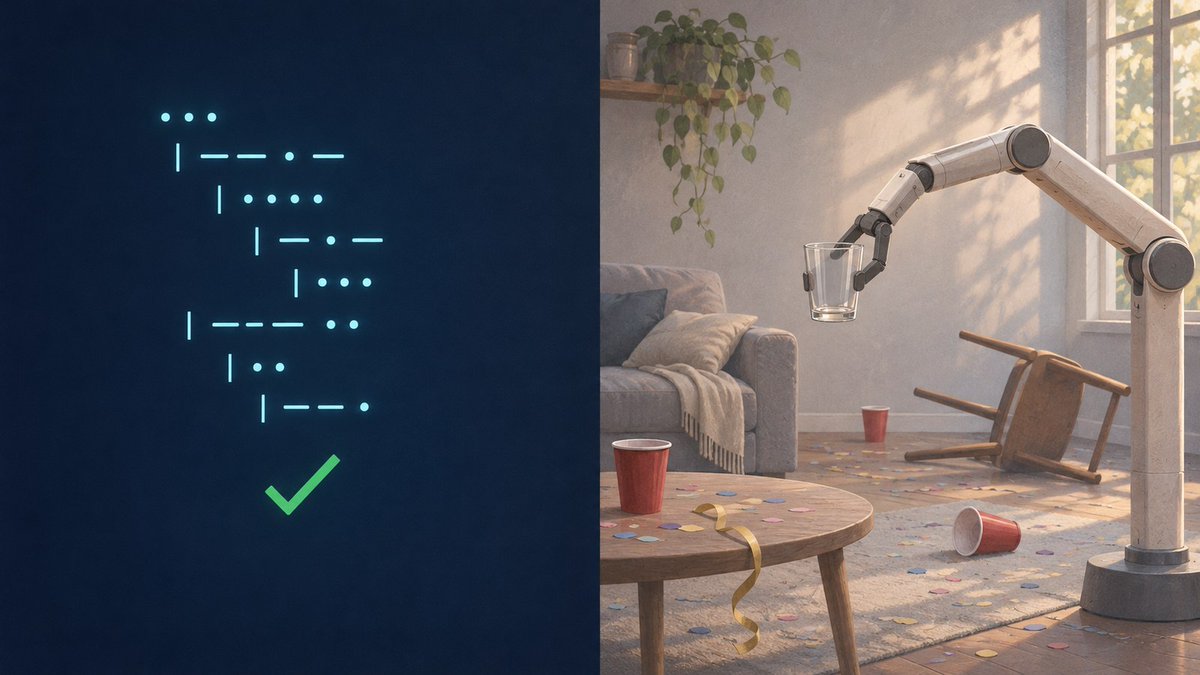
A robot tidying up after a party gets graded by a tired person next morning, and nobody wrote down what "done" means.
That checker is what I'd build first
The boring test of incremental: when Spot flags a hot motor on a round, does that reading open a ticket in the system the maintenance crew already works in? If yes, the data plumbing is real. If it lands in a separate dashboard, it waits for someone to look https://t.co/pv6ef7ezxj
The promise of AI and MCP is that integrating the physical and digital worlds is easier than ever. That may be true, but data siloes and real world messiness still stymy projects. Rather than wait for a perfect data environment, leading companies are building incremental progress, uniting inspection data from autonomous robots with other information sources to help identify problems, make better decisions, and act on insights more quickly. https://t.co/v8HwEItGZU
Why can't a bigger model alone solve it? A robot doesn't get to regenerate its answer. Once a grasp slips, the cup is already on the floor. What I'll look for on Nov 25 is how IRON notices a mistake and recovers mid-task, not how big the model is https://t.co/k7qZFXuuSV
XPENG AI Day is coming on November 25.
The next frontier of AI isn't just about making models smarter. It's about making intelligence work in the physical world.
Why is Physical AI fundamentally different? Why can't a more powerful model alone solve it?
On November 25, we'll share our latest thinking, explore the co-evolution of AI models and physical systems, showcase the latest capabilities of IRON humanoid robot, and unveil how physical AI will reshape the future mobility experience.
See you there!
Robot demo captions now carry a checklist: autonomous, uncut, 1x speed. Elon says most demos you see are staged, and his bar is moving the apple to a new spot. Both point at the same problem. The line I'd add to every caption is simpler: take 1 of how many.
What happens in the other 1%? For a hotel laundry room that is the whole question. The chapter I'd watch first is observability to root-cause issues remotely, because staff only walk away from a robot that can show why it stopped https://t.co/Pnl1nN3wz5
BREAKING: Inside the first company to achieve 99%+ success rates with a robot foundation model and now the first company with working physical agents.
@DynaRobotics co-founder and CEO Lindon Gao (@Lindon_Gao) sat down with @HerbertOng, @GoingBallistic5 and @Rewkang to talk about US-made robots already working real shifts at hotels, restaurants and data centers.
Lindon says customers send Dyna a video of the task, and a new site running a task Dyna already knows can be up in as little as three days. Its robot Taku can now run an entire laundry room workflow end to end, so staff can walk away.
Lindon on where to see them:
"If you go to some of the Best Westerns and Hiltons in California, you'll be able to see our robots at work. So yes, robot is ready for production in prime time."
Lindon on customer demand:
"Your customers are consistently texting you and asking you, when can I get my next batch of robots?"
Timestamps
(00:00) US-made robots already working today
(03:40) Ready for production prime time
(07:18) Acquired by Instacart, scaled to hundreds of cities
(10:55) Robotics is defined by your weakest link
(13:44) The learning loop must spin fast
(15:11) We needed to build our own hardware
(20:22) 99% success is just the starting line
(21:28) Taku completes the entire job end to end
(25:46) Observability to root-cause issues remotely
(27:04) First physical agent shipped in the field
(31:54) Teach the robot in 10 minutes
(33:23) Taku rang the NASDAQ bell
(34:30) 2027 is going to be about deployments
(38:16) Robot as a service, a monthly fee
(39:02) Deployed zero-shot, no extra post-training
(41:11) Scalable across 100,000 US locations
(43:40) If we nail laundry, we nail anything
(49:18) The benchmark is real-world value
(52:47) US ahead in models, China in hardware
(54:28) Ship hundreds of thousands of robots
(55:39) Manufacturing sites in California and Texas
(1:00:59) I thought high-quality data was everything
The test I'd run on a home robot isn't day one. It's day two. Figure hopes to do hours of chores in a never-seen home within six months. Come back next morning: the basket moved, a drawer sticks, the dog sleeps in the hallway. Day one shows the model. Day two shows the product.
One joint modeled too simply can be the whole sim-to-real gap. Treat the G1's closed-loop ankle as a plain hinge and its motion and torque come out different, so the policy trains on a different robot than the one it ships on https://t.co/UeItKX1GKu
Qiayuan (@qiayuanliao) and I wrote about modeling the Unitree G1’s closed-loop ankle linkage in @mujoco.
We look at how the linkage changes the ankle’s motion and dynamics, and what it takes to simulate it reliably.
We spent quite a bit of time on the blog post making interactive demos and shareable models, and we hope you find it useful!
https://t.co/3ujBvBHhGK
100,000 hours of skilled work, free on Hugging Face, commercial use too. That used to be a moat. Tasks done right are getting cheap. The rare hour is the grasp that slipped and the person who stepped in. Hub says deployment rollouts come later - that's the batch I'd wait for
Interpretable has a very practical test on a factory floor: can the night-shift tech see which check stopped the robot without calling the vendor. Agent-written code passes it only if a person can still read it and diff it https://t.co/uT5f0oiOq3
Thank you @dev_and_ ! Industry wants robots that are 1) reliable, 2) fast, 3) interpretable. Production managers like code that they can verify and are understandably wary of anything controlled by a “black box”. That’s why they like Agentic Robotics.
World models just became chip strategy: AMD closed its World Labs deal and made Fei-Fei Li chief scientist. NVIDIA has Cosmos. Training can follow the silicon. A robot on the floor runs on whatever was bought years ago, so the part that decides on it can't belong to one vendor
Game physics is built to fool a player, not a gripper. Robots in GTA-style worlds get millions of streets, crowds and odd layouts for free. But a game engine fakes contact whenever it keeps the frame rate up. Let games teach a robot where to go, and reality how hard to grip
@CyberRobooo The can kicked on purpose is the part I'd test harder. If anyone in the room can make something urgent, someone will learn to steer the robot that way. A kid who finds out a kicked can pulls it off the table has a new game, and the table never gets cleared
Robotics is now one bullet in a weekly shipping list, between TPUs and a genome model. That is the 2026 shift: robots get the release cadence of chat models. The hard part moves to the floor, which has to absorb a new brain every month and prove nothing it relied on changed https://t.co/D1U9CN4jRK
What we shipped this week @google
Monday: Two new 8th-gen TPUs
Tuesday: Gemini 4 Carbon
- AlphaProof Code verified Signal protocol
- Gemini Robotics 2.5
Wednesday: AlphaGenome 2 for disease research
- Gemini Decisions API in AI Studio
Thursday: Gemini 4 Hydrogen
- intelligent eyewear pre-orders
Friday: U2 new album (ok not us but exciting!)
onwards!
@mark_k@OpenAI Generalist brain, specific body. The model can learn to move any arm, but the stop condition for this arm, this payload and the person standing next to it is local knowledge. Dissolving the robotics team doesn't remove that work, it hands it to every integrator downstream
The strictest user of a stable local runtime is a robot. A cell can't wait on a network hop or absorb a breaking API change mid-shift. v1 is what lets on-device models stop being a demo and start being a part number https://t.co/GHI9LaCedJ
We’re not going to win by lobbying, plotting, or manipulating. We’re going to win by building, in the open, with the whole community!
Today, with @ggerganov we’re super excited to announce the release of llama.cpp v1, the first major fully stable version of the most used library to run AI models locally, meaning on your phone, your laptop, and your workstation.
It means you can own your intelligence for free, not send your data to anyone and be 100% in control, wherever you are in the world. It shows our commitment to support every hardware, platform and model type out there and makes AI distributed rather than concentrated in a few Silicon Valley orgs.
Huge thanks to the team, the long-time maintainers and every contributor who helped make this happen. Let’s build! 💛🧡💚
@qiayuanliao 128 GPUs for 7 days down to 1 GPU for 3 hours changes who gets to work on humanoid control. The quieter shift: the policy improves inside a learned model of the body, so that model's blind spots become the robot's. Which motions did it get most wrong on real hardware?
@Qualcomm Not compute anymore - it's the change loop. A robot on the edge meets a new part on Tuesday and waits weeks for a cloud retrain. Scale starts when it can adapt on the device and you can diff what it learned, like code