@meta_nomad I think I had something similar. It’s a muscle/tendon problem probably from when you sleep and pressing your head too hard onto your pillow. Try stretching it by rotating your head as much as you can with help of both your hands. Tilt and rotate your head until you reach the spot
@eurofounder I think that’s mid entry level salary in Sweden aka Stockholm? Seems quite low though if he works for the famous streaming company. But also I think you conflate marginal tax rate with total.
@DschlopesIsBack Think I also had this. For me it was because of leaning my head too much. Just lean in the other direction to stretch. I also press my pillow unconsciously when sleeping(rotate pressure). I just rotate my head, chin to shoulder as hard as l can using my hand as well.
@penberg Yes. I think PR should be subsystem of code dependent on current system/code only.
About the commits. How do you structure them if you write a function A that depends on function B? One commit for A and one commit for B. And then a bunch for missed cases?
Really hope they will succeed. Community needs it. The biggest mountain to climb is type checking Typescript files. It was imo the nr 1 reason why romejs failed. TS has a very powerful type system. Modelling that system in code takes a lot of time and it’s not an easy task.
Hello world!
We are on a mission to build a next-generation toolchain for JavaScript that is unified, high-performance, composable, and runtime-agnostic.
We are excited to announce our $4.6m seed funding led by @Accel - read more in the blog post: https://t.co/L6YvPk96xA
The half-life of code is an interesting predictor of project quality.
Linux, has one of the longest code half-life’s at 6.6 years.
WordPress, less than 2.
Every software change induces some risk. Repos with numerous "change bursts" have the highest incidence of defects.
If this is the case. It means the models have data that is contradictory. Any logical statements cannot have contradictory statements. Output of first iteration feeding into to the next cleans it. AI is slowly reaching a formal system.
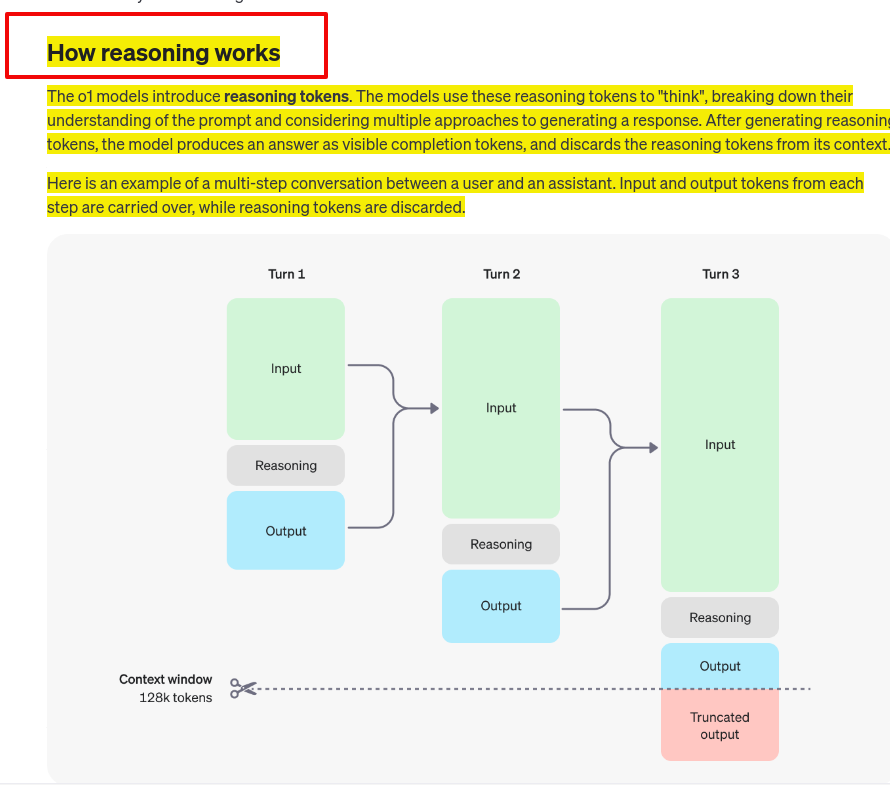
How Reasoning Works in the new o1 models from @OpenAI
The key point is that reasoning allows the model to consider multiple approaches before generating final response.
🧠 OpenAI introduced reasoning tokens to "think" before responding. These tokens break down the prompt and consider multiple approaches.
🔄 Process:
1. Generate reasoning tokens
2. Produce visible completion tokens as answer
3. Discard reasoning tokens from context
🗑️ Discarding reasoning tokens keeps context focused on essential information
📊 Multi-step conversation flow:
- Input and output tokens carry over between turns
- Reasoning tokens discarded after each turn
🪟 Context window: 128k tokens
🔍 Visual representation:
- Turn 1: Input → Reasoning → Output
- Turn 2: Previous Output + New Input → Reasoning → Output
- Turn 3: Cumulative Inputs → Reasoning → Output (may be truncated)
@davepl1968 Use array instead of vector. Seems like you don’t like implicit construction? But would rather return pResult directly. pOldest should take a reference by deref unique_ptr.
Would add methods to acquire the lock for multiple methods instead of locking per method.
TS biggest strength is being able to narrow the type to the most narrowest type possible in most locations of your code. Though there are examples where it doesn’t work. Solving this problem solves the program safety problem associated with all programs. Including memsafety.
Narrowing down the types of values is key knowledge for any TypeScript dev.
Here's 11 different ways you can do it. I bet you won't know 2 or 3 of them!
🧵
We’re making it easier to cancel subscriptions and memberships.
You shouldn’t have to navigate a maze just to cancel unwanted subscriptions and recurring payments.
The FTC is hard at work finalizing its “Click to Cancel” rule that it proposed to make this process a requirement.
We've been evaluating a number of C++ successor languages for @ladybirdbrowser, and the one best suited to our needs appears to be @SwiftLang 🪶
Over the last few months, I've asked a bunch of folks to pick some little part of our project and try rewriting it in the different languages we were evaluating. The feedback was very clear: everyone preferred Swift!
Why do we like Swift?
First off, Swift has both memory & data race safety (as of v6). It's also a modern language with solid ergonomics.
Something that matters to us a lot is OO. Web specs & browser internals tend to be highly object-oriented, and life is easier when you can model specs closely in your code. Swift has first-class OO support, in many ways even nicer than C++.
The Swift team is also investing heavily in C++ interop, which means there's a real path to incremental adoption, not just gigantic rewrites.
Strong ties to Apple?
Swift has historically been strongly tied to Apple and their platforms, but in the last year, there's been a push for "swiftlang" to become more independent. (It's now in a separate GitHub org, no longer in "apple", for example).
Support for non-Apple platforms is also improving, as is the support for other, LSP-based development environments.
What happens next?
We aren't able to start using it just yet, as the current release of Swift ships with a version of Clang that's too old to grok our existing C++ codebase. But when Swift 6 comes out of beta this fall, we will begin using it!
No language is perfect, and there are a lot of things here that we don't know yet. I'm not aware of anyone doing browser engine stuff in Swift before, so we'll probably end up with feedback for the Swift team as well.
I'm super excited about this! We must steer Ladybird towards memory safety, and the first step is selecting a successor language that we can begin adopting very soon. 🤓🐞
We've been evaluating a number of C++ successor languages for @ladybirdbrowser, and the one best suited to our needs appears to be @SwiftLang 🪶
Over the last few months, I've asked a bunch of folks to pick some little part of our project and try rewriting it in the different languages we were evaluating. The feedback was very clear: everyone preferred Swift!
Why do we like Swift?
First off, Swift has both memory & data race safety (as of v6). It's also a modern language with solid ergonomics.
Something that matters to us a lot is OO. Web specs & browser internals tend to be highly object-oriented, and life is easier when you can model specs closely in your code. Swift has first-class OO support, in many ways even nicer than C++.
The Swift team is also investing heavily in C++ interop, which means there's a real path to incremental adoption, not just gigantic rewrites.
Strong ties to Apple?
Swift has historically been strongly tied to Apple and their platforms, but in the last year, there's been a push for "swiftlang" to become more independent. (It's now in a separate GitHub org, no longer in "apple", for example).
Support for non-Apple platforms is also improving, as is the support for other, LSP-based development environments.
What happens next?
We aren't able to start using it just yet, as the current release of Swift ships with a version of Clang that's too old to grok our existing C++ codebase. But when Swift 6 comes out of beta this fall, we will begin using it!
No language is perfect, and there are a lot of things here that we don't know yet. I'm not aware of anyone doing browser engine stuff in Swift before, so we'll probably end up with feedback for the Swift team as well.
I'm super excited about this! We must steer Ladybird towards memory safety, and the first step is selecting a successor language that we can begin adopting very soon. 🤓🐞
No rejuvenation technology available today is powerful enough to enable Biden to effectively lead as President of the United States for another four years.