Congratulations @biohub on the release of ESMFold2, ESMC, and ESM Atlas!
Excited to share that these models are available on day one to AI agents powered by ToolUniverse @ScientistTools
Stay tuned for agentic skills that let AI agents use SAE representations for protein variant interpretation, loss-of-function mechanism analysis, structural annotation, and mechanistic protein reasoning @GaoShanghua@AdaFang_@_yepeng
https://t.co/lWHESvWXTo
🚨 Neuralink patient #3 Brad (ALS) just got his REAL voice back, thanks to Neuralink + ElevenLabs cloning.
His family can finally hear him again! Warm, familiar, full of life.
No more robotic sound. Just him.
This is the most beautiful side of AI.
The Illustrated NeurIPS 2025: A Visual Map of the AI Frontier
New blog post!
NeurIPS 2025 papers are out—and it’s a lot to take in. This visualization lets you explore the entire research landscape interactively, with clusters, summaries, and @cohere LLM-generated explanations that make the field easier to grasp.
Link in thread!
I’m looking forward to hosting our PhD Open Day next Monday, 20 Oct at 9:30am (BST), an interactive session for those interested in applying to join the lab.
It’s a great chance to hear about our research, meet current PhD researchers, and ask questions about life in our lab.
🧬 Building the Virtual Cell starts with data.
Today, we’re making the X-Atlas/Orion Perturb-seq dataset even more accessible — now live on Hugging Face @huggingface 🤗
📊 One of the largest & highest-quality perturbation datasets ever released, it provides the foundation for training AI models that can simulate and reason about cellular behavior.
👉 Explore here: https://t.co/0bszMU32nT
Fewer barriers. More models. A step closer to the virtual cell. 🌌
#VirtualCell #FoundationModels #AIinBiology #HuggingFace
Multi-agent AI is a $50B lie.
99% of "multi-agent" systems are just single agents with fancy marketing.
I just read the paper that exposes what real multi-agent intelligence actually looks like.
Most people think multi-agent AI is just "multiple ChatGPTs in a room.
That's like saying a surgical team is just "multiple people with knives."
The real story is way deeper.
Task allocation is completely broken.
Current systems are basically throwing darts at a board. Give the math problem to whoever's free. Ask the creative agent to debug code. It's chaos disguised as intelligence.
Real multi-agent systems need dynamic specialization. Not just "Agent 1 does X, Agent 2 does Y" but context-aware matching based on capability, workload, and past performance.
The memory problem is insane.
Single agents just track conversations. Multi-agent systems need five different memory types: short-term task state, long-term expertise, episodic collaboration history, consensus knowledge, and hierarchical access control.
Most current systems give every agent amnesia between tasks.
Context management is where everything breaks.
Each agent needs to track three layers simultaneously: the big picture mission, their specific piece, and what everyone else is doing.
Fail at any layer and the whole system becomes expensive nonsense.
Game theory matters more than code.
When agents debate or negotiate, you're not optimizing for "correctness." You're finding equilibrium states. The research shows Stackelberg dynamics work better than Nash equilibrium for most real tasks.
Nobody talks about this because it's not as sexy as "look, the robots are talking."
The applications they outline are wild.
Agents that negotiate smart contracts autonomously. Fraud detection where different specialists hunt different attack patterns. Consensus mechanisms that actually think through decisions.
We're not building better chatbots. We're building the foundation for autonomous economic systems.
The gap between current "multi-agent" demos and actual multi-agent intelligence is massive.
Real systems will have specialized roles, shared memory architectures, and game-theoretic coordination. They'll solve problems no individual agent can handle.
Same principle that makes human teams work. Just faster, and at scale.
Most of what people call "multi-agent" today is just single agents with fancy prompting.
The companies that figure out real multi-agent coordination first will have a 10x advantage.
Everyone else is building expensive theater.
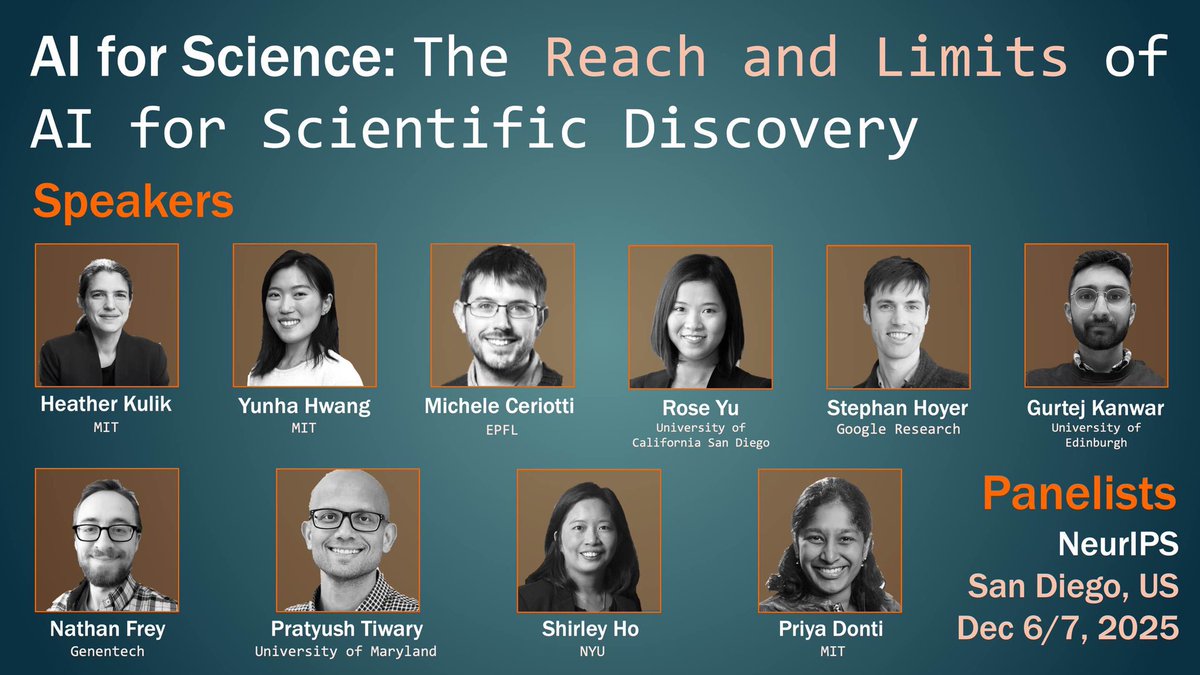
AI for Science will be returning to @NeurIPSConf 2025! We aim to bring together scientists and AI researchers to discuss the reach and limits of AI for Scientific Discovery 🚀
📖 Workshop submission deadline: Aug 22
💡 Dataset proposal competition: more details coming soon
Announcing the ICLR 2026 Call for Papers!
Abstract submission: Sept 19 (AoE)
Paper submission: Sept 24 (AoE)
Reviews released: Nov 11
Author/Reviewer discussion: Nov 11-Dec 3
Final decisions: Jan 22 2026
https://t.co/iERvCJZ8uB
Thinking Machines Lab exists to empower humanity through advancing collaborative general intelligence.
We're building multimodal AI that works with how you naturally interact with the world - through conversation, through sight, through the messy way we collaborate. We're excited that in the next couple months we’ll be able to share our first product, which will include a significant open source component and be useful for researchers and startups developing custom models. Soon, we’ll also share our best science to help the research community better understand frontier AI systems.
To accelerate our progress, we’re happy to confirm that we’ve raised $2B led by a16z with participation from NVIDIA, Accel, ServiceNow, CISCO, AMD, Jane Street and more who share our mission.
We’re always looking for extraordinary talent that learns by doing, turning research into useful things. We believe AI should serve as an extension of individual agency and, in the spirit of freedom, be distributed as widely and equitably as possible. We hope this vision resonates with those who share our commitment to advancing the field. If so, join us. https://t.co/EaAKidpany
🚀 Introducing TxAgent: a first of its kind AI agent for therapeutic reasoning across a universe of 211 tools, with a comparison against DeepSeek-R1 671B @NVIDIAAI
TxAgent is an AI agent that redefines how AI can reason, retrieve, and integrate biomedical knowledge for precision therapeutics, led by stellar @GaoShanghua
🔍 Beyond prediction—reasoning AI for medicine
TxAgent is not just another predictive model. It is the first AI system designed to think through therapeutic problems, iteratively query external sources, and generate transparent, step-by-step reasoning traces. By integrating real-time biomedical knowledge, TxAgent's treatment recommendations are accurate and continuously updated
🔗 Benchmarking TxAgent against 671B DeepSeek-R1
We benchmarked TxAgent against DeepSeek-R1 (671B, @NVIDIAAI) and other leading AI models. The results? TxAgent outperformed much larger LLMs in multi-step therapeutic reasoning in drug selection, treatment personalization, and therapeutic reasoning
🏥 What’s Inside the 211 tools in TxAgent’s ToolUniverse?
✅ All FDA-approved drugs since 1939 – Includes drug mechanisms, indications, contraindications, dosing, safety warnings, and pharmacokinetics from FDA drug labels and OpenFDA
✅ Clinical insights from Open Targets – Provides up-to-date drug-disease, phenotype, and molecular target associations used in precision medicine
✅ Pharmacology – Covers drug-drug interactions, metabolic pathways, and contraindications based on comorbidities and concurrent medications
✅ Personalized treatment guidelines – Assesses patient-specific factors such as age, pregnancy, renal function, and genetic variations. Simultaneously assesses molecular, pharmacokinetic, and clinical-level interactions. Evaluates patient factors like genetics, comorbidities, and disease stage
✅ Real-time retrieval – Queries latest treatment indications, regulatory approvals from continuously updated sources
🔥 Key features:
✅ Reasoning over retrieval – Moves beyond RAG-based retrieval to structured, multi-step decision-making
✅ Tool-augmented AI – Interacts with 211 biomedical tools
✅ Real-time knowledge integration and continuous learning – Responses are always grounded in up-to-date clinical knowledge. No outdated medical knowledge by always integrating live sources
✅ Dynamic tool selection – Adapts its reasoning by choosing the most relevant tools in real time
✅ Grounded medical AI – Reduces the risk of hallucinations, verifies every step of the way, and aligns recommendations with clinical guidelines
@HarvardDBMI@harvardmed@KempnerInst@harvard_data@MIT@broadinstitute@MIPhilanthropy@cziscience@Harvard
Congratulations to a fantastic team Shanghua Gao @GaoShanghua, Richard Zhu @RichardYXZhu, Zhenglun Kong @ZKong50693, Ayush Noori @ayushnoori, Xiaorui Su @xiaorui_su, Curtis Ginder, Theodoros Tsiligkaridis
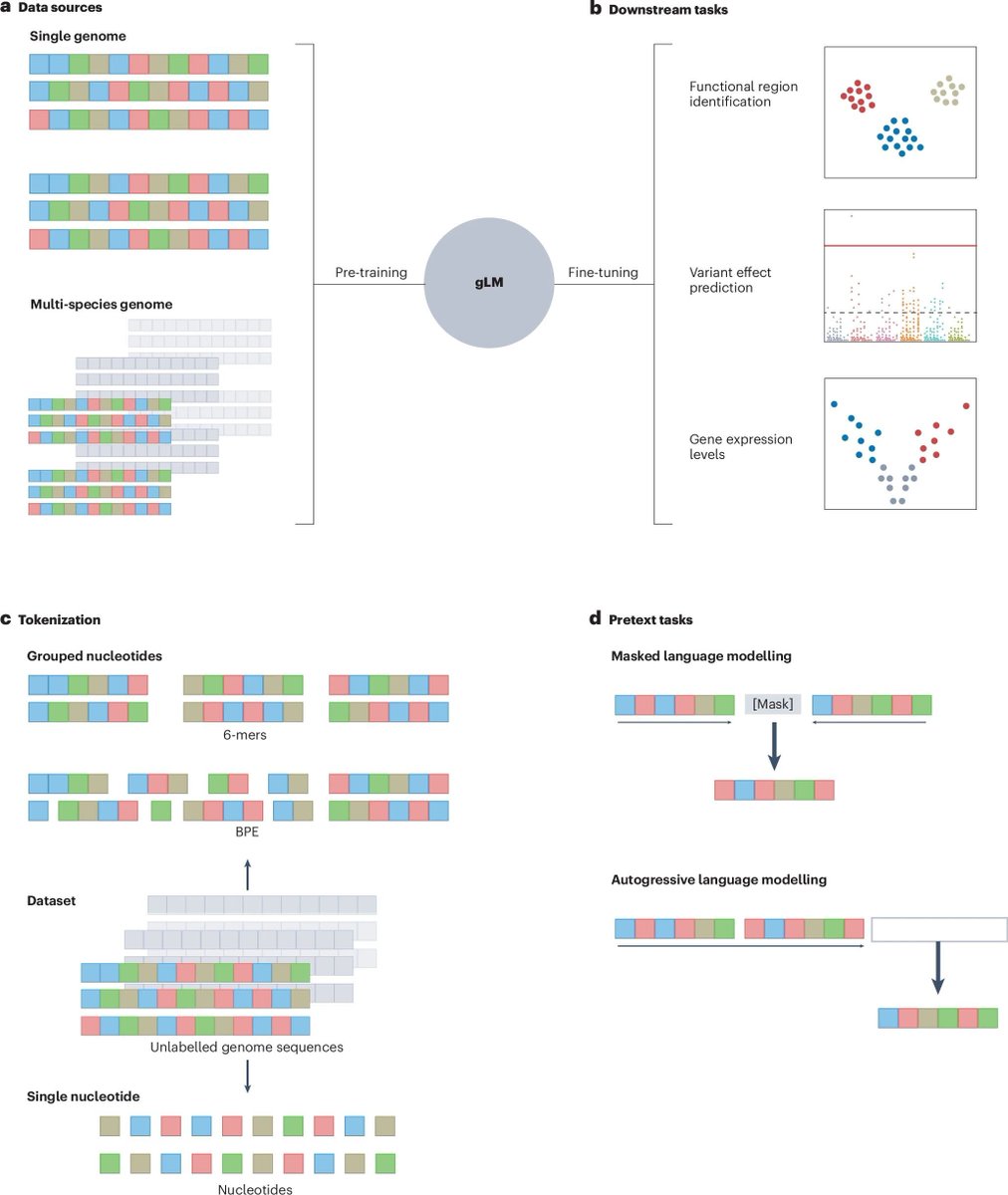
🔥 Unveiling the Future of Genomics with Genome Language Models (gLMs)! 🔥
Our comprehensive review, "Transformers and genome language models," is finally published in Nature Machine Intelligence!
Link: https://t.co/hCk6EzLKDB
Key Highlights:
🔬 The Challenges Addressed by gLMs: gLMs tackle the intricate task of interpreting vast genomic sequences, enabling predictions about gene regulation, variant effects, and more.
🧠 Transformers in Genomics: Discover how transformer architectures, renowned for their success in natural language processing, are adept at capturing long-range dependencies in genomic data, leading to more accurate models.
🚀 Beyond Transformers—Introducing HyenaDNA: Explore innovative architectures like HyenaDNA, which offer efficient long-range genomic sequence modeling at single nucleotide resolution, pushing the boundaries of genomic research.
📊 Comparative Analysis of Models: We delve into the evolution from sequence-to-function models like DeepSEA and Enformer to sequence-to-sequence models such as DNABERT and Evo, highlighting their respective strengths and applications.
⚡ Strengths, Limitations, & Future Directions: Gain insights into the current capabilities of genomic AI, its limitations, and the promising avenues for future research and application.
This pivotal work is the result of a collaborative effort led by Micaela E. Consens (@micaelanonsense ), with contributions from Cameron Dufault, Michael Wainberg (@michaelwainberg ), Duncan Forster, Mehran Karimzadeh, Hani Goodarzi (@genophoria ), Fabian J. Theis (@fabian_theis ), Alan Moses.
@UHNAIHUB@UHN@VectorInst @uoftoront
#Genomics #AI #MachineLearning #Transformers #HyenaDNA #DeepLearning #Bioinformatics #GenomeResearch
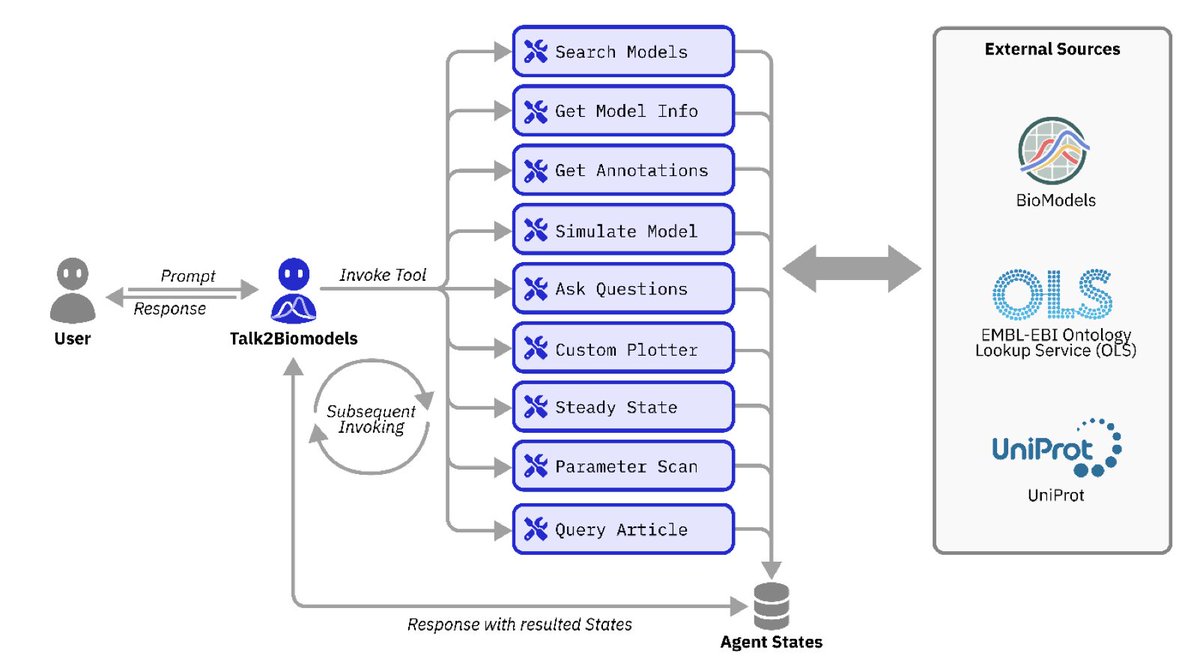
Talk2Biomodels: AI agent-based open-source LLM initiative for kinetic biological models
1. The paper introduces Talk2Biomodels (T2B), an AI-powered, open-source platform designed to democratize access to kinetic biological models by enabling users to interact with them using natural language.
2. Unlike traditional GUI-based modeling tools, T2B provides an agentic AI framework that supports dynamic model exploration, simulation, and analysis without requiring programming expertise.
3. T2B integrates with the BioModels database, allowing users to seamlessly retrieve, analyze, and simulate curated systems biology models encoded in Systems Biology Markup Language (SBML).
4. The system employs a retrieval-augmented generation (RAG) approach to ensure accurate model interpretation while minimizing hallucination, making it a reliable tool for both experts and non-experts.
5. T2B supports diverse modeling tasks, including time-course simulations, steady-state analysis, and parameter scans, offering an interactive and flexible approach to studying biological dynamics.
6. The platform provides access to foundational LLMs, including GPT-4o-mini and NVIDIA’s Llama-3.3-70B-Instruct, enhancing its reasoning and interpretation capabilities for biological modeling.
7. Use cases in precision medicine, epidemiology, and systems biology highlight T2B’s potential to assist in drug discovery, pandemic modeling, and understanding emergent network properties.
8. The study demonstrates that T2B can guide users through model-based hypothesis testing, optimizing experimental conditions and generating biological insights in a user-friendly manner.
9. By adhering to FAIR principles (Findability, Accessibility, Interoperability, and Reusability), T2B enhances the reproducibility and accessibility of computational biology models.
10. Future developments aim to expand T2B’s capabilities to additional modeling frameworks, improve integration with experimental data, and enhance AI-driven decision-making in biomedical research.
💻Code: https://t.co/q0ne8RltyK
📜Paper: https://t.co/Ok8Fb4SSip
#AIforScience #ComputationalBiology #SystemsBiology #Bioinformatics #MachineLearning
@m_bousleiman@BiologyAIDaily ...more to come already accepted #ICLR2025 Talk2Biomodels and Talk2KnowledgeGraph: AI agent-based application for prediction of patient biomarkers and reasoning over biomedical knowledge graphs | OpenReview
Talk2Biomodels: AI agent-based open-source LLM initiative for kinetic biological models
1. The paper introduces Talk2Biomodels (T2B), an AI-powered, open-source platform designed to democratize access to kinetic biological models by enabling users to interact with them using natural language.
2. Unlike traditional GUI-based modeling tools, T2B provides an agentic AI framework that supports dynamic model exploration, simulation, and analysis without requiring programming expertise.
3. T2B integrates with the BioModels database, allowing users to seamlessly retrieve, analyze, and simulate curated systems biology models encoded in Systems Biology Markup Language (SBML).
4. The system employs a retrieval-augmented generation (RAG) approach to ensure accurate model interpretation while minimizing hallucination, making it a reliable tool for both experts and non-experts.
5. T2B supports diverse modeling tasks, including time-course simulations, steady-state analysis, and parameter scans, offering an interactive and flexible approach to studying biological dynamics.
6. The platform provides access to foundational LLMs, including GPT-4o-mini and NVIDIA’s Llama-3.3-70B-Instruct, enhancing its reasoning and interpretation capabilities for biological modeling.
7. Use cases in precision medicine, epidemiology, and systems biology highlight T2B’s potential to assist in drug discovery, pandemic modeling, and understanding emergent network properties.
8. The study demonstrates that T2B can guide users through model-based hypothesis testing, optimizing experimental conditions and generating biological insights in a user-friendly manner.
9. By adhering to FAIR principles (Findability, Accessibility, Interoperability, and Reusability), T2B enhances the reproducibility and accessibility of computational biology models.
10. Future developments aim to expand T2B’s capabilities to additional modeling frameworks, improve integration with experimental data, and enhance AI-driven decision-making in biomedical research.
@tommiandreani
💻Code: https://t.co/q0ne8RltyK
📜Paper: https://t.co/Ok8Fb4SSip
#AIforScience #ComputationalBiology #SystemsBiology #Bioinformatics #MachineLearning
I’m tired of telling AI what to do. I want AI that truly helps me do things better! That’s why I’ve written about “Genies”—AI that thinks, learns, and co-creates with us. 1/5
Great news before starting 2025. TRUST4 is highly recommended in this benchmark evaluating TCR reconstruction method from scRNA-seq data. https://t.co/H1RxjT68gl by @WanluLiu lab.