🧚 Fairy Cursor is now downloadable and open-source:
https://t.co/ww0qrdCo2y
I’ve been using it everyday. It’s probably the most frequently used (and least 'intelligent') tool I’ve built for myself. Saved a lot of context-switching.
Capabilities are modularized. You can add any capabilities you want. Curious what others would want their cursor to do!
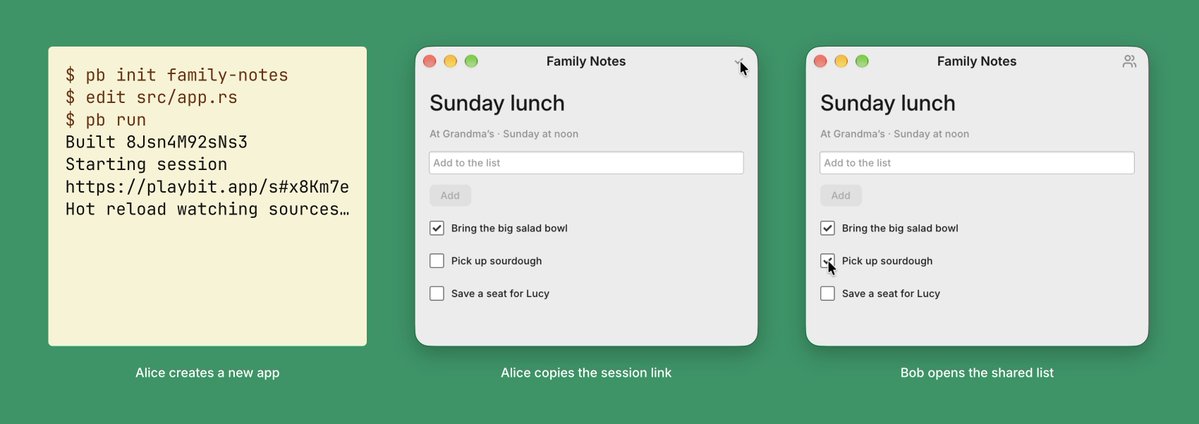
Playbit is a pursuit of personal-scale software. Today we’re launching a beta version of a brand-new Playbit. It’s macOS only for now (more platforms soon.) Playbit is infrastructure for a new era of personal-scale, local-first software.
Ever since I started working on Playbit in 2020, have I had this nagging feeling that making software is just too damn complicated. For anything practical, you end up having to do so much “grunt work” that isn’t about the essence of what you’re actually trying to build: maintain servers, week-long waits on Apple bureaucracy, writing your own data sync or just accept that your software will be unavailable when someone uses it on a train that goes through a tunnel.
Playbit is a cultural platform for doing things differently.
You own your data. A Playbit Volume is like a fancy Dropbox that can contain not only files, but also structured data that can be edited offline and syncs whenever you are online. The data is encrypted and uses public-key cryptography to allow sharing volumes with other people or service accounts.
Apps are written in any programming language you’d like. Playbit is like an operating system kernel, a syscall-style C ABI with forwards version compatibility. Apps store their state in Volumes, so when you use an app you have complete visibility into the data stored by the app.
Sessions are like “private spaces” where an app runs. You can invite someone to join a session with a single click — Playbit is fully multiplayer. Session data is of course fully encrypted; a session invitation link holds the encryption key to the session.
We’d love to hear what you think and what you make!
I built a tiny Dreamer-inspired world model from scratch.
It has ~550k parameters and learns to play video games by practicing inside its own imagination.
write up + implementation 👇
Every software should have a margin, like the margin in a book, or the chaotic side of our desk.
A freeform space right next to the main UI to jot down thoughts, park half-baked pieces, and jailbreak out of the app's predefined layout; then fold away whenever not needed.
Feels especially helpful beside linear chat UIs: a shared desk for you and agents to leave notes, spin off side threads, and drop bespoke widgets...
We ran Thinking Machines' Inkling 2 Mini on an engine we wrote ourselves in Zig + Metal.
No MLX. No Python in the model.
On the same Mac it decodes faster than MLX and exo on our megakernel!
On December 3, @clattner_llvm presents an ACM Tech Talk: "Mojo: One Systems Language for Heterogeneous Hardware."
Shipping one AI project today often means juggling multiple languages, and the hardware underneath continues diversifying.
Chris will walk through two foundations Mojo uses to tackle these challenges: parametric metaprogramming and an ownership model built on origins.
He'll also speak openly about the language design problems that remain unsolved, and answer questions from attendees.
Free to attend (virtual). Register here: https://t.co/xvYPIBS1aY
B.A.P. (bureau of accidental percussion): a Mojo-powered pocket sampler.
my dead Teenage Engineering K.O. is sitting silently behind the one i built on the @arduino UNO Q, watching its reincarnation unfold.
Quake running on an @arduino UNO Q: hybrid Mojo/C port, with the original QuakeC game logic running in a Mojo interpreter
& an AI is playing it. MiniMax plans, Gemma 4 makes the moment-to-moment calls, both on @Modular ’s MCloud endpoints
Introducing AnyMachine: a system that lets your agents fully model, rig and animate machines in Blender.
Everything in this video was made that way with Claude Fable 5.2: a helicopter, a lifeboat, a 30 m stilt walker robot and even a small cute porter robot.
The workflow guiedes the agent to first generate reference sheets for the whole machine and close-ups of every joint and mechanism. It then picks a route. Either it hard-surface models it part by part in Blender if you use fable 5.2 (or astra 6.2), or start from a generated mesh and rebuild the moving parts on real axes.
It renders its work beside the references and does a second pass where it fell short. It pays close attention to the size and complexity of your machine and depending on that generates close ups and videos whenever necessary using fal image and video models.
https://t.co/omB0ehdlsD
Got to experience the magic of @uisdk.
Two prompts of fx + Gemini Argon. Pure Web Components. No framework.
The agent reused 14 UI SDK behaviors out of the box 🤯: window resizing, drag, menubar hover-switching, typeahead, roving toolbar focus, 10-band EQ sliders, scoped hotkeys, ARIA, and WebMCP agent control.
https://t.co/1Ol3xqKWJz (source linked)
Music by @suno.
What if three.js could render beyond the limits of the browser?
Meet ThreeRT: a native JS runtime and hardware-accelerated real-time path tracer, bringing lifelike lighting to Three.js scenes on macOS, Windows, iOS, Android, and Steam Deck.
Fully open source 🧵
Planning on tackling Advent of Code this year?
We put together an Advent of Mojo tutorial that covers the key language and standard library features for solving AoC puzzles, like reading text from a file, extracting numbers from strings, sorting values, and working with grids.
Now that Mojo is stabilized and open source, it's a great time to pick up the language. And AoC is a great excuse to try something new.
https://t.co/1IgAuWLXl0
#AdventOfCode