Happy to share our last paper 👉 https://t.co/cmwPEm8x1m where we show how beads can turn flexible fiber networks into load-bearing structures. Fun to build, tricky to crack—these metamaterials keep you on your toes! (literally) @LaurenDreier@Trev_J_Jones
Shoutout to the folks at Polytechnique (Montréal & Palaiseau) for their work just out in @Nature on how kirigami principles✂️ can be applied to make parachutes 🪂
In a scene toward the end of the 2006 film, “X-Men: The Last Stand,” a character claps and sends a shock wave that knocks out an opposing army.
Sunny Jung, professor of biological and environmental engineering in @CornellCALS, was intrigued.
“It made me curious about how the wave propagates when we clap our hands,” Jung said.
Jung is senior author of a study, published March 11 in Physical Review Research, that elucidates the complex physical mechanisms and fluid dynamics involved in a handclap, with potential applications in bioacoustics and personal identification, whereby a handclap could be used to identify someone.
“Clapping hands is a daily, human activity and form of communication,” Jung said. “We use it in religious rituals, or to express appreciation: to resonate ourselves and excite ourselves. We wanted to explore how we generate the sound depending on how we clap our hands.”
Read more at https://t.co/wihoqGV7l3.
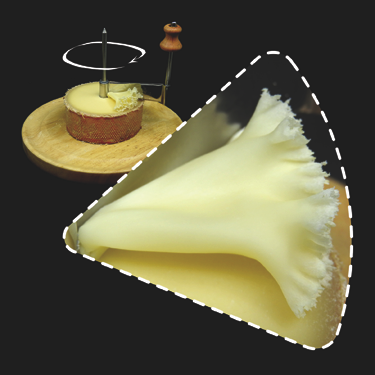
Inhomogeneities in plastic deformation and friction coefficient lead to the characteristic wrinkled patterns of scraped Tête de moine cheese
Letter: https://t.co/rbbVulS4oA
Synopsis: https://t.co/E2zkuuFmpc
Volume 134, Issue 20
https://t.co/yXR2w0Y1K8
Cover: Cheese flower with characteristic wavy edge scraped from a wheel of Tête de Moine cheese
https://t.co/Z109CtBqj2
In an experiment reminiscent of the Transformers movies, @Princeton engineers created a type of material that can expand, assume new shapes, move and follow electromagnetic commands like a remotely controlled robot even though it lacks internal gears: https://t.co/IxDihhRHWH
Augmented snap-through instability of folded strips, Tom Marzin, Barath Venkateswaran, Thomas Baroux, and P.-T. Brun #Materials https://t.co/T5Zc4ghGHr
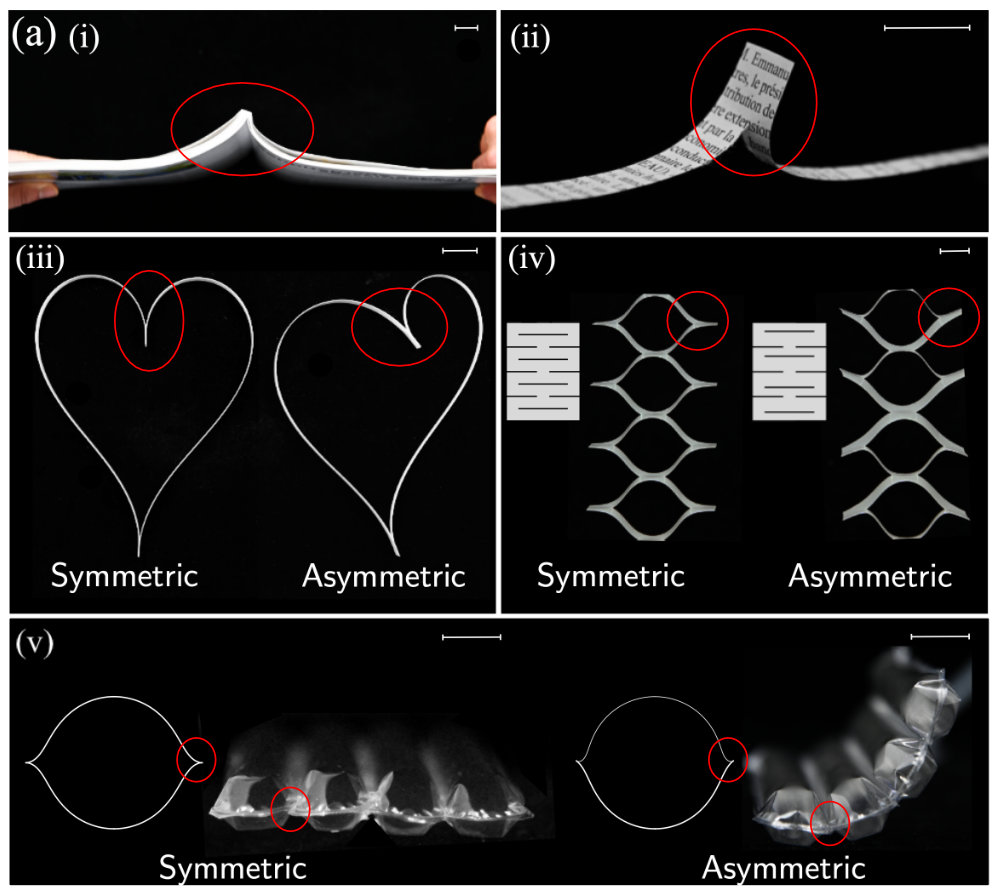
Our article on the junction of slender objects under tension has just been published @ESPCI_Paris! We discuss a cool phenomenon found in numerous systems, from kirigamis, kuttsukigami, and inflatables to more traditional tearing and peeling
https://t.co/ohrkqa6ppo
A new kind of elastic surface instability is observed during flow of extremely soft elastic solids through a confined space
Letter: https://t.co/ck293crDBD
Video: https://t.co/5QjH7upir6
Combining CFD simulations and machine learning, we refined droplet stacking in inkjet 3D printing, achieving an 85° stacking angle to enhance electrical performance. Discover the implications for high-frequency electronics: https://t.co/gmlE7J0gq6
PRFluids Editors' Suggestion: Who knew falling plates could be so exciting? New paper (https://t.co/JEtO4DmyYN) from Sánchez-Rodríguez and Gallaire shows that adding holes can turn a tumbling disaster into a smooth glide! It's like giving your plate a parachute! #fluiddynamics
Supplemental cover art for our recently published work on patterning from evaporating drops! The paper was available a few months back but was officially published along with the cover art on Christmas day. https://t.co/XBXUIhGKdI
Fresh off the press @NatureComms, our work on wing deployment in Drosophila 🪰:
https://t.co/ikMkvsS7Ey
Work by: @HadjajeS, @Ignacio00432963, Marie-Julie Dalbe and Raphaël Clément
💧Ever seen a droplet do pole dancing? Our study reveals how asymmetrical droplets "dance" along twisted fibers! 🌪️By adjusting fiber twists we control droplet speeds✨
👉 Check it out https://t.co/RJT41vdZE5
@vdwnico@Matteo_Leonard_@UniversiteLiege
🌀 Spiraling Upwards, the second exhibition in the Traveling Gallery of Fluid Motion series, is now open for a three-month run in Salt Lake City, Utah! This exhibition continues the journey of merging science and art.
Ever had paint drops rain on your head from a ceiling? These stalactite-like hardened polymer structures were created in a similar way. These "flexicles" might someday serve as a force sensor in soft-robotics applications. Read about it in Physics journal https://t.co/ylq54A6fSe