🚨 BREAKING: Google Gemini can now analyze any stock like a Wall Street analyst (for free).
Here are 10 insane Gemini prompts that replace $4,000/month Bloomberg terminals:
Save for later🔖
One of the biggest lessons from studying thousands of winning #stocks is this:
Stock selection solves a lot of trading problems before the trade even starts. 👇
Most traders spend enormous amounts of time trying to improve their entries. They focus on finding the perfect pivot, the perfect stop, or the perfect risk-reward ratio.
I understand why.
Entries feel important.
But when I review my biggest winners over the last two decades, I rarely think about the entry first.
I think about the stock.
Was it a leading stock?
Did it have exceptional sales or EPS growth?
Was it part of a powerful theme?
Was institutional money clearly accumulating shares?
Was Relative Strength already telling me something important?
The best stocks make trading easier.
Not easy.
But easier.
When you own a true leader, pullbacks are easier to sit through. Conviction is higher. The stock often gives you multiple opportunities to manage the position correctly.
Average stocks do the opposite.
They constantly force you to make difficult decisions because the quality simply isn't there.
That's why I spend much more time looking for exceptional stocks than looking for trades.
In my experience, many traders could improve dramatically by doing one thing:
Take fewer trades.
Become much more selective.
Reject more opportunities.
The market gives us thousands of stocks.
Our job is not to trade many of them.
Our job is to find the few that can make a meaningful difference.
Want better trading results?
Start with the basics most traders ignore.
🎥 Latest videos 👇
1. The Sell Rules Behind My Biggest Winners — the exact framework I use to manage winning swing trades. https://t.co/OMWHBDusOh
2. How I Recognize A+ Swing Trading Setups (15 Real Trades) https://t.co/y5EPvsx1IL
3. How I Survive Sideways Markets (And Still Find Winning Trades) https://t.co/IeleIZJ7MT
4. How I Keep My Drawdowns Small (And Why Most Traders Fail Here) https://t.co/O19YZjipcI
5. My Best Stock Screener for Growth & Momentum Stocks (TradingView Setup for Swing Traders) https://t.co/JjPFAcauA4
Most traders think a great chart pattern is enough.
It isn't.
The biggest winners usually combine:
1. Technical Pattern
2. Fundamentals
3. Story
That's where the biggest stock winners come from. 👇
Most traders study today's hot stocks.
I study the biggest winners from the last 100 years.
Why?
Because the patterns never change. 📈
Look at the chart below.
The stock is from 2004.
Yet it shows the exact characteristics I still look for today:
1. A clean chart pattern (Cup & Handle, Flat Base, Base-on-Base)
2. Huge volume accumulation
3. Strong EPS and sales growth
4. Support at key moving averages
5. Relative strength before the breakout
6. A market coming out of a correction
Different decade.
Different stock.
Same footprints.
I've studied thousands of historical winners.
The surprising part?
The biggest winners rarely look random.
They leave clues before the move.
The more charts you study, the more you realize that monster winners tend to follow the same blueprint again and again.
Most traders spend their time searching for the next stock.
I spend a lot of time studying the last great ones.
That's where the real lessons are.
These patterns repeat.
I've taught this process to thousands of traders.
You can learn it too.
Outsized performance isn’t driven by trade selection alone—it comes down to these four principles, which have a far greater impact on your results than simply being right on a few trades.
Two traders can run the exact same ideas over a full year and still end up with drastically different outcomes—anywhere from +30% to +500% on the same set of trades.
The gap comes down to
1. Execution Quality — the same idea traded to the same exit price can be a 3R vs 10R difference on the same 1R loss. You multiply that by one full year of trade execution. Optimal entry is very important to me, and if you’re subscribed, you’ll know how strict I am about what qualifies as an actionable setup. I am very sure this is the biggest takeaway from the community how entry quality can define your performance in just under 2 weeks (avoiding stop losses specifically).
2. Dynamic Risk as a % of Equity — which drives position sizing and it has to be anchored dynamically to your streak. you can't possibly be trading the same % risk when you are on a downswing, and running the same % risk when market has rewarded your diligence and situational awareness),
3. Capital efficiency — and the ability to compound within a single idea enhanced through leveraged ETFs versus outright stock exposure ( 3x ETF has positive compounding that give you more than 3x return at 33% of the capital required when trend eg. $SOXX +54% vs $SOXL +211% in 42 days)
4. Sell rules — minimizing loss size when wrong ((a stop loss should not be fixated to -1R. It can be done much less than that eg. -0.67R per loss) while maximizing gains when right (are you willing to part some shares to sell at strength on your most eutrophic winner that makes u feel great that day? how controlled are your unrealized profit loss per trade to your final exit?)
Don’t keep repeating the same approach if it isn’t producing the results you want. Use the four rules above as a framework, backtest them against your trading data over the past few years, and review the outcome. You may gain clarity on the direction you need to take next.
https://t.co/0F5tgGM49z
🚨 Backtesting completely changed how I think about trading.
I analyzed my last 400 trades from 2025-2026.
I tested some of the most common trading advice.
The results surprised many traders in our community. 👇
1. Skip all trades when VIX ≥20?
Result: Performance DROPPED by 10%.
2. Skip all trades when VIX ≥18?
Result: Performance DROPPED by 15%.
The popular filter made my results worse.
Now look at this:
3. Skip trades when my Market Trend Model is red?
Result: Performance IMPROVED by roughly 50%.
4. Remove most of my 3-star setups (post analysis rating!)?
Result: Performance IMPROVED by more than 100%.
That is a massive difference.
The biggest lesson wasn't about the VIX.
The biggest lesson was this:
Less trading beats more trading.
Better stock selection beats more stock selection.
Waiting beats forcing.
The challenge is that this is easy to understand in hindsight and difficult to execute in real time.
When the Market Trend Model is red, some stocks will still work.
When you skip a 3-star setup, some will still become huge winners.
That's what makes discipline so difficult.
You're always tempted by the exceptions.
But trading isn't about one trade.
It's about the next 200, 300 or 400 trades.
That's why I test everything.
Not because I want to be right.
Because I want evidence.
The chart doesn't care what is popular.
The market doesn't care what everybody believes.
Data wins.
What's one trading rule everybody repeats that you've never actually tested?
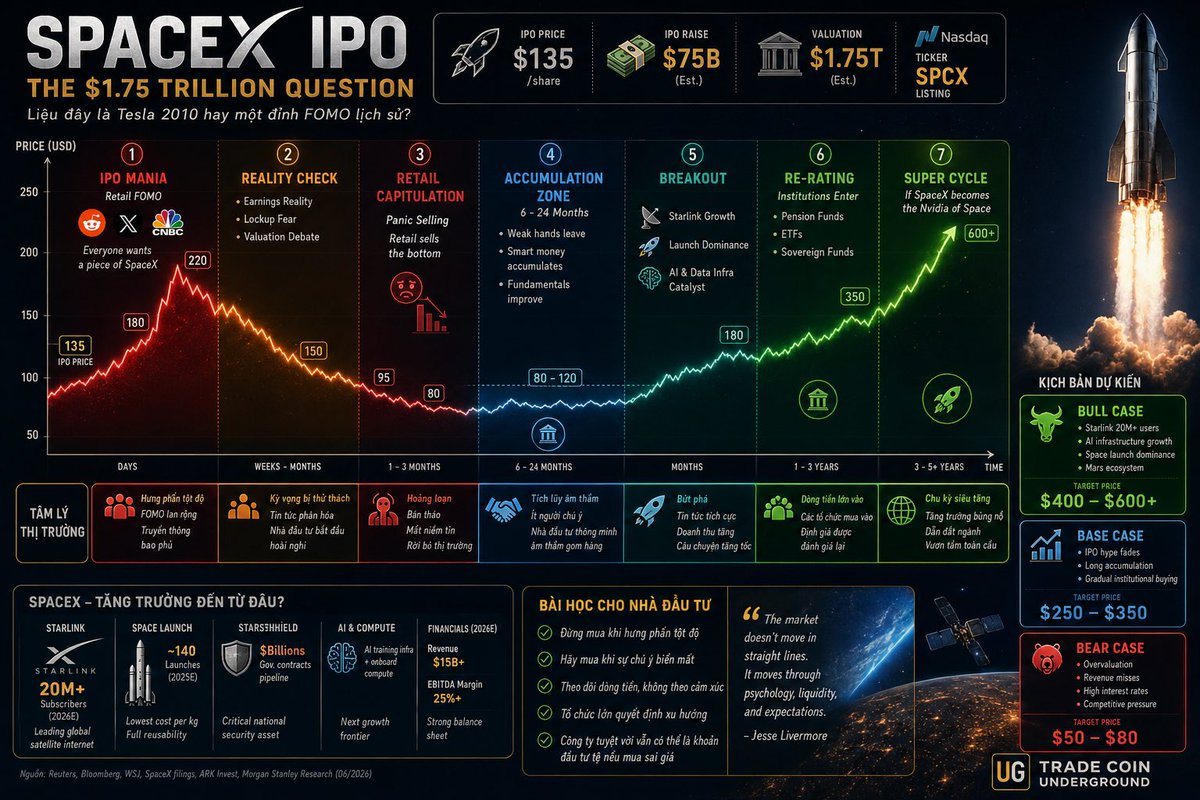
:)) Câu hỏi tỷ $
Thật ra thì IPO to tổ bố nào nó cũng có hàh trình như nhau thôi .
Vẽ cái này cho các bố đang vay tiền khắp nơi chuẩn bị múc Spacex :)) Lướt sóng thì nhớ lướt rồi té nhé
BREAKING: Claude can now run Stock Market research like a top consulting firm (for free).
Here are 10 Claude prompts that replace $100K/year stock analysts (Save for later)
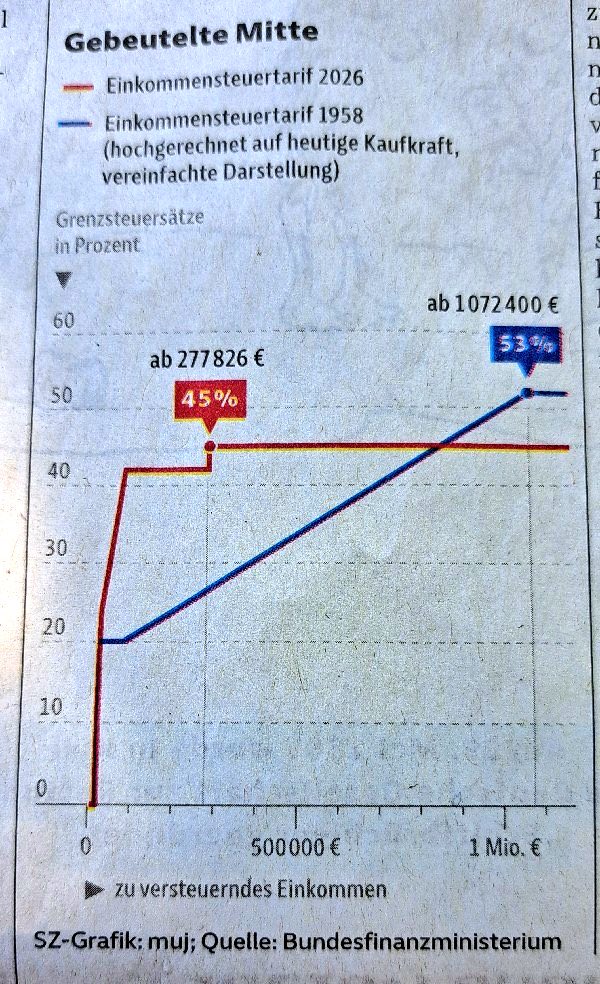
Diese Grafik zeigt wie der gierige Staat unsere Mittelschicht zerstört hat. In den Jahren des deutschen Wirtschaftswunders bezahlten gut verdienende Arbeitnehmer einen Steuersatz von etwa 25 %.
Familien konnten sich Häuser leisten. Ein Einkommen genügte. Das Fundament für eine stabile Gesellschaft wurde gelegt. Der Spitzensteuersatz in Höhe von 53 % griff inflationsbereinigt erst ab 1.072.000 €.
Heute kennt das Steuersystem keine Mittelschicht mehr. Wenn Du eine guten Job hast, kommt sofort der Staat und verlangt 42 %. Vermögensaufbau wird unmöglich. Das eigene Haus wird zum fernen Traum.
Linke Politik hat ein Steuersystem erschaffen, das die Bürger knechtet. Es ist hochgradig ungerecht.
for those of you trying to find edge in trading
this was written by a former Jane Street trader and it will destroy most of what you think you know about trading.
super solid book to read this week.