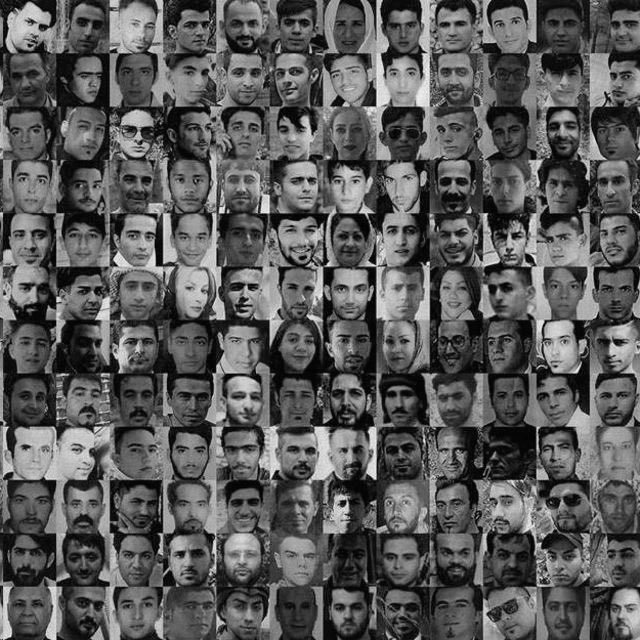
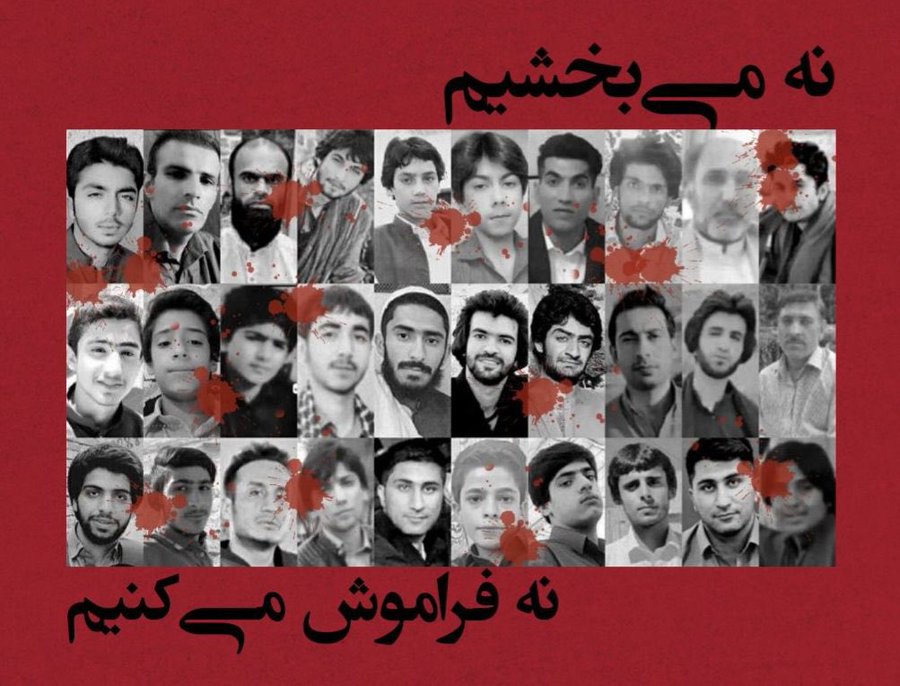
This is Tehran now. They are not Iranians. They don’t speak our language. They are Hashd Al shabi jihadists from Iraq speaking Arabic.
Iran does not have a “government” that somehow kills “its own people”. Iran is under Arab-Islamic occupation for 47 years. The Ayatollahs just learned a bit of Persian, but they are all foreign enemies to Iran, killing Iranians and will continue to do so as long as they remain in power.
Where is the anti-occupation crowd? Where are the opposers of “foreign invasion” when US and IDF troops came to take out these jihadists? Where are the UN and EU debates about breach of international law? Where is the “no war” rally for these guys patrolling the streets of Iran in preparation for a massacre?
If you are not doing everything you can to take this regime and their proxy forces down you are complicit in all their crimes against our people.
Heartbreaking moment, but powerful.
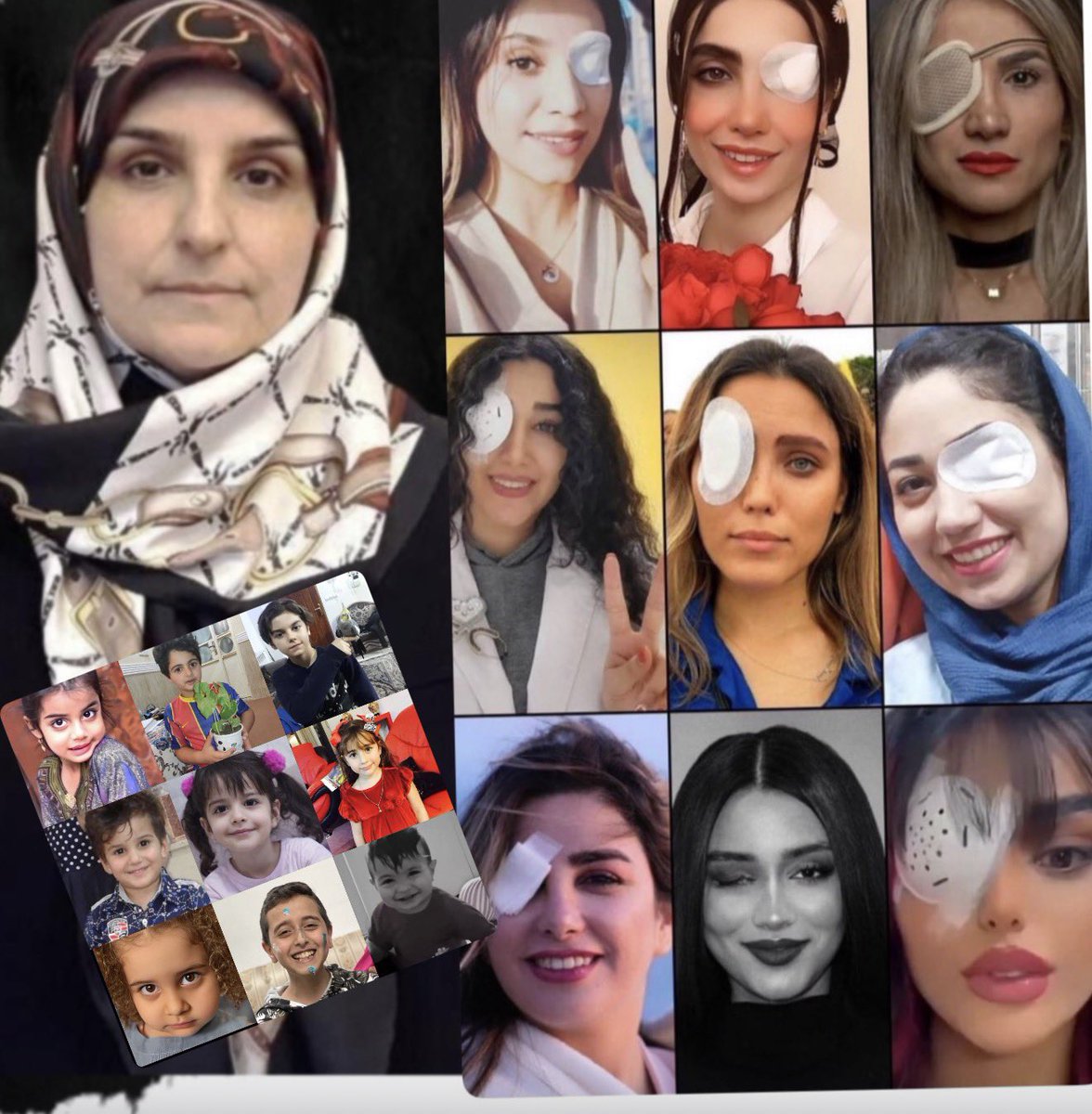
Look at Kosar Eftekhari. The Islamic regime shot her eye out and blinded her during the Women, Life, Freedom revolution. Now she is in Germany, shocked that people there defend the same regime, the same IRGC. She’s asking them: Who are you defending? She shows them her eye, see what they did. Why defend them?
I’ve known Kosar since she was a teenager in Iran, part of my #WhiteWednesdays campaign against forced hijab. She’s a hero, not a victim but here she cries from the pain of watching the very people who shot her and killed thousands of innocent Iranians being praised in the West. And I’m just as shocked when I see that the relatives and children of those who blinded her are living luxurious lives in Europe and America.
@kosareftekharii
A community college professor taught the same study skills lecture for 30 years, and the video quietly became one of the most watched educational recordings on the internet.
His name is Marty Lobdell. He spent his career as a psychology professor watching students fail not because they were lazy, but because nobody had ever taught them how their brain actually works under the pressure of learning something hard.
The lecture is called "Study Less Study Smart." Over 10 million views. Passed around in Reddit threads, Discord servers, and university study groups for over a decade. And the core insight buried inside it has been sitting in cognitive psychology research for years, waiting for someone to explain it in plain language.
Here is the framework that completely changed how I think about effort.
Your brain does not sustain focus the way you think it does. Studies tracking real students found that the average learner hits a wall somewhere between 25 and 30 minutes.
After that, efficiency doesn't just decline. It collapses. You're still sitting at your desk, still looking at the page, but almost nothing is going in.
Lobdell illustrated this with a student he knew personally. She set a goal of studying 6 hours a night, 5 nights a week, to pull herself out of academic probation. Thirty hours of studying per week. She failed every single class that quarter.
She wasn't failing because she lacked effort. She was failing because she had confused time spent near books with time spent actually learning. The 25-minute crash hit her at 6:30pm every night. She spent the next five and a half hours sitting in the wreckage of her own focus and calling it studying.
The fix sounds almost too simple. The moment you feel the slide, stop. Take five minutes. Do something that actually gives you a small reward. Then go back. That five-minute reset returns you to near full efficiency. Across a six-hour window, the difference is not marginal. It is the difference between thirty minutes of real learning and five and a half hours of it.
The second thing he taught destroyed something I had believed about how memory actually works.
Highlighting feels productive. Going back over your notes and recognizing everything feels like knowing. But recognition and recollection are two completely different cognitive processes, and your brain is very good at making you confuse them.
You can see something you've read before and feel completely certain you understand it, even when you couldn't reconstruct a single sentence from memory if the page were blank.
He proved this live in the room. He read 13 random letters to his audience. Almost nobody could recall them. Then he rearranged the same 13 letters into two words: Happy Thursday. The whole room got all 13 without effort.
Same letters. Same count. The only thing that changed was meaning.
The brain stores meaning. Not repetition. The moment new information connects to something you already understand, the retention changes entirely.
This is what the cognitive psychology literature calls elaborative encoding, and it is the mechanism underneath every effective study technique.
The third principle was the one that hit me hardest, and the one almost nobody applies.
Lobdell cited research showing that 80 percent of your study time should be spent in active recitation, not passive reading. Close the material. Say it back in your own words.
Teach it to someone else, or to an empty chair if no one is around. The struggle of retrieval is where the actual learning happens. Reading your notes again is watching someone else do the work.
His parting line has stayed with me longer than almost anything else I have read about learning.
He told the room that if what he shared didn't change their behavior, they hadn't actually learned it. It would just live in their heads as something they had heard once and felt good about.
He was right. And most people leave every lecture exactly like that.
The students who remember everything aren't putting in more hours.
They stopped confusing the feeling of studying with the fact of it.
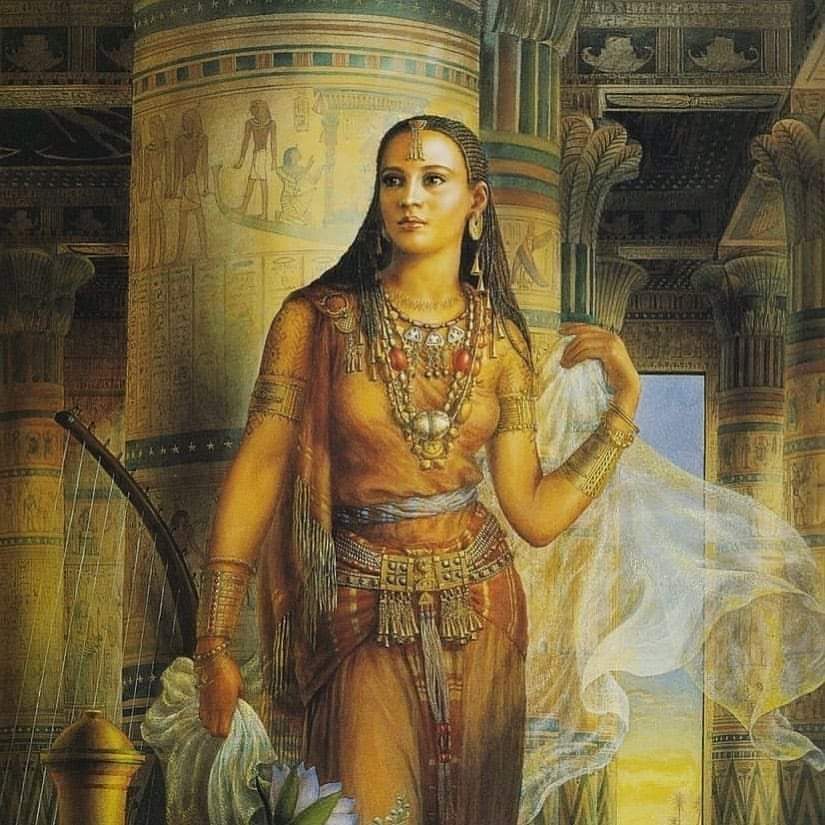
Women in ancient Egypt were regarded as the equals of men in every aspect save that of occupation. It is often assumed that women in the ancient world held little power or influence. However, women in ancient Egypt could become highly influential physicians, political advisors, scribes or even rulers. But like women in many cultures throughout history and today, they had to fight to acquire and hold onto their rights. The man was the head of the household and nation, but women ran the home and contributed to the stability of that nation as artisans, brewers, doctors, musicians, scribes, and many other jobs, sometimes even those involving authority over men.
One of central values of ancient Egyptian civilization, arguably the central value, was ma'at – the concept of harmony and balance in all aspects of one's life. This ideal was the most important duty observed by the pharaoh who, as the mediator between the gods and the people, was supposed to be a role model for how one lived a balanced life. Egyptian art, architecture, religious practices, and even governmental agencies all exhibit a perfect symmetry of balance and this can also be seen in gender roles throughout the history of ancient Egyptian civilization.
Women's social standing, however, depended on the support and approval of men and, in some cases, was denied or challenged. It also seems clear that many women were not aware of their rights and so never exercised them. Even so, the respect accorded to women in ancient Egypt is evident in almost every aspect of the civilization from religious beliefs to social customs. The gods were both male and female, and each had their own equally important areas of expertise. Women could marry who they wanted and divorce those who no longer suited them, could hold what jobs they liked – within limits – and travel as they pleased. The earliest creation myths of the culture all emphasize, to greater or lesser degrees, the value of the feminine principle.
Women in ancient Egypt worked in many jobs traditionally dedicated to them, but they were powerful enough to be independent, have their own workshops producing textiles, jewelry and other goods, and even take an important role in political life, become physicians or scribes. Although, they were underestimated by many historians for centuries, their strong position in the powerful civilization of ancient Egypt could be an inspiration for modern women in many parts of the world.
After thousands of years of equal rights, Ptolemy IV tried to stop the strong tradition of cults of women. He changed the law and canceled many rights that had made women equal to men. It was the beginning of the dark age characteristic for the upcoming dominating beliefs, which had their roots in Rome and Greece. However, Egyptian women didn't want to accept a patriarchal society. Until the power of the Egyptian civilization came to an end, they fought for their rights. Commonly, researchers accept that the end of Egyptian women’s independence arrived with the death of the great scientist Hypatia in 415 AD. Before that event took place, Ancient Egyptian women had thrived in society for more than three millennia.
#archaeohistories
Ali Larijani murdered 35,000 Iranians in January.
He sent forces into hospitals to murder wounded protesters while they were still hooked up to IVs.
Then he would murder the doctors and nurses who treated them.
Anyone who tries to spin Larijani as a “moderate” is a disgrace.
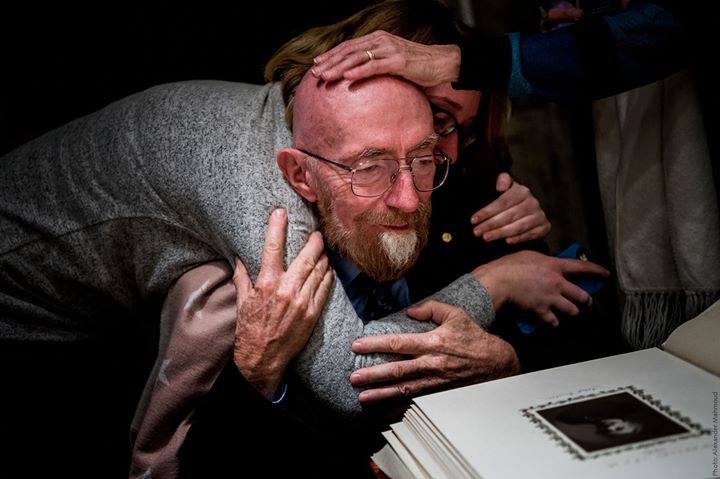
When 2017 physics laureate Kip Thorne collected his Nobel Prize medal, he was overcome with emotion while looking at an image of fellow Nobel Prize laureate, Albert Einstein.
A century ago, Einstein predicted the existence of gravitational waves. These 'ripples' in a four-dimensional spacetime occur when objects with mass accelerate. The effects are very small.
In the 1970s, the LIGO detector was developed, which uses laser technology to measure small changes in length caused by gravitational waves.
Kip Thorne made crucial contributions to the development of the detector, and on 14 September 2015, he was among some 1,000 physicists who were finally able to observe gravitational waves for the first time.
Kip Thorne shared the Nobel Prize in Physics in 2017 with Rainer Weiss and Barry Barish "for decisive contributions to the LIGO detector and the observation of gravitational waves."
Imagine that everything you see, the vastness of galaxies, the depth of oceans, the entire three-dimensional world around you, could, at a deeper level, be described by information encoded on a distant two-dimensional boundary.
It sounds like an idea borrowed from science fiction, yet it emerged from one of the most surprising discoveries in modern theoretical physics. The possibility that the universe might be “holographic” did not begin as speculation about simulations or digital realities. It began with black holes.
In the 1970s, physicists studying the thermodynamics of black holes encountered a puzzle that seemed almost impossible to reconcile with conventional intuition.
Normally, the amount of information a physical system can contain, what physicists describe through entropy, grows with the system’s volume. A larger box can hold more particles, and therefore more possible microscopic configurations.
But calculations by Jacob Bekenstein and Stephen Hawking showed something very different for black holes. The entropy of a black hole is not proportional to its volume. It is proportional to the area of its event horizon, the two-dimensional surface that surrounds it.
This result immediately raised deep questions. If the maximum amount of information inside a region of space is determined by its surface area rather than its volume, perhaps the true degrees of freedom describing that region do not live throughout the volume at all.
Perhaps they are encoded on the boundary itself. In other words, what we experience as a three-dimensional region might be fully described by information stored on a two-dimensional surface surrounding it. This idea eventually became known as the holographic principle.
The analogy comes from optical holograms. In a holographic image, a flat surface encodes the information needed to reconstruct a three-dimensional picture when illuminated appropriately. The holographic principle suggests something conceptually similar in physics: the complete description of a volume of space may be equivalent to a theory defined on its boundary, which has one fewer spatial dimension.
For years this idea remained intriguing but speculative. That changed dramatically in 1997, when Juan Maldacena proposed a remarkable theoretical relationship now known as AdS/CFT duality. In this framework, a universe containing gravity in a higher-dimensional curved spacetime can be mathematically equivalent to a quantum field theory without gravity defined on its lower-dimensional boundary.
Two seemingly different descriptions, one with gravity and one without, can encode exactly the same physics.
What makes this correspondence extraordinary is its precision.
Calculations performed in one description produce results identical to those obtained in the other. Phenomena that appear geometric in one picture can emerge from purely quantum interactions in the other.
The equivalence does not mean the universe literally exists on a physical surface somewhere. Instead, it shows that the same underlying reality can be described in radically different ways, and that spacetime itself might emerge from more fundamental informational relationships.
The connection between geometry and information becomes especially striking when we look again at black holes. When matter falls into a black hole, the information describing that matter cannot simply vanish without violating quantum mechanics. Yet the event horizon seems to hide that information from the outside universe.
One possible resolution is that the information is encoded on the horizon itself. In this sense, the surface of a black hole behaves like a storage layer containing the information about everything that has fallen inside.
Over time, these insights have reshaped how physicists think about gravity.
1/2
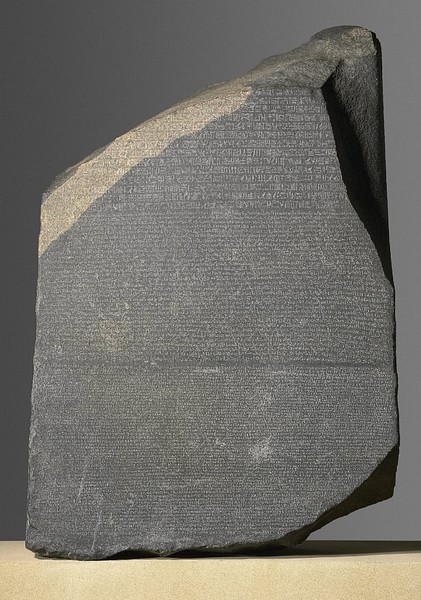
The Rosetta Stone, discovered in July 1799 by French officer Pierre-Francois Bouchard during Napoleon's invasion of Egypt, became the key that unlocked nearly 1,400 years of lost language.
The stone is a granodiorite slab inscribed with the same decree in three scripts: ancient Egyptian hieroglyphs at the top, Demotic script in the middle, and Greek at the bottom.
The decree itself dates to 196 BC, issued by Egyptian priests honoring the young Pharaoh Ptolemy V.
Because ancient Greek was well known to European scholars, the Greek text provided the critical starting point for decipherment.
Stephen Weston delivered the first English translation of the Greek text at London's Society of Antiquaries in April 1802, and Hubert-Pascal Ameilhon published the first printed translation in 1803.
The real breakthrough began with the middle Demotic text, when scholars Johan David Åkerblad and Antoine-Isaac Silvestre de Sacy identified five proper names by cross-referencing them with their Greek equivalents.
Åkerblad correctly identified 29 phonetic characters from those names, proving the Demotic script was at least partially alphabetical.
The hieroglyphic text proved far more difficult, as scholars had long assumed hieroglyphs were purely symbolic rather than phonetic.
Thomas Young made a decisive advance in 1814 when he identified the phonetic characters spelling "Ptolemaios" inside a cartouche in the hieroglyphic text.
Young also noticed up to 80 structural similarities between the hieroglyphic and Demotic scripts, disproving the long-held belief that the two were entirely unrelated systems.
Jean-Francois Champollion built directly on Young's work, and in 1822 identified the phonetic characters spelling "Kleopatra" by studying the Philae obelisk, which contained both Greek and hieroglyphic inscriptions.
Armed with two confirmed royal names, Champollion rapidly assembled a phonetic alphabet for hieroglyphs and announced his findings on September 27, 1822, in a landmark lecture in Paris.
He confirmed his system the following year by identifying the cartouche names of Ramesses and Thutmose at Abu Simbel, proving phonetic hieroglyphs applied to Egyptian names as well, not just foreign ones.
The full decipherment unlocked not just one inscription but an entire civilization's written record, silent for over a millennium.
Since 1802, the stone has remained on near-continuous public display at the British Museum, where it is the single most visited object in the collection.
Egypt has repeatedly requested its return, arguing the stone is central to Egyptian cultural identity, but the British Museum has so far declined to repatriate it.
The decipherment of the Rosetta Stone fundamentally transformed the study of ancient Egypt, converting a civilization that had been historically mute for over a thousand years into one of the most documented cultures in human history. Before Champollion's breakthrough, Egyptian temples, tombs, and monuments were filled with symbols no living person could read, leaving historians to rely almost entirely on secondhand accounts from Greek and Roman writers. Once the phonetic structure of hieroglyphs was understood, scholars gained direct access to religious texts, administrative records, royal proclamations, and literature stretching back thousands of years. The discovery also established a methodological template for deciphering other lost scripts, and the phrase "Rosetta Stone" entered the broader language as a universal metaphor for any foundational key that unlocks a larger system of knowledge.
#archaeohistories
Iranian woman explains why freeing Iran from 47 years of Islamic rule doesn’t fit the left’s narrative. Pay attention to what she’s saying.
“The Islamic Republic is NOT a victim of Western imperialism. It’s a theocratic regime that survives via terrorism.
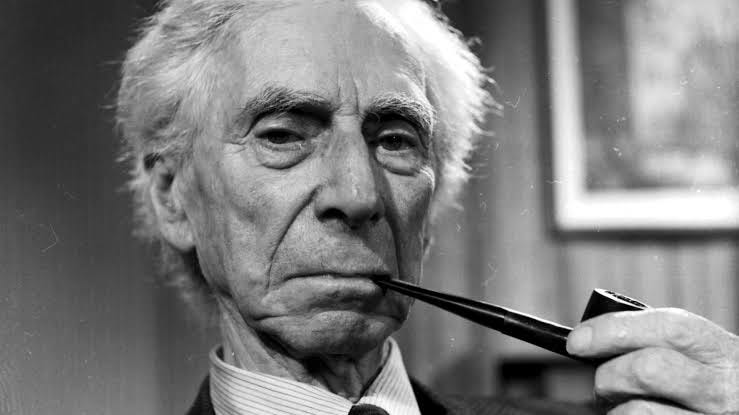
Physics is mathematical not because we know so much about the physical world, but because we know so little: it is only its mathematical properties that we can discover.
- Bertrand Russell
🙋♀️Hello - Iranian here.
For those fixated on 'legality' to excuse the regime in Iran - F*ck You.
No, I will not let you be my voice. You don't get to narrate my story, you don't get to claim moral superiority. You don't get to tell me my feelings are wrong.
Is it legal to throw women in prison for strands of hair? Is it legal to mass execute people? Is it legal to turn a fertile land into a parched desert? Is it legal to rape? Is it legal to shoot innocent people? Is it legal to kill children? Is it legal to torture people to death? Is it legal to spread terrorism? Is it legal to deprive people of a livelihood? Is it legal to shoot people in the eye to blind them? Is it legal to silence people and take away all of their human rights? Is it legal to shoot down a passenger plane? Is it legal to drive millions to leave their country? Is it legal to jail women for singing and dancing? Is it legal to disappear people including children?
You will never experience anything like Iranians have experienced for the last 47 years.
Iranians have fought barehanded and they've paid a price. All up to 1,000,000 (one million) Iranians have been murdered since the regime came to power.
Your books on 'civil disobedience' and 'collective protest' are useless against an armed opposition that is ideologically driven and will kill all that stand in its way.
You want legality? The world has a duty to protect innocent lives. It's enshrined in R2P. Some people seem to think Iranians aren't humans. The murder, genocide and massacre of Iranians receives scant media attention - hence scant sympathy.
Those who proclaim to care about 'human rights' must think Iranians are animals and not worthy. Their hatred of Israel and US is so great they've lost all perspective.
Yes, Iranians are happy. They're happy someone took out Ali Khamenei and many others directly responsible for so much pain and agony.
And you know what? We're unashamedly hopeful that with the help of the world's superpower, we can reclaim our country and build a better tomorrow.
We know there's a long way to go, but give us this brief moment of reprieve, because daily we sit and try to tell the story of the lives lost, those at risk of execution, those under torture. We've seen the pictures and videos of massacres taking place.
Our dance and happiness comes with a heavy weight. We do so, in knowledge of the many who never lived to see this day.
The day of freedom will come to Iran, it's glorious - and we're not sorry if some outside help contributed to making that happen.
So don't speak on my behalf and stop excusing this regime on grounds of 'anti-colonialism'. and 'anti-Zionism'.
#Iran
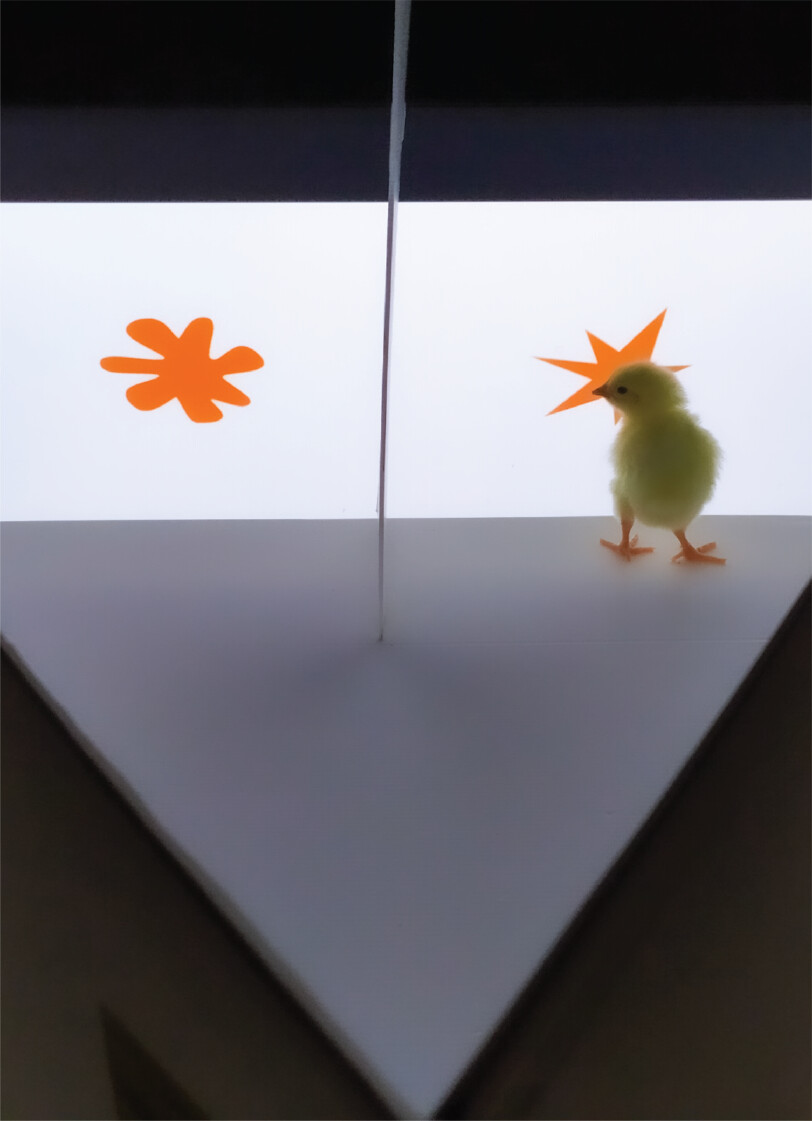
In linguistics studies across cultures, humans have been shown to associate certain nonwords with shapes; the iconic example is “bouba,” which associates with a round shape, and “kiki,” which sounds spiky.
In a new Science study, researchers report that the bouba-kiki effect is also exhibited by newly hatched chickens.
The authors propose that such sound-shape correspondences may belong to a set of innate cross-modal associations that are shared across species, rather than being a speech-related phenomenon that is distinctive to humans.
📄: https://t.co/JC6GvitgEu
#SciencePerspective: https://t.co/csaa2BiTG5
🚨Don’t stop talking about Iran.
Fa’eze Mosta’an was only 20 years old.
Twenty.
In Fardis, Karaj, the terrorist Islamic Republic regime shot her straight through the heart with a Kalashnikov. Not a warning shot. Not rubber bullets. A war weapon. To the heart.
She didn’t “pass away.” She was killed.
After she was shot, her parents carried her lifeless body home. They hid her for two days so the security forces wouldn’t take her body. Imagine that. Parents forced to hide their own daughter’s corpse from the state. A mother holding the cold body of her 20-year-old child one last time inside her own house, saying goodbye in fear and silence.
This is what the terrorist Islamic Republic regime does. It kills young women with military weapons and then terrorizes their families so badly that they have to hide the body.
Look at this story and really understand it. This isn’t “unrest.” This isn’t “clashes.” This is a government shooting its own young people in the heart and turning parents into fugitives just to mourn.
And the world barely whispers about it.
Tomorrow in Geneva, I will stand before the United Nations with @HillelNeuer to ask whether the UN now intends to let the Islamic Republic teach the free world how to kill children, how to blind women, and how to hang men for protesting.
Apparently, massacring tens of thousands of civilians now qualifies you for a Human Rights advisory role.
This is an insult not to us Iranian’s, but to you every single of you who live in democratic countries, because a regime that massacre up to 40,000 people is now in charge of giving you advice about human rights.
Do you not feel even a flicker of embarrassment?
@kusha_alagband@antonioguterres Proof that diplomacy is not inherently moral, but inherently amoral. It only cares about States, not Humans. As long as we continue its worship as the only valid protocol of international discourse, we will not have peace. We must replace diplomacy with democracy.
Golshifteh Farahani does the damage in French on prime‑time TV, then whispers “sorry” in Farsi on Instagram with comments off.
While people in Iran are being massacred and the diaspora is getting ready to march for them on Feb 14 in Toronto, Los Angeles, and Munich, @potus is under huge pressure to “do something” on Iran whether that’s a limited strike, a rushed deal with the reformists, or both.
And right on cue, we’re being pulled to focus on curated celebrities, Narges Mohammadi’s supposed imprisonment, Golshifteh Farahani’s ridiculous but “timely” apology, and Shervin’s disempowering latest song, instead of what gets decided about our country in these next days. This should be a wake‑up call. @marklevinshow #IranMassacre #IranRevoIution2026
Anticorruption efforts declining in "vast majority" of democracies around the world, warns watchdog Transparency International in new report https://t.co/qGpcyPbw5Z
These were the days when the world not only had respect for a U.S. president, they loved him as much as America did.
His representation of his country on the world stage was NEVER viewed as it is by a man now viewed as the global village idiot.
His name appears ZERO times in the Epstein files. He never needed to praise himself once, name a road or a building after him. He never sued the DOJ or filed malicious law suits against those who disagreed with or criticised him, because real men can take criticism.
He didn’t pretend to have a healthcare plan, he passed one into law. He never mocked disabled people or asked not to be seen with service members who had lost limbs in service of this nation, neither did he call those who fought and died for this nation ‘suckers and losers’
He won an ACTUAL Nobel Peace Prize and didn’t have to make up numbers for how many people attended his inauguration. He needed no monuments to his presidency because he had absolutely nothing to prove.
He served his nation with honour dignity and respect, the same respect he afforded America’s allies. He did not run an international extortion gang from the Oval Office and certainly didn’t send masked thugs into red state communities to brutalise them in order to instil fear.
He rebuilt a broken economy after the housing crash he faced in the year he was elected, handing off a growing economy when he left office in 2016.
He never stole money from low and middle income workers to hand tax cuts to the rich, while setting up a crypto bribe pipeline.
His speeches will go down in history as rhetorical masterpieces, with joined up coherent sentences and punctuation.
He never once felt the need to post an inflammatory vile and disgusting video about ANYONE, because he is a good and honest man, who remains to this day a beloved statesman and a man Donald J Trump will never be, even in a tan suit.
🎥 TikTok - https://t.co/qcvpnAvZb7