Nearly 44% of all visible industrial fishing on Earth is tied to a massive fleet controlled by the CCP and the ecological destruction is reaching catastrophic levels.
According to tracking data from ocean conservation group Oceana and details highlighted by U.S. Senator Ted Cruz, a fleet of up to 16,000 vessels is operating across 90 nations. They aren't just overfishing local waters in places like West Africa and Latin America—they are regularly turning off tracking transponders to evade international oversight.
Beyond plundering fish stocks, these state-backed operations are indiscriminately destroying marine ecosystems. Environmental investigations report massive bycatch killing endangered sharks, whales, and dolphins, while fuel tankers and support ships keep the fleet at sea indefinitely. On July 24, a bipartisan group of U.S. senators officially called on the Treasury Department to slap sanctions on these support vessels to curb what they describe as rampant ecocide and severe labor abuses.
When state-subsidized fleets plunder food supplies from developing coastal communities and devastate global oceans under the cover of darkness, how should international powers step in to enforce accountability?
In most countries, earning a PhD means writing a dissertation.
Hundreds of pages of theory, research, and citations that very few people will ever read.
China decided to try something different.
Under a law passed in 2024, select universities can now award engineering doctorates based on physical prototypes, new techniques, or major installations instead of traditional papers. The rule is straightforward: build something that works in real life and at scale, and you can graduate.
The first cohort has already finished.
Zheng Hehui earned his doctorate by designing reinforced steel blocks that snap together like Lego to form massive bridge pylons. His invention is already in use on the Changtai Yangtze River Bridge, the world's longest cable-stayed bridge.
Wei Lianfeng became the first practical PhD graduate at Harbin Institute of Technology by developing vacuum laser welding processes for the Nuclear Power Institute of China.
Another candidate built a fire-fighting system for large seaplanes.
At least 11 engineers have now earned their doctorates through this route.
Since 2022, more than 60 universities and 100 companies have collaborated, selecting over 20,000 students for practical doctorate programmes.
The goal is to close the gap between academic theory and industrial application, particularly in fields like artificial intelligence and semiconductors.
One student built a bridge. Another welded nuclear components.
And they got the same three letters as everyone else.
The US doesn't have such a program. What do you think? Good idea or not? Weigh in
🚨 A recording of DeepSeek’s founder has been leaked! They finally said the quiet part out loud, and it may cost DeepSeek a $71 billion valuation.
For years Washington accused Chinese labs of smuggling banned Nvidia chips and running on borrowed American silicon. Beijing called it paranoia. Then, on July 22, a recording from a closed-door investor meeting held by DeepSeek founder Liang Wenfeng leaked and tore across Chinese networks. In it, Liang confirms nearly every suspicion himself.
We know how a founder sounds when he thinks the door is shut. Liang was not selling. He was confessing. DeepSeek, he admitted, holds only about 20,000 Nvidia H-series-equivalent chips, most delivered in just the past month or two. Even if the company burned every yuan of its 50-billion-RMB first round, he said flatly, it "couldn't afford to train" a frontier model. "Even if we stacked one up, we couldn't afford to run it."
Then came the number that should end the "China has caught up" narrative. America's largest models run roughly 80 billion active parameters; China's best sit in the tens of billions, a full order of magnitude behind. By his own account, Chinese labs can only train models "ten times smaller" than their US rivals.
The domestic-chip fairytale fared no better. Huawei boasted on July 17 that its Ascend 950 SuperPod delivers 6.7 times the compute of Nvidia's comparable rack. Liang's private math: four Huawei 950s to match a single Nvidia GB300, and two years behind on process. The 16,000 Huawei cards he has been allocated? Equivalent, he shrugged, to about 4,000 Nvidia B-series chips, "not a big deal."
So where does the real compute come from? Liang says it plainly: "We can buy some non-compliant cards," meaning chips under US export controls. That is not a loophole. That is a smuggling supply chain, and it now has a founder's voice attached to it.
The enforcement trail backs him up. In March, a Supermicro co-founder and a Taiwanese middleman were arrested for reselling restricted chips into China. In June, Taiwanese prosecutors raided a board maker and detained executives over the same trade. Washington has since warned that a chip's location no longer matters: if the user or parent company sits in China, the controls follow it.
That is the trap DeepSeek just walked into. Liang thought he was rallying nervous investors with "positive energy." Instead he handed the US Commerce Department a confession, exposed how wide Beijing's compute gap really runs, and spooked his own backers badly enough to freeze a round that would have valued the company at $71 billion, up 37 percent from June.
DeepSeek has not confirmed the tape's authenticity and will not touch the funding question. It does not need to. The most damaging testimony against China's AI miracle did not come from a US agency or a rival lab. It came from the man Beijing keeps holding up as proof that it is winning.
ACI — Aric Chen | Insights
Thai police just arrested 37 individuals in a massive scheme using hired "fake fathers" to illegally register over 1,400 Chinese children as Thai citizens.
By manipulating birth records through corrupt hospital staff and local registrars, foreign networks bypassed strict real estate and welfare laws. This birth-registration loophole exposes how easily transnational criminal networks exploit civil administrative gaps across East Asia.
How vulnerable are your country's citizenship records to moneyed foreign networks?
See below for full details.
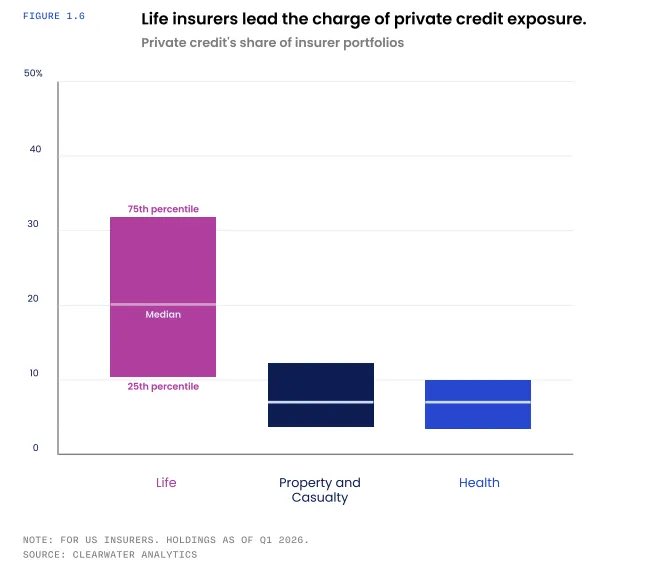
Private Credit’s Pockets of Distress
Some insurers are way more exposed than the average suggests.
“The question is which insurers own too much of it, how they own it, and whether their reported diversification survives a borrower-level look-through.”
“I would watch the places where incentives and opacity overlap. That is where the bodies are most likely buried. Not necessarily in the average.”
“The better question is simpler: Which insurers do not fully know what they own?”
Link below
Courtesy @RepricedRisk
The most recent Iran 🇮🇷 TACO 🌮 pause is just that… just another pause…They’ve said as much. The SOH isn’t opening & the war isn’t ending, & everyone now finally sees it. (B/c the risk of losing the exorbitant privilege of the US $ 💵 simply isn’t an option.) that’s causing more financial stress.
What most people don’t realize though is that there’s a new TACO 🌮 in town…
They’re starting to fire bigger & bigger guns 🔫… 1st the ORCL Pentagon deal, (which failed miserably to arrest the slide) & now this.
Bessent is working OT to get this CDS moving back in the right direction…They know they have to try & backstop Private Credit.
That’s the heart ♥️ of the coming crises & they know it.
In September 2015, standing in the White House Rose Garden, Xi Jinping looked America in the eye and pledged Beijing’s commitment to “a neighboring foreign policy characterized by good neighborliness.” He then stated clearly: “China does not intend to pursue militarization” in the Nansha (Spratly) Islands.
Today those same reefs are bristling with military airbases, anti-ship missiles, and long-range radar pointed at free nations. Chinese ships ram Filipino fishermen and blast them with water cannons, openly defying the 2016 Hague ruling.
Xi’s words were a lie. The CCP’s promises on security are worthless.
Watch the 2015 statement below. Then look at the reality.
There we go: Hyperscaler CDS just hit record wides, led by a disintegrating ORCL and SPCX. And today the "supersafe" names finally ripped.
Bond market is done funding this negative ROI lunacy
Credit default swap spreads for major hyperscalers (Nvidia, Alphabet, Meta, Amazon, Microsoft) have spiked to their highest levels in recent months, with some names trading near 60 basis points as macro volatility and capex concerns weigh on investor risk appetite. Rising borrowing costs for AI-infrastructure leaders signal tightening credit conditions and reduced tolerance for leveraged corporate debt in the current environment.
$BTC #BTC #MACRO #ALTCOIN
Oracle’s credit market is sending a much darker signal than its AI growth narrative. The company’s five-year CDS has climbed to roughly 200 basis points, around the highest level in its history and above the peak reached during the Global Financial Crisis. At approximately 203 basis points, insuring $10 million of Oracle debt would cost about $203,000 annually. That does not mean Oracle is about to default, but it shows that creditors now demand substantially more compensation for carrying its risk.
The concern is not Oracle’s underlying software business. Its databases, enterprise applications and recurring customer relationships remain valuable. The problem is that Oracle is transforming from a highly cash-generative software company into a capital-intensive AI infrastructure operator. Data centers require enormous upfront spending on land, power, networking and accelerators, while the revenue and cash-flow returns arrive much later and remain dependent on utilization.
That mismatch becomes dangerous when expansion is financed with debt. Oracle’s bond spreads are widening across maturities, meaning future borrowing and refinancing are becoming more expensive precisely when the company needs access to enormous amounts of capital. S&P’s July 9 downgrade from BBB to BBB-, only one notch above junk, reflects the view that Oracle’s AI infrastructure expansion is weakening its historically strong credit profile and requires more investment than previously expected.
This is also a warning about customer concentration and contract quality. A massive backlog looks attractive, but long-term AI infrastructure commitments are only valuable when customers can ultimately finance them, demand remains durable and the facilities generate adequate returns. Oracle may carry the debt and lease obligations years before receiving the expected cash flows. Credit investors are therefore asking a different question from equity investors: not how large Oracle’s AI revenue could become, but how much balance-sheet risk must be absorbed before that revenue arrives.
Personally, I am not bearish on AI infrastructure demand, but I am increasingly cautious on Oracle’s financing model. The company could still execute successfully if utilization rises rapidly and AI contracts convert into strong cash flow. However, the margin for error has become much smaller. Oracle’s credit risk is not necessarily signaling imminent insolvency, but it is signaling that the AI boom is no longer being funded with cheap and patient capital. Oracle now has to prove that its enormous infrastructure commitments can produce returns faster than its cost of capital continues to rise.
Great stuff from Jon. The AI buildout has become increasingly reliant on the rates market. And as a result, given the scale, the rates market is being determined by the AI buildout. Reflexivity. No excuse to not be on top of hyperscaler developments.
https://t.co/RTq7HBzOPT
Rates will become an increasing factor of importance in 2026 for the AI trade as the buildout moves to debt financing. Market has been able to largely ignore the Fed given hyperscaler capex has been self funded, that’s changing
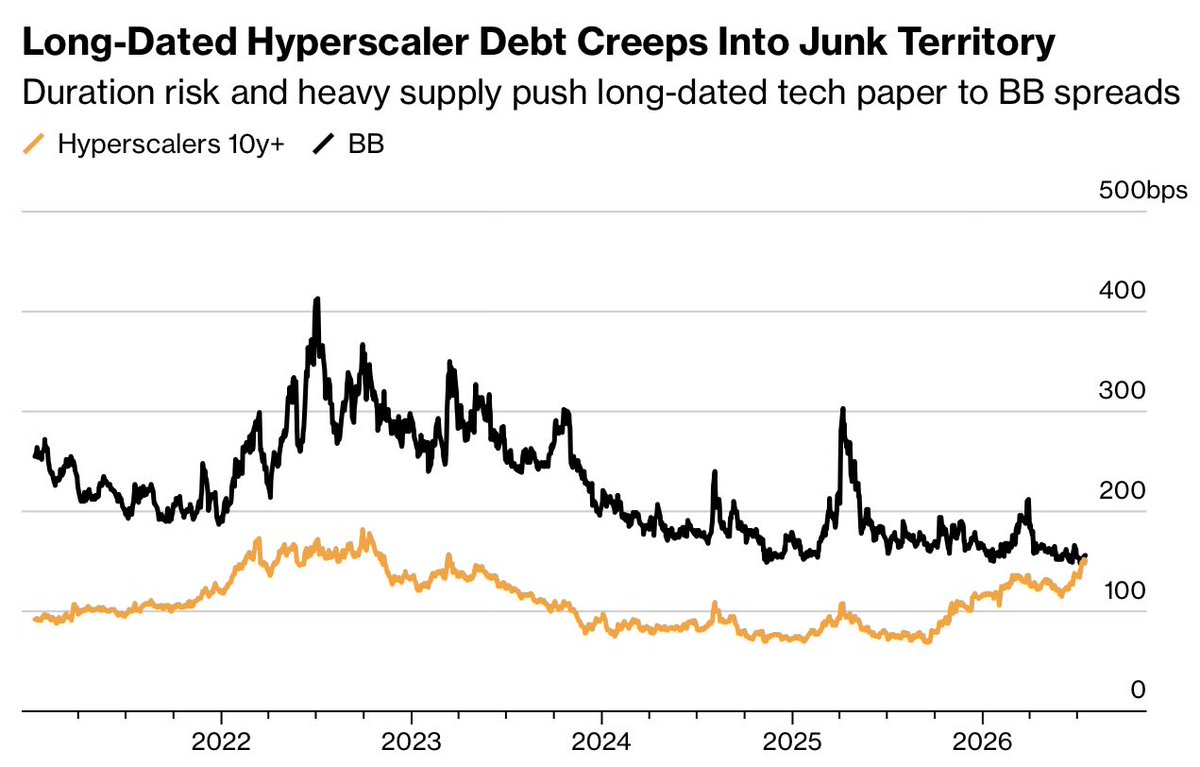
Investment-grade bond spreads for hyperscalers are exploding every day, as credit investors refuse to fund semiconductor & memory chip purchases any longer and want higher compensation
"The recent widening in credit spreads of hyperscaler bonds has reignited investor debate about the viability of their business models, especially in light of their abundant capex."
UniCredit via @WallStJesus
Everyone is watching crude prices. Wrong number.
Crude inventories are only 6% below normal. Fine, seemingly.
But gasoline stocks just dropped 5 million barrels in a week. Diesel is 12% below average, even with soft freight demand.
This isn't a demand story. US gasoline demand is down 2.2% year over year.
It's a supply story. Refineries are running at 95.8% and still can't keep up.
That gap between crude and refined product is the crack spread, and it's at record highs. Which means the refinery, not the oil field, is setting your price at the pump.