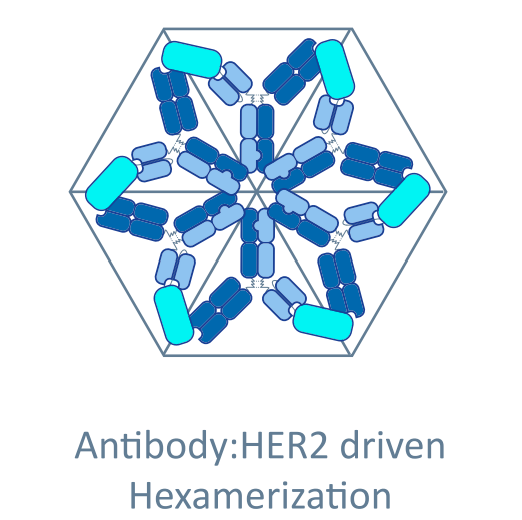
Zanidatamab is a particularly good example – it's 'biparatopic', so it binds two sites in the same molecule (HER2).
This means that, as well as blocking downstream signalling, it crosslinks HER2 into clusters, with a Zanidatamab hexamer at the centre.
These clusters trigger cancer cell killing by the complement system, which the monospecific equivalent, Trastuzumab, does not do!
Designing a protein binder used to mean years of lab experiments. ESMFold2 lets researchers run hundreds of thousands of designs computationally—then take only the most promising into the lab. We tested it across 5 targets in oncology and immunology. It worked.
Download and build: https://t.co/odrOR3U1hj
David Baker & Veesler labs "building viruses - Institute for Protein Design (IPD)
-Two new Nature papers - "building viruses, at University of Washington" if you believe the headlines. What they've actually done is more interesting than that.
https://t.co/EjXP70iwQX
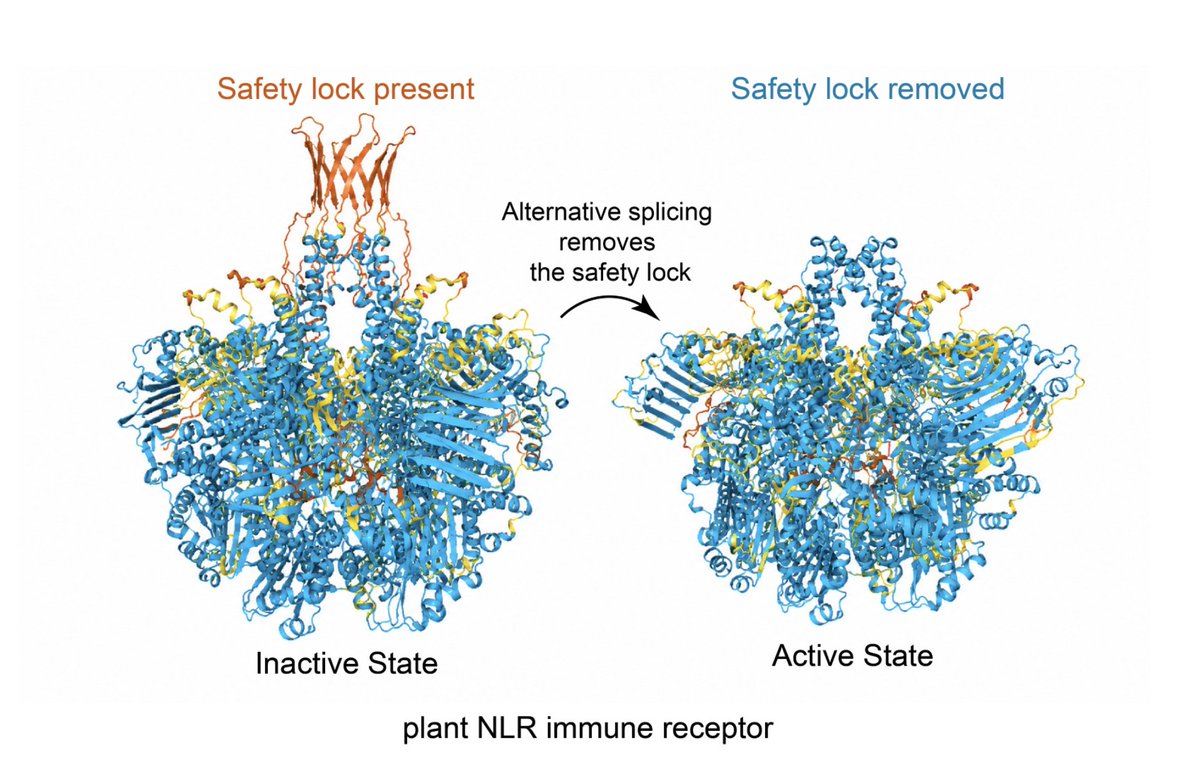
AlphaFold-based modelling lets us visualise these N-terminal “safety caps” and predict how they interfere with formation of the pore-forming resistosome. https://t.co/Ws1mU9fym7
A Generalizable Interface-Seeded Framework for De Novo Design of Functional Oligomers
1. The paper introduces an “interface-seeded” generative design strategy: instead of docking existing protein building blocks into a target symmetry, it uses a previously validated protein–protein interface (PPI) as the seed and generates new symmetry-compatible protomers around it.
2. Key implementation detail: a new symmetric motif-scaffolding module in RFdiffusion that preserves the interface motifs while sampling seed orientations and radial placements, then “drags” the motif radially during denoising to bias toward compact, well-packed cyclic oligomers.
3. This directly addresses a practical bottleneck in symmetric assembly design: dock-and-design success is often limited by geometric incompatibility between chosen protomers and target symmetries (C3/C4/C5), producing strong biases and low hit rates.
4. Benchmarking with LHD heterodimer seeds (LHD101, LHD29), the framework produced many expressible designs (63/64 expressed), with a substantial fraction matching the intended oligomeric states by SEC (33/63) and SEC-MALS (18/63).
5. Structural accuracy was validated by crystallography for multiple designs: C3 trimers (PI25, PI31) and a C4 tetramer (PI57) closely matched design models (Cα RMSD < 1.6 Å), including accurate interface side-chain placement; the resulting folds were also “new-to-nature” by Foldseek comparisons.
6. The approach generalizes to chemical triggers by reusing ligand/metal-dependent PPIs as seeds (often fragmented into many discontinuous segments), enabling conditional C3 assembly for Cu2+ (MC11), cholic acid (CHD04), and venetoclax (LBM10). Measured effective assembly affinities were in the ~100 nM range (e.g., MC11 Kd,eff 137 nM; LBM10 Kd,eff 130 nM).
7. Crystal structures of CHD04 and LBM10 matched their design models and showed ligand occupancy in the engineered pockets, demonstrating that the seeded responsive interface can be transplanted into entirely new oligomer topologies while retaining chemical control.
8. A major functional advance is reversible phosphorylation-controlled oligomerization using a dynamic “phosphoswitch” interface seed: phosphorylation by PKA shifts monomer→oligomer, and λ-phosphatase reverses it back. Single interface-weakening mutations reduced unwanted basal oligomerization while preserving phospho-dependent assembly (PO5s, PO18s).
9. The work also demonstrates multi-input control: introducing a disulfide lock created a system that requires both reducing conditions and phosphorylation to oligomerize, enabling dual-gated assembly behavior in a de novo designed oligomer.
10. Applications go beyond in vitro biophysics: (i) ligand-triggered membrane binding via MinD membrane-targeting sequence fusions (Cu2+ or CHD induces oligomerization-driven avidity on supported lipid bilayers), and (ii) phosphorylation-inducible transcription in HEK293T cells by coupling PO18s trimerization to an HSF1-based reporter, yielding ~6-fold induction (and >14-fold with combined endogenous + engineered PKA activation).
💻Code: https://t.co/XfOyrQXTCQ ; https://t.co/L7pDzceKN7
📜Paper: https://t.co/Oy61XIA0Dl
#ProteinDesign #RFdiffusion #AlphaFold3 #SyntheticBiology #ComputationalBiology #ProteinEngineering #DeNovoDesign #SignalTransduction #Phosphorylation #Nanobiotechnology
Some bacteria that are harmful to humans escape elimination by antibiotics because they carry resistance genes. However, antibiotic-susceptible bacterial populations often harbor rare persister cells that survive antibiotic exposure without being resistant. Antibiotic persistence favors recurrent infections and resistance emergence and is a public health threat.
Persister cells are thought to be metabolically dormant. Decreased activity of antibiotic targets would enable them to remain alive when antibiotics are present and to regrow after antibiotic removal.
In a new Science study, researchers report that Escherichia coli persister cells do not simply enter a dormant state upon antibiotic treatment. Instead, genetically identical cells diverge into two physiological states.
Some cells produce membrane vesicles that are loaded with specific proteins, which are taken up by other cells to enhance survival. Therefore, vesicle donors and recipients actively cooperate to benefit the entire bacterial population.
Learn more in a new #SciencePerspective: https://t.co/be5JNwqHJa
Why excite fluorescence when the probe can make its own light?
Visualizing cellular G-quadruplexes with a bioinspired chemiluminescent probe that enables excitation-free imaging of G-quadruplexes in living cells with high contrast and low background.
https://t.co/KSTvpg72G7
De novo designed oligomers that respond to copper, small molecules, and phosphorylation...
Using a single design strategy? 🧬⚙️
🎉
Excited to share our new bioRxiv preprint—a collaboration between the Khmelinskaia, Correia, Schoeder and a Tinnefeld labs!
https://t.co/8Hdfs52L0E