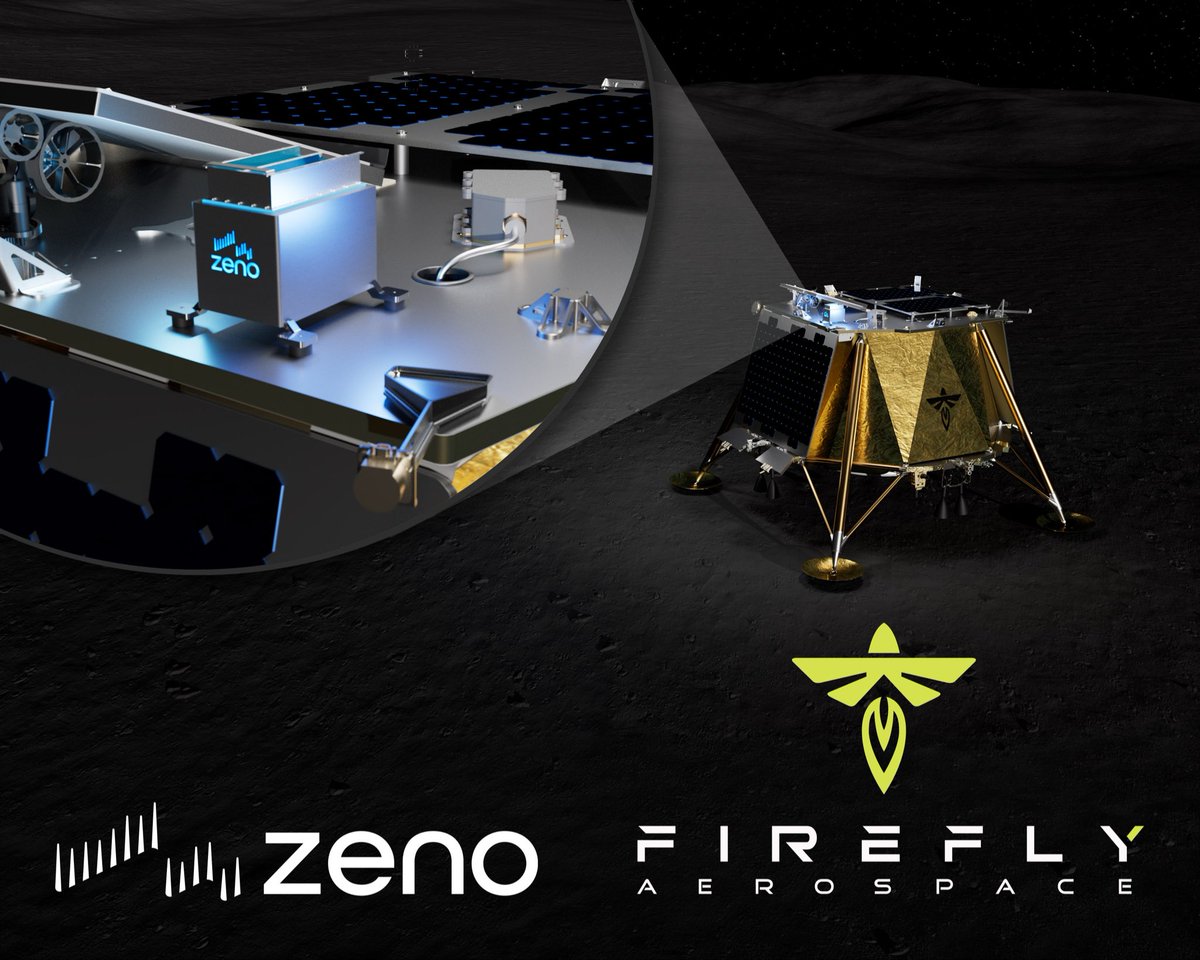
We're bringing nuclear power to the Moon in 2028.
Today, @Zeno_Power announced an agreement with @FireflySpace to fly our Americium-241 Radioisotope Heater Unit (RHU) and Survive-the-Night Package on an upcoming Blue Ghost mission, in support of @NASAMoonBase.
The race back to the Moon is a race to stay, and staying means surviving the two-week lunar night when temperatures fall below -280°F. Today, America is behind.
Since 2019, China's Chang'e 4 mission has survived repeated lunar nights using radioisotope technology to stay alive. Recent U.S. lunar missions, relying on solar power and batteries, have not survived.
That's about to change.
After Blue Ghost completes its lunar-day operations, our RHU will provide continuous heat to keep the Survive-the-Night Package running through the dark as it transmits operational data back to Earth.
NASA's demand signal for this was explicit: it specifically incentivized this mission to demonstrate surviving the lunar night with radioisotope technology by 2028. With Firefly, we're answering that call.
Permanence is a power problem. @NASAMoonBase – and the dozens of missions in the coming years that will build toward a permanent lunar presence – will require nuclear at a scale that doesn't exist today. At Zeno, we're ready to meet that demand.
Ad Lunam Per Nuclear!
“Energy is one of the biggest constraints to operations and to subsea superiority, and the holy grail in that market has always been a distributed, persistent energy source that can sustain these platforms for years at a time, and that is what we’re now delivering.”
@tybernstein spoke with @barratt_dewey at @tectonicdefense about our seabed deployment.
We successfully demonstrated an electrically heated prototype of our maritime nuclear battery on the seabed, a key step toward our first fueled deployment in 2027.
During the two-week test, our electrically heated Stirling generator (ESG) produced more than 20 watts of electricity underwater, using an electric heater in place of a radioisotope heat source. This marks the first time an ESG has generated power on the seabed.
As Admiral John Richardson, former Chief of Naval Operations and a member of Zeno’s board, said:
“As competition intensifies in contested domains, long-lived subsea systems will help keep us ahead. Zeno Power has steadily reduced risk, proven its technology, built a supply chain, and prepared to scale production. This test was another important step towards undersea superiority.”
@Zeno_Power successfully deployed an electrically heated prototype of our maritime nuclear battery on the seabed – positioning us to deliver our first nuclear-fueled systems to customers in 2027.
Competition is intensifying undersea, and power that lasts for years will be critical to keeping the U.S. and our allies ahead. We’re ready to deliver.
Monthly landings are how we build a Moon Base – and beat China to it – but only if the hardware survives the two-week lunar night and accumulates into permanent infrastructure.
Scaling radioisotope power makes that possible!
Under @POTUS’ national space policy, the first mission to begin building the Moon Base launches this December, with robotic landers and rovers to follow at a near-monthly cadence in 2027.
NASA’s plans for a permanent Moon Base have dramatically accelerated the need for nuclear power on the Moon. Today, we’re preparing for our first lunar deployment in 2028.
@NASAMoonBase will be built mission by mission, and spacecraft need to survive the lunar night to establish a permanent presence.
Thanks for the chat @itsmoislam and @JackKuhr.
The Space & Defense Update is LIVE from @NASA@itsmoislam and @JackKuhr are joined today by:
– @GoesslerAlyssa, VP at AE Industrial Partners
– @tybernstein, Co-founder & CEO of @zeno_power
– Carlos Garcia-Galan, Moon Base Program Manager at NASA
– AJ Gemer, Co-founder & CTO of @LunarOutpostInc
– @endeffector, Founder & CEO of @Astrolab_Space
– @TaylorCSargent, Partner at @IndustriousVC
We’re digging into:
* Building NASA’s Moon base
* Nuclear power for surviving the lunar night
* The race to put rovers on the Moon
* Autonomous exploration & the lunar economy
* The investors backing the next generation of space companies
Comment if you love space (help us share the show!) 👇
https://t.co/XpPpxHu769
We are teaming up with @FireflySpace to fly our Am-241 Radioisotope Heater Unit to the Moon on an upcoming Blue Ghost mission in 2028 - keeping a payload alive through the brutal cold and dark of lunar night.
@NASAAdmin has been clear: nuclear power is crucial to building @NASAMoonBase. Zeno is ready to deliver it.
Ad lunam per nuclear!
We've been selected by @NASA for a NIAC Phase I grant to study a new application of space nuclear technology: integrating compact nuclear batteries into astronaut spacesuits.
The project, EARENDIL, could help keep astronauts warm in the coldest permanently shadowed regions on the Moon, such as the lunar south pole.
Nuclear Batteries are completely slept on
100x-1000x energy density of Li-Ion, decades long duration of stable power output
Rovers on the dark side of the Moon
Deep space satellites far past the Belt
Drones lying in wait for years at the bottom of the ocean
Humanity is going back to the frontier – but this time to stay.
And the frontier won't be held by a few large platforms, it'll be held by fleets and constellations of systems numbering in the thousands. That requires a category of distributed power at a scale the world has never built. Until now.
My latest on why we're industrializing nuclear battery production at the historic Vallecitos Nuclear Center:
https://t.co/iVjmRRtB9g
In 1957, America's commercial nuclear era began at the Vallecitos Nuclear Center.
Nearly seventy years later, we're putting that site back to work – restoring its world-class hot cells to industrialize nuclear battery production.
The world is returning to the frontier, from the seabed to the lunar surface, but this time to stay.
That demands distributed power at scale, and Zeno now has the manufacturing capability to deliver it – beginning in 2027.