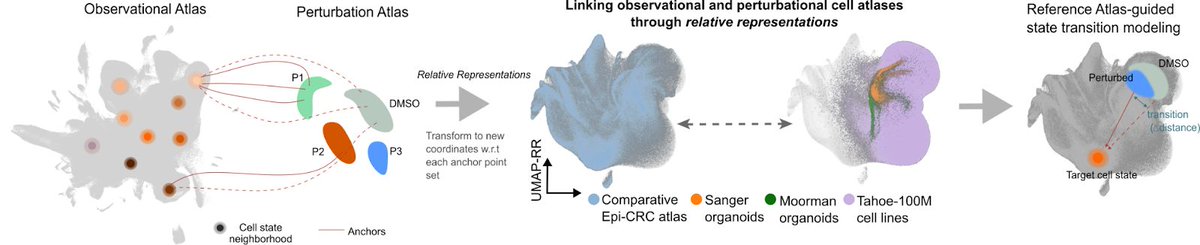
New preprint from @Garnettlab and @fabian_theis lab! A joint project with @soroorh1!🧬🖥️ We show how to move from descriptive single-cell atlases to a causal, predictive understanding of the mechanisms that define and control malignant cell states. https://t.co/PLhowNZXOM
🧵👇
BIG NEW piece by me.
A few years ago, if you asked me to summarize my entire worldview in one article, I would’ve said it was too broad and too difficult. But this year, I decided to do it.
https://t.co/HupJtlwyDx
The central drama of the modern world is innovation against suffering, and we have made incredible progress so far.
But we are doing far worse than we could. Millions still suffer from untreatable diseases, because of bottlenecks that we could fix. You can help fix them.
Thrilled to post thread re: new single-cell lineage of mouse embryo reconstructed w/ DNA Typewriter. One animal, zygote to late organogenesis (E13.5). Tree has 1,340,794 transcriptionally profiled, annotated tips (cells), 1,142,588 dated internal nodes, rooted at zygote
1/n
I'm starting a biotech journal committed to excellent prose. We'll build many tools to make papers useful and fun to read for humans.
I'm looking to connect with people who know how to navigate this, sort indexing, etc. If you'd like to work together on this, please DM!
Check out some words from me about exponents in biology and why we should be doing experiments at their intersection even if they are weird.
https://t.co/mHANHDl5nL
We’re looking to recruit a postdoc to work on developing genomic language models. We’ve been spending the last few years developing new multimodal sequencing methods for sequencing and assembling new genomes (paper soon) — the ultimate pretraining data. Email me at [email protected] if interested
22/n On a personal note, I’ll soon start an independent research group in the Genome Biology Unit at EMBL Heidelberg. If you enjoy this type of work and want to engineer genomes at the largest scale, please reach out!
https://t.co/PZtPj6fnrE
https://t.co/XMH6FH4dJQ
1/n What fraction of the human genome is essential for cellular viability?
Excited to share our preprint that explores this question by combining an unusual CRISPR system, phage promoters, and thousands of deletion launchpads.
@sudpinglay@JShendure
https://t.co/rTO1MyFv3q
If you’re based in Cambridge (UK) and want to meet interesting people in biology — come along to one of our events!!
Next Sunday evening we’ll be meeting to talk about organisms with weird genomes.
Message/like for details
We see our home planet as a whole, lit up in spectacular blues and browns. A green aurora even lights up the atmosphere. That's us, together, watching as our astronauts make their journey to the Moon.
These two images were taken by @astro_reid only minutes apart. The stark difference is the result of camera settings. In the first, a longer shutter speed let in much more light from Earth, while the shorter shutter speed in the second emphasizes our planet's nighttime glow.
Even in darkness, we glow.
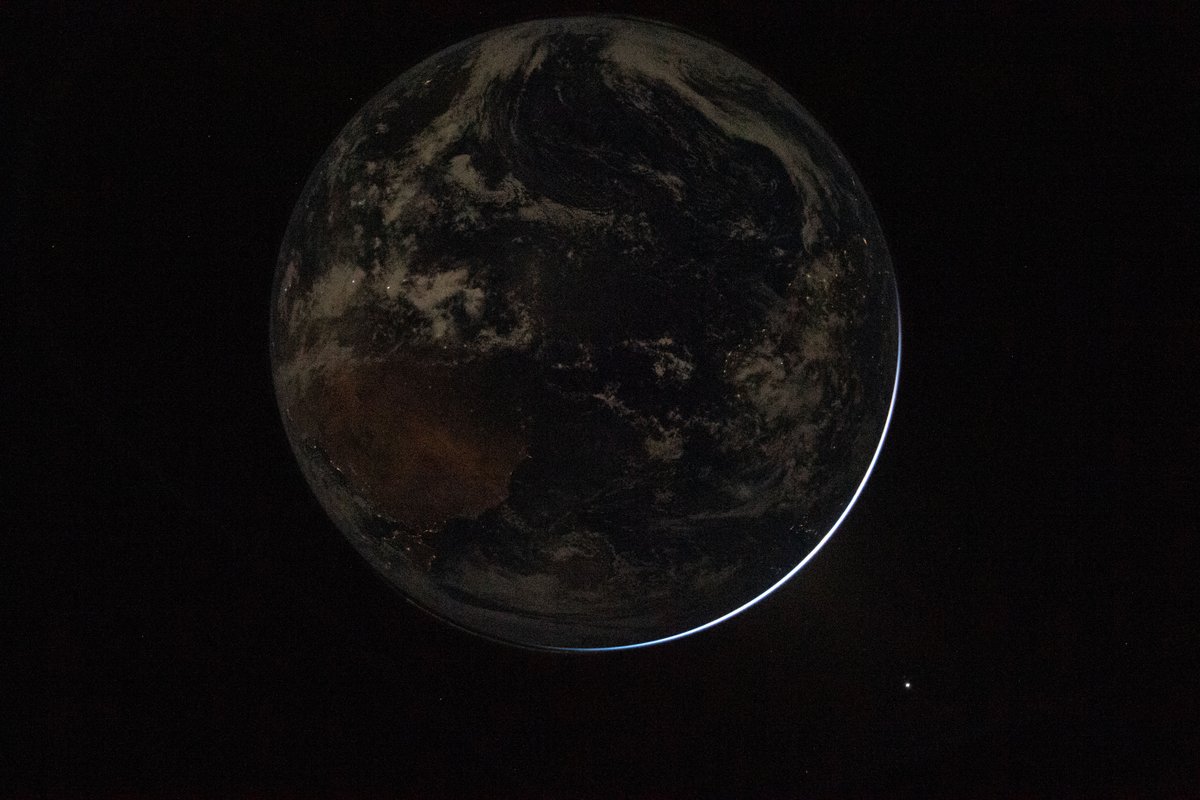
In this image of Earth taken by the Artemis II crew, we can see the electric lights of human activity. In the lower right, sunlight illuminates the limb of the planet.
New preprint with Garnett lab 🚀: from descriptive → causal single-cell atlases in CRC.We build the largest CRC atlas (>300 pts, 1.5M cells) using continual learning, and link cell states to causal drivers via Tahoe-100M, validated in organoids! https://t.co/WTKMeKCjWS
In CRC organoids, we predict and validate that MAPK inhibition drives convergence of cells along an axis of proliferative and poor prognosis endoderm-like states, linking therapeutic perturbation to cell-state transitions and clinical outcome.