this is one of the most important ideas in AI right now, and it just got two independent validations.
yesterday, Anthropic shipped an "advisor tool" in the Claude API that lets Sonnet or Haiku consult Opus mid-task, only when the executor needs help.
the benefit is straightforward: you get near Opus-level intelligence on the hard decisions while paying Sonnet or Haiku rates for everything else. frontier reasoning only kicks in when it's actually needed, not on every token.
back in February, UC Berkeley published a paper called "Advisor Models" that trains a small 7B model with RL to generate per-instance advice for a frozen black-box model.
same idea. two very different implementations.
the paper's approach: take Qwen2.5 7B, train it with GRPO to generate natural language advice, and inject that advice into the prompt of a black-box model.
the black-box model never changes. the advisor learns what to say to make it perform better.
GPT-5 scores 31.2% on a tax-filing benchmark. add the trained advisor, it jumps to 53.6%.
on SWE agent tasks, a trained advisor cuts Gemini 3 Pro's steps from 31.7 to 26.3 while keeping the same resolve rate.
training is cheap too. you train with GPT-4o Mini, then swap in GPT-5 at inference. the advisor even transfers across families: a GPT-trained advisor improves Claude 4.5 Sonnet.
Anthropic's advisor tool takes a different path to the same idea. Sonnet runs as executor, handles tools and iteration.
when it hits something it can't resolve, it consults Opus, gets a plan or correction, and continues.
Sonnet with Opus as advisor gained 2.7 points on SWE-bench Multilingual over Sonnet alone, while costing 11.9% less per task.
Haiku with Opus scored 41.2% on BrowseComp, more than double its solo 19.7%.
it's a one-line API change. advisor tokens bill at Opus rates, and the advisor typically generates only 400-700 tokens per call.
blended cost stays well below running Opus end-to-end.
both approaches point at the same thing: you don't need the most powerful model on every token.
you need it at the right moments, for the right inputs.
Paper: https://t.co/KvzlBIL39S
Code: https://t.co/IajPpfafSs
🎉 Excited to share our latest work, “scDFM: Towards Distributional Flow Matching for Single-Cell Perturbation Prediction”, accepted to ICLR 2026 @iclr_conf
scDFM is a generative framework for single-cell perturbation prediction. Instead of relying on the impractical one-to-one cell correspondence assumption, it models perturbation effects as distribution-level generation. Concretely, we combine Conditional Flow Matching with MMD-based distribution alignment to capture population-level shifts without paired cell labels.
For more information:
📦 Code Repository: https://t.co/nBba3LqwqB
📚 Paper Link: https://t.co/F3g8TbG0vH
🧾 OpenReview: https://t.co/GH9MYUMKJu
AI × bio is the only field where:
— you're too slow for AI people and too fast for bio people
— you're too computational for biologists and too biological for ML folks
— tech VCs overprice you and bio VCs underprice you
You are permanently miscalibrated in every direction.
It's great actually.
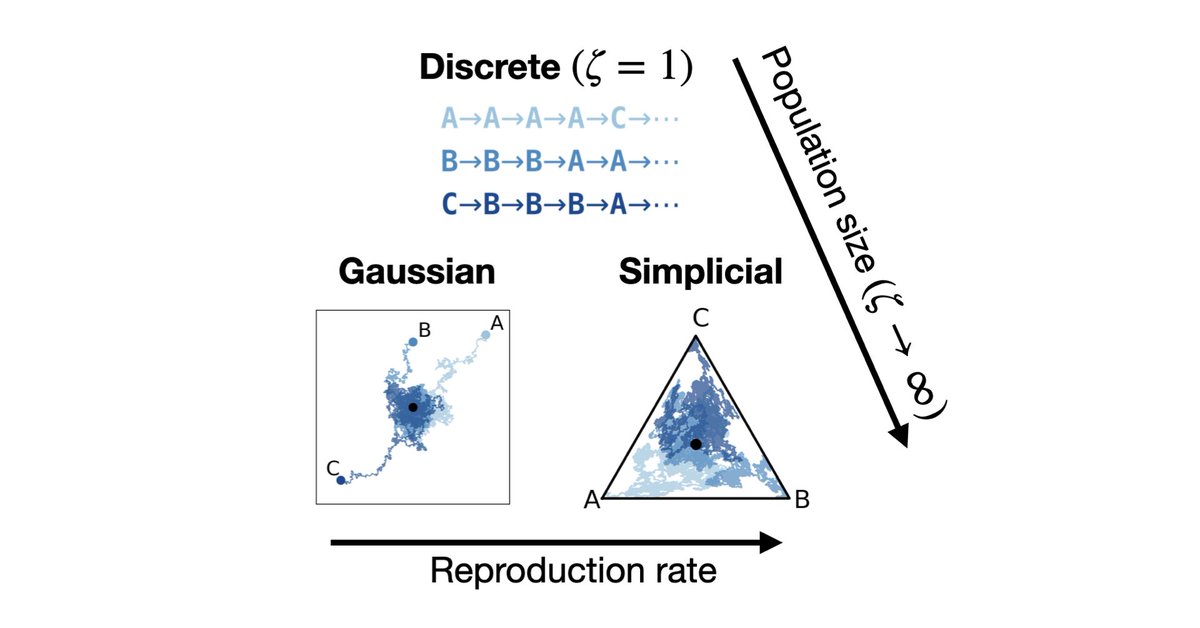
If you want to do diffusion on discrete data, you have three choices: discrete, Gaussian, or simplicial. How are they related? Which should you use? We theoretically unify all three and train one model to do them all! @AlinaChandra@yucenlily@alex4ali@andrewgwils 1/7
🚀 Thrilled to share a preview of Biomni-R0 — we trained the first RL agent end-to-end for biomedical research.
➡️ nearly 2× stronger than its open-source base
➡️ >10% better than frontier closed-source models
➡️ Scalable path to hill climb to expert-level performance
🔗 Technical report: https://t.co/a5fGBTfehk
Collab between @ProjectBiomni and SkyRL @NovaSkyAI, with the amazing @RyanLi0802 @shiyi_c98@YuanhaoQ@jure.
Open-sourcing soon!
🤔 What if protein design models knew where they’re uncertain and adapted their predictions accordingly?
🚀 We introduce uncertainty-aware discrete diffusion for structure-conditioned protein design: https://t.co/n4RabqYo7W.
📍Catch us at #ICML2025 FM4LS workshop this week! 1/4
Good software should be fast, reliable, reusable, and maintainable. A lot of BioML benchmarking is uh… not.
But biology doesn’t standardize to a few data types like language, audio, or images. We’re constantly inventing new ways to measure life... 1/n
Flows and transport methods are widely used to connect one distribution to another. What about going up one level to transporting between distributions over distributions?
My new talk overviews some methods in this space:
https://t.co/B93hcTXnv6
& a quick 🧵 below
We trained a genomic language model on all observed evolution, which we are calling Evo 2.
The model achieves an unprecedented breadth in capabilities, enabling prediction and design tasks from molecular to genome scale and across all three domains of life.
I could not agree more, specially for grad students, instead of making another or be first apply superTransfomerX , HyperdiffusionY, worldFoundationZ and CrazymambaX, think deeply about the problem, learn the biology behind it and distill them into math and architectural atoms making a bigger system. There is a very nice piece by @MoAlQuraishi about differentiable biology https://t.co/GreINAsBnp which discusses a few of these principles.
GeneGPT: Augmenting large language models with domain tools for improved access to biomedical information https://t.co/jMdK1iSLWT 🧬🖥️ https://t.co/48riumC97B
@nomad421@RECOMBconf Yeah, it is very competitive. I saw my reviews on the submission site. I feel like there is a huge gap between the reviewer from a biology background and the researcher from a pure CS background. My most negative review is the reviewer cannot understand my modeling details.