new grads often ask me what they should be doing so they don't fall behind in the ai space. there's a lot, but its honestly super manageable. become intimate with model internals. proof based linear algebra. non-convex optimization. this is stuff you could've done in undergrad. it definitely takes some time and work, but its doable. have taste, have opinions. train a small model, then train a big one. vLLM internals, tensor parallelism. hand roll kernels. cluster orchestration. do you have opinions on synthetic data? why don't you? SFT, PPO, you should know this. learn Triton. everyone is reproducing papers now so you need to be doing more. do you know the semi supply chain? where are the bottlenecks? hardware, man, hardware. your little gpu rig erector set in your basement isnt gonna cut it. build a cluster, a big one. pretrain a 800B model. now postrain it. serve it to millions of people. you should be able to beat deepseek on some benchmarks now. its a lot to take in but it all snowballs. this what job security looks like from now on. do you want to work in tech or not
Narrative violations abound:
- Demand for software engineers is rising
- Software devs are rising as a share of new jobs
- AI exposed industries are seeing above-trend wage growth
- Open PM jobs haven't been higher since 2022
More from a16z's David George on the "AI job apocalypse" myth: https://t.co/7sbadmEElG
It's only a matter of time before only the model creators have access to the most powerful models. The rest get access to smaller, distilled versions. Or access the models through first party apps and services that don't provide direct access to the token path.
The investment needs for training are too high, and distillation too effective to warrant any other future.
🤖📈 Autonomous Agents Are The Fastest Growing Open-Source Technology In History
- But... what are autonomous agents?
- How do they work?
- How can you build or use one?
I wrote you the best overview on the planet.
Get ready for your mind to explode 🤯
https://t.co/YUrrlzGthO
Thrilled to launch Project Genie, an experimental prototype of the world's most advanced world model. Create entire playable worlds to explore in real-time just from a simple text prompt - kind of mindblowing really! Available to Ultra subs in the US for now - have fun exploring!
A deeply under-appreciated economic benefit of AI agents is the ability to experiment and throw away things at near 0 cost.
Most projects traditionally get stuck on a one way train based on initial decisions that get made early on. Restarting or testing multiple ideas early on is usually completely cost prohibitive. Now you can explore the solution space far more than you would have otherwise because there’s no cost to starting over.
You’ll just have multiple agents running in parallel for most tasks and just choose the best work. This could be for coding, writing a legal briefing, building a marketing campaign, doing research, or anything else.
You save so much time and energy once your relationships are with confident people. You never have to worry about whether facts might accidentally offend them. You can be yourself, they can be themselves. Everyone can focus on meaningful goals instead of each other’s feelings.
I've never felt this much behind as a programmer. The profession is being dramatically refactored as the bits contributed by the programmer are increasingly sparse and between. I have a sense that I could be 10X more powerful if I just properly string together what has become available over the last ~year and a failure to claim the boost feels decidedly like skill issue. There's a new programmable layer of abstraction to master (in addition to the usual layers below) involving agents, subagents, their prompts, contexts, memory, modes, permissions, tools, plugins, skills, hooks, MCP, LSP, slash commands, workflows, IDE integrations, and a need to build an all-encompassing mental model for strengths and pitfalls of fundamentally stochastic, fallible, unintelligible and changing entities suddenly intermingled with what used to be good old fashioned engineering. Clearly some powerful alien tool was handed around except it comes with no manual and everyone has to figure out how to hold it and operate it, while the resulting magnitude 9 earthquake is rocking the profession. Roll up your sleeves to not fall behind.
A new meta-analysis on the impact of goal setting on performance found:
1. Process goals had a large effect on performance
2. Performance goals had a moderate effect
3. Outcome goals had a negligible effect
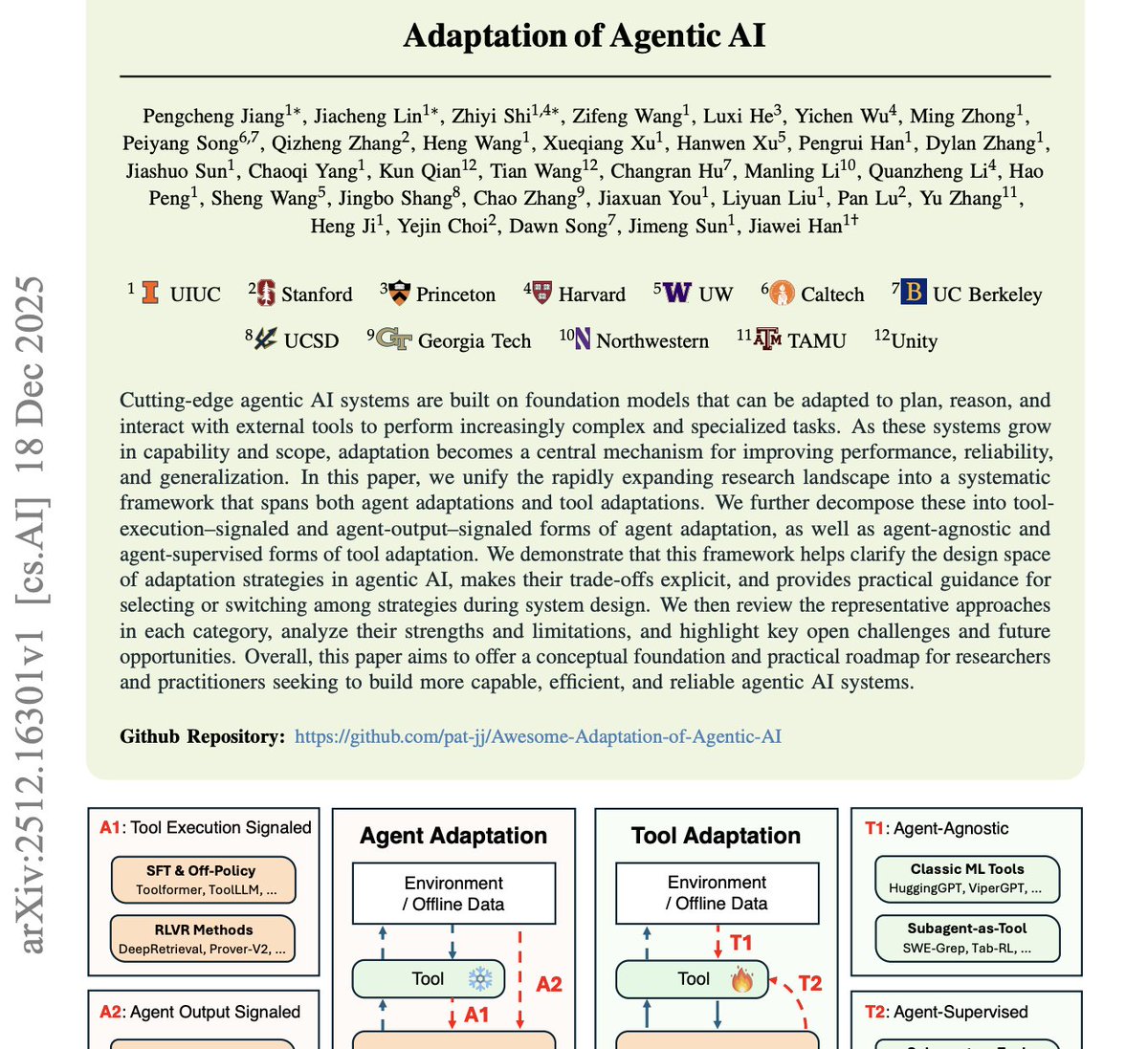
This paper from Stanford and Harvard explains why most “agentic AI” systems feel impressive in demos and then completely fall apart in real use.
The core argument is simple and uncomfortable: agents don’t fail because they lack intelligence. They fail because they don’t adapt.
The research shows that most agents are built to execute plans, not revise them. They assume the world stays stable. Tools work as expected. Goals remain valid. Once any of that changes, the agent keeps going anyway, confidently making the wrong move over and over.
The authors draw a clear line between execution and adaptation.
Execution is following a plan.
Adaptation is noticing the plan is wrong and changing behavior mid-flight.
Most agents today only do the first.
A few key insights stood out.
Adaptation is not fine-tuning. These agents are not retrained. They adapt by monitoring outcomes, recognizing failure patterns, and updating strategies while the task is still running.
Rigid tool use is a hidden failure mode. Agents that treat tools as fixed options get stuck. Agents that can re-rank, abandon, or switch tools based on feedback perform far better.
Memory beats raw reasoning. Agents that store short, structured lessons from past successes and failures outperform agents that rely on longer chains of reasoning. Remembering what worked matters more than thinking harder.
The takeaway is blunt.
Scaling agentic AI is not about larger models or more complex prompts. It’s about systems that can detect when reality diverges from their assumptions and respond intelligently instead of pushing forward blindly.
Most “autonomous agents” today don’t adapt.
They execute.
And execution without adaptation is just automation with better marketing.
Many of the biggest opportunities in AI right now are going after categories where there was never software to accomplish the problem before, or the categories were too small to matter.
AI agents represent the first time ever where we can bring along the work with the software, which means TAMs get very big even in spaces that traditionally had small software spend. Legal services, healthcare, accounting, software engineering, and so on.
The key though is a lot of these markets require a deep understanding of the problem in the domain because you’re fundamentally being used to augment a critical workflow vs. just enable people to solve their own problems.
Tools like excel work as horizontal technologies because the user of the tool can figure out how to leverage it to do their unique work.
But when you’re hiring workers to do a job for you, you don’t also want to have to do all the work to train them on every single part of how to do their job. When you hire for work today, you rarely want it to be “generic”; instead you want it to solve a particular problem you have.
The same is going to be true of AI Agents. You will want agents that are purpose built for the domains or problems you’re trying to solve. Which will lead to agents that are specialized by vertical or particular type of workflow.
The game then is to build agents that combine a deep domain understand, propriety (customer) data that the models weren’t inherently trained on, a tight naturally interaction with the user’s workflow (either today’s or reimagined), and all of the resources necessary for the change management for the customer to be successful.
On a daily basis there are new examples of AI agent use-cases that a company didn’t do previously because it was too expensive or impractical to scale.
The economic impact of AI agents will be that we will, en masse, take things that were previously extremely scarce and make them near infinitely available and abundant.
Things like: AI agents that continuously review all your code for bugs or security vulns. AI agents that audit your systems and data for risk. AI agents that review all your contracts for revenue upside. AI agents that respond to issues before a human could to keep your services online. AI agents that do research in all of your data for new discoveries.
Small companies basically don’t have the resources to do most of this work today. But even the largest enterprises are usually only resourced to do a small percentage of the total work that’s possible.
Now, sometimes there’s an argument of “if the market already needed this work, then the company would have hired for it”. This is false on its face.
For almost any new task category in an enterprise, the company has to decide whether it’s worth hiring a person or working with an outside firm (which is often even more expensive) the very moment they want to try and solve the problem.
This immediately eliminates the vast majority of work a company might find valuable because the incremental cost can’t be justified. Either the ROI isn’t known in advance to fund it, or it’s not sufficient ROI (at the start) for a full time hire. But if the cost of that “hire” was 1/100 the price, the work all of a sudden would be valuable.
If you’re building AI agents, this is the clearest area of opportunity right now. Build the agents that solve problems that were just never practical for enterprises to scale labor to solve before.
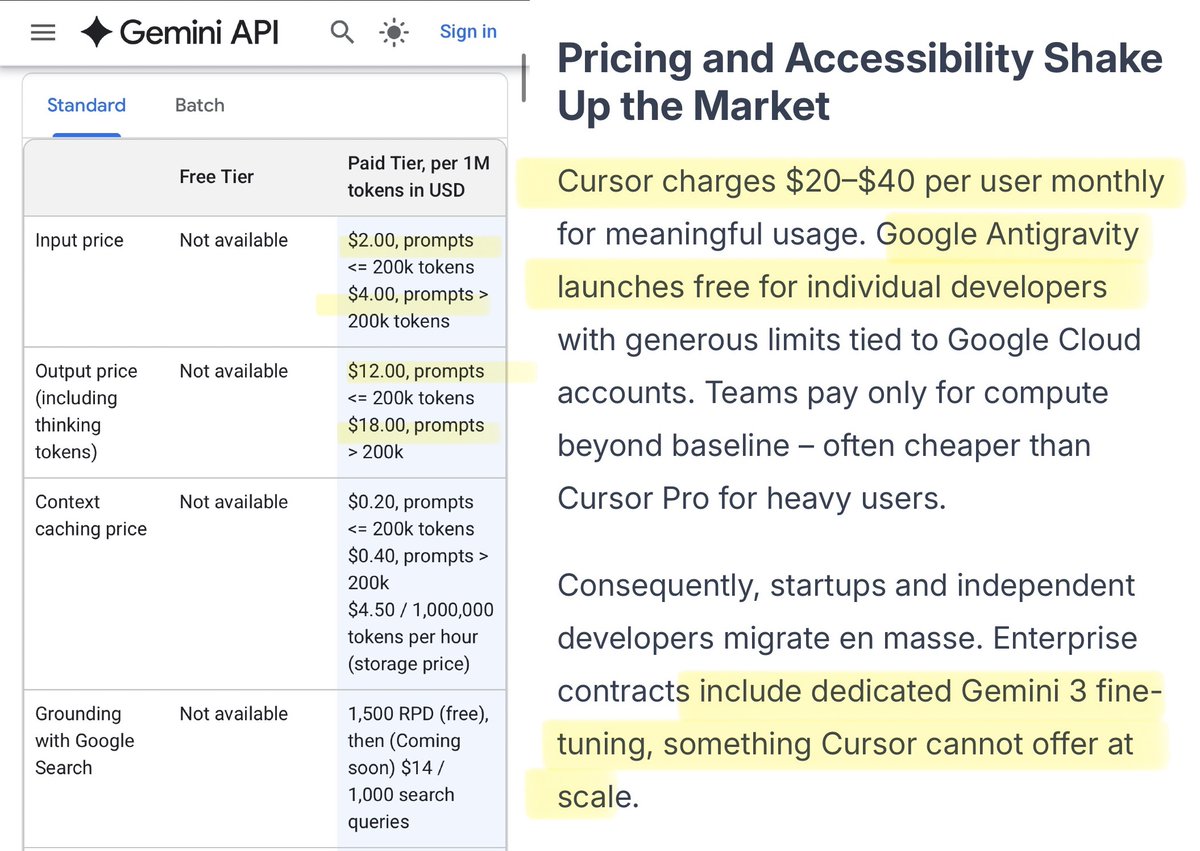
We're in the "what if Google does that" part of the AI cycle.
They can make
— cheaper models ($2/M in, $12/M out, just above GPT5.1, cheaper than Pro)
— better models (benchmarks)
— distribute products at no cost to billions of users (Gemini has >50% MAU of ChatGPT, Antigravity is free vs Cursor $20-40/mo)
— get good unit economics (own TPU, no reliance on Nvidia premiums), use it to retain premium talent cheaper
Of the BigTech giants, Amazon and Microsoft chose to be infra partners. Apple chose not to play. Meta shat the bed. Google is coming out on top.